
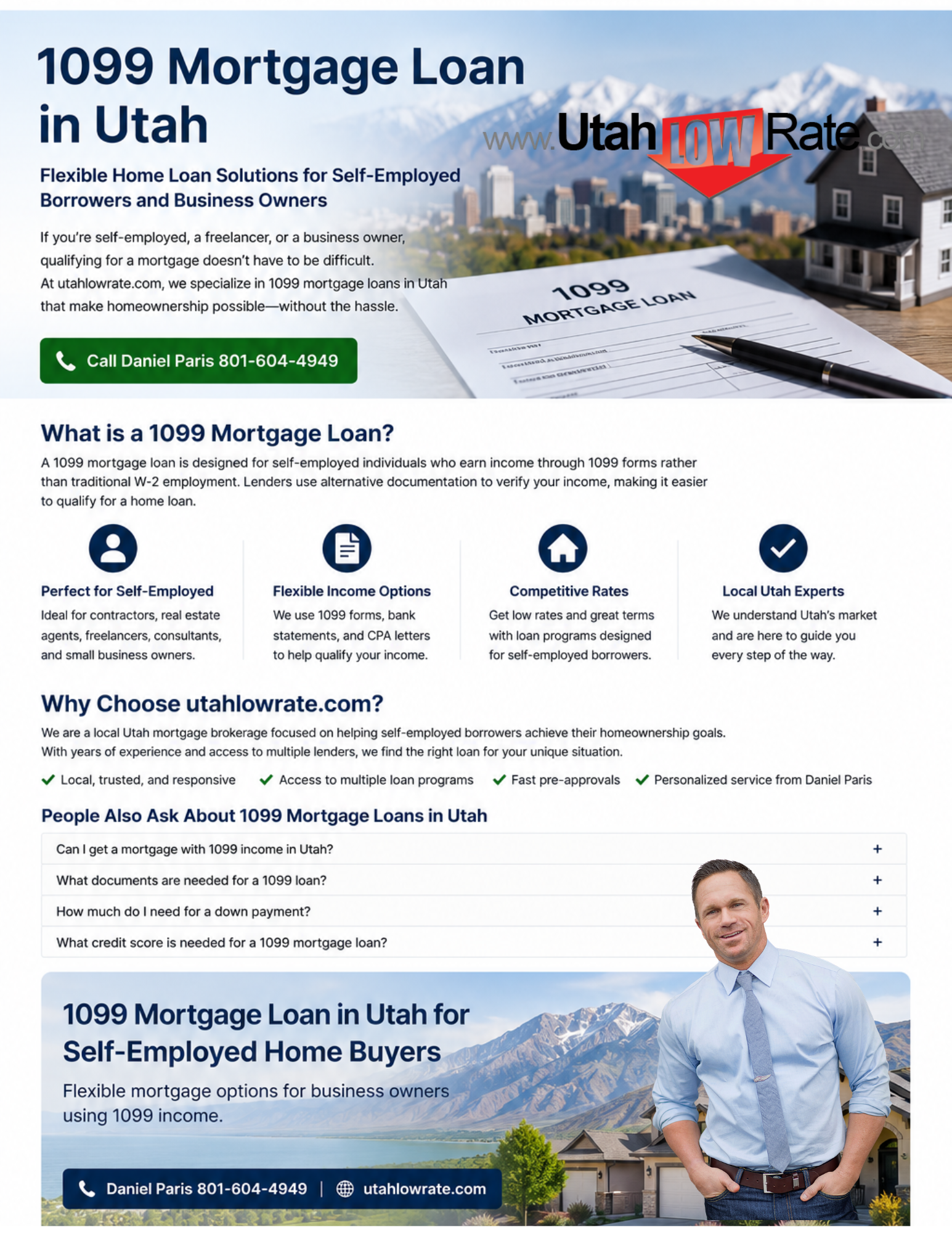
1099 mortgage loans in Utah may help contractors and self-employed buyers use Form 1099 income to qualify for a home loan. Some programs do not need tax returns for the income review. Daniel Paris helps you compare options based on your income, credit and down payment.
1099 Mortgage Loans in Utah: Qualify With 1099 Income

Do you earn income as a contractor, freelancer or gig worker? Tax write-offs can lower the income shown on your tax returns. That can make a home loan harder to qualify for, even when your business earns steady income.
1099 mortgage loans in Utah may provide an alternative.
Some 1099 programs use a share of your gross income after an expense allowance. The 75% example below uses a 25% expense allowance. Each lender sets its own rules and must review your credit, funds and loan details.
At UtahLowRate.com, Daniel Paris helps Utah borrowers compare loan options. He reviews how you earn income and which records fit your loan needs.
Daniel Paris
Utah Mortgage Broker
NMLS #243976
801-604-4949
UtahLowRate.com
Loan programs, documentation requirements, income calculations, rates, terms and eligibility are subject to lender/investor guidelines and may change. Not every borrower will qualify.
Quick Answer: What Is a 1099 Mortgage Loan in Utah?
1099 mortgage loans in Utah may use Form 1099 to show income. These loans can suit contractors whose tax write-offs reduce their reported net income. The lender still checks credit, assets and debts. Your income must meet the rules for the chosen loan.
Under qualifying programs, the lender may use a percentage of eligible 1099 income to account for estimated business expenses. For example, a program allowing 75% of eligible 1099 income would generally apply a 25% expense factor before evaluating qualifying income.
This can be particularly useful for borrowers who take legitimate business deductions that reduce the taxable income shown on their federal tax returns.
Utah 1099 Mortgage Loan Quick Facts
| Feature | 1099 Mortgage Loan |
|---|---|
| Best suited for | Independent contractors and eligible self-employed 1099 earners |
| Primary income document | IRS Form 1099 |
| Tax returns | May not be required by certain programs |
| Potential income calculation | Up to 75% of eligible 1099 income under qualifying programs |
| Expense factor | Commonly 25% for the specific 75% program described here |
| Loan category | Alternative-documentation / Non-QM |
| Purchase financing | Available for qualified borrowers |
| Credit requirements | Vary by lender and program |
| Down payment | Depends on credit, loan amount and program |
| Reserves | May be required |
| Property eligibility | Subject to program guidelines |
| Location | Available to qualified borrowers throughout Utah |
| Underwriting | Full lender/investor underwriting and approval required |
How Does a 1099 Mortgage Loan Work?
A standard home loan often uses pay stubs, W-2s or tax returns to check income.
That process can create challenges for an independent contractor.
You may earn good income and still have large business costs. These can include tools, mileage, insurance and ads. Tax write-offs for those costs can reduce your reported net income.
Those deductions can lower taxable income.
A 1099 mortgage program takes a different approach. Depending on the program, qualifying income may be determined primarily from eligible 1099 income rather than the net taxable income reported on personal tax returns.
For the particular program described on this page, up to 75% of eligible 1099 income may potentially be considered for qualification, subject to underwriting and program requirements.
How Is 1099 Income Calculated for a Mortgage?
Here is a simplified example.
Assume an eligible independent contractor receives $120,000 in qualifying 1099 income for the applicable period.
If the mortgage program permits 75% of eligible 1099 income:
$120,000 × 75% = $90,000
In this example, divide the annual amount by 12 to estimate monthly income.
$90,000 ÷ 12 = $7,500 per month
In this simplified example, $7,500 per month could potentially be considered qualifying income before applying the program's other underwriting requirements.
This example is for educational purposes only. Actual calculations depend on the applicable 1099 period, income history, documentation, continuity of income, lender guidelines and other underwriting factors.
Why Can Tax Returns Make Mortgage Qualification Difficult for 1099 Borrowers?
Self-employed borrowers often use legitimate deductions to reduce taxable business income.
This can be beneficial for tax purposes but may create a challenge when applying for a conventional mortgage.
Traditional underwriting may focus heavily on the income remaining after allowable deductions and adjustments.
As a result, a borrower can have strong cash flow while showing significantly less qualifying income under a traditional tax-return analysis.
A 1099 mortgage loan without tax returns may offer an alternative for borrowers who satisfy the program's eligibility requirements.
Who May Benefit From a 1099 Mortgage Loan in Utah?
1099 mortgage programs may be appropriate for borrowers who receive consistent 1099 income but have difficulty documenting enough qualifying income through traditional tax returns.
Potential candidates can include:
- Independent contractors
- Freelancers
- Realtors and real estate professionals
- Construction contractors and subcontractors
- Consultants
- Sales professionals
- Commission-based professionals receiving 1099 income
- Truck drivers and owner-operators
- Medical professionals working as independent contractors
- Technology consultants
- Marketing professionals
- Insurance professionals
- Financial professionals
- Designers and creative professionals
- Gig-economy workers
- Business consultants
- Other qualifying self-employed 1099 earners
Receiving a 1099 by itself does not guarantee eligibility. The lender must evaluate the borrower's complete financial and credit profile.
Can I Get a Mortgage in Utah With a 1099 and No Tax Returns?
Potentially, yes.
Certain Non-QM mortgage programs may allow qualified Utah borrowers to document income with their 1099s without providing personal federal income tax returns for the income calculation.
The lender may still require additional documentation to verify factors such as the borrower's identity, employment or business history, credit, assets, reserves, source of funds and continuation of income.
"No tax returns" does not mean "no documentation" or "no underwriting."
Can I Use 75% of My 1099 Income to Qualify for a Mortgage?
Under the specific 1099 mortgage program described here, qualified borrowers may potentially use up to 75% of eligible 1099 income for qualification.
This effectively applies a 25% expense factor to the eligible gross 1099 income.
The exact amount that can be used depends on the borrower's circumstances and the current guidelines of the lender or investor funding the loan.
1099 Mortgage Loan vs. Conventional Mortgage
| Feature | 1099 Mortgage | Conventional Mortgage |
|---|---|---|
| Designed for 1099 borrowers | Yes | Not specifically |
| 1099 income | Primary documentation may be permitted | Can be considered |
| Tax returns | May not be required | Often required for self-employed income |
| Income calculation | Alternative methodology | Agency guidelines |
| Business deductions | Program may use an expense factor | Can affect qualifying income |
| Non-QM | Typically yes | No |
| Underwriting | Program-specific | Fannie Mae/Freddie Mac guidelines |
A conventional mortgage may still be the better choice when a borrower can qualify under agency guidelines. The purpose of a 1099 program is to provide another potential option when traditional documentation does not appropriately reflect a borrower's financial circumstances.
1099 Mortgage Loans vs. Bank Statement Loans
Both programs can help self-employed borrowers, but they document income differently.
A 1099 mortgage loan generally focuses on eligible income reported through Form 1099.
A bank statement mortgage loan generally analyzes eligible deposits shown on personal or business bank statements over the program's required period.
For someone whose income is clearly documented through 1099s, a 1099 program may provide a simpler alternative. For a business owner receiving income from multiple sources or deposits that are not fully represented by 1099 forms, a bank statement program may be more appropriate.
1099 Mortgage Loans vs. Profit and Loss Mortgage Loans
A Profit and Loss mortgage loan may calculate qualifying income using a qualifying P&L statement under the lender's guidelines.
A 1099 mortgage loan instead focuses primarily on eligible Form 1099 income.
The better option depends on how you earn your income, how it is documented and which program produces an acceptable qualifying-income calculation.
Other Mortgage Options for Self-Employed Utah Borrowers
If a 1099 mortgage does not fit your situation, other mortgage programs may be available.
Alternatives can include Bank Statement Loans, Profit and Loss Mortgage Loans, Asset Depletion Loans, DSCR Loans for real estate investors, conventional mortgages, FHA loans, VA loans, jumbo mortgages, super jumbo loans and other Non-QM mortgage programs.
The appropriate loan depends on the borrower's income structure, credit profile, assets, down payment, property, occupancy and financing objectives.
Documents That May Be Required for a 1099 Mortgage Loan
Documentation varies by lender and program, but a borrower may be asked for items such as:
- Applicable Form 1099s
- Proof of self-employment or independent-contractor history
- Identification
- Bank or asset statements
- Documentation of down-payment funds
- Reserve verification
- Housing history
- Property information
- Purchase contract for a home purchase
- Homeowners insurance information
- Additional documents requested during underwriting
The absence of personal tax returns from an income calculation does not eliminate normal mortgage underwriting requirements.
Credit Score, Down Payment and Reserves
There is no single credit score, down-payment requirement or reserve requirement that applies to every 1099 mortgage.
Requirements can change based on factors including:
Credit profile • Loan amount • Property type • Occupancy • Loan-to-value ratio • Debt-to-income ratio • Reserves • Income history • Transaction type
Generally, stronger overall borrower profiles can provide access to more favorable program parameters.
Contact UtahLowRate.com for a current evaluation based on your actual 1099 income and financing scenario.
1099 Jumbo Mortgage Loans in Utah
1099 borrowers are not limited to entry-level or traditionally priced homes.
Qualified borrowers purchasing higher-value properties may also have access to jumbo and Non-QM mortgage programs designed for alternative income documentation.
This can be particularly relevant in higher-priced Utah housing markets such as Park City, Deer Valley, Salt Lake City, Holladay, Cottonwood Heights, Draper, Alpine, Highland, Heber City and Midway.
Jumbo underwriting can involve additional requirements for credit, assets, reserves, property valuation and down payment.
1099 Mortgage Loans Throughout Utah
UtahLowRate.com works with qualified 1099 borrowers across Utah, including borrowers purchasing or refinancing in:
Salt Lake City, Holladay, Millcreek, Murray, Cottonwood Heights, Sandy, Draper, South Jordan, West Jordan, Riverton, Herriman, Bluffdale, Park City, Deer Valley, Heber City, Midway, Kamas, Provo, Orem, Lehi, Alpine, Highland, American Fork, Saratoga Springs, Eagle Mountain, St. George, Washington, Ivins and surrounding Utah communities.
A local mortgage strategy can be especially important when loan size, property type or the borrower's income documentation requires specialized underwriting.
Why Work With Daniel Paris for a Utah 1099 Mortgage?
Alternative-documentation loans can require a different approach from standard W-2 mortgage underwriting.
Daniel Paris has more than 27 years of mortgage-industry experience and works with borrowers seeking traditional, jumbo and Non-QM mortgage financing in Utah.
UtahLowRate.com provides access to mortgage options for borrowers with a variety of income profiles, including self-employed borrowers, independent contractors and 1099 earners.
Because every 1099 borrower has a different financial profile, the goal is to compare available programs and determine which documentation method provides an appropriate path to qualification.
Discuss Your 1099 Mortgage Options
Daniel Paris
Utah Mortgage Broker
NMLS #243976
801-604-4949
UtahLowRate.com
Have your recent 1099 information available when you call so your potential qualifying-income options can be reviewed.
Frequently Asked Questions About 1099 Mortgage Loans in Utah
What is a 1099 mortgage loan?
A 1099 mortgage is an alternative-documentation mortgage that may allow eligible self-employed borrowers and independent contractors to qualify using 1099 income instead of relying on traditional tax-return income calculations.
Can I qualify for a Utah mortgage using only my 1099 income?
Certain programs allow 1099 forms to serve as the primary income documentation, although lenders can require additional documentation and the borrower must meet all underwriting requirements.
Do I need tax returns for a 1099 mortgage loan?
Not necessarily. Certain Non-QM 1099 mortgage programs do not require personal tax returns to calculate qualifying income.
Can 75% of my 1099 income be used to qualify?
For the particular program discussed on this page, qualified borrowers may potentially use up to 75% of eligible 1099 income, subject to lender and investor guidelines.
Why isn't 100% of the 1099 used?
A 1099 generally reports gross compensation before certain business expenses. The program's expense factor is designed to account for estimated expenses when determining qualifying income.
Are 1099 mortgage loans only for independent contractors?
They are primarily designed for qualifying borrowers whose income is documented through Form 1099, which can include independent contractors, freelancers and other eligible self-employed professionals.
Can I get a 1099 mortgage if I write off business expenses?
Potentially. That is one reason alternative-documentation mortgage programs can be useful. Eligibility depends on the lender's current underwriting guidelines.
Are 1099 loans considered Non-QM mortgages?
Many 1099-only or reduced-documentation mortgage programs fall within the broader Non-QM category because their underwriting does not follow the standard qualified-mortgage income-documentation approach.
Can I use a 1099 mortgage to buy a home in Salt Lake City?
Yes, subject to qualification and program availability. 1099 mortgage programs may be available to eligible borrowers purchasing homes in Salt Lake City and other Utah communities.
Can I get a 1099 mortgage for a jumbo loan?
Potentially. Alternative-documentation jumbo mortgage options may be available for qualified 1099 borrowers, subject to loan amount, credit, assets, reserves, property and program guidelines.
What if a 1099 mortgage does not work for me?
Depending on your financial profile, alternatives could include a bank statement mortgage, Profit and Loss loan, asset-depletion mortgage, conventional mortgage, FHA or VA financing, DSCR financing for an eligible investment property, or another Non-QM program.
Get a 1099 Mortgage Loan Quote in Utah
If your tax returns do not accurately reflect the income you earn as an independent contractor or 1099 professional, 1099 mortgage loans in Utah may provide another way to document qualifying income.
Find out whether your 1099 income can be used and which mortgage program may fit your situation.
Call Daniel Paris at 801-604-4949
UtahLowRate.com
Serving self-employed borrowers, independent contractors and 1099 professionals throughout Utah.

