Bank Statement Mortgage Loans in Utah for Self-Employed Borrowers


Self-Employed? Your Bank Deposits May Help Document Your Income

Being self-employed can make mortgage qualification more complicated when your tax returns do not reflect the cash flow your business actually generates.

Bank Statement Mortgage Loans in Utah provide an alternative income-documentation option for certain self-employed borrowers. Instead of relying primarily on W-2 wages or traditional tax-return income calculations, qualifying income may be determined by reviewing eligible deposits shown on personal or business bank statements.

These programs may help business owners, entrepreneurs, independent contractors, real estate professionals, consultants, medical professionals, tradespeople, freelancers, 1099 earners, and other self-employed borrowers purchase or refinance property in Utah.

Select wholesale investor programs may offer options for a wide range of loan amounts, including jumbo bank statement mortgages for higher-priced Utah properties. Loan amounts, LTV limits, credit requirements and other guidelines vary significantly by program.

Discuss Your Bank Statement Mortgage Options

Daniel Paris
Utah Mortgage Broker
NMLS #243976
801-604-4949
UtahLowRate.com

A review of your bank statements, credit profile, assets, property, occupancy and loan objective can help determine which available mortgage programs may fit your situation.

All loans are subject to underwriting, investor guidelines and program availability. Qualification is not guaranteed.


What is a Bank Statement Mortgage Loan in Utah?

A Bank Statement Mortgage Loan in Utah is an alternative-documentation mortgage that may allow qualifying self-employed borrowers to document income using eligible deposits from personal or business bank statements rather than relying primarily on traditional tax-return income. Lenders also evaluate credit, assets, reserves, property, occupancy and other underwriting factors.


What Are Bank Statement Mortgage Loans?

Bank statement mortgage loans are designed primarily for borrowers whose income does not fit neatly into the documentation methods used for many traditional mortgages.

A self-employed borrower can operate a profitable business while reporting taxable income that does not fully represent business cash flow because legitimate business expenses and deductions may reduce taxable income.

A bank statement mortgage takes a different approach.

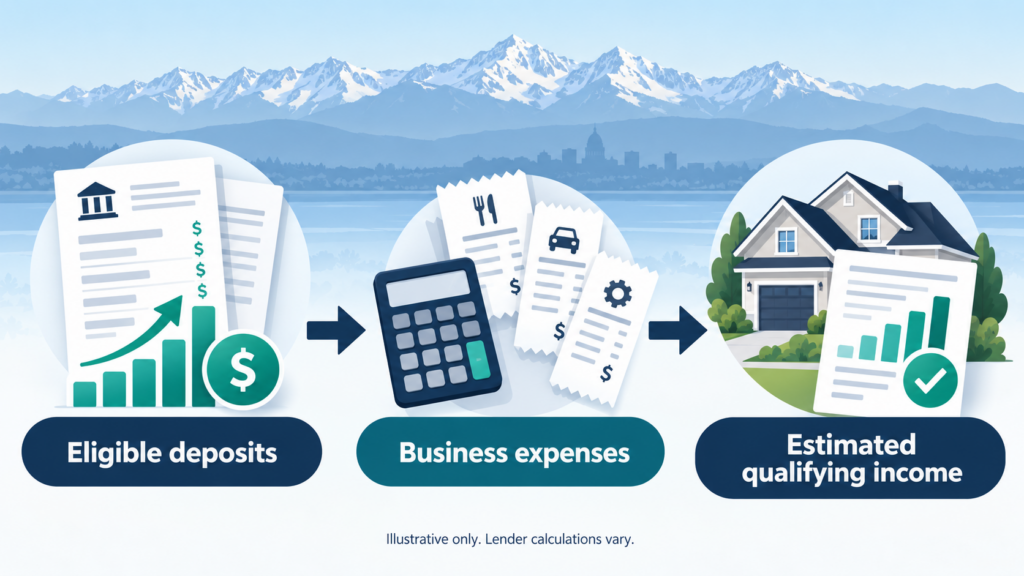
Depending on the program, an underwriter may analyze eligible deposits appearing on personal or business bank statements over a specified period, commonly 12 or 24 months, and use the lender's methodology to determine qualifying income.

The lender does not simply add every deposit and call it income.

Deposits generally must be reviewed to determine whether they represent legitimate business or personal income. Transfers between accounts, loan proceeds, unusual deposits and other non-income deposits may need to be identified and excluded.

The lender then evaluates the borrower under the complete guidelines for that mortgage program.

That review can include:

  • Qualifying bank statement income
  • Credit history and credit score
  • Assets
  • Down payment or equity
  • Mortgage reserves
  • Existing liabilities
  • Debt-to-income considerations
  • Property type
  • Property value
  • Occupancy
  • Loan purpose
  • Loan amount
  • Business history

Bank statement mortgages therefore remain fully underwritten mortgage loans.

They should not be confused with loans where a borrower simply states an income figure without supporting documentation.


How Do Bank Statement Mortgage Loans Work in Utah?

A bank statement mortgage generally begins with determining which bank accounts best document the borrower's recurring income.

Depending on the program, the lender may review:

  • Personal bank statements
  • Business bank statements
  • Multiple qualifying business accounts
  • A combination of documentation when permitted

The underwriter reviews deposits over the required statement period and identifies deposits that can be considered for income qualification.

A simplified process may look like this:

1. Collect the required statements.
The borrower provides the required number of consecutive bank statements.

2. Identify eligible deposits.
Recurring deposits associated with legitimate income are separated from transfers, loan proceeds and other deposits that cannot be treated as income.

3. Apply the investor's income methodology.
Business-account programs generally apply an allowable expense factor or another investor-approved method to determine qualifying income.

4. Calculate average qualifying monthly income.
Eligible qualifying income is generally averaged over the applicable statement period.

5. Review the rest of the mortgage file.
Income is only one component. Credit, assets, reserves, debts, property, occupancy and the requested loan structure must also meet the investor's underwriting requirements.

This is why two borrowers with similar deposits may receive different qualification results.


Who Uses Bank Statement Loans in Utah?

Bank statement mortgage programs are most commonly considered by self-employed borrowers whose cash flow may be stronger than the qualifying income calculated from traditional documentation.

Potential borrowers include:

Independent Contractors and 1099 Earners

Consultants, contractors and other professionals who receive non-W-2 income may have recurring deposits that can potentially be documented through bank statements.

Real Estate Agents and Commission-Based Professionals

Real estate professionals and commission-based business owners can experience income that varies throughout the year. A longer bank statement history may help an underwriter evaluate recurring cash flow.

Real Estate Investors

Some real estate professionals own operating businesses or receive income that does not fit traditional W-2 documentation. Depending on the purpose of the transaction, a bank statement program or another program such as DSCR financing may be evaluated.

Freelancers and Independent Professionals

Designers, programmers, photographers, marketing professionals, consultants and other independent professionals may receive income from numerous clients instead of one employer.

Medical Professionals

Physicians, dentists and other healthcare professionals operating private practices or business entities may have income structures that differ substantially from traditional salaried employment.

Construction and Trade Business Owners

Potential borrowers can include:

  • General contractors
  • Electricians
  • Plumbers
  • Landscapers
  • Framers
  • HVAC contractors
  • Pool contractors
  • Property-maintenance companies
  • Other construction and trade businesses

Attorneys and Professional-Service Businesses

Law firm partners, attorneys, consultants and other professionals operating through partnerships, LLCs or corporations may have complex income documentation.

Transportation and Trucking Businesses

Owner-operators and transportation business owners frequently have significant business revenue combined with substantial operating expenses. The lender's expense calculation is especially important for these businesses.

Agency and Consulting Business Owners

Insurance, marketing, staffing, consulting and other agency owners may have recurring business deposits that potentially support alternative income documentation.

E-Commerce and Online Business Owners

Online retailers and digital business owners may receive revenue through numerous payment processors. Documentation must clearly establish eligible business income and avoid counting transfers or duplicate deposits.

The appropriate loan is determined by the complete financial profile—not simply by occupation.


Who May Not Be a Good Candidate for a Bank Statement Loan?

A bank statement mortgage is not automatically the right choice simply because someone is self-employed.

Another mortgage program may make more sense when:

  • Traditional tax-return income already supports qualification
  • Bank deposits are highly inconsistent
  • A significant portion of deposits cannot be documented as income
  • Business and personal funds are difficult to distinguish
  • Available assets or reserves do not satisfy the program
  • Credit does not meet the selected investor's requirements
  • The requested LTV is outside available guidelines
  • The property does not meet investor eligibility requirements
  • The borrower has insufficient self-employment history for the selected program
  • Another documentation method produces a better qualification result

The objective should be to compare realistic financing strategies rather than automatically choosing the program with the most flexible marketing description.


How Is Bank Statement Income Reviewed?


Bank statement underwriting focuses on identifying recurring, supportable income.

A lender may review personal statements, business statements or multiple eligible business accounts when the program permits.

The exact calculation varies considerably among investors.

Business Bank Statement Example

Assume a qualifying business has:

Average eligible deposits: $40,000 per month

If a particular investor's approved methodology allows 50% of those eligible deposits to be treated as qualifying income after its expense calculation:

Potential qualifying income: $20,000 per month

If another investor approves a different expense factor for that borrower's documented business circumstances, the resulting qualifying income could be different.

This difference illustrates why the percentage used cannot be treated as a universal rule.

Some programs available through wholesale lenders may allow a higher percentage of eligible deposits to be considered when supported by the applicable investor guidelines and documentation. In certain qualifying situations, the resulting calculation may reach approximately 75% of eligible deposits.

That does not mean every borrower can automatically use 75% of deposits.

The calculation depends on the lender, business, documentation, expense methodology and underwriting requirements.


Are Transfers Counted as Bank Statement Income?

Generally, transfers between a borrower's own accounts should not be counted as new income because doing so could count the same money more than once.

Underwriters may also investigate:

  • Large, unusual deposits
  • Loan proceeds
  • Transfers
  • Account-to-account movements
  • Refunds
  • Asset sales
  • Other deposits that do not represent recurring qualifying income

Maintaining clear banking records can make the underwriting process easier.


Personal vs. Business Bank Statements

Personal Bank Statement Programs

Personal bank statement programs may be appropriate when business or self-employment income is regularly deposited into a personal account and the investor's guidelines permit that documentation.

The underwriter still reviews deposits to identify eligible recurring income.

Business Bank Statement Programs

Business bank statement programs are designed for borrowers whose income flows primarily through business accounts.

Because gross business deposits are not the same as personal income, an expense calculation generally must be considered.

Can Multiple Business Accounts Be Used?

Potentially.

If a business legitimately operates through multiple accounts, some programs may permit more than one account to be reviewed.

The accounts must satisfy the investor's documentation requirements, and transfers between accounts need to be identified so income is not counted twice.


12-Month vs. 24-Month Bank Statement Loans

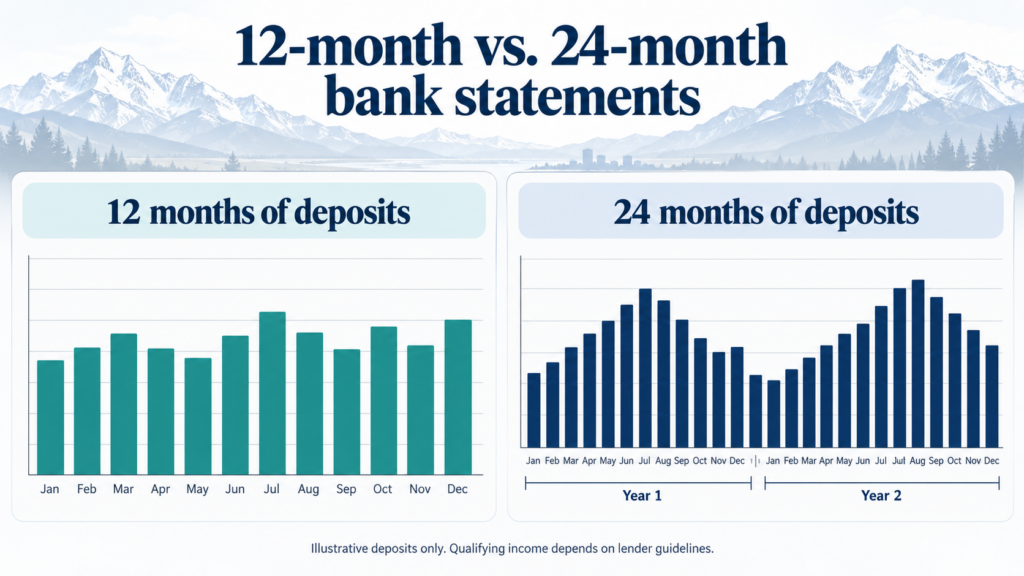
Bank statement programs commonly evaluate either 12 or 24 months of statements.

12-Month Bank Statement Program

A 12-month program may provide a shorter documentation period for borrowers who meet the selected investor's requirements.

It can be useful when the most recent year provides an appropriate representation of the business.

24-Month Bank Statement Program

Twenty-four months of statements provide a longer history from which the lender can evaluate deposits and income consistency.

A longer period may also reveal seasonality within a business.

Which Is Better?

Neither is automatically better.

The appropriate documentation period depends on factors such as:

  • Investor requirements
  • Self-employment history
  • Deposit consistency
  • Business seasonality
  • Credit
  • LTV
  • Property
  • Loan amount
  • Overall risk profile

A preliminary review can help determine which approach is appropriate before a full mortgage application is submitted.


Can You Qualify After Only One Year of Self-Employment?

Select bank statement programs may consider borrowers with approximately one year of self-employment when all applicable requirements are satisfied.

This is an investor-specific feature and should not be interpreted as a universal bank statement mortgage rule.

Employment history, previous occupation, business history and other documentation may be reviewed depending on the program.


Credit Score Considerations

There is no single universal minimum credit score for every bank statement mortgage.

Credit requirements can depend on:

  • Loan-to-value
  • Loan amount
  • Occupancy
  • Property type
  • Recent mortgage history
  • Significant credit events
  • Available reserves
  • Investor
  • Overall loan profile

Select programs may offer higher-LTV options for stronger credit profiles, while other programs may allow lower credit scores when more borrower equity or a larger down payment is available.

For example, certain programs available through wholesale investors may offer options around 90% LTV for qualified borrowers with approximately a 680 credit score or around 80% LTV with approximately a 660 credit score.

These figures are examples of program guidelines that may be available and are not universal qualification standards or guarantees.

Current guidelines should be verified for the individual transaction.


How Much Down Payment Is Required?

The required down payment depends on the maximum LTV available for the specific borrower and transaction.

For example:

  • 90% LTV generally corresponds to 10% borrower equity/down payment.
  • 80% LTV generally corresponds to 20% borrower equity/down payment.
  • 75% LTV generally corresponds to 25% borrower equity/down payment.

However, the maximum available LTV may change based on credit score, loan amount, property, occupancy, transaction type and investor guidelines.

Cash-out refinance limits may also differ from purchase and rate-and-term refinance limits.


Are Mortgage Reserves Required?

Bank statement mortgage programs frequently have reserve requirements.

Reserves generally refer to eligible assets remaining after closing that can cover a specified number of months of housing obligations.

Certain programs may require several months of reserves, while larger or more complex transactions can require more.

Reserve requirements should be verified against the current investor guideline because there is no single 3-month or 6-month rule that applies to every bank statement mortgage.


What Documents May Be Needed?

Documentation varies, but a bank statement mortgage application may require:

  • 12 or 24 months of applicable bank statements
  • Identification
  • Asset statements
  • Housing history
  • Business documentation
  • Evidence of self-employment
  • Documentation explaining certain deposits
  • Documentation identifying transfers
  • Purchase contract for a purchase transaction
  • Property information
  • Insurance information
  • Additional documentation required by underwriting

The absence of traditional tax-return income qualification does not mean the mortgage is a no-documentation loan.


Can Bank Statement Loans Be Used to Purchase a Home?

Yes, qualifying bank statement programs may be used for home purchases.

The available financing depends on the borrower's income calculation, credit, assets, reserves, property, occupancy, loan amount and applicable investor guidelines.

A bank statement preapproval before shopping for a home can be particularly useful because the qualifying-income calculation may differ substantially from the borrower's gross business revenue.


Can Bank Statement Loans Be Used for Refinancing?

Yes. Qualifying programs may offer rate-and-term refinancing and, depending on the program, cash-out refinancing.

Rate-and-Term Refinance

A rate-and-term refinance generally focuses on restructuring an existing mortgage without taking substantial cash proceeds beyond permitted limits.

Cash-Out Refinance

Certain bank statement programs may permit borrowers to access home equity through a cash-out refinance.

Maximum LTV, credit requirements, reserves, seasoning and other restrictions may differ from purchase financing.


Can a Bank Statement Loan Be Used for a Jumbo Mortgage?

Yes. Certain wholesale investors offer jumbo bank statement mortgage programs for qualified borrowers who need larger loan amounts.

These programs can be relevant in Utah markets where higher-priced homes are common, including areas of Park City, Deer Valley, Holladay, Draper, Salt Lake City and other luxury-home markets.

Select programs available through wholesale channels may accommodate very large loan amounts, potentially extending into the multi-million-dollar range and, under specialized circumstances, up to approximately $30 million.

Availability at these loan sizes is highly program-specific.

Large bank statement mortgages generally receive detailed underwriting of:

  • Bank statement income
  • Credit
  • Assets
  • Reserves
  • Property
  • Appraisal
  • Occupancy
  • Loan amount
  • LTV
  • Overall borrower financial strength

A maximum advertised program loan amount does not mean every borrower or property qualifies for that amount.


Primary Residence, Second Home and Investment Property Options

Depending on the investor, bank statement programs may be available for:

Primary Residences

A home occupied as the borrower's principal residence may qualify under applicable owner-occupied bank statement guidelines.

Second Homes

Certain programs may permit second-home financing subject to investor occupancy and property requirements.

Investment Properties

Some bank statement mortgage programs permit investment-property financing.

However, real estate investors should also consider whether a DSCR loan may be appropriate because DSCR underwriting generally focuses on the property's qualifying rental cash flow rather than the borrower's bank statement income.

The two programs solve different qualification problems.


Bank Statement Mortgage vs. Conventional Mortgage

Feature Bank Statement Mortgage Conventional Mortgage
Primary Income Approach Eligible bank deposits under investor methodology Traditional agency income documentation
Self-Employed Borrowers Designed to accommodate alternative income documentation Self-employment income can qualify under agency requirements
Tax-Return Dependence May not rely primarily on traditional tax-return income Tax documentation may be important for self-employed income
Bank Statements Central to income calculation Commonly used primarily for asset verification
Credit Requirements Investor-specific Agency/program-specific
Down Payment Depends on investor and borrower profile Depends on agency program and borrower profile
Rates/Pricing May differ from conventional financing Agency pricing framework
Underwriting Private investor / program guidelines Agency guidelines
Jumbo Availability Select programs Conventional conforming limits differ from jumbo financing

A bank statement mortgage should not automatically be assumed to be cheaper or more expensive than another loan. Pricing depends on current markets, credit, LTV, occupancy, property, loan amount and program.


Bank Statement vs. Other Alternative Mortgage Programs

Program Primary Qualification Approach Potential Borrower
Bank Statement Eligible bank deposits Self-employed borrower
1099 Eligible 1099 income under program guidelines Independent contractor / 1099 professional
Profit & Loss Qualifying P&L documentation Self-employed business owner
DSCR Property rental cash flow Real estate investor
Asset Depletion Eligible assets converted into qualifying income Asset-rich borrower
Jumbo Alternative Documentation Investor-specific alternative documentation High-loan-amount borrower

The best documentation method depends on the borrower, property and transaction.


Advantages of Bank Statement Mortgage Loans

Potential advantages include:

  • Alternative method for documenting self-employment income
  • Less dependence on traditional tax-return income calculations
  • Personal or business statement options under qualifying programs
  • 12- or 24-month options may be available
  • Purchase and refinance options
  • Potential cash-out refinance availability
  • Primary, second-home and investment options under select programs
  • Jumbo mortgage availability
  • Potential options for certain borrowers with shorter self-employment histories
  • Ability to evaluate recurring business cash flow differently from conventional underwriting

Potential Disadvantages

Bank statement mortgages also have important considerations:

  • Not every deposit counts as income
  • Business expenses must be considered
  • Transfers generally cannot be double counted
  • Pricing may differ from conventional financing
  • Down-payment requirements may be higher depending on the program
  • Reserve requirements may apply
  • Investor guidelines vary
  • Large deposits may require explanation
  • Property restrictions may apply
  • Underwriting can require significant documentation
  • Program availability can change

Choosing the Right Loan Strategy for Your Financial Profile

A bank statement mortgage can be valuable for self-employed borrowers, but it is not always the appropriate financing strategy.

The analysis should go beyond finding the program that appears to have the most flexible guideline.

A bank statement loan may be less suitable when deposits are inconsistent, available reserves are limited, credit presents additional challenges, a large percentage of deposits cannot be treated as income, the property creates additional underwriting considerations, or another mortgage program provides a better overall structure.

The objective is to identify financing that fits the borrower's actual income, assets, credit, property and longer-term objectives.

For some borrowers that may be a bank statement mortgage.

For others, it could be conventional financing, a 1099 program, P&L mortgage, asset-depletion program, DSCR loan or another alternative-documentation solution.


Common Reasons Bank Statement Mortgage Applications Run Into Problems

1. Counting Transfers as Income

Money moved from one account to another generally does not represent new income.

2. Large Unexplained Deposits

Unusual deposits may need documentation before they can be considered.

3. Inconsistent Deposits

Significant fluctuations can complicate the determination of stable qualifying income.

4. Business Expense Issues

Gross deposits are not automatically equivalent to qualifying personal income.

5. Insufficient Reserves

A borrower can have adequate qualifying income but still fail to meet an investor's asset or reserve requirement.

6. Credit Issues

Credit score is only part of credit underwriting. Mortgage history and significant credit events may also matter.

7. Property Eligibility

Certain property characteristics can create additional restrictions.

8. Waiting Too Long to Review Statements

A bank statement income review before making an offer can identify issues early.


How Does Bank Statement Mortgage Preapproval Work?

Step 1: Discuss the Transaction

Identify whether the mortgage is for a purchase, refinance or cash-out refinance and whether the property will be a primary residence, second home or investment property.

Step 2: Review the Bank Statement Structure

Determine whether personal statements, business statements or another documentation method may be appropriate.

Step 3: Analyze Deposits

Review eligible recurring deposits and identify transfers or deposits that may need to be excluded or documented.

Step 4: Compare Available Programs

Evaluate relevant wholesale investor programs based on the borrower's income, credit, assets, reserves, loan amount and property.

Step 5: Determine a Potential Qualification Range

Estimate qualifying income under the applicable program methodology.

Step 6: Complete Formal Underwriting Requirements

Final loan approval remains subject to complete underwriting, appraisal, title, documentation, investor requirements and other applicable conditions.


Bank Statement Mortgage Loans Throughout Utah

UtahLowRate.com works with borrowers seeking bank statement mortgage options throughout Utah.

Different Utah markets can create different financing needs.

Salt Lake County

Self-employed borrowers in Salt Lake City, Holladay, Sandy, Draper, Cottonwood Heights, Millcreek, Murray, South Jordan, West Jordan, Riverton and Herriman may be purchasing everything from entry-level residences to high-value properties.

The appropriate mortgage structure depends on the borrower and property—not simply the city.

Park City, Summit County and Wasatch County

Higher property values in Park City, Deer Valley, Heber City, Midway and surrounding communities can make jumbo financing particularly relevant.

A self-employed buyer purchasing a higher-priced property may need both alternative income documentation and a jumbo loan structure. Certain jumbo bank statement programs are designed for this combination.

Utah County

Business owners and self-employed professionals purchasing in Provo, Orem, Lehi, American Fork, Alpine, Highland and surrounding Utah County communities may consider bank statement financing when traditional taxable-income calculations do not accurately represent their qualifying cash flow.

Southern Utah

Self-employed borrowers in St. George, Washington, Ivins, Santa Clara and surrounding Southern Utah communities can also explore qualifying bank statement mortgage programs for purchases and refinances.

Northern Utah

Bank statement mortgage options may also be available for qualified borrowers in Logan and other Northern Utah communities, subject to property and investor requirements.

Bank statement mortgages are offered based on program eligibility and underwriting—not based on a preferred Utah city.


Daniel Paris
Utah Mortgage Broker
NMLS #243976
UtahLowRate.com
801-604-4949

Daniel Paris works with Utah borrowers evaluating traditional and alternative mortgage programs, including bank statement financing for self-employed borrowers.

A mortgage broker can review programs available through multiple wholesale lending sources and compare relevant guidelines for a borrower's specific scenario.

For bank statement mortgages, that can include comparing differences in:

  • Deposit calculations
  • Expense methodologies
  • Statement periods
  • Credit requirements
  • LTV limits
  • Reserve requirements
  • Property eligibility
  • Loan amounts
  • Jumbo options
  • Self-employment history requirements

Mortgage information on this page is educational and does not constitute a loan approval or commitment to lend. Individual qualification requires review of the borrower's complete financial and property information.


Find Out How Your Bank Statements May Be Evaluated

If you are self-employed and your tax returns do not appear to reflect the cash flow of your business, you can have your situation reviewed before deciding which mortgage program to pursue.

Daniel Paris
Utah Mortgage Broker
NMLS #243976
801-604-4949
UtahLowRate.com

Ask about bank statement mortgage options for purchases, refinances, cash-out transactions and jumbo properties in Utah.


Buying a Higher-Priced Utah Home?

Certain bank statement programs may provide jumbo financing for qualified self-employed borrowers who require larger loan amounts.

Contact Daniel Paris to discuss the proposed property, purchase price, down payment, bank statement income, credit and available assets.

Call: 801-604-4949


1. What is a bank statement mortgage in Utah?

A bank statement mortgage is an alternative income-documentation loan that may allow qualifying self-employed borrowers to use eligible deposits from personal or business bank statements to establish income. Credit, assets, reserves, property, occupancy and other underwriting factors are also reviewed.

2. Can I get a mortgage without using traditional tax-return income?

Potentially. Certain bank statement programs allow eligible self-employed borrowers to qualify using a bank-deposit analysis instead of relying primarily on traditional tax-return income. The loan still requires documentation and full underwriting.

3. How many months of bank statements are required?

Many programs use either 12 or 24 months of bank statements. The appropriate period depends on the investor, self-employment history, deposit consistency, business characteristics and complete loan profile.

4. Can I use personal bank statements?

Yes, certain programs permit personal bank statements when they appropriately document the borrower's qualifying income. Requirements vary by investor.

5. Can I use business bank statements?

Yes. Business bank statements are commonly used for self-employed borrowers. Because business revenue is not the same as personal income, the investor generally applies its approved expense methodology before determining qualifying income.

6. Can multiple business bank accounts be used?

Potentially. Some investors may allow multiple qualifying business accounts. Transfers between accounts need to be identified so the same funds are not counted as income more than once.

7. Can 75% of my deposits be counted as income?

Possibly under certain investor methodologies, but not automatically. Some qualifying programs may permit calculations resulting in approximately 75% of eligible deposits being used. Other programs may use 50% or another calculation. Business type, expense treatment, documentation and investor guidelines determine the result.

8. Are transfers between my accounts counted as income?

Generally, account-to-account transfers are not new income and should not be counted twice. The underwriter reviews transaction activity to identify transfers and other non-income deposits.

9. What credit score is required?

There is no universal minimum for every bank statement mortgage. Select programs may provide higher-LTV options around a 680 credit score and other options around a 660 score, but requirements vary based on LTV, property, occupancy, loan amount and investor.

10. How much down payment do I need?

It depends on the maximum LTV available for your specific program. For example, 90% LTV corresponds to 10% equity/down payment and 80% LTV corresponds to 20%, but not every borrower qualifies for those LTV levels.

11. Do bank statement mortgages require reserves?

Many programs require mortgage reserves. The required amount varies by investor, loan amount, property, occupancy and overall financial profile. Larger or more complex transactions may require additional reserves.

12. Can I qualify with only one year of self-employment?

Certain investor programs may consider borrowers with approximately one year of self-employment when all applicable requirements are satisfied. This is program-specific and should not be treated as a universal guideline.

13. Can a bank statement loan be used for a jumbo mortgage?

Yes. Certain programs provide jumbo bank statement financing for qualified borrowers. Credit, assets, reserves, property, LTV, loan amount and overall financial strength are important considerations.

14. How large can a bank statement mortgage be?

Maximum loan amounts vary significantly. Select specialized wholesale programs may extend into multi-million-dollar loan amounts and potentially as high as approximately $30 million for qualifying scenarios. Maximum program size does not guarantee borrower eligibility.

15. Can I refinance using bank statements?

Yes. Certain bank statement programs offer rate-and-term refinancing and cash-out refinancing for qualified borrowers. LTV and other requirements can differ from purchase guidelines.

16. Can bank statement loans finance investment properties?

Certain programs allow investment properties. Real estate investors may also want to compare a bank statement mortgage with DSCR financing, which generally focuses on qualifying property rental cash flow.

17. Are bank statement loans the same as stated-income loans?

No. Bank statement mortgages require documented bank activity and underwriting. The lender evaluates eligible deposits along with credit, assets, reserves, property and other factors. The borrower is not simply providing an unsupported income number.

18. Are bank statement mortgage rates lower than other Non-QM loans?

Not necessarily. Mortgage pricing changes and depends on factors including credit, LTV, loan amount, occupancy, property and investor. Bank statement financing should be compared using actual available terms for the specific borrower rather than assuming it will always have a lower rate.