
Explore Your Home Equity and Reverse Mortgage Options
If you are 62 or older and own a home in Utah, a reverse mortgage may allow you to access a portion of your home equity without making the monthly principal-and-interest mortgage payments associated with a traditional mortgage.
The most common reverse mortgage is the Home Equity Conversion Mortgage (HECM), which is insured by the Federal Housing Administration. Unlike a traditional mortgage where borrowers generally make monthly payments that reduce their loan balance, interest and fees on a reverse mortgage are added to the balance over time.

Talk With a Utah Mortgage Broker About Reverse Mortgages
Daniel Paris
Utah Mortgage Broker
Utah Low Rate — UtahLowRate.com
801-604-4949
Call today to discuss whether a reverse mortgage may fit your financial goals and circumstances.
Important: A reverse mortgage is a loan, not free money. Borrowers remain responsible for applicable property taxes, homeowners insurance, property maintenance and other required property charges. Eligibility and loan proceeds are subject to program requirements, financial assessment, property eligibility and underwriting.
What Is a Reverse Mortgage?
A reverse mortgage is a home loan that allows eligible older homeowners to borrow against their home equity.
For an FHA-insured HECM, borrowers generally must be at least 62 years old. The home must be the borrower's principal residence and other borrower, financial and property requirements apply.
One major difference between a reverse mortgage and a traditional mortgage is the direction of the loan balance.
With a traditional mortgage, borrowers generally make monthly principal-and-interest payments that reduce their balance.
With a reverse mortgage, borrowers generally do not have required monthly principal-and-interest mortgage payments. Instead, interest and applicable fees are added to the outstanding balance, so the loan balance generally increases over time.
That distinction is important:
No required monthly principal-and-interest mortgage payment does not mean no homeowner expenses.
You must continue meeting the requirements of the reverse mortgage.
Who May Qualify for a Reverse Mortgage in Utah?
For an FHA-insured HECM, eligibility is not based on age alone.
Typical requirements include:
- At least one eligible borrower meeting HECM age requirements
- The property serving as the borrower's principal residence
- Sufficient home equity
- Paying off an existing mortgage at closing if one remains
- Meeting applicable financial-assessment requirements
- Keeping property taxes and homeowners' insurance current
- Maintaining the home
- Meeting FHA property requirements
- Completing required counseling through a HUD-approved reverse mortgage counseling agency
The amount of an existing mortgage matters because it generally must be satisfied when the HECM closes. Reverse-mortgage proceeds may potentially be used toward that payoff.
How Does a Utah Reverse Mortgage Work?
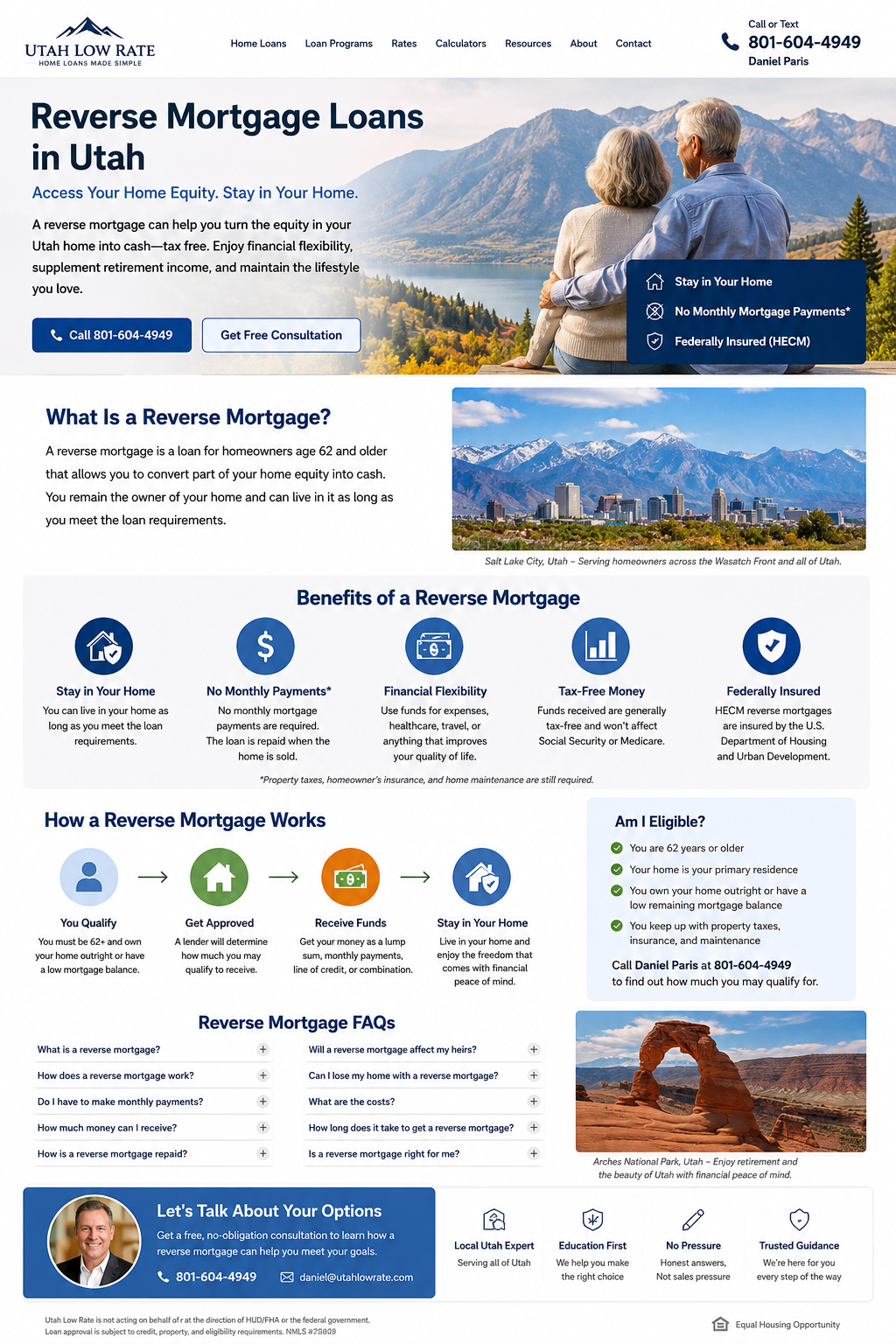
A reverse mortgage converts a portion of your home's equity into loan proceeds.
The general process looks like this:
1. Review Your Situation
Start by reviewing your age, property, estimated home value, current mortgage balance and financial objectives.
2. Complete Required Counseling
HECM borrowers must receive counseling from a HUD-approved reverse mortgage counseling agency. The counseling process is intended to help borrowers understand the loan, costs, responsibilities and alternatives before proceeding.
3. Apply for the Reverse Mortgage
Your loan application and supporting information are reviewed under the applicable HECM guidelines.
4. Property and Financial Review
The lender evaluates the property and performs the required financial assessment.
5. Existing Mortgage Is Addressed
If you currently have a mortgage, it generally must be paid off as part of the reverse-mortgage transaction.
6. Receive Available Proceeds
Depending on the loan structure and applicable requirements, proceeds may be available through options such as a line of credit, monthly disbursements or lump-sum payment. The available amount depends on factors including age, interest rate and home value.
How Much Can You Receive From a Reverse Mortgage?
There is no single amount that applies to every Utah homeowner.
The amount available through a reverse mortgage can depend on factors such as:
Age + Home Value + Interest Rate + Existing Mortgage Balance + Program Requirements
For HECMs, the borrowing limit—often referred to as the principal limit—takes age, interest rate and home value into consideration.
This is why homeowners should obtain a personalized analysis rather than relying on a generic online estimate.
Daniel Paris — 801-604-4949
Do You Still Own Your Home With a Reverse Mortgage?
Yes. A reverse mortgage does not automatically transfer ownership of your home to the lender.
The title remains in the homeowner's name, subject to the mortgage lien and loan requirements.
However, borrowers must continue satisfying their obligations.
For an HECM, these include:
- Occupying the property as the principal residence
- Paying property taxes
- Maintaining homeowners insurance
- Paying other applicable property charges
- Maintaining the property in acceptable condition
Failure to meet required obligations can cause the loan to become due and payable and may ultimately result in foreclosure.
Reverse Mortgage vs. Traditional Mortgage
| Traditional Mortgage | Reverse Mortgage |
|---|---|
| Borrower typically makes monthly P&I payments | Generally no required monthly P&I mortgage payment |
| Balance generally decreases as principal is repaid | Balance generally increases as interest/fees accrue |
| Available to qualifying borrowers of various ages | HECM generally requires borrower eligibility beginning at age 62 |
| Builds equity as principal is repaid, assuming stable value | Using loan proceeds generally reduces remaining equity over time |
| Loan repaid through scheduled payments | Typically repaid after sale, death or when the home is no longer the borrower's principal residence |
A reverse mortgage should therefore be evaluated as a long-term financial decision, not simply as a way to eliminate a monthly mortgage payment.
What Can Reverse Mortgage Proceeds Be Used For?
Depending on the reverse mortgage and the homeowner's circumstances, proceeds may provide additional financial flexibility.
Homeowners may consider available funds for things such as:
- Paying off an existing mortgage
- Home improvements or repairs
- Creating additional cash-flow flexibility
- Establishing an available line of credit
- Paying certain living expenses
- Other personal financial needs
How proceeds are used should be considered in the context of the homeowner's broader financial plan.
Reverse Mortgage Costs in Utah
Reverse mortgages have costs, just like other mortgage products.
HECM expenses may include an origination fee, appraisal and other third-party closing costs, FHA mortgage insurance, interest and potentially servicing-related charges. CFPB notes that reverse mortgages can be more expensive than other types of home loans.
Some costs may be financed into the loan rather than paid directly at closing, but financing costs reduces the amount of equity remaining and potentially the proceeds available to the borrower.
This is another reason to compare the long-term cost—not simply the initial cash available.
When Does a Reverse Mortgage Have to Be Repaid?
A reverse mortgage generally becomes due when triggering events occur, such as when the borrower sells the property or it is no longer the borrower's principal residence.
The loan can also become due if required obligations aren't maintained, including payment of property taxes and homeowners' insurance or maintaining the home.
Because repayment can affect spouses and heirs, homeowners should discuss those implications during the decision-making and counseling process.
Reverse Mortgage Loans Throughout Utah
Utah homeowners have very different property values, equity positions and retirement objectives depending on where they live.
Utah Low Rate can discuss reverse-mortgage financing with homeowners throughout the state, including:
Salt Lake City, Holladay, Millcreek, Murray, Cottonwood Heights, Sandy, Draper, South Jordan, West Jordan, Riverton, Herriman, Park City, Deer Valley, Heber City, Midway, Lehi, Alpine, Highland, American Fork, Provo, Orem, Ogden, Layton, Bountiful, Logan, St. George, Washington, Ivins and surrounding Utah communities.
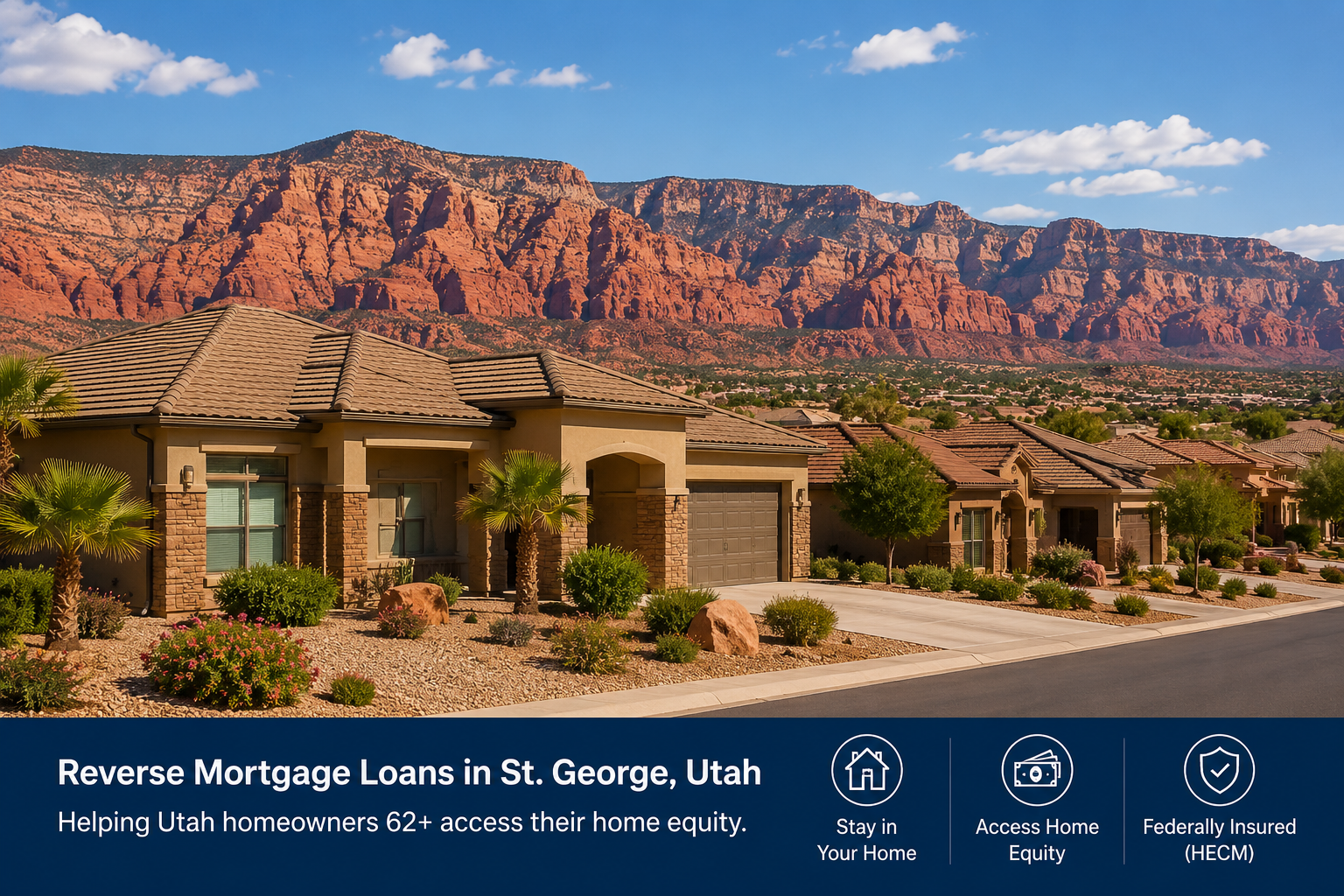
For homeowners with higher-value properties, it can also be useful to ask whether an FHA-insured HECM or another available reverse-mortgage structure is more appropriate for the property and financial situation.
Utah Reverse Mortgage Questions & Answers
What is a reverse mortgage in Utah?
A reverse mortgage allows an eligible homeowner to borrow against home equity. The most common reverse mortgage is the FHA-insured Home Equity Conversion Mortgage (HECM) for eligible homeowners age 62 and older.
How old do you have to be for a reverse mortgage in Utah?
For an FHA-insured HECM, eligible borrowers generally must be 62 or older. Other reverse-mortgage products may have different requirements.
Do I have to make a monthly mortgage payment?
HECM borrowers generally do not make required monthly principal-and-interest mortgage payments. However, borrowers remain responsible for property taxes, homeowners' insurance, maintenance and applicable property charges.
Can I get a reverse mortgage if I still owe money on my Utah home?
Potentially. An existing mortgage generally must be paid off when the reverse mortgage closes. Available reverse-mortgage proceeds may be used toward that payoff, subject to qualification and sufficient proceeds.
How much money can I receive?
The amount depends on factors including the borrower's age, applicable interest rate and home value. Your existing liens and transaction costs also affect the net proceeds available to you.
Is reverse mortgage counseling required?
Yes for a HECM. Borrowers must receive counseling from a HUD-approved reverse mortgage counseling agency before obtaining the loan.
Will I still own my Utah home?
Yes. The homeowner retains title, subject to the reverse-mortgage lien and ongoing loan requirements.
Is a reverse mortgage free money?
No. A reverse mortgage is a loan. Interest and applicable fees are added to the outstanding balance, causing the amount owed to generally increase over time.
Can my heirs keep the home?
Potentially. When the reverse mortgage becomes due, heirs may have options for satisfying the loan and retaining the property, depending on the circumstances. This is an important subject to discuss with the HECM counselor and appropriate legal or financial professionals.
Is a reverse mortgage right for every Utah homeowner over 62?
No. Homeowners should compare a reverse mortgage with alternatives such as remaining with their existing mortgage, refinancing, a home-equity product where appropriate, downsizing or other financial strategies. CFPB specifically recommends considering alternatives before taking out a reverse mortgage.
Talk With Daniel Paris About Reverse Mortgage Loans in Utah
If you are considering a reverse mortgage, the first step is understanding the numbers, requirements, costs and alternatives.
Daniel Paris
Utah Mortgage Broker
Utah Low Rate
801-604-4949
Call to discuss your property, current mortgage balance and available Utah reverse-mortgage options.
Loan programs, eligibility, interest rates, proceeds and guidelines are subject to change and underwriting requirements. This page is educational and does not constitute financial, tax or legal advice. Reverse mortgages involve costs and reduce available home equity over time. Borrowers must continue meeting applicable property and occupancy obligations.

