

Alternative Home Financing
Stated Income Mortgage Loans in Utah can provide an alternative financing option for qualified borrowers whose income, employment, assets, or business structure does not fit traditional mortgage underwriting.
These programs may be useful for business owners, entrepreneurs, self-employed professionals, borrowers between jobs, people relocating to Utah, and borrowers with substantial assets but nontraditional income documentation.
Modern stated income and alternative-documentation mortgages are not automatic-approval or old-style no-doc loans. Borrowers must provide accurate information and meet applicable lender requirements for credit, assets, reserves, property, occupancy, loan-to-value ratio, and other underwriting criteria.
Daniel Paris
Utah Mortgage Broker
NMLS #243976
UtahLowRate.com
801-604-4949
Last Updated: September 2026
Quick Answer: What Are Stated Income Mortgage Loans in Utah?
A stated income mortgage loan in Utah is an alternative mortgage program for qualified borrowers who may not fit standard W-2, tax-return, or conventional income-documentation requirements. Depending on the program, qualification may place greater emphasis on credit, assets, reserves, down payment or equity, property value, occupancy, and the borrower's overall financial profile.
Stated income does not mean a borrower can misrepresent income, employment, assets, or other financial information. All loans remain subject to lender and investor underwriting.
Stated Income Mortgage Loans Utah: Key Facts
| Feature | General Program Information |
|---|---|
| Location | Utah |
| Loan Type | Alternative-documentation / Non-QM |
| Purchase | Available on eligible programs |
| Rate-and-Term Refinance | Available on eligible programs |
| Cash-Out Refinance | Available on eligible programs |
| Primary Residence | Available on eligible programs |
| Traditional W-2 Income | May not be the primary qualification method |
| Tax Returns | May not be required for certain programs |
| Credit Review | Required |
| Assets and Reserves | Generally required |
| Property Review | Required |
| Underwriting | Required |
| Approval Guaranteed | No |
Guidelines vary by lender and loan program. Loan amounts, LTV limits, credit requirements, reserve requirements, documentation, pricing, and program availability can change.
Who May Benefit From a Stated Income Mortgage in Utah?
Traditional mortgage underwriting works well for borrowers with predictable W-2 salaries and easily documented employment.
Not every borrower has that type of financial profile.
A Utah stated income mortgage may be worth exploring for qualified:
- Business owners
- Entrepreneurs
- Self-employed professionals
- Independent contractors
- Consultants
- Real estate professionals
- Construction professionals
- Home builders
- Commission-based professionals
- Freelancers
- High-net-worth borrowers
- Borrowers with significant liquid assets
- Borrowers with several income sources
- Borrowers starting a new business
- Borrowers transitioning between jobs
- Borrowers relocating to Utah
- Borrowers whose tax returns do not accurately represent their overall financial strength
The right program depends on the complete borrower, property, and transaction profile.
How Do Stated Income Mortgage Loans in Utah Work?
Traditional mortgage underwriting often calculates qualifying income using documents such as W-2s, pay stubs, tax returns, and employment verification.
Alternative mortgage programs may evaluate a borrower differently.
Depending on the lender and program, underwriting may consider factors such as:
- Credit history
- Available assets
- Cash reserves
- Down payment
- Existing home equity
- Property value
- Loan-to-value ratio
- Occupancy
- Property type
- Loan amount
- Existing financial obligations
- Business ownership
- Employment circumstances
- Overall borrower financial profile
This does not eliminate underwriting.
Instead, it provides qualified borrowers with another way to structure a mortgage when traditional documentation does not adequately reflect their financial situation.
Utah Stated Income Loan Requirements
Requirements vary significantly between lenders.
Before choosing a program, review the complete Stated Income Loan Requirements Utah guide. That page covers credit, loan-to-value ratios, reserves, assets, occupancy, purchase and refinance guidelines, and other program considerations.
A typical review may include:
Credit
Credit requirements vary according to loan amount, LTV, property, occupancy, and lender guidelines.
Higher credit scores may provide access to more favorable LTV or pricing tiers.
Down Payment or Equity
Alternative-documentation mortgages can require more equity or a larger down payment than some conventional programs.
The required amount depends on the borrower's credit profile and the specific loan.
Assets
Borrowers generally need to document enough eligible assets for the down payment, closing costs, and required reserves.
Reserves
Some stated income mortgage programs require several months of mortgage payments or other qualifying reserves after closing.
Property
The lender will review the property to make sure it meets program requirements.
Occupancy
Not every stated income program allows every occupancy type.
Primary residences, second homes, and investment properties may have different program options and documentation requirements.

Stated Income Mortgage Loans for Utah Business Owners
Business owners can be strong mortgage borrowers while still having difficulty with traditional income calculations.
A successful business owner may have significant revenue and cash flow while taking legitimate deductions for:
- Payroll
- Equipment
- Advertising
- Vehicles
- Insurance
- Office expenses
- Materials
- Travel
- Professional services
- Depreciation
- Other business expenses
Those deductions can reduce taxable income.
As a result, the income appearing on a tax return may not always provide a complete picture of the borrower's overall financial position.
A stated income or other alternative-documentation mortgage may provide another option for qualified borrowers.
Stated Income Loans for Newly Self-Employed Borrowers
Becoming self-employed can create a mortgage qualification challenge.
A borrower may have years of experience in an industry but only recently:
- Started a business
- Formed an LLC
- Opened a professional practice
- Became an independent contractor
- Changed from W-2 employment to self-employment
- Purchased an existing company
- Relocated a business to Utah
Traditional mortgage programs can have specific self-employment history requirements.
Certain alternative mortgage programs may evaluate qualified borrowers differently.
Credit, assets, reserves, industry experience, business history, property, loan amount, and other factors may affect eligibility.
Can You Get a Mortgage While Between Jobs?
Potentially.
A borrower between jobs may have substantial savings, excellent credit, significant investments, or substantial equity while temporarily lacking the employment documentation required by a traditional mortgage program.
Certain alternative mortgage programs may be available for qualified borrowers who are:
- Changing employers
- Starting a company
- Moving into self-employment
- Relocating to Utah
- Taking time between professional positions
- Restructuring a business
- Living primarily from eligible assets
The complete borrower profile must be reviewed before determining whether a program is available.
Stated Income Mortgages for Borrowers Relocating to Utah
Relocation can create unusual mortgage-documentation issues.
A borrower moving to Utah may simultaneously be:
- Changing employers
- Opening a new business
- Moving an existing company
- Becoming self-employed
- Restructuring compensation
- Transitioning between professional positions
That borrower might have strong credit, substantial assets, and a large down payment but still have difficulty meeting conventional employment-history requirements.
Alternative mortgage programs may provide another financing path for qualified borrowers.
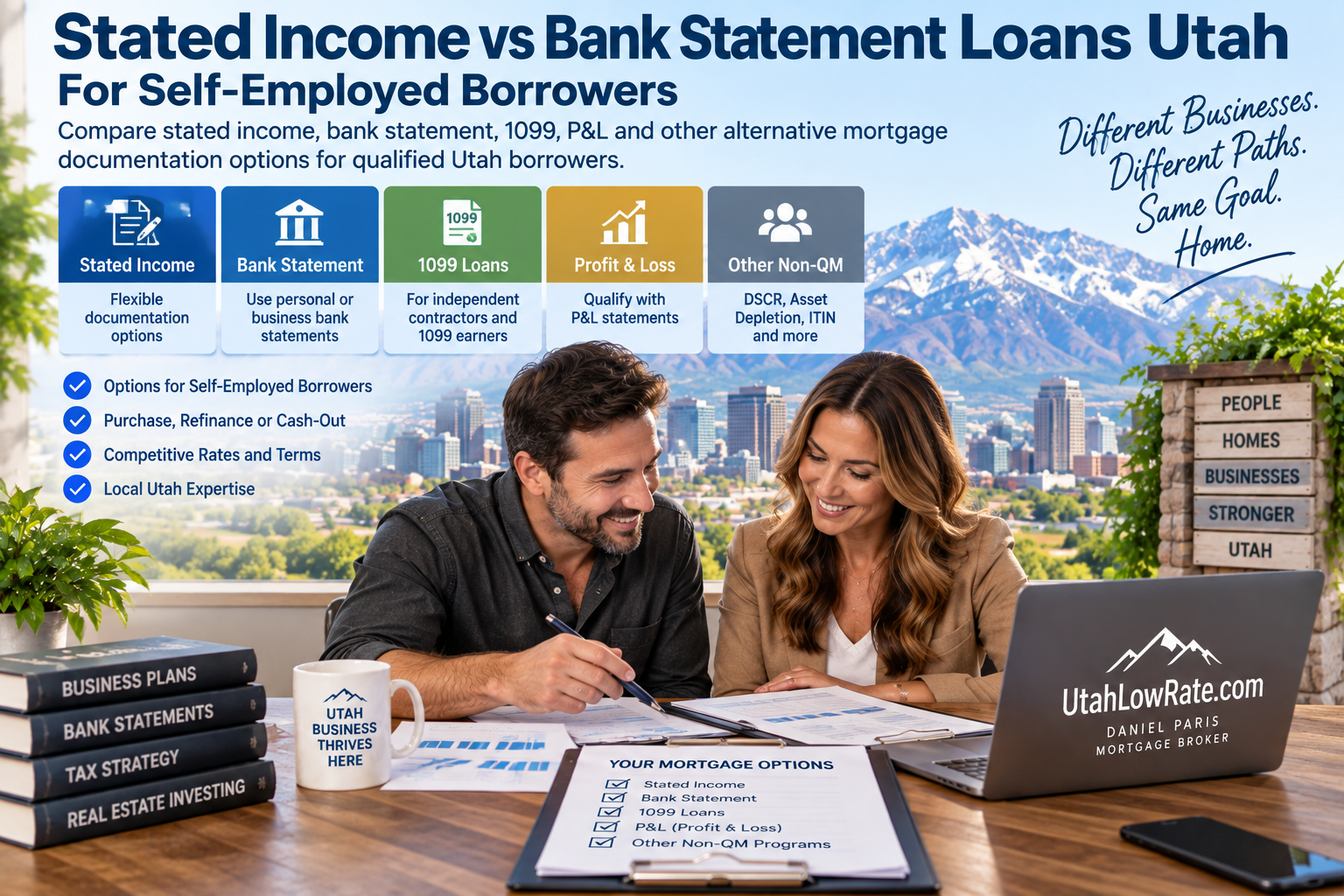
Stated Income vs. Bank Statement Loans in Utah
A stated income mortgage and a bank statement mortgage should not automatically be treated as the same loan.
Bank statement loans generally calculate qualifying income using eligible deposits appearing on personal or business bank statements over a specified period.
A stated income or other alternative-documentation mortgage may use a different qualification method depending on the lender and program.
For established self-employed borrowers with consistent business deposits, a Bank Statement Mortgage Loan in Utah may be worth comparing with a stated income program.
The better structure depends on the borrower's actual financial profile.
Stated Income vs. Profit and Loss Mortgage Loans
A Profit and Loss Mortgage Loan in Utah may provide another alternative for qualified self-employed borrowers.
Depending on program guidelines, a P&L program may use an eligible profit-and-loss statement and supporting documentation to help establish qualifying income.
This can be useful when a business owner's financial records provide a clearer picture of income than traditional personal tax-return calculations.
Compare both approaches before deciding which documentation method fits your situation.
Stated Income vs. 1099 Mortgage Loans
Independent contractors and other professionals who receive 1099 compensation may have another alternative.
A 1099 Mortgage Loan in Utah may use eligible 1099 income under program-specific guidelines rather than requiring the same documentation structure as a traditional self-employed mortgage.
Potential borrowers may include:
- Consultants
- Sales professionals
- Real estate professionals
- Contractors
- Technology professionals
- Medical professionals
- Freelancers
- Independent service providers
Borrowers should compare 1099, bank statement, stated income, and other Non-QM programs rather than assuming one alternative-documentation loan is automatically the best fit.
Stated Income vs. Asset-Based Mortgage Loans
Borrowers with substantial liquid assets may have additional options.
An asset depletion or asset utilization program may use eligible assets as part of the mortgage qualification calculation.
This can potentially help qualified:
- Retirees
- Entrepreneurs
- Investors
- Business owners
- High-net-worth borrowers
- Borrowers with significant investment portfolios
Asset-based mortgage calculations vary substantially among lenders.
Stated Income Mortgage vs. DSCR Loan
These programs serve different purposes.
A stated income or alternative-documentation mortgage may be available for certain owner-occupied transactions.
A DSCR Mortgage Loan in Utah is generally designed for investment properties. Qualification commonly focuses on the property's qualifying rental cash flow rather than the borrower's traditional personal income.
Utah real estate investors should therefore compare DSCR and other investment-property programs instead of assuming an owner-occupied stated income program can be used for a rental property.
Stated Income vs. Conventional Mortgage
A conventional mortgage may be the appropriate first option when a borrower can document enough qualifying income under agency guidelines.
Conventional financing can offer advantages for eligible borrowers, including competitive pricing and standardized underwriting.
Stated income and other Non-QM programs become particularly relevant when a borrower's financial profile does not fit those conventional documentation rules.
The goal should not be to use alternative documentation when it is unnecessary.
The goal is to find a mortgage structure that fits the borrower's actual financial circumstances.

Stated Income Jumbo Mortgage Loans in Utah
Higher-priced Utah properties can create an additional challenge.
A borrower may need both:
- A larger mortgage amount; and
- An alternative method of evaluating income or financial strength.
This is particularly relevant for entrepreneurs, business owners, executives, investors, and high-net-worth borrowers purchasing higher-value homes.
Depending on the borrower and property, it may be useful to compare:
- Stated income jumbo programs
- Jumbo bank statement loans
- Asset-based jumbo mortgages
- Traditional jumbo loans
- Super jumbo financing
- Other Non-QM jumbo programs
Large loan amounts require careful review because lender guidelines can differ substantially.
Stated Income Mortgage Loans in Salt Lake City
Borrowers in Salt Lake City and throughout the Salt Lake Valley may have access to alternative-documentation mortgage programs.
For more local information, visit Stated Income Mortgage Loans Salt Lake City, Utah.
Areas served include:
- Salt Lake City
- Holladay
- Millcreek
- Murray
- Cottonwood Heights
- Sandy
- Draper
- South Jordan
- West Jordan
- Riverton
- Herriman
- Bluffdale
- Midvale
- Taylorsville
Salt Lake County includes a wide range of borrowers, from traditional employees to entrepreneurs and business owners with complex financial structures.
Stated Income Loans in Park City, Deer Valley and Summit County
Park City borrowers can have particularly complex financial profiles.
Luxury-home purchasers may own businesses, investment portfolios, multiple properties, or several sources of income.
Visit Stated Income Loans Park City Utah for information focused on Park City, Deer Valley, and surrounding Summit County communities.
Potential service areas include:
- Park City
- Deer Valley
- Empire Pass
- Old Town
- Canyons Village
- Jeremy Ranch
- Pinebrook
- Promontory
- Summit Park
- Hideout
- Kamas
Higher property values can also make it useful to compare stated income programs with jumbo, super jumbo, bank statement, and asset-based financing.
Stated Income Mortgage Loans in Utah County
Utah County has a large population of entrepreneurs, technology professionals, contractors, business owners, consultants, and other self-employed borrowers.
Alternative-documentation mortgage options may be available for qualified borrowers in:
- Lehi
- Alpine
- Highland
- American Fork
- Pleasant Grove
- Saratoga Springs
- Eagle Mountain
- Orem
- Provo
- Springville
- Spanish Fork
Borrowers should compare available documentation methods before shopping for a home so they understand their potential financing range.
Stated Income Mortgage Loans in Heber City and Wasatch County
Heber City, Midway, and the surrounding Wasatch Back attract business owners, executives, investors, remote professionals, and borrowers relocating from other states.
A borrower purchasing a higher-value property may need to compare several programs, including stated income, bank statement, jumbo, asset-based, and traditional mortgage financing.
Property price alone does not determine the right program.
The borrower's entire financial profile matters.
Stated Income Mortgage Loans in St. George and Southern Utah
St. George and Southern Utah continue to attract business owners, retirees, investors, entrepreneurs, and people relocating from other states.
Alternative mortgage programs may be available to qualified borrowers in:
- St. George
- Washington
- Ivins
- Santa Clara
- Hurricane
- Cedar City
- Surrounding Southern Utah communities
A relocation combined with a change in employment or business ownership can make early mortgage planning especially important.
Utah Non-QM Mortgage Loans and Alternative Documentation
Stated income financing is only one part of the alternative mortgage market.
Borrowers who do not fit conventional underwriting should also review Utah Non-QM Mortgage Loans.
Depending on the borrower's situation, alternatives may include:
- Stated income mortgages
- Bank statement loans
- 1099 mortgage loans
- Profit and loss mortgages
- Asset depletion programs
- DSCR investment-property loans
- Non-QM jumbo loans
- Other alternative-documentation programs
Comparing several programs can help identify the documentation structure that best matches the borrower's financial profile.
How to Prepare for a Utah Stated Income Mortgage Review
Even when traditional tax-return income is not the primary qualification method, preparing your financial information can make the initial review much more efficient.
Be prepared to discuss:
- Purchase price or estimated property value
- Desired loan amount
- Down payment or current equity
- Current mortgage balance if refinancing
- Estimated credit profile
- Liquid assets
- Available reserves
- Property type
- Proposed occupancy
- Employment situation
- Business ownership
- Length of time in your industry or business
- Source of funds
- Other properties owned
- Whether the transaction is a purchase, refinance, or cash-out refinance
The objective is to match the borrower to the correct underwriting structure before unnecessary documentation is collected.
Frequently Asked Questions About Stated Income Mortgage Loans Utah
Are stated income loans still available in Utah?
Alternative-documentation mortgage programs are available for certain qualified borrowers. Today's programs involve underwriting and should not be confused with the loosely documented stated-income mortgages associated with the pre-2008 market.
Are stated income loans the same as no-doc loans?
No. Modern alternative-documentation mortgages still require borrower information, underwriting, credit review, assets, property evaluation, and other documentation according to the specific program.
Do Utah stated income loans require tax returns?
Not every alternative mortgage program uses traditional tax returns to calculate qualifying income. Requirements depend on the lender and program.
Can self-employed borrowers qualify?
Potentially. Self-employed borrowers and business owners are among the borrowers who may consider alternative-documentation mortgage programs.
Can I qualify if I recently started a business?
Possibly. Some alternative programs may evaluate a recently self-employed borrower differently from conventional financing. Industry experience, assets, reserves, credit, business history, property, and other factors may be considered.
Can I get a mortgage if I am between jobs?
Potentially. Certain alternative programs may be available to qualified borrowers with strong assets, reserves, credit, or other financial strengths who do not currently satisfy traditional employment-documentation requirements.
Can I use a stated income loan to purchase a home?
Certain programs allow purchase transactions for qualified borrowers, subject to lender and investor requirements.
Can I refinance with a stated income mortgage?
Some programs permit rate-and-term and cash-out refinancing. Requirements vary by program.
Can I get cash out?
Potentially. Cash-out eligibility depends on credit, property value, LTV, loan amount, occupancy, reserves, and lender guidelines.
Can stated income financing be used for a jumbo loan?
Certain alternative-documentation programs support larger loan amounts. Jumbo stated income guidelines vary considerably between lenders.
Are investment properties eligible?
The answer depends on the program. Investors should also evaluate DSCR and other investment-property mortgage programs because those programs are specifically designed around investment-property qualification.
Are stated income mortgage rates higher?
Alternative-documentation mortgages may be priced differently from conventional financing. Rates depend on market conditions, credit, LTV, loan amount, occupancy, property, documentation type, and other factors.
How much down payment is required?
Down-payment requirements depend on the program, credit profile, loan amount, occupancy, and property. Alternative-documentation loans may require more equity than certain conventional programs.
Are reserves required?
Many programs require reserves. The amount and eligible assets depend on lender guidelines.
Is a stated income loan better than a bank statement loan?
Neither program is automatically better. A borrower with consistent business deposits may fit a bank statement program, while another borrower may be better suited to a stated income, asset-based, 1099, P&L, or other alternative mortgage program.
Are stated income mortgage loans guaranteed?
No. All mortgage programs are subject to underwriting and applicable lender and investor requirements.
Stated Income Mortgage Loans Throughout Utah
UtahLowRate.com works with borrowers throughout Utah, including Salt Lake City, Park City, Deer Valley, Draper, Holladay, Sandy, Cottonwood Heights, Millcreek, Murray, South Jordan, West Jordan, Riverton, Herriman, Bluffdale, Bountiful, Farmington, Layton, Ogden, Logan, Lehi, Alpine, Highland, American Fork, Pleasant Grove, Saratoga Springs, Eagle Mountain, Orem, Provo, Heber City, Midway, Kamas, Cedar City, St. George, Washington, Ivins, Santa Clara, Hurricane, and surrounding Utah communities.
Location is only one part of mortgage qualification.
The correct mortgage strategy depends on the borrower, property, loan amount, transaction, occupancy, credit, assets, reserves, and applicable lender guidelines.
Why Work With a Utah Mortgage Broker for Alternative Financing?
Alternative mortgage lending can be more complicated than a standard conventional loan because lender guidelines can vary significantly.
One lender may evaluate a borrower differently from another based on:
- Credit
- LTV
- Assets
- Reserves
- Employment
- Business ownership
- Documentation
- Property
- Occupancy
- Loan amount
- Cash-out
- Self-employment history
A mortgage broker can compare programs from different lending sources rather than trying to force every borrower into the same underwriting model.
Daniel Paris — Utah Mortgage Broker
Daniel Paris works with Utah borrowers seeking traditional and alternative mortgage financing.
This includes business owners, entrepreneurs, self-employed borrowers, investors, high-net-worth borrowers, and other borrowers whose income or financial circumstances may require an alternative to standard mortgage documentation.
Available mortgage categories may include conventional, FHA, VA, jumbo, super jumbo, bank statement, stated income, 1099, P&L, DSCR, asset-based, and other Non-QM mortgage programs.
Daniel Paris
Utah Mortgage Broker
NMLS #243976
UtahLowRate.com
801-604-4949
Check Your Stated Income Mortgage Options in Utah

If conventional mortgage underwriting does not fit your income, employment, business, or asset situation, compare the alternative mortgage programs available for your actual financial profile.
You may have more than one option.
A stated income mortgage, bank statement loan, 1099 program, P&L mortgage, asset-based loan, jumbo alternative-documentation mortgage, or another Non-QM program may provide a potential solution.
See If I Qualify
Compare Stated Income Programs
Ask a Mortgage Question
Daniel Paris
Utah Mortgage Broker
NMLS #243976
801-604-4949
UtahLowRate.com
This information is provided for educational purposes and does not constitute a commitment to lend, mortgage approval, or a guarantee of any rate, loan amount, LTV, savings, or loan terms. Mortgage programs, credit requirements, documentation requirements, pricing, reserves, loan limits, and availability are subject to change. All loans are subject to applicable lender/investor underwriting and eligibility requirements.

