
Content updated: October 12, 2026
Rental Property Financing for Utah Real Estate Investors
DSCR mortgage loans in Utah provide real estate investors with an alternative way to finance rental properties. Instead of relying primarily on W-2 wages, personal tax returns, or traditional debt-to-income calculations, a DSCR loan generally evaluates whether the rental income generated by the investment property can support its housing-related debt obligations.
For Utah investors purchasing, refinancing, or accessing equity from rental properties, DSCR financing can be especially useful when personal income documentation does not accurately reflect the strength of an investment.
Daniel Paris with UtahLowRate.com helps Utah real estate investors evaluate DSCR mortgage programs for qualifying rental properties throughout the state.
Call Daniel Paris: 801-604-4949
Programs, rates, loan-to-value limits, credit requirements, DSCR calculations, property eligibility, prepayment provisions and underwriting requirements vary by lender and are subject to change.

What Is a DSCR Mortgage Loan?
A Debt Service Coverage Ratio (DSCR) mortgage is an investment-property loan that evaluates the property's rental income relative to its qualifying monthly debt obligations.
Instead of asking only:
“How much personal income does the borrower earn?”
DSCR underwriting focuses heavily on:
“Does this rental property generate enough qualifying rent to support its mortgage-related expenses?”
This distinction can make DSCR financing useful for:
- Real estate investors
- Rental property owners
- Self-employed investors
- Business owners
- Investors with multiple properties
- Investors using LLCs or other eligible entities
- Buyers expanding rental portfolios
- Investors whose tax returns show substantial deductions
- Long-term rental investors
- Qualified short-term rental investors
DSCR loans are generally designed for business-purpose investment properties rather than owner-occupied primary residences.
Utah DSCR Loans: Quick Answer
A Utah DSCR loan allows a real estate investor to potentially qualify for an investment-property mortgage based primarily on the property's qualifying rental income rather than traditional personal-income documentation. The lender compares qualifying rent with the property's required debt obligations to calculate its Debt Service Coverage Ratio.
This structure may allow qualified investors to purchase or refinance Utah rental properties without using the same income-verification process required for many conventional mortgages.
Utah DSCR Loan Quick Facts
| Feature | Typical DSCR Structure |
|---|---|
| Primary purpose | Investment-property financing |
| Qualification | Primarily property rental cash flow |
| Personal tax returns | Often not required for income qualification |
| W-2 income | Often not used for income qualification |
| Traditional personal DTI | Generally not the primary qualification method |
| Purchase | Available through qualifying programs |
| Rate-and-term refinance | Available through qualifying programs |
| Cash-out refinance | May be available |
| LLC/entity ownership | May be permitted |
| Property types | Program dependent |
| Credit requirements | Vary by lender/program |
| DSCR requirement | Varies by lender/program |
| Reserves | May be required |
| Prepayment penalty | May apply where permitted |
| Occupancy | Investment properties |
Exact requirements depend on the lender, transaction, property, credit profile and current underwriting guidelines.
How Is DSCR Calculated?

The basic concept is straightforward:
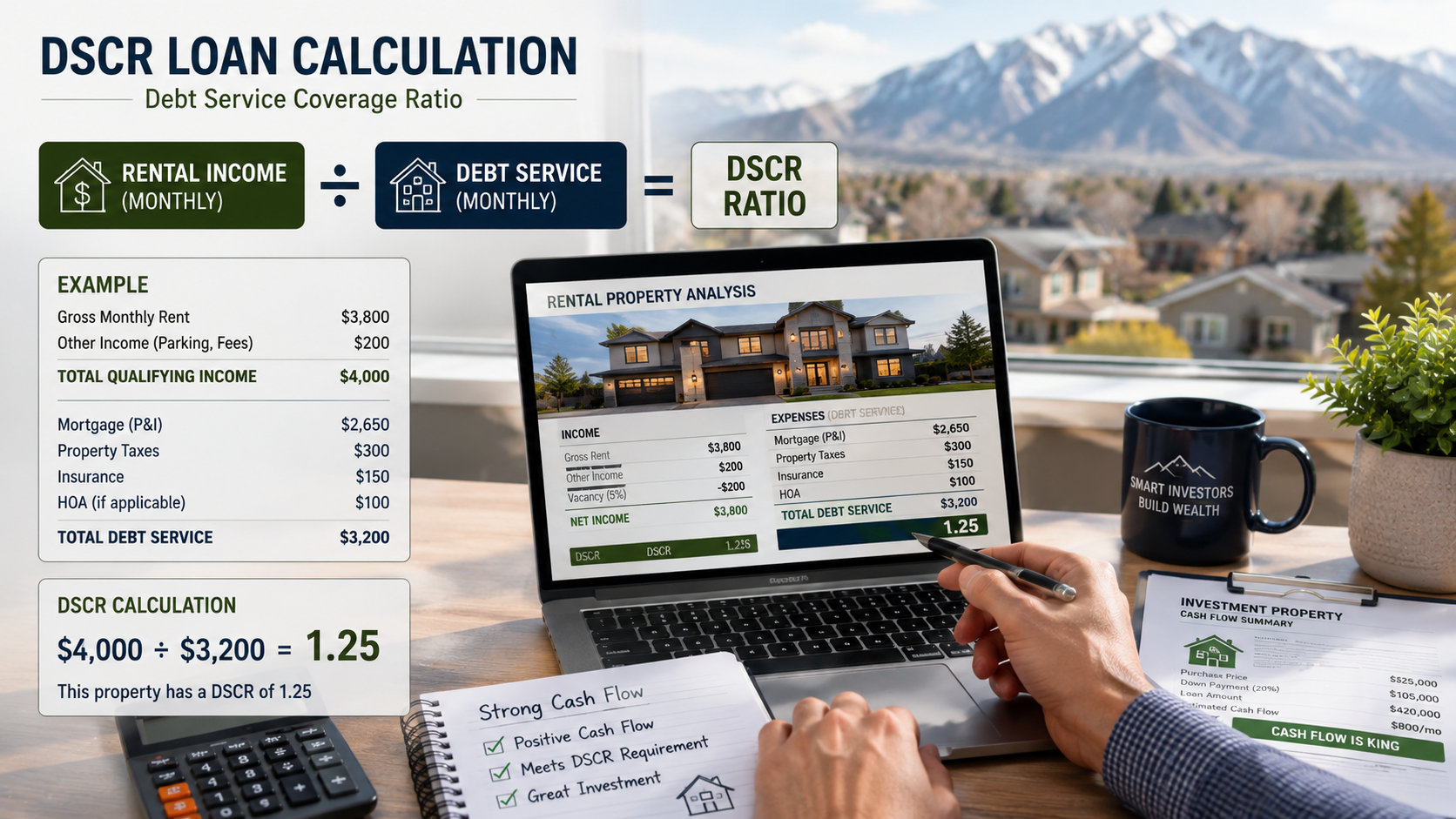
DSCR = Qualifying Monthly Rental Income ÷ Qualifying Monthly Property Debt Obligation
The exact income and expense components used by a lender can vary.
Simple DSCR Example
Suppose a Utah rental property generates:
Qualifying monthly rent: $4,000
And its qualifying monthly housing obligation is:
$3,200
The calculation would be:
$4,000 ÷ $3,200 = 1.25 DSCR
In this simplified example, the property generates approximately 1.25 times its qualifying monthly debt obligation.
What Does a 1.00 DSCR Mean?
A 1.00 DSCR generally means qualifying rental income equals the qualifying debt obligation used in the lender's calculation.
What Does a DSCR Above 1.00 Mean?
A DSCR above 1.00 indicates that qualifying rent exceeds the debt obligation used in the calculation.
For example:
1.25 DSCR means the qualifying rental income is approximately 125% of the qualifying debt obligation.
Can You Get a DSCR Loan Below 1.00?
Potentially.
Some DSCR programs may consider properties with ratios below 1.00, while other lenders require a higher minimum ratio.
Lower-DSCR transactions may require different pricing, additional equity, stronger credit, reserves, or other compensating factors.
This is why Utah investors should compare actual DSCR programs instead of assuming every lender uses the same minimum.
How Do DSCR Loans Work in Utah?
The process typically begins with the investment property, rather than with traditional employment-income documentation.
A lender may evaluate factors such as:
- Property value
- Expected or documented rental income
- DSCR
- Loan amount
- Loan-to-value ratio
- Borrower credit
- Property type
- Available reserves
- Investor experience when applicable
- Transaction type
- Entity structure
- Property location
- Lease or market-rent documentation
- Applicable prepayment provisions
This creates a fundamentally different underwriting approach from a traditional owner-occupied mortgage.
Do Utah DSCR Loans Require Tax Returns?
Personal tax returns are often not required to establish qualifying income for a DSCR loan because qualification is primarily based on the investment property's rental income and other program requirements.
That can be especially useful for self-employed Utah real estate investors.
A business owner might have substantial cash flow but show lower taxable income because of legitimate business deductions and depreciation.
Traditional mortgage underwriting may not always reflect the investor's full financial position.
A DSCR program approaches the transaction differently by focusing on the rental property's ability to support the proposed financing.
However, lenders can still require financial, entity, asset, property and other documentation needed to underwrite the transaction.
DSCR Loans for Self-Employed Utah Real Estate Investors
DSCR financing can be particularly attractive to self-employed real estate investors in Utah.
Self-employed borrowers frequently have complicated tax returns involving:
- Business deductions
- Depreciation
- Multiple entities
- Schedule E income
- K-1 income
- Rental properties
- Partnerships
- S corporations
- LLCs
- Multiple income sources
Instead of reconstructing all of those income streams for a conventional mortgage, a qualifying DSCR program may primarily evaluate the investment property's rental cash flow.
Investors who need financing for an owner-occupied home should explore other programs, including bank statement mortgages, 1099 mortgage loans, Profit & Loss loans, asset-depletion programs, conventional mortgages or other Non-QM financing, depending on their circumstances.
What Credit Score Is Needed for a Utah DSCR Loan?
There is no single universal credit-score requirement for every DSCR mortgage program.
Minimum credit scores and pricing tiers vary among lenders.
Generally, stronger credit may provide access to:
- Better interest-rate pricing
- Higher allowable loan-to-value ratios
- Larger loan amounts
- More favorable program options
- Potentially better reserve requirements
- Greater flexibility
Rather than asking only, “What is the minimum credit score for a DSCR loan?”, investors should ask:
“Which DSCR program provides the best combination of rate, LTV, reserves and cash-flow requirements for my credit profile and property?”
That is a much more useful comparison.
How Much Down Payment Is Required for a DSCR Loan in Utah?
Many DSCR programs require more equity than traditional owner-occupied financing.
The required down payment can depend on:
- Credit score
- DSCR
- Property type
- Loan amount
- Investor experience
- Purchase versus refinance
- Short-term versus long-term rental
- Rural or unique property characteristics
- Interest-only versus amortizing structure
- Current lender guidelines
Down-payment and maximum LTV requirements depend on the selected lender, credit, DSCR, loan amount, property and transaction. Request a current review before relying on an equity percentage.
Investors should therefore obtain a property-specific DSCR quote rather than assuming a universal down-payment requirement.
Utah DSCR Purchase Loans
Investors can use DSCR financing to purchase qualifying rental properties throughout Utah.
Potential uses include:
- Single-family rental acquisitions
- Rental condos
- Townhomes
- Duplexes
- Triplexes
- Fourplexes
- Portfolio expansion
- Long-term rentals
- Eligible short-term rentals
- Certain vacation-rental investments
Property eligibility varies by program.
The primary question remains whether the transaction, borrower and property satisfy the lender's DSCR and underwriting guidelines.
DSCR Refinance Loans in Utah
A Utah investor who already owns a rental property may also use DSCR financing for a rate-and-term refinance.
Reasons an investor might refinance include:
- Replacing existing financing
- Changing loan terms
- Moving from short-term financing to longer-term financing
- Restructuring investment debt
- Changing an adjustable-rate structure
- Consolidating the property's financing strategy
The benefit of a DSCR refinance is that qualification may continue to focus primarily on the rental property's cash-flow characteristics rather than traditional employment income.
DSCR Cash-Out Refinance in Utah
A DSCR cash-out refinance may allow a qualified Utah real estate investor to access equity from an existing rental property.
Investors may use available proceeds for legitimate business or investment purposes, subject to program requirements.
Potential uses can include:
- Acquiring another investment property
- Renovating rental properties
- Building investment reserves
- Paying off investment-related debt
- Repositioning a real estate portfolio
- Funding another qualifying business purpose
Maximum cash-out and LTV limits depend on the lender, property, credit profile, DSCR and transaction.
Can I Buy a Utah Rental Property Through an LLC With a DSCR Loan?
Many DSCR programs allow eligible investment properties to be financed in an LLC or other approved borrowing entity.
This can make DSCR loans useful for professional real estate investors who structure their rental holdings through business entities.
Requirements vary.
A lender may review:
- LLC organizational documents
- Operating agreement
- Ownership structure
- EIN
- Good-standing documentation
- Personal guarantors
- Borrower credit
- Authorized signers
Investors should also discuss ownership structure, liability protection and tax treatment with qualified legal and tax professionals.
What Utah Properties Can Be Financed With DSCR?
Depending on the lender, DSCR financing may be available for qualifying:
Single-Family Rental Homes
Detached rental properties are among the most common uses for DSCR financing.
Condominiums
Eligible investment condominiums may qualify, subject to project and lender requirements.
Townhomes
Rental townhouses may also be eligible.
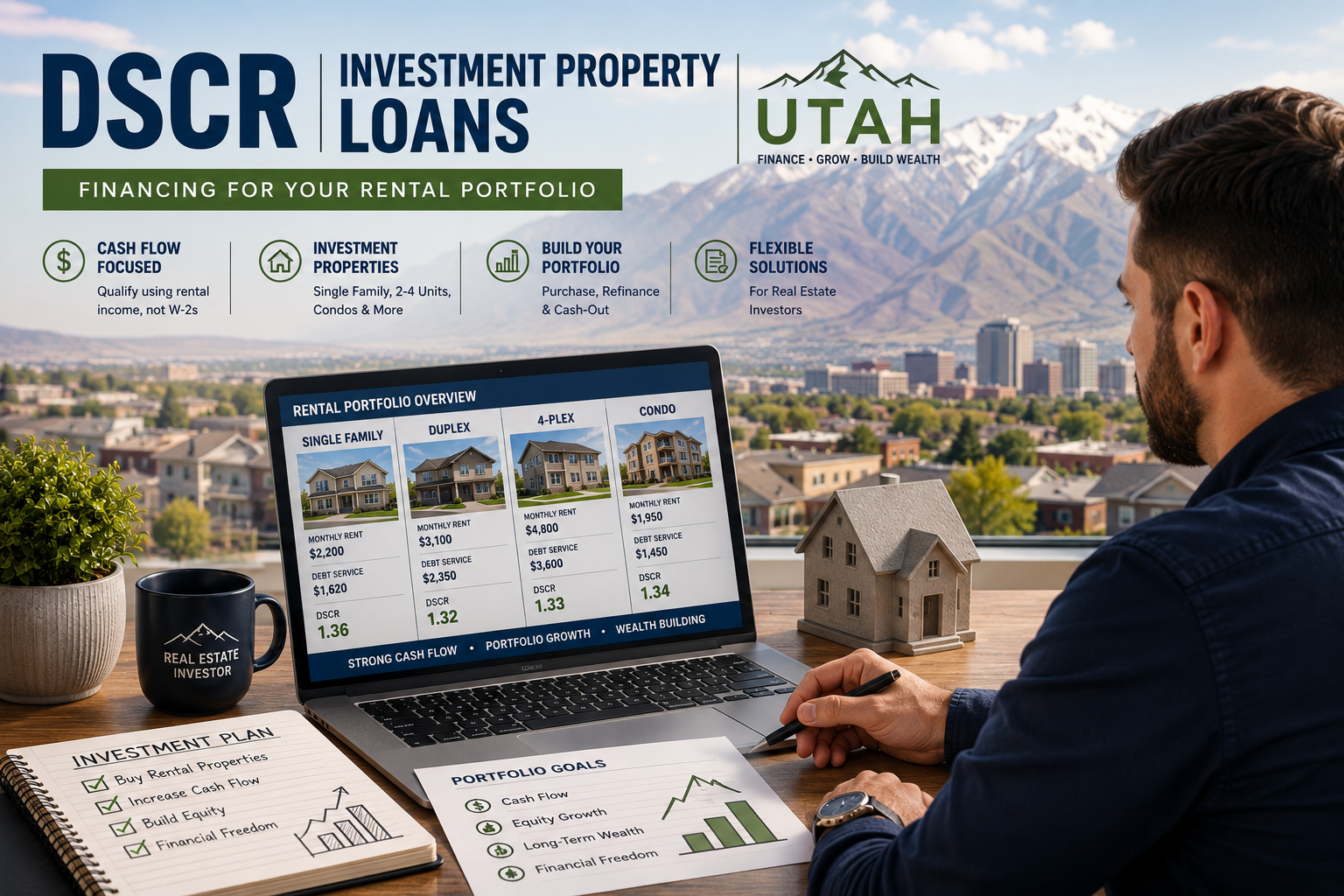
2–4 Unit Investment Properties
Duplexes, triplexes and fourplexes can be attractive to investors seeking multiple rental-income streams from one property.
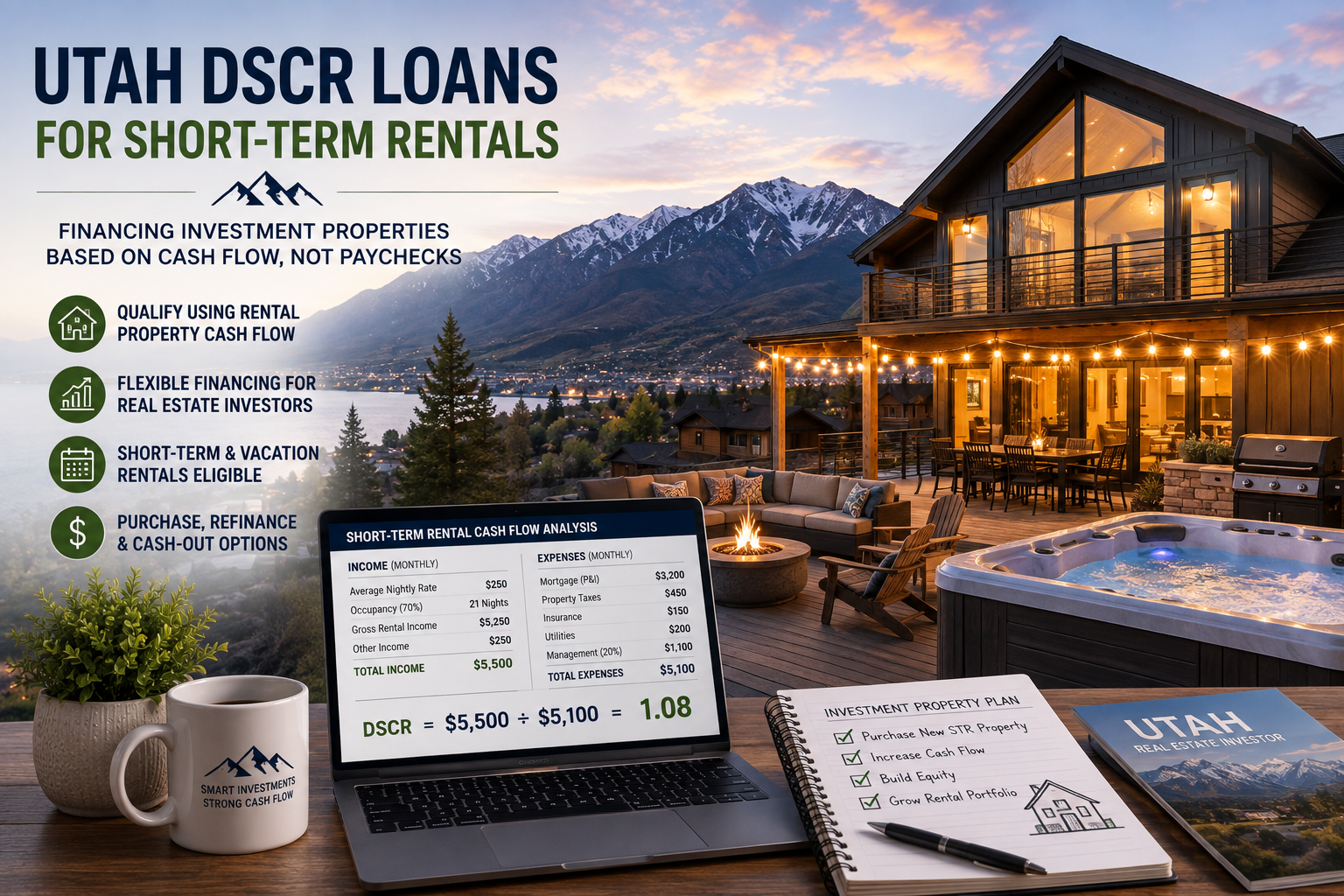
Short-Term Rentals
Certain lenders offer DSCR financing for qualifying short-term or vacation rentals.
Short-term rental underwriting can differ significantly between lenders, particularly regarding how rental income is established.
DSCR Loans for Short-Term Rentals in Utah
Utah's recreation and tourism markets create demand for short-term rental investment properties in certain locations.
Depending on the lender and property, DSCR programs may consider qualifying short-term rentals.
However, financing approval does not mean a property is legally permitted to operate as a short-term rental.
Investors should independently verify:
- City regulations
- County regulations
- Zoning
- HOA restrictions
- Licensing
- Rental restrictions
- Property-specific requirements
before purchasing a property based on expected short-term rental income.
DSCR Loans in Salt Lake City and Salt Lake County
Salt Lake County contains a diverse range of potential rental-property markets, from urban Salt Lake City properties to suburban rental homes throughout the Wasatch Front.
Daniel Paris can help qualified investors evaluate DSCR financing for eligible properties in areas including:
Salt Lake City, Murray, Holladay, Millcreek, Cottonwood Heights, Sandy, Draper, South Jordan, West Jordan, Riverton, Herriman, Bluffdale, Midvale and surrounding communities.
The property's rent, price, taxes, insurance, HOA expenses and proposed financing can all influence its DSCR.
DSCR Loans in Utah County
Utah County continues to attract rental-property investors seeking opportunities along the Wasatch Front.
DSCR financing may be available for eligible investment properties in:
Provo, Orem, Lehi, American Fork, Alpine, Highland, Pleasant Grove, Saratoga Springs, Eagle Mountain, Spanish Fork and surrounding Utah County communities.
Rather than relying solely on appreciation projections, investors should evaluate the property's actual potential cash flow and total financing costs.
DSCR Loans in Park City and the Wasatch Back
Park City and the Wasatch Back present a different investment profile than many traditional Wasatch Front rental markets.
Higher property values, second-home demand, tourism and short-term rental activity can create specialized financing situations.
Eligible investment properties may include properties around:
Park City, Deer Valley, Old Town, Canyons Village, Kimball Junction, Promontory, Heber City, Midway, Jordanelle, Kamas and Hideout.
For higher-value properties, Daniel Paris can also evaluate jumbo and specialized investment-property financing when standard DSCR options are not the best fit.
DSCR Loans in St. George and Southern Utah
Southern Utah attracts investors interested in long-term rentals, second-home markets and qualifying vacation-rental properties.
Potential markets include:
St. George, Washington, Ivins, Santa Clara, Hurricane and surrounding Washington County communities.
Short-term rental rules can vary significantly by municipality, subdivision and HOA, so investors should verify the legal rental status of a property independently from mortgage qualification.
DSCR Loans vs. Conventional Investment Property Loans
| Feature | DSCR Loan | Conventional Investment Loan |
|---|---|---|
| Main income qualification | Property rental income | Borrower's qualifying income |
| Personal DTI | Generally not primary qualification method | Usually required |
| Tax returns for qualifying income | Often not required | May be required |
| W-2/paystubs | Generally not used for DSCR income qualification | Commonly required |
| Investment property | Yes | Yes |
| Primary residence | No | Yes, under separate conventional programs |
| LLC ownership | Often available | More restrictive |
| Multiple financed properties | Potentially flexible | Agency rules may apply |
| Rates | Risk-based non-QM pricing | Conventional market pricing |
| Prepayment penalty | May apply | Generally different rules |
Neither program is automatically better.
The appropriate financing depends on the investor, property, income documentation, portfolio and investment strategy.
DSCR Loan vs. Bank Statement Loan
These two programs solve different problems.
A DSCR loan generally qualifies an investment property based primarily on rental-property cash flow.
A bank statement mortgage uses eligible personal or business bank deposits to establish qualifying borrower income.
A real estate investor purchasing a rental property may prefer DSCR financing.
A self-employed borrower purchasing a primary residence may instead need a bank statement mortgage or another alternative-income program.
What Determines Utah DSCR Mortgage Rates?
DSCR mortgage rates are not based on one factor.
Pricing can be influenced by:
- Credit score
- DSCR
- Loan-to-value ratio
- Loan amount
- Property type
- Transaction type
- Purchase versus refinance
- Cash-out amount
- Investor experience
- Prepayment structure
- Fixed versus adjustable rate
- Interest-only features
- Short-term rental characteristics
- Current capital-market conditions
Because DSCR pricing changes with the market and lender appetite, investors should obtain a current quote for the specific property.
Call Daniel Paris at 801-604-4949 for a current Utah DSCR loan scenario.
Why Work with a Mortgage Broker for a Utah DSCR Loan?
DSCR lending is a specialized segment of the mortgage market.
Individual lenders can have substantially different guidelines regarding:
- Minimum DSCR
- Credit scores
- LTV
- Loan amounts
- Short-term rentals
- Condominiums
- Rural properties
- LLCs
- First-time investors
- Cash-out refinances
- Reserves
- Prepayment penalties
- Interest-only options
A mortgage broker can evaluate multiple available lending programs instead of forcing every investment property into one lender's underwriting box.
Daniel Paris has more than 27 years of mortgage lending experience and works with Utah borrowers through UtahLowRate.com.
The goal is to identify a financing structure appropriate for the property, borrower and investment strategy, subject to lender approval.
How to Apply for a DSCR Mortgage Loan in Utah
Step 1: Identify the Investment Property
Provide the property address, estimated purchase price or value, and expected rental income.
Step 2: Review the Rental Income
Determine how the lender may establish qualifying rent.
Depending on the transaction, documentation can include an existing lease, appraisal rent schedule or other acceptable market-rent documentation.
Step 3: Calculate the Estimated DSCR
Compare qualifying rental income with the applicable property debt obligation.
Step 4: Review Credit and Equity
Your credit profile and LTV can materially affect both eligibility and pricing.
Step 5: Compare DSCR Programs
Compare rate, points, lender fees, DSCR requirements, reserves, prepayment terms and other material loan conditions—not simply the advertised interest rate.
Step 6: Complete Underwriting
The lender evaluates the borrower, property, appraisal, title, assets, entity documentation and all applicable program requirements.
Step 7: Close the Investment Property Loan
After final approval and satisfaction of closing conditions, the transaction can proceed to closing.
Frequently Asked Questions About DSCR Mortgage Loans in Utah
What does DSCR stand for?
DSCR stands for Debt Service Coverage Ratio. It measures qualifying property income relative to the debt obligation used by the lender.
Can I get a DSCR loan in Utah without tax returns?
Many DSCR programs do not require personal tax returns to calculate qualifying income because qualification is primarily based on the rental property's cash flow. Other documentation is still required.
Are DSCR loans only for investment properties?
Generally, yes. DSCR loans are primarily designed as business-purpose financing for non-owner-occupied investment properties.
Can I use a DSCR loan for my primary residence?
Generally, no. Borrowers seeking alternative-income financing for a primary residence should consider programs such as bank statement, 1099, Profit & Loss, asset-depletion or other qualifying mortgage programs.
Can an LLC obtain a Utah DSCR loan?
Many DSCR programs allow eligible LLC or entity vesting, subject to lender requirements and personal-guaranty provisions.
What is considered a good DSCR?
A higher DSCR generally indicates stronger property cash flow relative to debt obligations. A ratio of 1.25 means qualifying rental income is approximately 125% of the debt obligation used in the calculation. Minimum requirements vary by lender.
Can I qualify if my DSCR is below 1.00?
Some programs may consider lower DSCR ratios, subject to additional restrictions, pricing or equity requirements. Availability varies considerably.
Can I cash out a Utah rental property with a DSCR loan?
Potentially. DSCR cash-out refinancing is available through certain programs, subject to property, equity, credit, seasoning and underwriting requirements.
Can first-time real estate investors get DSCR loans?
Some lenders accept first-time investors while others impose additional restrictions or pricing adjustments. The specific program must be reviewed.
Are DSCR loans available for Airbnb or vacation rentals in Utah?
Some programs finance eligible short-term rental properties. Local zoning, HOA rules, rental legality and the lender's method of calculating short-term rental income must also be considered.
How much do I need to put down on a DSCR property?
Down-payment and maximum LTV requirements depend on the selected lender, credit, DSCR, loan amount, property and transaction. Request a current review before relying on an equity percentage.
Do DSCR loans have prepayment penalties?
Some business-purpose DSCR mortgages include prepayment provisions where legally permitted. Investors should review the specific prepayment structure before closing.
Can I own multiple properties with DSCR financing?
Potentially. DSCR financing can be useful for investors building rental portfolios because qualification focuses heavily on individual property cash flow rather than relying solely on traditional personal DTI calculations.
Utah DSCR Mortgage Loans with Daniel Paris
Real estate investors often need financing that evaluates an investment as an investment.
DSCR mortgage loans in Utah can provide qualified investors with a way to purchase, refinance or access equity from rental properties using the property's qualifying rental income as a central component of underwriting.
Daniel Paris with UtahLowRate.com helps Utah investors evaluate available DSCR and investment-property mortgage programs for properties throughout:
Salt Lake County • Utah County • Davis County • Weber County • Summit County • Wasatch County • Washington County and communities throughout Utah.
Whether you are purchasing your first rental property, adding another property to an existing portfolio, refinancing an investment property or evaluating cash-out financing, the first step is determining how the property performs under current DSCR guidelines.
Get a Utah DSCR Loan Quote
Daniel Paris
Utah Mortgage Broker | UtahLowRate.com
Call: 801-604-4949
Ask about:
DSCR Mortgage Loans Utah • Investment Property Loans • Rental Property Financing • DSCR Cash-Out Refinancing • Bank Statement Loans • 1099 Loans • Non-QM Loans • Jumbo Investment Property Financing
Loan programs, rates, terms, DSCR calculations, LTV limits, credit requirements and property eligibility are subject to change and lender underwriting. This information is educational and is not a commitment to lend. Equal Housing Opportunity.

