

Stated income mortgage loans in Salt Lake City, Utah may provide an alternative home-financing option for qualified borrowers who do not fit traditional income-documentation rules. These programs may help certain business owners, entrepreneurs, self-employed borrowers, professionals, and borrowers with substantial assets or other complex financial profiles.
Instead of assuming that tax returns or W-2 income tell the entire financial story, some alternative mortgage programs evaluate a broader set of qualifying factors.
These may include credit, assets, reserves, down payment, property value, occupancy, loan amount, and loan-to-value ratio.
Check My Stated Income Loan Options
Daniel Paris
Utah Mortgage Broker
NMLS #243976
801-604-4949
UtahLowRate.com
All programs are subject to lender and investor guidelines, underwriting, credit approval, property eligibility, pricing, and current availability.
Quick Answer: How Do Stated Income Mortgage Loans Work in Salt Lake City?
A stated income mortgage loan in Salt Lake City is an alternative mortgage program for qualified borrowers who may not fit standard income-documentation guidelines. Depending on the program, qualification may place greater emphasis on credit, assets, reserves, down payment, property value, occupancy, and the overall borrower profile.
Modern stated income and alternative-documentation mortgages still require underwriting. They are not automatic-approval or no-qualification loans.
Stated Income Mortgage Loans Salt Lake City Utah: Key Facts
| Program Feature | General Guidelines Described Here |
|---|---|
| Location | Salt Lake City and eligible Utah communities |
| Loan Purpose | Purchase, rate-and-term refinance and cash-out refinance |
| Primary Residence | Eligible |
| Loan Amount | $100,000–$2.5 million |
| Purchase/R&T LTV | Up to 80% |
| Cash-Out LTV | Up to 75% |
| Credit Tiers | 640, 660, 680 and 720+ |
| Reserves | Generally 6–9 months, depending on tier |
| Traditional W-2 Income | May not be the primary qualifying factor |
| Second Home | Not eligible under the specific program described |
| Investment Property | Not eligible under the specific program described |
| Underwriting | Required |
These figures describe general parameters for a specific program and are not guaranteed loan terms. Guidelines and program availability can change.
Who May Consider a Stated Income Mortgage in Salt Lake City?
Stated income mortgage loans in Salt Lake City, Utah may be worth exploring when a qualified borrower has a strong overall financial profile but does not fit conventional income-documentation requirements.
Potential borrowers may include:
- Business owners
- Entrepreneurs
- Self-employed professionals
- Independent contractors
- Consultants
- Real estate professionals
- Construction company owners
- Home builders
- Commission-based professionals
- Freelancers
- 1099 workers
- Borrowers with multiple income sources
- Borrowers with substantial liquid assets
- Qualified borrowers starting a new business
- Borrowers changing careers
- Qualified borrowers relocating to Utah
Eligibility is based on the complete borrower, property, and transaction profile.
Why Can Self-Employed Borrowers Have Trouble with Conventional Mortgage Qualification?

A successful business does not always produce taxable income that fits traditional mortgage calculations.
Business owners may use legitimate deductions and business expenses that reduce taxable income. Traditional mortgage underwriting may rely heavily on tax returns and standardized calculations.
That can create a gap between a borrower's overall financial position and the income available for conventional mortgage qualification.
Alternative mortgage programs may evaluate the situation differently.
Depending on the program, underwriting may consider:
- Credit history
- Liquid assets
- Down payment
- Reserves
- Property value
- Occupancy
- Loan amount
- LTV and CLTV
- Existing housing obligations
- Overall borrower profile
The goal is not to eliminate underwriting. It is to determine whether another documentation method fits the borrower's circumstances.
Stated Income Loans for Salt Lake City Business Owners
Salt Lake City has a diverse community of business owners, entrepreneurs, independent professionals, and self-employed borrowers.
A business owner may generate strong cash flow while reporting taxable income that does not support the desired conventional mortgage amount.
When that happens, it can be useful to compare several mortgage strategies rather than assuming conventional financing is the only choice.
Depending on the borrower, possible alternatives may include:
- Stated income or alternative-documentation loans
- Bank statement mortgages
- Profit-and-loss loans
- 1099 mortgage programs
- Asset-based or asset-depletion programs
- Jumbo non-QM financing
- Other non-QM mortgage programs
The appropriate option depends on the actual financial profile.
Starting a New Business in Salt Lake City?
A recent move into business ownership can make mortgage qualification more difficult.
Traditional programs may require an established history before self-employment income can be used for qualification.
This can affect someone who recently:
- Started a consulting company
- Opened a professional practice
- Created a construction business
- Formed a real estate company
- Started a technology business
- Left W-2 employment for self-employment
- Relocated an existing business to Utah
Certain alternative mortgage programs may provide another path for qualified borrowers.
Credit, assets, reserves, down payment, property, loan amount, and other underwriting factors may become especially important.
Relocating to Salt Lake City Without Established Utah Income
Relocating can create a unique mortgage challenge.
A borrower may have excellent credit, substantial savings, investments, and enough money for a significant down payment but still have difficulty documenting a conventional employment history after moving to Utah.
This can happen when someone relocates while:
- Changing employers
- Opening a business
- Becoming self-employed
- Restructuring a company
- Moving an existing company
- Transitioning between careers
For qualified borrowers, an alternative mortgage program may be worth comparing with conventional financing.
Stated Income vs. Bank Statement Loans in Salt Lake City
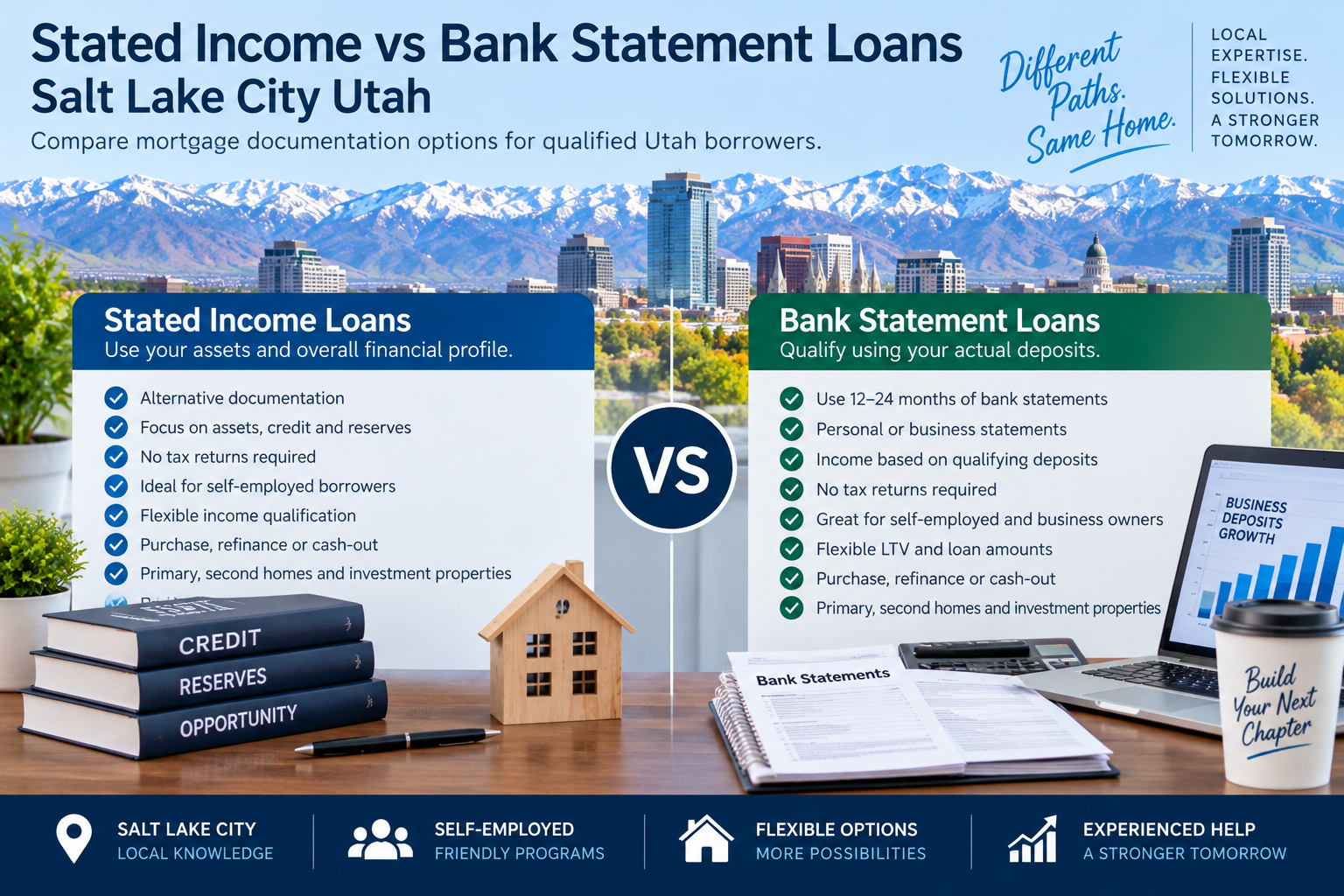
Stated income and bank statement mortgages should not automatically be treated as the same program.
A bank statement mortgage generally uses eligible deposits from personal or business bank statements to calculate qualifying income.
An alternative stated income program may use a different qualification method and place greater weight on other parts of the borrower's financial profile.
For a well-established Salt Lake City business owner with consistent deposits, a bank statement mortgage may be worth comparing.
For another borrower with substantial assets but an unusual income structure, a different alternative-documentation program may make more sense.
Compare the programs based on your actual finances rather than choosing a loan because of its name.
Stated Income vs. Conventional Mortgages
| Feature | Conventional Mortgage | Alternative/Stated Income Program |
|---|---|---|
| Traditional income documentation | Usually required | Requirements may differ |
| Pay stubs/W-2s | Common | May not be primary method |
| Tax-return analysis | May be required | May not be primary method |
| Credit review | Required | Required |
| Asset verification | Required as applicable | Often important |
| Reserves | Program dependent | May be significant |
| Appraisal | Generally required | Generally required |
| LTV limits | Apply | Apply |
| Underwriting | Required | Required |
| Guaranteed approval | No | No |
Alternative documentation does not mean the lender ignores the borrower's ability to qualify.
Purchase and Rate-and-Term Refinance Guidelines
The specific program described on this page includes the following general purchase and rate-and-term refinance tiers:
| Maximum LTV / CLTV | Credit Score | Reserves |
|---|---|---|
| 80% / 80% | 720+ | 9 months |
| 75% / 75% | 680+ | 6 months |
| 70% / 70% | 660+ | 6 months |
| 65% / 65% | 640+ | 6 months |
These are maximum program parameters, not guaranteed terms.
Other credit, property, asset, occupancy, loan amount, and underwriting requirements apply.
Cash-Out Refinance Guidelines
Qualified Salt Lake City homeowners may also have cash-out refinance options.
| Maximum LTV / CLTV | Credit Score | Reserves |
|---|---|---|
| 75% / 75% | 720+ | 9 months |
| 70% / 70% | 680+ | 6 months |
| 65% / 65% | 660+ | 6 months |
Cash-out requirements can include additional restrictions involving property ownership, seasoning, property value, reserves, loan size, and the amount of cash received.
What Does LTV Mean?
Loan-to-value, or LTV, compares the first mortgage balance with the property's applicable value or purchase price.
For example, an 80% LTV generally means the first mortgage represents 80% of the applicable property value used for underwriting.
CLTV means combined loan-to-value. It can include the first mortgage plus applicable subordinate financing.
LTV can affect your:
- Required down payment
- Available mortgage programs
- Credit requirements
- Reserve requirements
- Pricing
- Refinance options
- Cash-out eligibility
A program offering a maximum 80% LTV does not mean every borrower qualifies for 80% financing.
How Much Money Must Be Kept in Reserves?
Reserves are eligible funds remaining after the mortgage transaction closes.
The program described here generally requires six or nine months of reserves, depending on the qualifying tier.
Acceptable reserve assets depend on lender requirements and may include eligible funds held in:
- Checking accounts
- Savings accounts
- Investment accounts
- Retirement accounts
- Other qualifying asset accounts
Having enough reserves does not by itself guarantee approval.
Can Gift Funds Be Used?
Certain programs may permit eligible gift funds, subject to lender guidelines.
Rules may address:
- Eligible donors
- Documentation
- Transfer of funds
- Borrower contribution
- Down payment
- Closing costs
- Reserve requirements
Discuss gift funds before money is transferred. That allows the specific lender requirements to be reviewed first.
Stated Income Mortgage Loans Throughout Salt Lake County
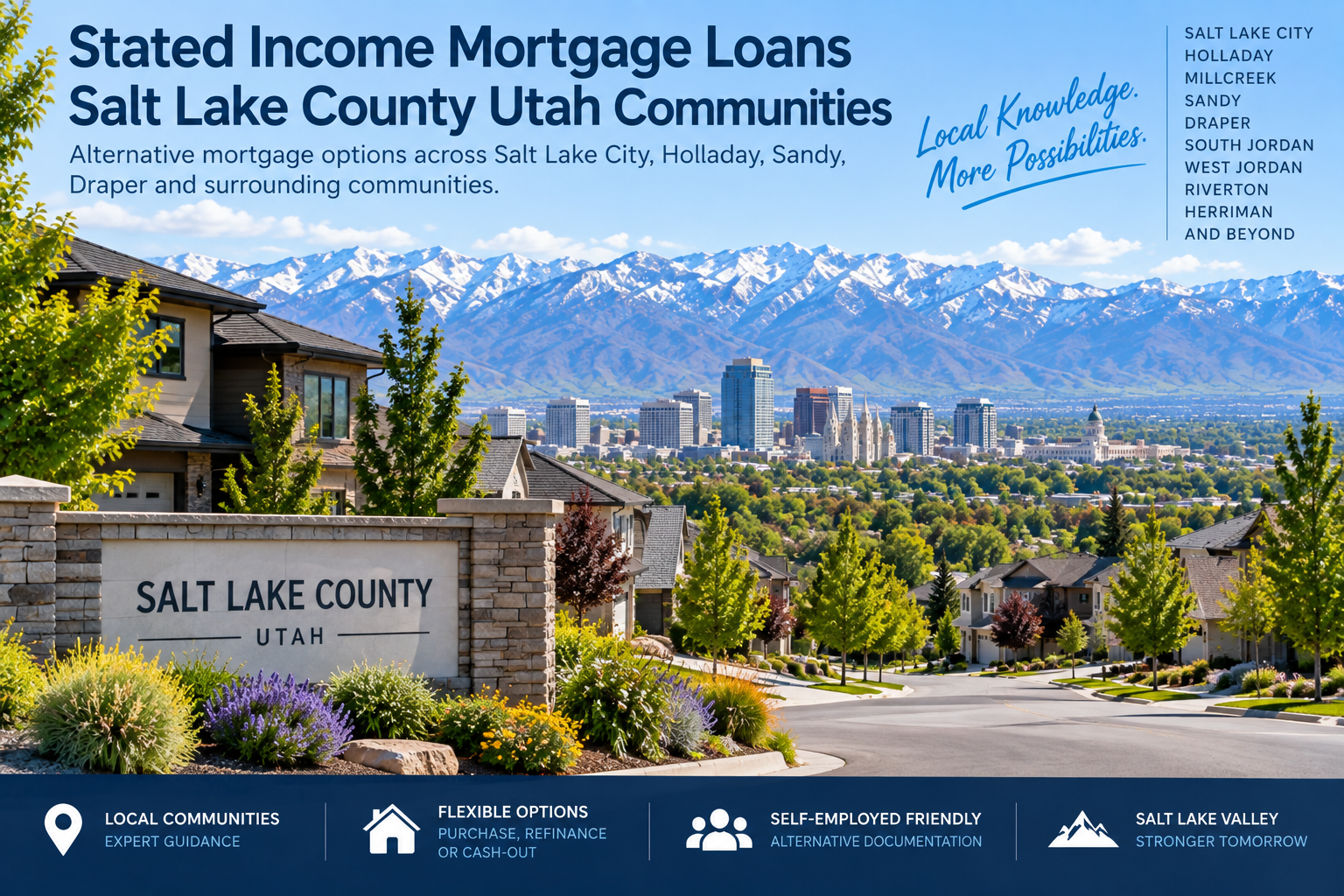
Stated income mortgage loans in Salt Lake City, Utah are not limited to properties in downtown Salt Lake City.
Qualified borrowers may have alternative mortgage options throughout Salt Lake County and the Salt Lake Valley, including:
- Salt Lake City
- Holladay
- Millcreek
- Cottonwood Heights
- Murray
- Sandy
- Draper
- South Jordan
- West Jordan
- Riverton
- Herriman
- Bluffdale
- Midvale
- Taylorsville
- South Salt Lake
These communities include everything from established neighborhoods and condominiums to new construction and higher-priced homes.
Location is only one part of mortgage qualification. The borrower, property, loan purpose, occupancy, credit, assets, reserves, and applicable underwriting guidelines matter as well.

Other Alternative Mortgage Options for Salt Lake City Borrowers
A stated income loan should not automatically be the first or only alternative considered.
Bank Statement Loans
Bank statement loans may help qualified self-employed borrowers use eligible personal or business deposits to document income.
1099 Mortgage Loans
Certain programs may allow qualified 1099 borrowers to use alternative calculations instead of traditional tax-return underwriting.
Profit and Loss Mortgage Loans
A P&L mortgage program may provide another documentation strategy for eligible self-employed borrowers.
Asset-Based Mortgage Programs
Borrowers with substantial liquid or investment assets may be able to explore asset-utilization or asset-depletion programs.
DSCR Loans
Real estate investors purchasing or refinancing rental properties may want to investigate DSCR financing rather than the owner-occupied stated income program described on this page.
Utah Non-QM Loans
Non-QM financing includes several alternative underwriting strategies. The appropriate program depends on the borrower's financial profile and the proposed property.
How to Compare Salt Lake City Stated Income Mortgage Options
Start with your actual financial situation rather than a particular loan name.
1. Review Your Credit
Credit can affect maximum LTV, pricing, reserves, and program eligibility.
2. Determine Available Assets
Identify funds available for the down payment, closing costs, and reserves.
3. Identify the Property and Occupancy
Primary residence, second home, and investment property programs can have very different requirements.
4. Compare Documentation Methods
Determine whether bank statements, 1099 income, P&L documentation, assets, or another qualifying method produces a stronger mortgage option.
5. Compare Loan Structure and Cost
Review rate, payment, down payment, reserves, loan amount, closing costs, and other relevant terms.
6. Complete Underwriting
Final approval depends on the complete borrower and property file and the applicable lender or investor requirements.
Frequently Asked Questions
What is a stated income mortgage loan in Salt Lake City?
It is an alternative mortgage program that may allow qualified borrowers to use a different documentation structure than a traditional mortgage. Credit, assets, reserves, property, occupancy, down payment, and other underwriting factors can be important.
Can self-employed borrowers get stated income mortgage loans in Salt Lake City?
Potentially. Business owners and self-employed borrowers are among the people who may explore alternative-documentation mortgages. Eligibility depends on the complete borrower and property profile.
What credit score is required?
The specific program described on this page includes tiers beginning at 640. Higher credit tiers may provide access to higher maximum LTV levels. Credit score alone does not determine eligibility.
How much can I borrow?
The specific program described here provides loan amounts from $100,000 to $2.5 million, subject to underwriting and current program requirements.
What is the maximum LTV?
For the program described here, qualified borrowers may have purchase or rate-and-term refinance options up to 80% LTV. Maximum cash-out LTV may be up to 75%, depending on the qualifying tier.
How many months of reserves are required?
The tiers described here generally require six or nine months of reserves. The required amount depends on the program and qualifying tier.
Can I buy an investment property with this program?
The specific program described on this page is designed for eligible primary residences. Investors should compare DSCR and other investment-property mortgage options.
Are second homes eligible?
Not under the specific program described here. Other programs may be available for qualified second-home borrowers.
Can I use a stated income loan to refinance?
Potentially. The program described here includes both rate-and-term and cash-out refinance options for qualified borrowers.
Is a stated income mortgage the same as a bank statement mortgage?
No. A bank statement loan generally analyzes eligible deposits to determine qualifying income. Other alternative-documentation programs may use different qualification methods.
Are stated income loans guaranteed?
No. All mortgage programs require applicable underwriting and eligibility review. Approval is never guaranteed.
Are stated income mortgage rates higher than conventional rates?
Pricing depends on the specific program, credit, LTV, property, loan amount, market conditions, and other factors. Alternative-documentation financing may be priced differently from conventional financing.
What is the best mortgage option for a self-employed Salt Lake City borrower?
It depends on the borrower's circumstances. Stated income, bank statement, 1099, P&L, asset-based, conventional, jumbo, and other programs may all be worth comparing before selecting a financing structure.
Talk With Daniel Paris About Stated Income Mortgage Loans in Salt Lake City
If conventional income documentation does not accurately represent your financial situation, compare the mortgage programs available for your actual profile.
Daniel Paris can help qualified Salt Lake City borrowers compare stated income and other alternative mortgage options based on credit, assets, reserves, down payment, property, occupancy, and loan amount.
See If I Qualify
Compare Stated Income Programs
Ask a Mortgage Question
Daniel Paris
Utah Mortgage Broker
NMLS #243976
801-604-4949
UtahLowRate.com
Serving Salt Lake City, Holladay, Millcreek, Cottonwood Heights, Murray, Sandy, Draper, South Jordan, West Jordan, Riverton, Herriman, Bluffdale, Midvale, Taylorsville, South Salt Lake, and qualified borrowers throughout Utah.
Information is provided for educational purposes only and does not constitute a commitment to lend, approval, rate lock, or guarantee of mortgage terms. Programs, pricing, credit requirements, LTV limits, documentation, reserves, and availability may change. All loans are subject to applicable lender and investor underwriting and eligibility requirements.

