
Utah Home Sales & Mortgage Rates in 2026: What Buyers and Sellers Need to Know
Updated August 2026 | By Daniel Paris, Mortgage Broker at Utah Low Rate (NMLS #243976-3138)
Utah’s housing market in 2026 is shifting toward balance after years of a tight seller’s market — and mortgage rates, while still elevated, are showing early signs of stabilizing. Whether you’re buying your first home in Salt Lake City, selling in Utah County, or refinancing in the Wasatch Front, here’s a clear, up-to-date breakdown of where Utah home sales stand and where mortgage rates are headed for the rest of the year.
Utah Home Sales & Listings: Where Things Stand Right Now
Utah’s housing inventory has grown steadily in 2026, giving buyers more breathing room than they’ve had in years:
- Statewide inventory: Utah had roughly 19,300 homes for sale as of June 2026, up nearly 5% year-over-year, with new listings also rising compared to last year.
- Statewide median home price: Utah’s median sale price is sitting in the upper-$500,000s to roughly $585,000 depending on the data source, with average home values around $535,000 (up about 1.4% year-over-year).
- Days on market: Homes are taking longer to sell than during the frenzied years of 2021–2022 — averaging in the 50s to low 60s statewide, giving buyers more time and negotiating leverage.
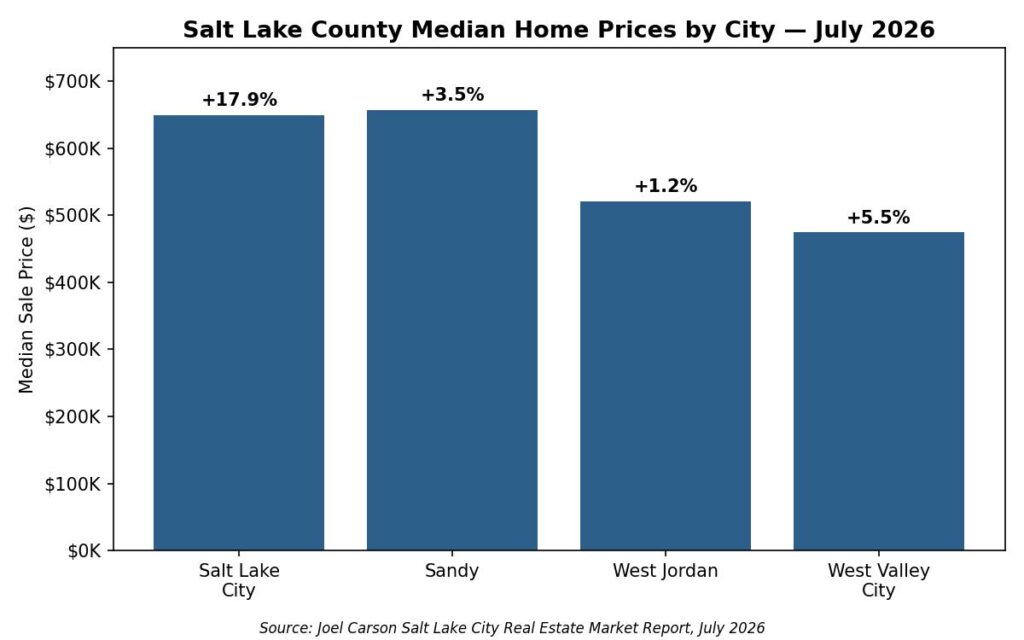
- Salt Lake County snapshot (July 2026): Roughly 1,587 new listings hit the market with about 1,115 homes sold, leaving around 3 months of supply — technically still a seller’s market, though a much more balanced one than in recent years. Salt Lake City proper saw a notable 2026 price jump to a median around $650,000, while surrounding cities like West Valley City and West Jordan posted more modest single-digit gains.
- Market temperature: A little over one in five Utah homes are still selling above list price, but price drops and longer market times show the extreme bidding-war conditions of previous years have cooled considerably.
The bottom line for 2026: Utah is no longer a runaway seller’s market, but it’s also far from a buyer’s market. Real estate professionals widely expect modest, sustainable price growth (roughly 2–4% statewide) and a gradual increase in sales volume as inventory keeps improving.
Where Are Mortgage Rates Headed in 2026?
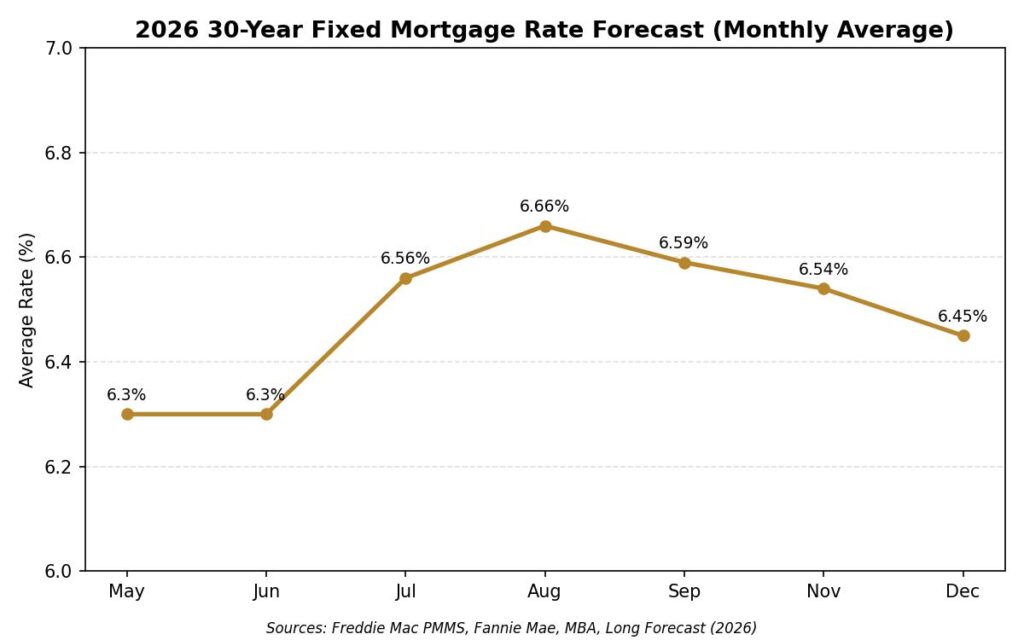
Mortgage rates have been the biggest wildcard of the year. As of early August 2026, the average 30-year fixed rate sits around 6.6–6.7%, according to Freddie Mac — higher than many buyers hoped for at the start of the year, though still below the peaks seen in late 2023.
Here’s what the major forecasters expect for the rest of 2026:
- Fannie Mae: Projects the 30-year fixed rate will average around 6.4% through the remainder of 2026.
- Mortgage Bankers Association (MBA): Forecasts rates near 6.5% in Q3 and Q4 of 2026.
- Bankrate / independent analysts: See a wider possible range, with some forecasts suggesting rates could dip into the high-5% to low-6% range by year-end if inflation cools and the Fed resumes cutting rates — though a return to 3–4% rates is considered very unlikely for the foreseeable future.
In short: most experts agree rates will hover in the low-to-mid 6% range for the rest of 2026, with only modest room for improvement absent a significant economic shift. That makes working with an experienced, responsive local mortgage broker more important than ever — someone who can structure your loan to make the most of today’s rate environment rather than waiting on a rate drop that may not fully materialize.
What This Means for Utah Buyers and Sellers
If you’re buying: More inventory and longer days on market mean more room to negotiate on price, closing costs, and repairs. Getting a strong mortgage pre-approval — and understanding exactly how today’s rates affect your monthly payment using our mortgage calculator — is essential before you start touring homes.
If you’re selling: Overpricing no longer works the way it did a few years ago. Strategic, realistic pricing from day one attracts serious buyers and avoids the stigma of a price cut later.
If you’re refinancing: With rates expected to stay in the low-to-mid 6% range through 2026, it’s worth having a broker run the numbers with our refinance advisor tool to see whether refinancing makes sense for your specific loan and timeline.
Frequently Asked Questions
Are Utah home prices going up or down in 2026? Utah home prices are still rising, but at a much slower, more sustainable pace than in recent years — roughly 2–4% statewide, according to industry forecasts.
Will mortgage rates drop in 2026? Most experts expect 30-year fixed mortgage rates to stay in the 6.0–6.5% range for the rest of 2026, with only a modest chance of dipping into the high-5% range by year-end.
Is it a buyer’s market or seller’s market in Utah right now? Utah is in a transitional, more balanced market. Most counties, including Salt Lake County, still technically favor sellers, but with far less competition and more negotiating room than in previous years.
Who can I contact about mortgage rates in Utah?
Daniel Paris is a Utah Mortgage Broker with Utah Low Rate (UtahLowRate.com), NMLS #243976-3138. Utah borrowers can contact Daniel at 801-604-4949 to discuss purchase mortgages, refinancing, conventional, FHA, VA, jumbo and alternative mortgage programs.
Work With Local Utah Real Estate & Mortgage Experts

Navigating Utah’s 2026 housing market is easiest with the right team in your corner. For mortgage pre-approval, rate shopping, and creative loan structuring, contact Daniel Paris at Utah Low Rate — 801-604-4949 — UtahLowRate.com.
Buying or selling in the Salt Lake City area? Connect with Ashley Paris of UtahHomeLady.com — 801-759-0911 for expert local guidance on Salt Lake City area listings and sales.
Looking to buy or sell in the St. George, Utah area? Connect with Nick Rastopchin, a St. George Realtor with 15+ years of local market experience, at Houses in St. George.
Data sources: Redfin, Zillow, Freddie Mac Primary Mortgage Market Survey, Fannie Mae Economic and Strategic Research Group, Mortgage Bankers Association, and Salt Lake County MLS data (2026).

