
30-Year Mortgage Rates Utah Hit 6.71% — What Utah Homebuyers Should Know
Published: September 4, 2026 | Last Updated: September 4, 2026
By Daniel Paris | Utah Mortgage Broker | UtahLowRate.com | 801-604-4949 | 27+ Years of Mortgage Lending Experience
Mortgage rates moved higher again this week, with the average 30-year fixed-rate mortgage reaching 6.71% as of September 3, 2026, according to Freddie Mac’s Primary Mortgage Market Survey.
That is up from 6.66% one week earlier and 6.50% one year ago. The average 15-year fixed mortgage also increased to 6.04%, compared with 5.98% the previous week.
The 6.71% national average represents the highest level for the 30-year fixed mortgage since July 2025.
For Utah homebuyers in Salt Lake City, Draper, Sandy, Lehi, Provo, Park City, Heber City, St. George and communities throughout the state, higher rates can affect purchasing power and monthly payments—but they do not necessarily mean buying a home should be put on hold.
The more useful question is: What mortgage rate and loan structure can you qualify for based on your specific financial situation?
National averages are benchmarks. Your actual Utah mortgage rate may be higher or lower depending on your credit, down payment, loan program, property, occupancy, loan amount, points and other factors.
Mortgage Rates at a Glance — September 2026
According to Freddie Mac’s September 3, 2026 Primary Mortgage Market Survey:
| Mortgage | Current Average | Previous Week | One Year Ago |
|---|---|---|---|
| 30-Year Fixed | 6.71% | 6.66% | 6.50% |
| 15-Year Fixed | 6.04% | 5.98% | 5.60% |
Freddie Mac also reported that purchase demand has remained relatively stable, suggesting buyers are continuing to participate in the housing market despite changing borrowing costs.
Important: The Freddie Mac rate is a national survey average, not a rate quote from UtahLowRate.com. Freddie Mac’s PMMS focuses on conventional, conforming, fully amortizing purchase loans and should be used as a market benchmark rather than the rate every borrower should expect to receive.
Why Did 30-Year Mortgage Rates Rise to 6.71%?
Mortgage rates are influenced by financial markets rather than being set directly by the Federal Reserve.
One of the most important indicators to watch is the 10-year U.S. Treasury yield. Mortgage-backed securities, inflation expectations, economic growth, employment data, government borrowing and Federal Reserve policy expectations can all influence mortgage pricing.
Recent upward pressure on Treasury yields and renewed inflation concerns have contributed to higher mortgage borrowing costs.
This is why mortgage rates can move even when the Federal Reserve has not changed its benchmark interest rate.
For someone considering a home in Salt Lake County, Utah County, Summit County, Wasatch County or Washington County, waiting for a specific Federal Reserve announcement does not guarantee that mortgage rates will move in the same direction.
Mortgage markets frequently anticipate economic developments before official Federal Reserve decisions occur.
What Does a 6.71% Mortgage Rate Mean for a Utah Homebuyer?
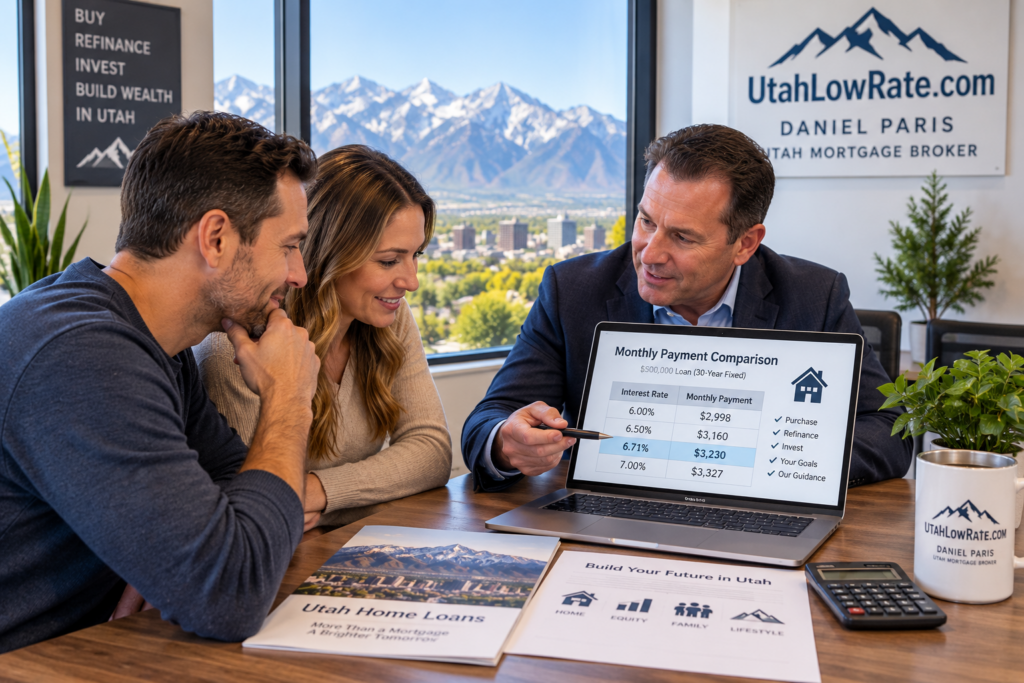
A higher mortgage rate generally means a higher monthly principal-and-interest payment for the same loan amount.
Consider a hypothetical $500,000 30-year fixed mortgage:
| Interest Rate | Approx. Monthly Principal & Interest |
|---|---|
| 6.00% | $2,998 |
| 6.50% | $3,160 |
| 6.71% | $3,230 |
| 7.00% | $3,327 |
These examples are approximate and exclude property taxes, homeowners insurance, HOA charges, mortgage insurance and other expenses.
The difference between 6.50% and 6.71% on a $500,000 loan is approximately $70 per month in principal and interest.
That matters—but interest rate should not be evaluated in isolation.
Purchase price, seller concessions, discount points, down payment, mortgage insurance, closing costs and the ability to refinance later can all affect the overall economics of buying a Utah home.
Should Utah Homebuyers Wait for Mortgage Rates to Fall?
Waiting for mortgage rates to fall is not automatically the best strategy because nobody can reliably predict short-term mortgage-rate movements.
A better approach is to determine whether the home and payment work with your finances at today’s available terms.
If rates decline later, refinancing may become an option, subject to qualification, property value, costs and market conditions. But buyers should never purchase a home based solely on the assumption that refinancing will definitely be available later.
There can also be tradeoffs to waiting.
If mortgage rates eventually decline substantially, additional buyers may return to the market. Increased demand can potentially create more competition for desirable homes.
Conversely, today’s higher-rate environment may provide certain buyers with more negotiating leverage on price, closing costs or seller concessions than they would have in a more competitive market.
The right decision depends on your finances, housing needs, time horizon and local Utah market—not simply the national mortgage-rate headline.
Your Actual Utah Mortgage Rate May Be Different From 6.71%
The Freddie Mac 6.71% figure does not mean every Utah borrower will receive a 6.71% mortgage rate.
Individual mortgage pricing can vary considerably.
Factors that may affect your rate include:
- Credit score and credit history
- Down payment and loan-to-value ratio
- Loan amount
- Property type
- Primary residence, second home or investment property
- Conventional, FHA, VA or other loan program
- Fixed-rate versus adjustable-rate financing
- Discount points
- Lock period
- Debt-to-income ratio
- Mortgage insurance
- Jumbo versus conforming financing
- Market pricing at the time the loan is locked
A borrower purchasing a home in Draper with strong credit and a substantial down payment may receive different pricing from a first-time buyer using FHA financing in Salt Lake City.
Likewise, someone purchasing a luxury residence in Park City or Deer Valley may need a jumbo mortgage with completely different pricing and underwriting requirements.
That is why comparing actual loan scenarios is more useful than relying on a national headline rate.
Ways Utah Homebuyers Can Respond to Higher Mortgage Rates
When rates rise, borrowers should focus on the parts of the mortgage transaction they can control.
1. Compare More Than the Interest Rate
Compare the interest rate, APR, lender fees, discount points, mortgage insurance, closing costs and monthly payment.
A low advertised rate can require substantial discount points. Depending on how long you expect to own the home or keep the mortgage, paying those points may or may not make financial sense.
2. Consider Seller-Paid Closing Costs
Depending on the transaction and loan guidelines, seller concessions may be used toward eligible closing costs and, in some cases, discount points.
For buyers in markets where sellers are willing to negotiate, this can potentially make financing more affordable without requiring the buyer to use as much cash.
3. Compare Mortgage Programs
Conventional financing is not the only option.
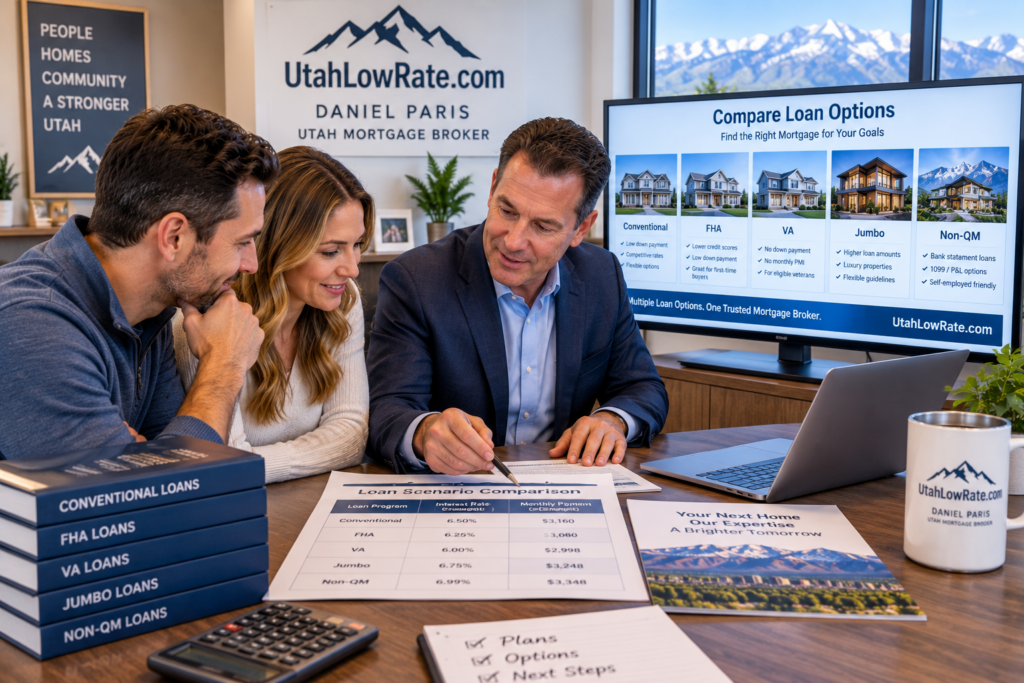
Qualified Utah borrowers may want to compare:
- Conventional mortgages
- FHA loans
- VA loans
- USDA loans
- Jumbo mortgages
- Super jumbo loans
- Bank statement mortgages
- 1099 mortgage programs
- Profit & Loss loans
- DSCR investment-property loans
- Other Non-QM programs
The lowest rate does not necessarily make a particular program the best mortgage. Qualification requirements, mortgage insurance, fees, down payment and long-term costs should also be considered.
4. Understand Mortgage Discount Points
Mortgage points allow a borrower to pay additional money at closing in exchange for a lower interest rate, subject to available lender pricing.
The key question is the break-even period.
If paying $5,000 in points reduces the mortgage payment by $100 per month, the simple break-even period would be approximately 50 months. A borrower expecting to refinance or sell before then may reach a different conclusion than someone planning to keep the mortgage for many years.
5. Work on Your Credit Before Applying
Credit can have a significant impact on conventional mortgage pricing.
Paying revolving balances down, avoiding unnecessary new debt and reviewing credit reports for errors before purchasing may help some borrowers improve their mortgage profile.
Do not make major credit changes without discussing them with your mortgage professional during an active transaction.
What Higher Rates Mean Across Utah

Mortgage-rate movements are national, but their impact can look different across Utah’s local housing markets.
In Salt Lake County, including Salt Lake City, Murray, Holladay, Sandy, Draper, South Jordan and surrounding communities, buyers should evaluate payment affordability along with purchase-price negotiations.
In Utah County, buyers in Lehi, American Fork, Alpine, Highland, Orem and Provo may find that even small changes in mortgage rates affect purchasing power when financing higher-priced homes.
In Summit County and Wasatch County, including Park City, Deer Valley, Heber City, Midway and surrounding Wasatch Back communities, jumbo financing becomes especially important because many properties require loan amounts beyond standard conforming financing.
In Washington County, including St. George, Washington, Ivins and Santa Clara, buyers should similarly compare the complete financing structure rather than focusing only on an advertised national mortgage rate.
Local property values may differ, but the principle is the same: your mortgage should be structured around your specific property, financial profile and long-term goals.
Is 6.71% a Historically High Mortgage Rate?
A 6.71% mortgage rate is high compared with the unusually low mortgage rates experienced during 2020 and 2021, but those historically low rates should not be treated as a normal benchmark for every housing cycle.
What matters to a buyer today is whether the complete housing payment fits the household budget and whether purchasing makes sense relative to the alternatives.
Trying to perfectly time mortgage rates is extremely difficult.
Instead, buyers can prepare by getting pre-approved, understanding their payment at several potential interest rates and comparing loan programs before making an offer.
Should Utah Homeowners Refinance at Today’s Rates?
Whether refinancing makes sense depends primarily on your existing mortgage and the objective of the refinance.
A homeowner who already has a very low fixed interest rate may have little reason to refinance solely to reduce the rate.
Other homeowners may consider refinancing for reasons such as restructuring debt, changing the loan term or accessing home equity through a cash-out refinance.
Before refinancing, compare:
Current loan → proposed loan → monthly savings or cash-flow change → closing costs → break-even period → long-term interest expense.
A refinance should be evaluated using the entire transaction, not merely the proposed interest rate.
Frequently Asked Questions About Utah Mortgage Rates
What is the average 30-year mortgage rate right now?
Freddie Mac reported that the average U.S. 30-year fixed-rate mortgage was 6.71% as of September 3, 2026, up from 6.66% the previous week. Your actual mortgage rate can differ based on your qualifications and loan structure.
Why did mortgage rates go up to 6.71%?
Mortgage rates have faced upward pressure from bond-market movements, Treasury yields, inflation concerns and broader economic conditions. Mortgage rates are market-driven and can change daily.
Is now a bad time to buy a house in Utah because rates are 6.71%?
Not necessarily. Whether buying makes sense depends on your income, debts, down payment, housing needs, purchase price, expected time in the property and available mortgage terms—not one national rate average.
Should I wait until mortgage rates go below 6%?
Waiting carries its own risks because future rates and home prices cannot be predicted with certainty. Consider whether the home and payment work today rather than making a purchase dependent on a future rate forecast.
Can I get a Utah mortgage rate lower than the Freddie Mac average?
Possibly. Freddie Mac publishes a national benchmark, while individual mortgage pricing depends on factors such as credit, down payment, loan type, property, occupancy, loan amount, points and current lender pricing.
How do I find my actual mortgage rate in Utah?
Request a personalized mortgage quote based on your credit profile, down payment, property, loan amount and mortgage program. Comparing actual lender pricing is more useful than relying exclusively on national averages.
Talk With Utah Mortgage Broker Daniel Paris
Mortgage headlines provide useful market context, but your personal mortgage quote is what ultimately matters when buying or refinancing a Utah property.
Daniel Paris of UtahLowRate.com has more than 27 years of mortgage lending experience helping borrowers evaluate home financing throughout Utah.
Mortgage options may include Conventional, FHA, VA, USDA, Jumbo, Super Jumbo, Bank Statement, 1099, Profit & Loss, DSCR and other Non-QM financing for qualified borrowers.
Daniel Paris
Utah Mortgage Broker
UtahLowRate.com
801-604-4949
Serving borrowers throughout Salt Lake County, Utah County, Summit County, Wasatch County, Davis County, Weber County, Washington County and communities across Utah.
For current mortgage-market information, see Freddie Mac’s Primary Mortgage Market Survey. For a personalized Utah mortgage quote, contact Daniel Paris at UtahLowRate.com.
Important Disclosure
Mortgage rates, APRs, fees, loan programs, qualification requirements and underwriting guidelines can change without notice. National mortgage-rate averages are provided for educational and market-comparison purposes and are not an offer or commitment to lend. Actual rates and terms depend on borrower qualifications, property, loan program, loan amount, loan-to-value ratio, occupancy, lock period and market conditions. All loans are subject to applicable lender and investor underwriting requirements.

