

How Do I Get a Mortgage If I’m Self-Employed in Salt Lake City?

Short answer: Self-employed mortgage Salt Lake City options come down to two main paths. The first is a full-documentation loan based on your tax returns, which Fannie Mae generally wants to cover two years. The second is a non-QM bank statement loan that uses 12 or 24 months of deposits instead. The main exception: if write-offs make your taxable income low, a conventional loan may not work, and a bank statement loan usually costs more.
Being your own boss does not stop you from buying a home. It changes how a lender proves your income. I am Daniel Paris, a mortgage broker in Salt Lake City with Utah Low Rate. This guide covers how self-employed borrowers qualify, who offers bank statement loans in Salt Lake City, and what to gather first.
Who this applies to
- Business owners with 25% or more ownership of a company
- Sole proprietors, freelancers and gig workers in Salt Lake County
- Owners whose tax returns show less income than their deposits
- Buyers and refinancers from Salt Lake City to Sandy, Draper and Holladay
Who needs another option
- W-2 employees: a standard pay-stub loan is usually simpler
- Investors buying rentals: a DSCR loan may fit better
- Borrowers who need a Utah Housing Corporation loan: those go through approved lenders, and Utah Low Rate does not offer them
- Anyone whose returns already show strong income: full-doc is often cheaper
Self-employed mortgage Salt Lake City: what determines how you qualify?
Your income documents decide which loan you can use. A lender has to verify the income it relies on. The CFPB ability-to-repay rule (12 CFR 1026.43) lists tax returns, W-2s and financial institution records as acceptable proof. That is why bank statements can be used at all.
Path 1: Full documentation with tax returns
This is the conventional route. Under the Fannie Mae Selling Guide, B3-3.2-01, anyone with a 25% or greater ownership interest in a business counts as self-employed. Fannie Mae generally requires a two-year history. One year of returns may be allowed if the business has existed for five years and you have owned 25% or more for those five years. The lender works out your income on a cash flow analysis, such as Fannie Mae Form 1084.
Path 2: Bank statement loans
A bank statement loan uses your deposits instead of your tax returns. These loans are usually non-QM. That means they fall outside the CFPB’s Qualified Mortgage standards. The lender still has to judge your ability to repay. Rates and down payments are often higher than conventional loans.
Path 3: 1099 or profit-and-loss loans
Some non-QM programs use 1099 forms or a profit-and-loss statement, often prepared or signed by a CPA or tax preparer. Rules vary by lender.
| Factor | Full-doc (tax returns) | Bank statement | 1099 or P&L |
|---|---|---|---|
| Income proof | Personal and business tax returns | 12 or 24 months of statements | 1099 forms or a P&L |
| Income used | Net income after write-offs | Eligible deposits less an expense factor | Varies by program |
| History | Generally 2 years (Fannie Mae) | Varies by lender | Varies by lender |
| Loan type | Usually QM | Usually non-QM | Usually non-QM |
| Credit, down payment, reserves | Set by agency rules | Varies by lender | Varies by lender |
| Choice | What it means |
|---|---|
| 12 months | Uses your most recent year. Can help if income is rising. |
| 24 months | Uses two years. Can help if one year was slow. |
| Personal statements | Deposits into your personal account are reviewed. Business transfers must be traced. |
| Business statements | The lender subtracts an expense factor. Our examples use 50% for illustration. Some lenders allow a CPA letter or a P&L to support a different ratio. |
Who offers bank statement loans in Salt Lake City?
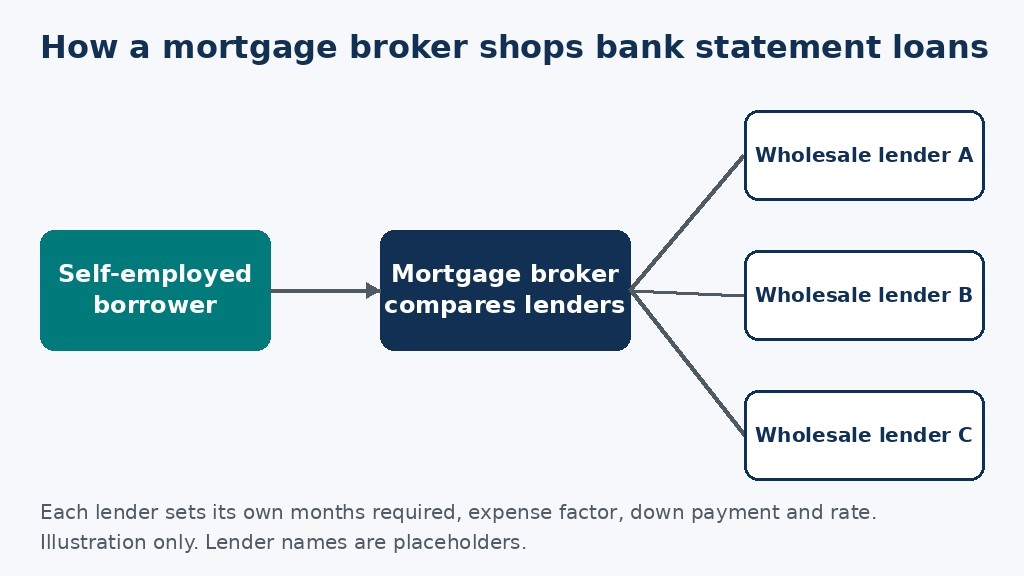
Most bank statement loans in Salt Lake City come from non-QM wholesale lenders, which work through mortgage brokers. Some portfolio lenders and credit unions also offer their own versions. Many large banks do not offer them at all.
Daniel Paris at Utah Low Rate is a mortgage broker who arranges bank statement loans through wholesale lenders. I do not lend my own money. I compare lender rules for your file, such as months required, expense factor and down payment. Read more about choosing a mortgage lender or broker in Salt Lake City. For program details, see our page on bank statement loans in Salt Lake City.
What does this look like in Salt Lake City, Utah?
Loan size matters first. The FHFA set the 2026 one-unit conforming loan limit for Salt Lake County at $832,750. A larger loan is a jumbo loan. Some wholesale lenders offer jumbo bank statement loans, with stricter rules.
Rates matter next. Freddie Mac’s Primary Mortgage Market Survey showed a 30-year fixed average of 7.28% as of November 19, 2026. That survey tracks conventional loans. Bank statement loans are priced by each lender and are often higher. As of November 21, 2026, the bank statement loan rates I see from wholesale lenders start at about 7.25% to 8.125%, depending on credit score and down payment.
These loans are used across Salt Lake County, from Salt Lake City and Holladay to Sandy, Draper, Murray, South Jordan and Herriman. The same rules apply along the Wasatch Front.
Practical example: a hypothetical bank statement loan
Hypothetical example, not a quote. Prepared November 21, 2026. Your numbers and loan terms will differ.
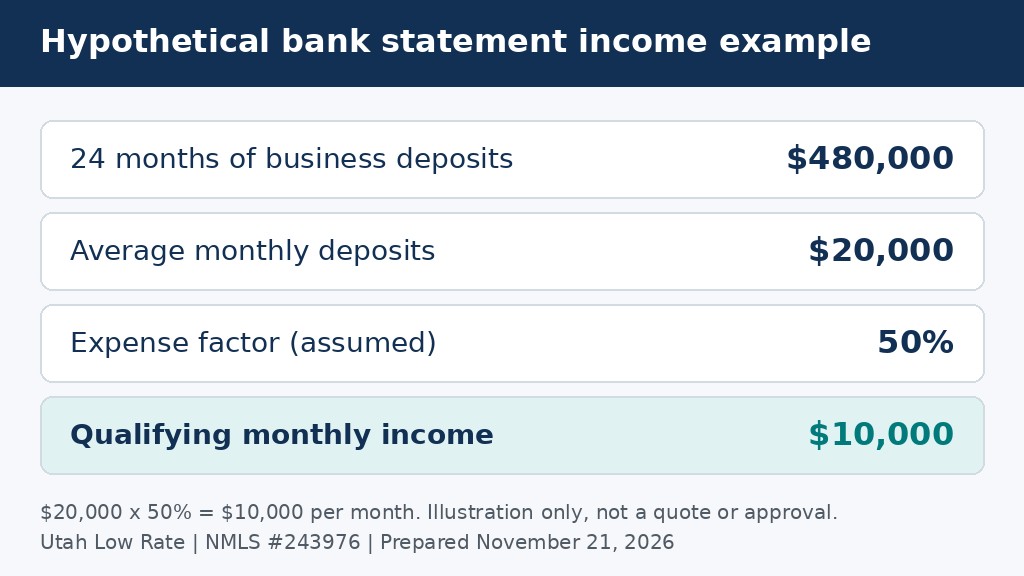
Assumptions: A Salt Lake City business owner uses 24 months of business bank statements. Eligible deposits total $480,000, or $20,000 per month. The lender uses a 50% expense factor. The home price is $650,000 with 20% down.
- Qualifying income: $20,000 × 50% = $10,000 per month.
- Down payment: $130,000. Loan amount: $520,000, which is under the 2026 Salt Lake County limit of $832,750 (FHFA).
- Closing costs: extra, on top of the down payment. Your Loan Estimate lists them.
- Principal and interest: about $3,816 per month at an assumed 8.00% 30-year fixed rate, within the 7.25% to 8.125% range above. The rate is assumed for illustration only. It is not a quote or an offer.
- Not included: property taxes, homeowners insurance, HOA dues and any mortgage insurance. These are added to the payment, then the lender compares it with your income and other debts.
Sources: FHFA 2026 limits; Freddie Mac PMMS (November 19, 2026) for rate context. This example does not mean approval.
Documents to prepare
- 12 or 24 months of complete bank statements, all pages
- Proof you own the business, such as a business license or CPA letter
- Two years of tax returns, if you want to test the full-doc path
- A year-to-date profit-and-loss statement, if your lender asks for one
- Asset statements for your down payment, closing costs and reserves
- Photo ID and details on any large or unusual deposits
Our Utah bank statement loan document checklist has the full list.

Steps to take next
- Test both paths. Ask for your income figured from your tax returns and from your deposits.
- Pick 12 or 24 months. Choose the period that shows steadier income.
- Keep accounts clean. Avoid moving money between accounts without records.
- Compare Loan Estimates. Look at rate, points, closing costs and any prepayment penalty.
- Get pre-approved before you shop. Sellers in Salt Lake County want proof you can close.
Common questions
Can I get a mortgage if I’m self-employed in Salt Lake City?
Yes. Self-employed borrowers in Salt Lake City can qualify with tax returns on a conventional loan or with 12 or 24 months of bank statements on a non-QM loan.
Who offers bank statement loans in Salt Lake City?
Bank statement loans in Salt Lake City mainly come from non-QM wholesale lenders through mortgage brokers, plus some portfolio lenders and credit unions. Daniel Paris at Utah Low Rate is a mortgage broker who arranges them through wholesale lenders.
How many years do I need to be self-employed to get a mortgage?
Fannie Mae generally requires a two-year history for self-employed income. Less may be allowed with a full year on your latest returns and prior work in the same field, and bank statement rules vary by lender.
Do bank statement loans cost more than regular mortgages?
Usually, yes. Bank statement loans are typically non-QM, and they often carry higher rates or larger down payments than conventional loans. As of November 21, 2026, rates start at about 7.25% to 8.125%, depending on credit score and down payment.
Should I use personal or business bank statements for a mortgage?
It depends on how your money flows. Business statements usually have an expense factor subtracted, while personal statements need business transfers traced, so compare both before you apply.
Questions to ask before you apply
- Does my income look stronger on 12 months or 24 months of statements?
- Will a CPA letter lower the expense factor on my business deposits?
- Does this program have a prepayment penalty?
- How many months of reserves will I need after closing?
Talk with Daniel Paris, mortgage broker in Salt Lake City
Daniel Paris, mortgage broker
Business: Utah Low Rate
NMLS: #243976
Phone: 801-604-4949
Website: utahlowrate.com
Specialties: bank statement and jumbo loans for self-employed borrowers
Service area: The entire state of Utah, including Salt Lake City and Salt Lake County (Sandy, Draper, Holladay, Murray, South Jordan, Herriman), the Wasatch Front, Utah County, Park City and St. George
Daniel Paris of Utah Low Rate is a mortgage broker in Salt Lake City who helps self-employed borrowers across Utah compare income options.
Not sure which path fits your income?
Request a bank statement income reviewSources and review information
- Fannie Mae Selling Guide, B3-3.2-01, Underwriting Factors and Documentation for a Self-Employed Borrower (Guide published November 4, 2026; accessed November 21, 2026).
- Fannie Mae, Cash Flow Analysis (Form 1084) (accessed November 21, 2026).
- Consumer Financial Protection Bureau, 12 CFR 1026.43, Minimum standards for transactions secured by a dwelling (accessed November 21, 2026).
- Consumer Financial Protection Bureau, “What is a Qualified Mortgage?” (accessed November 21, 2026).
- Federal Housing Finance Agency, 2026 Conforming Loan Limit Values (announced November 25, 2025).
- Freddie Mac, Primary Mortgage Market Survey, weekly averages as of November 19, 2026.
Written by Daniel Paris, mortgage broker, Utah Low Rate, NMLS #243976. Reviewed November 21, 2026.
Daniel Paris, Utah Low Rate, NMLS #243976. This is not a commitment to lend. All loans are subject to credit approval, property eligibility and underwriting guidelines. Rates, programs, terms and guidelines are subject to change without notice. Utah Low Rate is a mortgage broker and does not fund loans. Examples are hypothetical and are not quotes.

