
Fannie Mae Rental Income Guidelines Utah 2026: New Rental Property Rules Explained

Last Updated: September 2026
The Fannie Mae rental income guidelines for Utah borrowers changed in September 2026, creating more specific rules for rental properties, short-term rentals, departing residences and recently acquired investment properties.
These changes can affect how much rental income may be used when qualifying for a conventional mortgage.
If you own rental properties, are buying a Utah investment property, are converting your current home into a rental, or receive short-term rental income, understanding the new rules before applying for a mortgage can help prevent surprises during underwriting.
Daniel Paris with UtahLowRate.com has more than 27 years of mortgage lending experience and helps Utah homebuyers and real estate investors evaluate conventional, investment-property and alternative mortgage programs.
Call Daniel Paris: 801-604-4949
Check My Rental Income Scenario
Quick Answer: Fannie Mae reorganized and updated its rental-income requirements on September 2, 2026. The new structure separates standard rental properties, short-term rentals, departing residences and investment properties acquired within 45 days of the subject property. Lenders may implement the changes immediately and must use them for applications dated November 1, 2026 or later.
Fannie Mae Rental Income Guidelines: Key Facts
| Topic | 2026 Guideline to Know |
|---|---|
| Standard rental calculation | 75% calculation may apply when gross rent is established through applicable documentation |
| Short-term rental | More restrictive requirements apply |
| Property-management experience | Can affect whether positive rental income can be used |
| Departing residence | Special documentation and income-treatment rules apply |
| Recently acquired investment property | Separate rules apply when acquired within 45 days of the subject property |
| Lease agreements | New standards and validation requirements apply |
| Effective date | Mandatory for applications dated November 1, 2026 or later |
| Utah borrowers | Rules apply to eligible Fannie Mae conventional loans in Utah and nationwide |
Mortgage qualification depends on the complete loan scenario. Always verify the current Fannie Mae Selling Guide, Desktop Underwriter findings and lender requirements before relying on rental income for qualification.
What Changed With Fannie Mae Rental Income in 2026?
On September 2, 2026, Fannie Mae issued Selling Guide Announcement SEL-2026-08.
Rather than keeping most rental-income requirements in one broad section, Fannie Mae reorganized the guidance into specific rental-income scenarios.
The revised structure includes separate guidance for:
- general rental income;
- rental income from the subject property;
- short-term rental income from the subject property;
- rental income from non-subject properties;
- departing-residence rental income; and
- rental income from an investment property acquired within 45 days of the subject property.
Fannie Mae also introduced or strengthened requirements involving leases, market-supported rents, property-management experience and documentation.
Official source: Fannie Mae Selling Guide Announcement SEL-2026-08
How Much Rental Income Does Fannie Mae Count?
One of the most common questions Utah real estate investors ask is:
“If my property rents for $3,000 per month, how much can I use to qualify for a mortgage?”
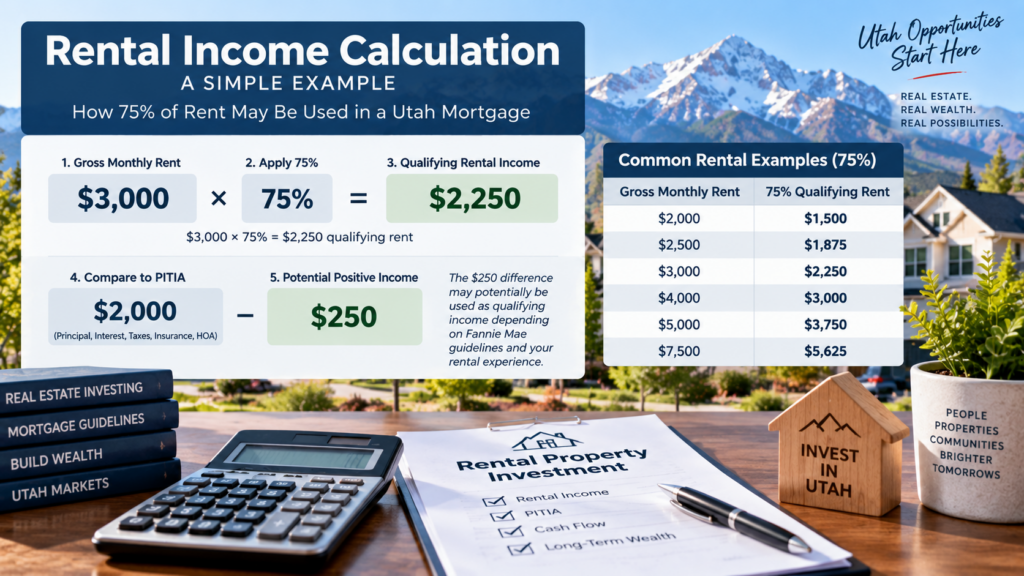
For scenarios where the applicable Fannie Mae calculation uses 75% of gross monthly rent, the calculation is simple:
Gross Monthly Rent × 75% = Adjusted Rental Income
Example
Suppose a qualifying Utah rental property generates:
Gross monthly rent: $3,000
The calculation would be:
$3,000 × 75% = $2,250
The $2,250 figure is then evaluated under the applicable Fannie Mae rules against the property’s qualifying expenses.
It does not automatically mean that $2,250 gets added to the borrower’s employment income.
Whether rental income creates positive qualifying income or is limited to offsetting the property’s housing obligation depends on the specific rental scenario, documentation and borrower history.
Why Does Fannie Mae Use 75% of Rent?
The reduction from gross rent recognizes that a rental property can have periods when it is vacant and can incur expenses associated with operating the property.
For example:
| Gross Monthly Rent | 75% Calculation |
|---|---|
| $2,000 | $1,500 |
| $2,500 | $1,875 |
| $3,000 | $2,250 |
| $4,000 | $3,000 |
| $5,000 | $3,750 |
| $7,500 | $5,625 |
This is only a simplified illustration. The actual underwriting treatment depends on the applicable Fannie Mae rental-income section and supporting documentation.
Why 12 Months of Landlord Experience Can Matter
A major concept in rental-income underwriting is the borrower’s history of receiving rental income or managing rental property.
Having sufficient property-management experience can affect how qualifying rental income is treated.
For certain scenarios, a borrower without the required history may be restricted from using positive rental income as additional qualifying income.
Instead, the qualifying rent may only be available to offset the applicable housing expense.
Simple Example
Assume:
Gross rent: $3,000
75% of rent: $2,250
PITIA: $2,000
The difference is:
$2,250 − $2,000 = $250
Depending on the applicable Fannie Mae requirements and the borrower’s rental-management history, that $250 may potentially receive different underwriting treatment.
That distinction can matter when calculating a borrower’s debt-to-income ratio.
What Is PITIA?
PITIA generally refers to:
P — Principal
I — Interest
T — Property Taxes
I — Homeowners Insurance
A — Applicable association dues or similar qualifying housing expenses
For rental-income underwriting, the relationship between qualifying rental income and PITIA can determine whether the property creates a qualifying loss, offsets its housing expense, or potentially produces qualifying positive income.
Example
A Utah investment property has:
Qualifying rental income: $2,250
PITIA: $2,500
Difference:
$2,250 − $2,500 = -$250
Depending on the applicable underwriting method, the $250 shortfall may affect the borrower’s debt-to-income calculation.
Fannie Mae Departing Residence Rental Income Guidelines
A departing residence is generally the home a borrower currently occupies but plans to convert to a rental when purchasing or financing another residence.
For example:
A homeowner lives in Sandy, Utah and purchases a new primary residence in Draper.
Instead of selling the Sandy property, the homeowner plans to rent it.
That Sandy property becomes the departing residence for underwriting purposes.
Under the September 2026 changes, Fannie Mae created a specific framework for departing-residence rental income.
The framework focuses on factors including:
- property eligibility;
- property-management experience;
- market-supported rent;
- reserves;
- qualifying rental-income calculations; and
- limitations on how rental income can offset PITIA.
A borrower should therefore not assume that simply obtaining a new lease will automatically allow the full proposed rent to be used for mortgage qualification.
Can I Use a New Lease for a Departing Residence?
This is an especially important question under the updated rules.
Fannie Mae’s new departing-residence framework relies on specific rental-income documentation and market-supported rents rather than simply treating a newly signed lease as sufficient evidence in every situation.
This is important for Utah homeowners who plan to keep their existing home as a rental when purchasing another property.
Before signing a lease based solely on mortgage-qualification assumptions, have the complete scenario reviewed.
Ask Daniel About a Departing Residence
Investment Property Purchased Within 45 Days
Fannie Mae also created specific guidance for situations involving an investment property acquired within 45 days of the subject property.
This matters for active Utah real estate investors purchasing properties close together.
For example, an investor may purchase:
Rental Property A: September 1
and then apply to purchase:
Rental Property B: September 25.
Because the properties were acquired close together, the rental income from the recently acquired property can be subject to the specific requirements established for this scenario.
Fannie Mae created separate eligibility, documentation and qualifying-income requirements for investment properties purchased within 45 days of the subject property.
Active investors should therefore review the timing of recent property acquisitions before assuming all projected rental income can be used for the next mortgage.
Fannie Mae Short-Term Rental Income Guidelines
Short-term rentals receive their own underwriting treatment under the updated Fannie Mae rental-income framework.
This can be especially relevant in Utah markets with vacation and recreational properties, including areas around:
Park City, Deer Valley, Canyons Village, Heber City, Midway, Jordanelle, St. George and Southern Utah.
Short-term rental income should not automatically be treated like rent from a traditional 12-month lease.
Fannie Mae’s new short-term-rental section establishes specific requirements covering:
- eligible properties;
- property-management experience;
- purchase transactions;
- refinance transactions;
- how long a property has operated as a rental;
- documentation used to establish gross rental income; and
- how much qualifying income may be used.
Local short-term-rental rules also matter.
A property’s mortgage eligibility does not establish that short-term rental activity is permitted by a city, county, HOA or other governing authority.
Utah investors should independently verify zoning, licensing, HOA restrictions and local short-term-rental requirements.
Short-Term Rental vs. Long-Term Rental Mortgage Qualification
| Issue | Long-Term Rental | Short-Term Rental |
|---|---|---|
| Rental structure | Traditional rental arrangement | Nightly/weekly or similar stays |
| Fannie Mae rental rules | Standard applicable rental-income rules | Separate short-term-rental rules |
| Documentation | Depends on transaction and property | Specialized documentation may apply |
| Management experience | Can matter | Can matter |
| Market-rent support | May be required | Specific requirements apply |
| Local STR legality | Generally not an STR issue | Must be independently verified |
| Qualifying income | Scenario dependent | More conservative treatment may apply |
Do not assume income shown on Airbnb, VRBO or another booking platform will automatically equal qualifying mortgage income.
What Changed With Fannie Mae Lease Requirements?
SEL-2026-08 also strengthens standards for lease agreements.
The update addresses items such as:
- minimum lease terms;
- when the first lease payment must occur;
- leases involving family members;
- interested-party leases;
- documentation supporting the lease amount;
- validation of lease terms; and
- evidence that the lease has actually gone into effect.
The objective is to establish reliable rental income rather than relying solely on a document stating what a property is expected to rent for.
What Documents May Be Needed to Verify Rental Income?
Required documents depend on the property, transaction and rental history.
Documentation may potentially include:
- federal income tax returns;
- Schedule E;
- lease agreements when permitted;
- evidence that lease terms have gone into effect;
- Single-Family Comparable Rent Schedule, Form 1007;
- Small Residential Income Property Appraisal Report, Form 1025;
- applicable rent information from the appraisal;
- evidence supporting market rent; and
- other documentation required by Fannie Mae, Desktop Underwriter or the lender.
Do not order or collect documents based solely on this list. The correct documentation depends on the specific loan scenario.
Fannie Mae Rental Income Example for a Utah Investment Property
Consider a Utah investor purchasing a rental home.
Property
Monthly qualifying gross rent: $3,000
Applicable 75% calculation: $2,250
Monthly PITIA: $2,000
Calculation
$3,000 × 75% = $2,250
Then:
$2,250 − $2,000 PITIA = $250
The next question is critical:
Can the $250 be treated as positive qualifying income?
The answer depends on the applicable Fannie Mae rental-income rules, including the borrower’s rental history, property-management experience, documentation and transaction type.
This is why two borrowers purchasing otherwise similar Utah rental properties can receive different qualifying-income results.
Rental Income vs. DSCR Loans in Utah
Fannie Mae conventional rental-property financing and DSCR loans use different underwriting approaches.
A conventional investment-property mortgage generally evaluates the borrower’s overall qualifying income, liabilities, credit, assets and property while applying Fannie Mae requirements to eligible rental income.
A DSCR mortgage generally focuses more heavily on whether the investment property’s qualifying rental income supports its applicable housing or debt obligation.
| Feature | Fannie Mae Conventional | DSCR Loan |
|---|---|---|
| Personal qualifying income | Generally important | Often not the primary qualification method |
| Personal DTI | Generally evaluated | Typically not the primary qualification method |
| Rental income | Fannie Mae rules apply | Lender-specific DSCR calculation |
| Tax returns | May be required | Often not required for qualifying personal income |
| Investment property | Eligible scenarios | Primary purpose |
| LLC vesting | Agency restrictions apply | Often available depending on program |
| Short-term rentals | Fannie Mae requirements apply | Some DSCR programs allow eligible STRs |
| Underwriting | Agency/DU requirements | Non-QM/lender-specific requirements |
A borrower who cannot use enough rental income under conventional underwriting may want to compare available alternatives rather than assuming the transaction cannot be financed.
Learn more about DSCR Mortgage Loans in Utah.
Conventional Investment Property Loans in Utah
Fannie Mae conventional financing may be available for eligible Utah investment properties.
Qualification can depend on:
- credit;
- income;
- rental-income documentation;
- debt-to-income ratio;
- down payment;
- reserves;
- number of financed properties;
- property type;
- occupancy;
- appraisal; and
- Desktop Underwriter findings.
Borrowers interested in traditional agency financing can also review Conventional Mortgage Loans in Utah.
Utah Rental Property Markets
Rental-property financing scenarios occur throughout Utah, but the type of rental activity can differ substantially by location.
Salt Lake County
Salt Lake City, Murray, Holladay, Millcreek, Cottonwood Heights, Sandy, Draper, South Jordan, West Jordan, Riverton and Herriman include a broad mix of traditional rental-property scenarios.
Utah County
Lehi, Provo, Orem, American Fork, Pleasant Grove, Saratoga Springs, Eagle Mountain, Highland and surrounding communities can include single-family rentals, townhomes and other investment properties.
Park City and the Wasatch Back
Park City, Deer Valley, Canyons Village, Heber City, Midway, Jordanelle, Hideout and Kamas can present more complicated scenarios because of higher property values, second homes and short-term-rental activity.
St. George and Southern Utah
St. George, Washington, Ivins, Santa Clara and Hurricane can include traditional rentals as well as vacation and short-term-rental properties.
Rental regulations can vary by municipality, HOA and property. Always verify local rental requirements separately from mortgage eligibility.
Five Questions to Ask Before Using Rental Income to Qualify
Before estimating how much rental income can be used, answer these questions:
1. Is the property a long-term or short-term rental?
The documentation and qualifying-income rules can differ.
2. How long has the borrower managed rental property?
Rental-management history can affect the treatment of positive rental income.
3. Is this the borrower’s current primary residence being converted to a rental?
If yes, departing-residence requirements may apply.
4. Did the borrower recently acquire another investment property?
An investment property acquired within 45 days of the subject property has specific requirements.
5. What documentation is available?
Tax returns, Schedule E, appraisal rent schedules, leases and other documentation can produce different underwriting requirements.
Frequently Asked Questions About Fannie Mae Rental Income
Does Fannie Mae use 75% of rental income?
Fannie Mae uses a vacancy-factor adjustment in applicable rental-income calculations when qualifying rent is established through certain permitted documentation. The exact calculation and treatment depend on the rental scenario and documentation.
Can rental income help me qualify for a mortgage in Utah?
Yes, eligible rental income can potentially be considered when qualifying for a conventional mortgage. How much can be used depends on the property, rental history, documentation, transaction and applicable Fannie Mae requirements.
Can positive rental income be added to my income?
Potentially, but not in every situation. Rental-management experience and the specific rental-income scenario can affect whether positive income can be counted or whether the rental income is limited to offsetting the property’s applicable housing expense.
Can I use rent from the house I’m moving out of?
Potentially. Fannie Mae has specific rules for a departing residence. The rental income must satisfy the applicable eligibility, documentation, reserve and qualifying-income requirements.
Can I use an Airbnb as qualifying income for a conventional mortgage?
Potentially, when the property and income meet Fannie Mae’s short-term-rental requirements. Short-term rentals have separate eligibility, documentation and calculation rules.
What if conventional rental-income guidelines don’t work for my investment property?
Qualified real estate investors may be able to compare conventional financing with alternative investment-property programs, including Utah DSCR loans.
When do the new Fannie Mae rental-income rules take effect?
Fannie Mae announced the changes on September 2, 2026. Lenders may implement them immediately and must implement them for applications dated November 1, 2026 or later.
Have Daniel Calculate Your Utah Rental-Income Scenario
Rental-income underwriting can become complicated quickly.
The result can change depending on whether you have:
- a standard investment property;
- a departing residence;
- a recently purchased rental property;
- a short-term rental;
- multiple financed properties;
- limited landlord experience; or
- income that doesn’t fit conventional underwriting.
Daniel Paris with UtahLowRate.com has more than 27 years of mortgage lending experience and can help Utah borrowers compare conventional investment-property financing with DSCR and other available mortgage options.
Get Your Rental-Income Scenario Reviewed
Daniel Paris
Utah Mortgage Broker
UtahLowRate.com
801-604-4949
Check My Rental Income Scenario
You can also explore:
Conventional Mortgage Loans Utah
Utah Mortgage Broker — Daniel Paris
Important: Mortgage guidelines, rental-income calculations, lender overlays and program requirements can change. This page is for educational purposes and is not a commitment to lend. Actual qualification is subject to the current Fannie Mae Selling Guide, Desktop Underwriter findings, lender requirements, property eligibility and underwriting approval.
The official Fannie Mae announcement confirms that the revision specifically adds new short-term-rental requirements, standardized treatment for investment properties acquired within 45 days, a new departing-residence framework, and strengthened lease standards. The separate Fannie Mae income-assessment resource also confirms that the revised chapter now breaks rental income into sections B3-3.8-01 through B3-3.8-06.

