
Content updated: September 29, 2026
Credit Score, Down Payment, Income, Reserves and Documentation for Utah Jumbo Mortgages
Buying or refinancing a higher-priced home in Utah may require a jumbo mortgage when the loan amount exceeds the applicable conforming loan limit.
Check My Jumbo Options or call 801-604-4949.
Jumbo loans can provide financing for luxury homes, custom properties, second homes and other higher-value real estate, but qualification requirements can differ significantly from conventional conforming mortgages.
Daniel Paris of UtahLowRate.com helps borrowers compare jumbo mortgage programs from multiple wholesale lenders for properties throughout Utah, including Salt Lake City, Park City, Draper, Holladay, Heber City, St. George, Utah County and surrounding communities.
Call Daniel Paris: 801-604-4949
NMLS #243976
Quick Answer: What Are the Jumbo Loan Requirements in Utah?
Jumbo loan requirements in Utah vary by lender, loan amount, property type and borrower profile. Lenders commonly evaluate credit score, down payment or equity, debt-to-income ratio, income documentation, employment history, cash reserves, assets and property value.
Because jumbo mortgages are not limited to one universal underwriting standard, requirements can vary considerably between lenders. A borrower who does not qualify under one jumbo program may qualify under another.
Utah Jumbo Loan Requirements at a Glance
Loan percentages, credit examples and payment calculations are illustrations unless linked to an identified current program. They do not establish available terms or approval.
| Requirement | What Jumbo Lenders May Evaluate |
|---|---|
| Credit score | Credit history, score and recent credit events |
| Down payment | Loan-to-value limits based on program and loan size |
| Income | Ability to document sufficient qualifying income |
| Employment | Stability and continuity of employment or self-employment |
| Debt-to-income ratio | Monthly obligations compared with qualifying income |
| Cash reserves | Liquid or eligible assets remaining after closing |
| Assets | Funds for down payment, closing costs and reserves |
| Property appraisal | Market value and property eligibility |
| Occupancy | Primary residence, second home or eligible investment property |
| Loan amount | Larger jumbo and super jumbo loans may have different guidelines |
These are general categories rather than universal approval standards. Actual jumbo mortgage requirements depend on the lender and specific loan program.
What Is a Jumbo Loan in Utah?

A jumbo loan is generally a mortgage with a loan amount above the applicable conforming loan limit for the property.
Conforming mortgages are designed to meet guidelines established for loans eligible for purchase by Fannie Mae or Freddie Mac. Jumbo mortgages fall outside standard conforming loan-size parameters.
That distinction gives jumbo lenders more flexibility to establish their own underwriting requirements.
As a result, two lenders may evaluate the same borrower differently.
This is one reason comparing multiple jumbo programs can be particularly important for borrowers financing higher-value Utah properties.
What Credit Score Is Needed for a Jumbo Loan in Utah?
There is no single credit score requirement that applies to every Utah jumbo mortgage.
Credit requirements can depend on:
- Loan amount
- Loan-to-value ratio
- Property type
- Occupancy
- Debt-to-income ratio
- Available reserves
- Mortgage history
- Overall credit profile
- Individual lender guidelines
Higher credit scores can potentially provide access to more jumbo programs, higher loan-to-value options or more favorable pricing.
Borrowers with lower scores may still have options through selected jumbo or non-QM programs, depending on the complete financial profile.
Credit Score Is Only Part of Jumbo Underwriting
Jumbo lenders generally evaluate the entire borrower profile rather than relying exclusively on a credit score.
A borrower with significant liquid assets, strong income, substantial equity and a lower loan-to-value ratio may present a very different risk profile from a borrower seeking maximum financing.
How Much Down Payment Is Required for a Jumbo Loan in Utah?
The down payment required for a Utah jumbo mortgage depends primarily on the lender, loan amount and maximum permitted loan-to-value ratio.
Some qualified borrowers may be eligible for relatively high-LTV jumbo financing, while larger loan amounts or more complex scenarios can require significantly more equity.
For example, jumbo underwriting may consider:
- Purchase price
- Requested loan amount
- Credit score
- Property type
- Primary, second-home or investment occupancy
- Cash reserves
- Debt-to-income ratio
- Income documentation
- Previous mortgage history
Instead of assuming that every jumbo loan requires 20% or 30% down, borrowers should compare programs based on their actual financial profile.
What Is LTV on a Jumbo Mortgage?
Loan-to-value ratio (LTV) compares the mortgage amount with the property's value.
For a purchase:
Loan Amount ÷ Purchase Price = LTV
For example, if a borrower purchases a $2,000,000 home and obtains a $1,500,000 mortgage:
$1,500,000 ÷ $2,000,000 = 75% LTV
The borrower would therefore have approximately 25% equity at closing, excluding transaction costs.
Jumbo lenders frequently use LTV together with credit score, loan amount, occupancy and property type when determining eligibility.
Jumbo Loan Income Requirements in Utah
Jumbo borrowers must generally demonstrate sufficient qualifying income or otherwise meet the income-documentation requirements of the selected program.
Traditional documentation may include:
- W-2 forms
- Recent pay stubs
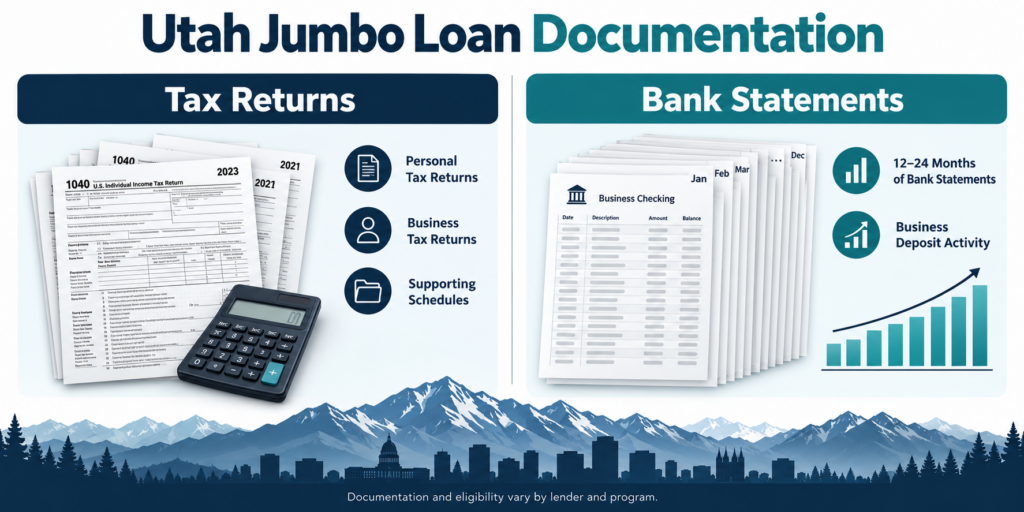
- Personal tax returns
- Business tax returns
- Employment verification
- K-1s
- 1099 forms
- Asset statements
- Other supporting financial documentation
Borrowers with bonuses, commissions, restricted stock, partnership income, multiple businesses or other complex compensation structures may require additional analysis.
Jumbo Loans for Self-Employed Borrowers in Utah
Self-employed borrowers can qualify for jumbo mortgages, but documenting income can be more complicated.
Traditional jumbo underwriting may review:
- Personal tax returns
- Business tax returns
- K-1 income
- Business ownership percentage
- Profit-and-loss statements
- Balance sheets
- Business liquidity
- Income trends
However, traditional tax-return qualification is not the only potential option.
Some qualified self-employed borrowers may be able to use alternative-documentation jumbo programs.
Depending on the lender and program, these can include:
- Bank statement mortgages
- 1099 income programs
- Profit-and-loss programs
- Asset-based qualification
- Asset depletion programs
- Other non-QM jumbo mortgages
This can be particularly useful for business owners whose taxable income does not fully reflect their available cash flow.
Bank Statement Jumbo Loan Requirements

A jumbo bank statement mortgage may allow eligible self-employed borrowers to document qualifying income using personal or business bank statements instead of relying primarily on traditional tax-return calculations.
The lender may evaluate factors such as:
- Eligible deposits
- Number of months of statements
- Business ownership
- Business expenses
- Deposit consistency
- Large or unusual deposits
- Credit
- Assets and reserves
- Property eligibility
Bank statement jumbo mortgages can be especially relevant for Utah entrepreneurs, business owners and independent professionals purchasing higher-value properties.
What Debt-to-Income Ratio Is Allowed for a Jumbo Loan?
The debt-to-income ratio (DTI) compares monthly qualifying debt obligations with qualifying monthly income.
Jumbo lenders may include obligations such as:
- Proposed housing payment
- Existing mortgages
- Auto loans
- Student loans
- Credit card payments
- Personal loans
- Other qualifying debts
There is no single DTI maximum for every jumbo loan.
Allowable DTI can vary according to credit score, LTV, loan amount, reserves and other compensating factors.
Borrowers with complex income or debt structures should have the scenario reviewed under the actual guidelines of potential jumbo lenders rather than relying on a universal DTI number.
How Much in Cash Reserves Do Jumbo Loans Require?
Cash reserves are assets remaining after the mortgage transaction closes.
Jumbo lenders frequently pay close attention to reserves because larger mortgages create larger monthly financial obligations.
Reserve requirements can vary based on:
- Loan amount
- Number of financed properties
- Occupancy
- Credit profile
- LTV
- Property type
- Income characteristics
Eligible reserve assets may include certain:
- Checking accounts
- Savings accounts
- Money market accounts
- Brokerage accounts
- Stocks and bonds
- Retirement accounts
- Other eligible liquid or investment assets
The lender determines which assets qualify and what percentage of an account can be counted.
Documents Needed for a Utah Jumbo Mortgage
The exact documentation depends on the program, but borrowers should generally be prepared to provide information related to income, assets, employment and the property.
Salaried or W-2 Borrowers
Common documentation may include:
- Pay stubs
- W-2s
- Tax returns when required
- Bank statements
- Brokerage or retirement statements
- Employment verification
- Identification
- Housing or mortgage history
Self-Employed Borrowers
Additional documents may include:
- Personal tax returns
- Business tax returns
- K-1s
- Profit-and-loss statements
- Balance sheets
- Business bank statements
- Business ownership documentation
Alternative-documentation programs can have substantially different requirements.
Jumbo Loan Property Requirements
The property securing a jumbo mortgage must also meet the lender's eligibility requirements.
Eligible properties can vary by program but may include:
- Single-family residences
- Luxury homes
- Custom homes
- Condominiums
- Second homes
- Vacation homes
- Certain investment properties
Unique luxury properties may require more extensive appraisal analysis because comparable sales can be limited.
This can be especially important in Utah luxury markets such as Park City, Deer Valley, Holladay, Draper, Alpine, Highland and parts of the Wasatch Back.
Jumbo Home Appraisal Requirements
Jumbo mortgages typically require an appraisal to establish the property's market value and evaluate its characteristics.
For particularly expensive or unique homes, a lender may require additional valuation review or, in some circumstances, more than one appraisal.
Factors that can complicate a jumbo appraisal include:
- Custom construction
- Large acreage
- Unusual architecture
- Limited comparable sales
- Luxury finishes
- Accessory structures
- Rapidly changing markets
- Unique locations
A low appraisal can affect the maximum available loan amount or require additional borrower equity.
Primary Residence vs. Second-Home Jumbo Requirements
Jumbo mortgage guidelines can differ according to how the property will be occupied.
Primary Residence
A home occupied as the borrower's principal residence may have access to a broader range of jumbo programs.
Second Home
Utah second-home financing is particularly relevant in resort and recreational markets such as Park City, Deer Valley, Heber Valley and other Wasatch Back communities.
Second-home requirements can differ from primary-residence requirements for:
- LTV
- Reserves
- Property eligibility
- Pricing
- Loan amount
Borrowers should accurately disclose intended occupancy when applying.
Jumbo Purchase, Refinance and Cash-Out Requirements
Jumbo financing is available for more than home purchases.
Jumbo Purchase Loans
Qualified borrowers can use jumbo financing to purchase properties requiring mortgage amounts above conforming limits.
Jumbo Rate-and-Term Refinance
Homeowners may refinance an existing higher-balance mortgage to change the rate, loan term or loan structure, subject to program requirements.
Jumbo Cash-Out Refinance
Selected programs may allow qualified homeowners to access equity from higher-value properties.
Maximum cash-out and LTV requirements can become more restrictive as loan amounts increase.
Jumbo vs. Conventional Loan Requirements
| Feature | Conventional Conforming Loan | Jumbo Loan |
|---|---|---|
| Loan size | Within conforming limits | Generally above conforming limits |
| Underwriting | Standardized agency guidelines | Lender/investor specific |
| Credit requirements | Program based | Often more dependent on loan size and LTV |
| Reserves | May be limited or not required in some cases | Often more important |
| Income documentation | Agency guidelines | Can vary substantially |
| Appraisal | Standard requirements | Additional review may apply |
| Alternative documentation | Limited | Available through selected jumbo/non-QM programs |
The primary difference is that jumbo underwriting is considerably more lender-specific.
Jumbo vs. Super Jumbo Loan Requirements
Very large mortgages are often described as super jumbo loans.
There is no single nationwide definition separating a jumbo mortgage from a super jumbo mortgage.
As loan amounts increase, lenders may require:
- Lower LTV
- Larger down payments
- Higher reserves
- More extensive asset verification
- Additional appraisal review
- Stronger credit
- More detailed financial documentation
Specialized programs may also provide alternative wealth-management structures for qualified high-net-worth borrowers.
Utah Jumbo Loan Requirements by Location
Jumbo financing is available throughout Utah, but local housing markets can affect property valuation and the type of financing borrowers need.
Salt Lake City and Salt Lake County
Higher-value properties in Salt Lake City, Holladay, Cottonwood Heights, Millcreek and surrounding communities can require jumbo financing depending on purchase price and down payment.
Draper and South Salt Lake Valley
Custom homes and higher-value properties in Draper and nearby communities can frequently create higher mortgage requirements.
Park City and Deer Valley
Park City is one of Utah's most important luxury real estate markets. Properties in Park City, Deer Valley and surrounding resort communities may require jumbo or super jumbo financing.
Heber City and the Wasatch Back
Higher-priced properties in Heber City, Midway, Jordanelle, Kamas and nearby communities can also require jumbo financing.
Utah County
Luxury and custom homes in Alpine, Highland, Lehi and other Utah County communities may exceed standard conforming financing levels.
St. George and Southern Utah
Luxury homes, custom residences, second homes and higher-value properties in St. George, Ivins, Santa Clara and surrounding Southern Utah communities may also require jumbo mortgages.
How to Qualify for a Jumbo Loan in Utah
The jumbo mortgage process generally begins with determining the required loan amount and identifying lenders whose guidelines match the borrower's financial profile.
A typical process includes:
- Determine the target loan amount and property type.
- Review credit, income, assets, debts and available down payment.
- Identify appropriate jumbo lenders and programs.
- Compare documentation and reserve requirements.
- Obtain a jumbo mortgage pre-approval when appropriate.
- Submit the property and borrower documentation for underwriting.
- Complete appraisal and lender-required property reviews.
- Satisfy final underwriting conditions and prepare for closing.
Comparing lenders before selecting a program can be especially valuable because jumbo underwriting is not standardized across the mortgage industry.
Common Reasons Jumbo Loans Are Denied
Jumbo mortgage applications can encounter problems involving:
- Insufficient documented income
- High debt-to-income ratio
- Insufficient reserves
- Credit problems
- Large unexplained deposits
- Inconsistent self-employment income
- Property appraisal issues
- Insufficient equity
- Property eligibility
- Complex ownership structures
- Documentation inconsistencies
Some problems may be specific to one lender rather than every jumbo program.
Before assuming a borrower cannot qualify, it can be useful to determine whether another lender has guidelines better suited to the scenario.
How to Improve Your Chances of Jumbo Loan Approval
Before applying for a jumbo mortgage, consider:
- Avoiding unnecessary new debt
- Maintaining adequate liquid reserves
- Organizing income documentation
- Documenting large account deposits
- Reviewing credit reports
- Avoiding major financial changes before closing
- Preparing business records if self-employed
- Comparing multiple jumbo lenders
- Obtaining pre-approval before making an offer when practical
For higher loan amounts, early financial preparation can reduce underwriting surprises.
Frequently Asked Questions About Jumbo Loan Requirements in Utah
What credit score do you need for a jumbo loan in Utah?
There is no universal minimum credit score for every jumbo mortgage. Requirements depend on the lender, loan amount, LTV, property, occupancy and overall borrower profile. Higher scores generally provide access to more financing options.
Do jumbo loans require 20% down?
Maximum financing and required equity depend on the selected lender, credit, loan amount, property, documentation and transaction. Request a current program review before relying on an LTV percentage.
Are jumbo loans harder to qualify for?
They can require more detailed underwriting because lenders are financing larger amounts and establishing their own eligibility standards. Strong income, credit, assets, reserves and property value can improve qualification.
How many months of reserves are required for a jumbo loan?
There is no universal reserve requirement. The number of months required can depend on loan amount, occupancy, LTV, credit profile and the number of financed properties.
Can a self-employed borrower get a jumbo mortgage?
Yes. Self-employed borrowers may qualify using traditional documentation or, when eligible, alternative-documentation programs such as bank statements, 1099 income, profit-and-loss statements or asset-based qualification.
Can I get a jumbo loan for a second home in Utah?
Yes. Selected jumbo programs finance eligible second homes. This can be particularly relevant for properties in Park City, Deer Valley, Heber Valley and other Utah recreational markets.
Can jumbo loans be used for cash-out refinancing?
Yes, selected jumbo programs permit cash-out refinancing. Maximum LTV, cash-out amount and qualification requirements depend on the lender.
Do jumbo loans require two appraisals?
Not every jumbo mortgage requires two appraisals. Additional valuation requirements may apply to certain loan amounts, properties or lender programs.
What is the maximum jumbo loan amount in Utah?
There is no single maximum loan amount for all jumbo lenders. Maximum financing depends on the lender, borrower profile, property, LTV and program. Specialized super jumbo programs can accommodate substantially larger mortgages.
Why do jumbo loan requirements vary between lenders?
Jumbo loans generally fall outside standard conforming agency guidelines. Individual lenders and investors therefore establish their own underwriting standards, risk limits and program requirements.
Compare Jumbo Loan Requirements in Utah
Jumbo mortgage qualification is not based on one universal checklist.
The right program depends on the combination of:
loan amount + property value + credit + income + assets + reserves + occupancy + documentation.
That makes lender selection particularly important.
Daniel Paris of UtahLowRate.com works with borrowers seeking jumbo and super jumbo financing throughout Utah and can compare available wholesale programs based on the specific transaction.
Call Daniel Paris: 801-604-4949
NMLS #243976
Program availability, underwriting requirements, interest rates, loan-to-value limits and qualification guidelines are subject to change and lender approval. This page provides general educational information and is not a commitment to lend.
Related guides: Utah jumbo mortgage guide · Jumbo mortgage rates · Jumbo payment calculation guide · Jumbo mortgage questions and answers ·

