
Content updated: October 12, 2026

Loans for Higher-Value Homes
By Daniel Paris, Utah Mortgage Broker | NMLS #243976
Buying or refinancing a higher-value property? A jumbo mortgage in Utah may be appropriate when the amount you need to borrow exceeds the conforming loan limit that applies to the property. Daniel Paris helps qualified borrowers compare jumbo programs for primary homes, second homes, refinances, and eligible investment properties throughout Utah.
Quick answer: A jumbo mortgage generally has a loan amount above the applicable conforming limit. The home’s purchase price alone does not determine whether a loan is jumbo. Lenders also review credit, qualifying income, assets, down payment or equity, reserves, occupancy, and property eligibility.
Check My Jumbo Options or call 801-604-4949.
Utah Jumbo Loan Quick Facts
| Question | Answer |
|---|---|
| What makes a mortgage jumbo? | Its loan amount generally exceeds the applicable conforming limit. |
| Is 20% down always required? | No. Requirements vary by program and borrower. |
| Are rates the same for everyone? | No. Pricing depends on the loan, borrower, property, and market. |
| Can self-employed borrowers qualify? | Potentially, through traditional or eligible alternative documentation. |
| Are second homes eligible? | Select jumbo programs allow qualifying second homes. |
| Can I refinance or take cash out? | Both may be available, subject to program and equity requirements. |
When Does a Utah Mortgage Become Jumbo?
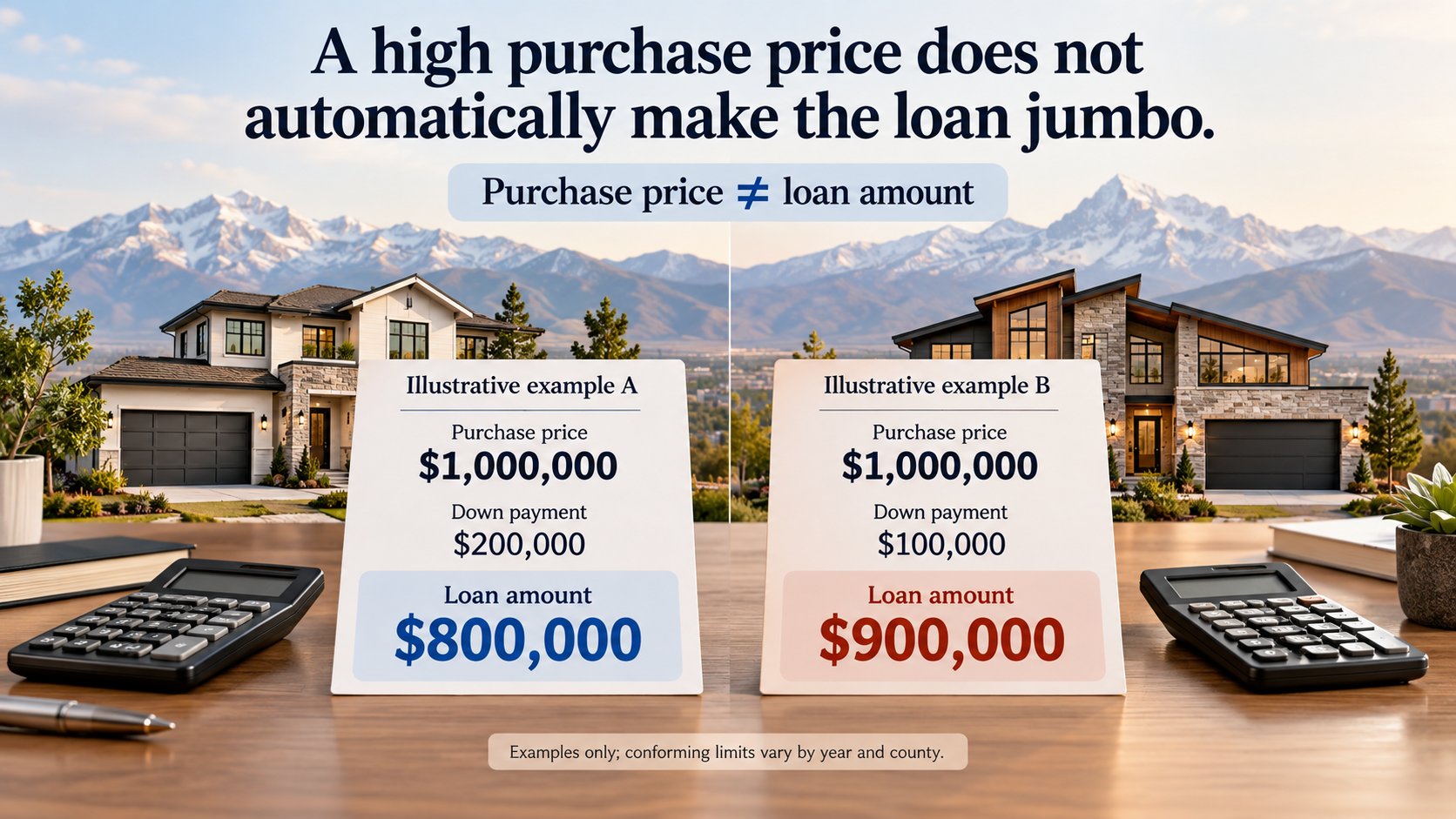
A high purchase price does not automatically make the loan jumbo.
Compare your proposed loan amount with the conforming limit for the property’s county, number of units, and year. For 2026, FHFA set the national baseline one-unit conforming limit at $832,750; certain high-cost counties have higher limits. Check the applicable county figure before deciding which loan category fits. FHFA conforming loan limits
A $1.2 million home purchased with $400,000 down has a proposed $800,000 mortgage. Its purchase price is above $1 million, but that alone does not make the mortgage jumbo.
Review the 2026 conventional loan limits in Utah and compare conventional mortgage options when the loan balance falls within the applicable limit.
How Are Utah Jumbo Mortgage Rates Determined?

Compare APR, points, fees, payment, and lock period along with the rate.
A jumbo mortgage quote is specific to the borrower and transaction. Factors commonly reviewed include:
- Loan amount and loan-to-value ratio
- Credit history and score
- Primary home, second home, or investment use
- Income documentation and existing debts
- Liquid assets and post-closing reserves
- Property type and appraisal
- Fixed-rate or adjustable-rate term
- Discount points, lender fees, and lock period
When comparing offers, ask for the interest rate, APR, monthly payment, points, closing costs, and lock period using the same assumptions. The Utah mortgage rates page provides market context; a personalized quote shows pricing for your scenario.
Get My Utah Jumbo Rate Quote or call 801-604-4949.
What Are Utah Jumbo Loan Requirements?
There is no single set of jumbo requirements across all lenders. A program’s terms may also change with the loan amount and intended property use.
Credit and income
Lenders review credit history, qualifying income, existing debts, and the reliability of the documentation. A borrower who does not fit one lender’s guidelines may fit another program. Self-employed borrowers can compare the documentation paths in the dedicated section below.
Down payment and loan-to-value ratio

Cash needed at closing and reserves remaining afterward are separate requirements.
Required equity depends on the lender, loan size, credit, property, occupancy, and documentation. A primary residence and second home may have different maximum loan-to-value ratios. Ask how much cash you need at closing and how much must remain after closing.
Assets and reserves
Jumbo lenders may require documented funds for the down payment, closing costs, and post-closing reserves. The required reserve amount and treatment of brokerage, retirement, or business assets vary by program. Discuss large transfers and unusual asset arrangements before moving funds.
Property eligibility
A unique home, condominium, resort property, large parcel, or custom construction can require additional review. Give the lender accurate property details early so a preliminary quote reflects the intended home.
Jumbo Loans for Self-Employed Borrowers in Utah

Business cash flow and qualifying mortgage income may be calculated differently.
Quick answer: Self-employed borrowers can qualify for a jumbo mortgage in Utah when they meet a lender’s income or asset documentation, credit, down payment, reserve, and property requirements. Some programs use tax returns; eligible alternative-documentation programs may analyze bank statements, 1099 income, or other approved records. The right approach depends on how your business income is earned and documented.
Business owners purchasing higher-value homes in Park City, Deer Valley, Salt Lake City, Draper, Alpine, Heber City, or St. George may have strong cash flow that looks different from the taxable income on a personal return. Jumbo lenders must determine which income they can use, whether it is likely to continue, and whether enough assets will remain after closing.
Daniel Paris helps qualified borrowers compare available documentation methods. For a detailed walkthrough, read the Utah self-employed jumbo mortgage guide.
How Can a Self-Employed Borrower Document Income for a Jumbo Loan?
| Documentation path | What a lender may review | When to consider it |
|---|---|---|
| Traditional jumbo underwriting | Personal and business tax returns, schedules, business records, and current income | Tax-return income supports the requested payment |
| Jumbo bank statement loan | Often 12 or 24 months of eligible personal or business deposits, with program-specific expense treatment | Business cash flow is stronger than income calculated from tax returns |
| 1099 or other approved documentation | Eligible 1099 forms and supporting records under a particular program | The borrower receives substantial independent-contractor income |
| Asset-based qualification | Eligible liquid or investment assets under lender rules | The borrower has substantial assets and a program permits their use for qualification |

Compare documentation methods before choosing a jumbo program
These are program categories, not guaranteed approvals. Loan size, occupancy, maximum LTV, pricing, and documentation requirements vary. Explore the jumbo bank statement loan page and Utah 1099 mortgage options for more detail.
Can You Get a Jumbo Mortgage Using Bank Statements Instead of Tax Returns?

Total deposits and qualifying income are not always the same
Potentially. Certain jumbo bank statement programs calculate qualifying income using eligible deposits shown on personal or business statements rather than relying primarily on tax-return income calculations.
The lender may distinguish customer revenue from transfers between accounts, borrowed funds, refunds, or other nonqualifying deposits. Business-account programs may also apply an expense calculation. A large total of deposits therefore does not automatically equal qualifying income.
The lender still reviews credit, debts, down payment or equity, reserves, property value, occupancy, and the requested mortgage amount. Compare 12- and 24-month bank statement options before selecting a program. Explore jumbo bank statement financing
What Documents Should a Self-Employed Jumbo Borrower Prepare?
The final list depends on the lender and income method, but an initial review may call for:
- Property address or target purchase price and proposed loan amount
- Evidence of business ownership and time in business
- Personal and business tax returns if using traditional qualification
- Requested personal or business bank statements if using a bank statement program
- Applicable 1099 forms, profit-and-loss records, or other approved documents
- Statements showing down payment funds, closing costs, and reserves
- Information on existing mortgages, debts, and other financed properties
- Explanations for significant deposits or transfers when requested

Prepare documents for the specific program being evaluated.
Prepare records for the specific program being evaluated. An incomplete file or transfers between personal and business accounts can make the income review harder. The self-employed jumbo mortgage red flags guide explains common documentation issues. Review jumbo qualification for self-employed borrowers
What Can Affect Approval for a Self-Employed Jumbo Loan?
A lender may ask follow-up questions when business income has declined, deposits vary significantly, accounts show overdrafts, transfers are difficult to trace, or the borrower needs most available cash for closing. A high credit score or large down payment does not resolve every income and reserve question.
Before making an offer on a higher-value property, ask Daniel Paris to compare programs using your actual statements, assets, requested loan amount, and intended property use. That review can identify the documentation path and potential issues early.
Check My Self-Employed Jumbo Options or call 801-604-4949.
Self-Employed Jumbo Mortgage Questions and Answers
Do I need two years of tax returns for a Utah jumbo mortgage?
Some traditional programs request tax returns. Eligible alternative-documentation programs may use another approved method, such as bank statements. The lender’s current rules determine the exact records required.
Can I qualify if I deduct substantial business expenses?
Possibly. Traditional underwriting and alternative-documentation programs may calculate income differently. Review both paths before assuming the tax-return figure determines every jumbo option.
Are business bank statements or personal statements better?
It depends on how the business receives revenue and how a particular lender treats deposits and expenses. Compare the eligible income calculation under each available program.
Can a 1099 contractor obtain a jumbo loan in Utah?
Potentially. Qualified contractors may have traditional or eligible 1099 mortgage program options, subject to loan amount, credit, assets, reserves, and property requirements.
Can I use business funds for the down payment or reserves?
The lender must determine whether those funds are eligible, properly documented, and available without impairing the business. Discuss the proposed source of funds before transferring money.
Are self-employed jumbo loans available for second homes?
Select programs may permit qualifying second homes. Occupancy, down payment, reserves, property eligibility, and income documentation can differ from primary-home requirements.
Are self-employed borrowers eligible for super jumbo financing?
Some qualified borrowers may access larger super jumbo mortgage programs. Larger loan amounts can bring more detailed asset, property, income, and reserve reviews.
Compare the focused jumbo bank statement requirements, rate and cost comparison and refinancing guides when tax-return income does not reflect eligible business cash flow.
Which Jumbo Mortgage Option Fits Your Goal?
| Your goal | Questions to ask |
|---|---|
| Purchase a primary residence | What are the down payment, reserve, and property requirements? |
| Buy a second home | Does the program allow the location, property type, and intended use? |
| Refinance | How do the new payment and total costs compare with the existing loan? |
| Take cash out | How much equity must remain, and what cash-out limits apply? |
| Qualify using business cash flow | Can eligible jumbo bank statement documentation be used? |
| Finance a multimillion-dollar property | Would a super jumbo mortgage fit better? |
Eligible Veterans buying a primary residence should also compare VA jumbo financing in Utah, which follows different program rules from a conventional jumbo loan.
Jumbo Mortgages Across Utah

Resort-area jumbo financing may involve second-home and property eligibility reviews.
Park City and Deer Valley: High-value primary and second homes can raise questions about loan size, occupancy, resort condominiums, and appraisal comparables.
Salt Lake City and the Wasatch Front: Buyers in Salt Lake City, Holladay, Cottonwood Heights, Sandy, and Draper should compare the actual mortgage amount with the applicable county limit before choosing jumbo financing.
Heber Valley and Utah County: Homes in Heber City, Midway, Alpine, Highland, and Lehi may involve custom features, acreage, or construction considerations. Read the local Heber jumbo loan page.
Southern Utah: Buyers in St. George, Washington, Ivins, and Santa Clara can review the St. George jumbo loan guide for local purchase, second-home, and refinance considerations. St. George jumbo mortgage guide

Compare jumbo options for eligible higher-value homes in Southern Utah.
Daniel Paris works with qualified borrowers statewide. Program eligibility depends on the specific borrower and property.
How Do You Compare Jumbo Loan Offers?
- Confirm the loan amount and county limit. See whether conforming financing is an option.
- Identify the intended use. State whether the property is a primary home, second home, or investment.
- Review documentation choices. Compare traditional income, eligible deposits, or other available methods.
- Separate closing funds from reserves. Both may matter.
- Compare written offers on equal terms. Review rate, APR, points, fees, payment, and lock period.
- Discuss the property early. Flag condominiums, acreage, construction, and unusual features.
Compare Jumbo Programs or call 801-604-4949.
Utah Jumbo Mortgage Questions and Answers
What is a jumbo mortgage in Utah?
A jumbo mortgage generally has a loan amount above the conforming limit applicable to the property. It uses lender or investor guidelines outside standard conforming loan limits.
What is the jumbo loan limit in Utah for 2026?
The relevant conforming limit depends on the county and number of units. FHFA’s 2026 national baseline for a one-unit property is $832,750; consult the Utah county loan-limit guide for the applicable figure. FHFA conforming loan limits
Does a home costing more than $1 million always need a jumbo loan?
No. The proposed mortgage balance, rather than the purchase price alone, determines whether it exceeds the applicable conforming limit.
How much down payment do I need for a Utah jumbo loan?
There is no universal percentage. The amount depends on the lender, loan size, occupancy, credit, documentation, and property.
Can I get a jumbo loan with 10% down?
Select programs may permit that level of financing for qualified borrowers and eligible properties. Availability and pricing depend on the complete scenario.
What credit score is required for a jumbo mortgage?
Requirements vary among programs. A lender also reviews the full credit history, LTV, loan size, income, assets, and reserves.
Can I qualify for a jumbo mortgage if I’m self-employed?
Potentially. Traditional income documentation, eligible bank statements, 1099 records, or assets may offer different qualification paths. See Jumbo Loans for Self-Employed Borrowers in Utah above.
Are Utah jumbo mortgage rates higher than conventional rates?
Not necessarily. Compare actual quotes with the same loan amount, lock period, points, and fees.
Can I refinance a jumbo mortgage?
Yes, qualified homeowners may have rate-and-term refinance options. Compare the new loan’s costs, payment, and expected time in the home.
Can I get cash out of a high-value Utah home?
A jumbo cash-out refinance may be available if the borrower, property, remaining equity, and requested loan meet lender requirements. Maximum cash-out and LTV limits vary.
Are second homes in Park City or Deer Valley eligible?
Select programs allow eligible second homes. The lender reviews the property, intended use, loan amount, assets, and occupancy requirements.
Can I finance an investment property with a jumbo mortgage?
Some programs allow eligible investment properties, often with different down payment, reserve, and pricing requirements. Investors can also compare Utah DSCR mortgage options where appropriate.
What is a super jumbo mortgage?
“Super jumbo” is a market term for especially large residential mortgages; it has no single government-defined starting amount. Review Utah and California super jumbo programs for larger transactions.
Ask Daniel Paris About Your Jumbo Mortgage
Whether you are buying a Park City second home, refinancing in Salt Lake City, or purchasing a high-value home in St. George, start with the actual loan amount and property details. Daniel Paris can help qualified borrowers compare available programs and complete borrowing costs.
Daniel Paris | UtahLowRate.com
Utah Mortgage Broker | NMLS #243976
Call [801-604-4949 (line 8016044949)](tel:8016044949)
Rates, terms, programs, loan amounts, and qualification requirements may change. All financing is subject to lender guidelines, property eligibility, and underwriting approval.
Publishing note: Remove the existing short self-employed and bank statement paragraphs when inserting this version. Keep the page at one H1, and use the clean internal URLs above without utm_source parameters.

