
SELF-EMPLOYED • HIGHER-VALUE HOMES • UTAH
Higher-value home financing for self-employed Utah borrowers
Finance a higher-value Utah home with an income review built around your eligible business cash flow. Jumbo bank statement loans in Utah may help self-employed buyers and homeowners whose tax-return income does not support the mortgage they need.
Daniel Paris, Utah Mortgage Broker · NMLS #243976
UtahLowRate.com · 801-604-4949
Check My Jumbo Bank Statement Options
Last reviewed: October 9, 2026

What is a jumbo bank statement loan in Utah?
A jumbo bank statement loan is a mortgage above the applicable conforming loan limit that uses eligible personal or business bank deposits to document self-employment income. Programs commonly review 12 or 24 months of statements. Approval also requires acceptable credit, debts, down payment or equity, reserves, and property eligibility under the selected lender’s rules.
Jumbo bank statement loan quick facts
| Topic | What to review |
|---|---|
| Income documentation | 12 or 24 months of eligible deposits; expense analysis when required |
| Borrower | Qualifying self-employed business owners and independent contractors |
| Loan amount | Above the applicable county conforming limit; maximum varies by investor |
| Credit and down payment | Depend on loan size, LTV, occupancy, property and investor |
| Reserves | Eligible assets remaining after closing; larger loans may require more |
| Loan purpose | Purchase, rate-and-term refinance or eligible cash-out refinance |
| Occupancy | Primary homes, with second-home and investment options under selected programs |
When does a Utah mortgage become jumbo?
Compare the proposed loan balance with the conforming limit for the property’s county, unit count and loan year. A home’s price alone does not determine whether its mortgage is jumbo. Check the current FHFA county loan limits before choosing a loan category.
For example, a $1.5 million purchase with $500,000 down requires a $1 million mortgage. Whether that balance is jumbo depends on the applicable limit. A bank statement mortgage can also be a non-QM loan below the conforming limit; alternative documentation and jumbo classification describe different parts of the loan.
Start with the Utah jumbo mortgage guide. For especially large balances, compare super jumbo mortgage options. A super jumbo program’s advertised ceiling does not establish the maximum available using bank statements.
How is jumbo bank statement income calculated?
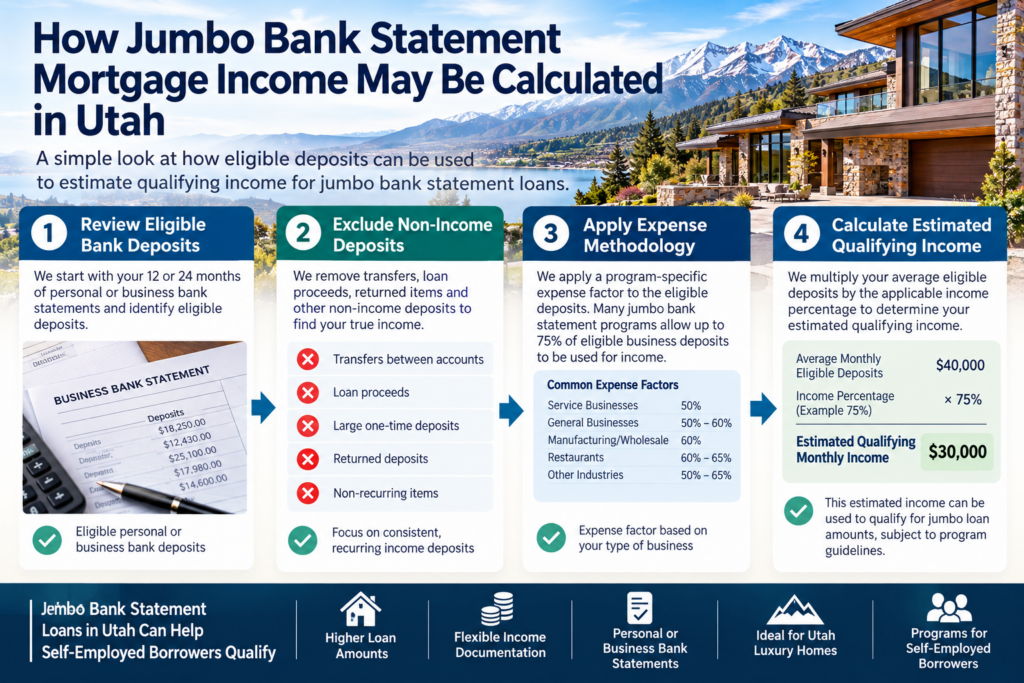
The lender starts with eligible revenue, rather than every dollar entering an account. Transfers between your own accounts, borrowed funds and other non-income deposits must be identified. Unusual customer payments may need invoices or other records showing that they are legitimate business revenue.
For business statements, the lender applies its permitted expense method and any required ownership adjustments. The result is an income estimate that must also pass the lender’s review of deposit trends and business continuity.
Illustrative formula: Eligible business deposits ÷ months reviewed × (1 − expense factor) = preliminary monthly income, before any additional lender adjustments.
Example: how an expense factor changes the result
Assume a sole owner has $600,000 in eligible business deposits over 12 months. Average eligible revenue is $50,000 per month. These hypothetical expense assumptions produce different estimates:
| Assumed expenses | Share remaining | Monthly income estimate |
|---|---|---|
| 25% | 75% | $37,500 |
| 30% | 70% | $35,000 |
| 50% | 50% | $25,000 |
These are mathematical examples, not promised lender rules. A 25% expense factor means subtracting 25%, not counting only 25% as income. An accountant’s expense letter or profit-and-loss statement may support an alternative method only if the selected investor accepts it and its requirements are met.
Use the bank statement loan income calculator, then request a review using your actual deposits and business costs.
Personal vs. business bank statements: which should you use?
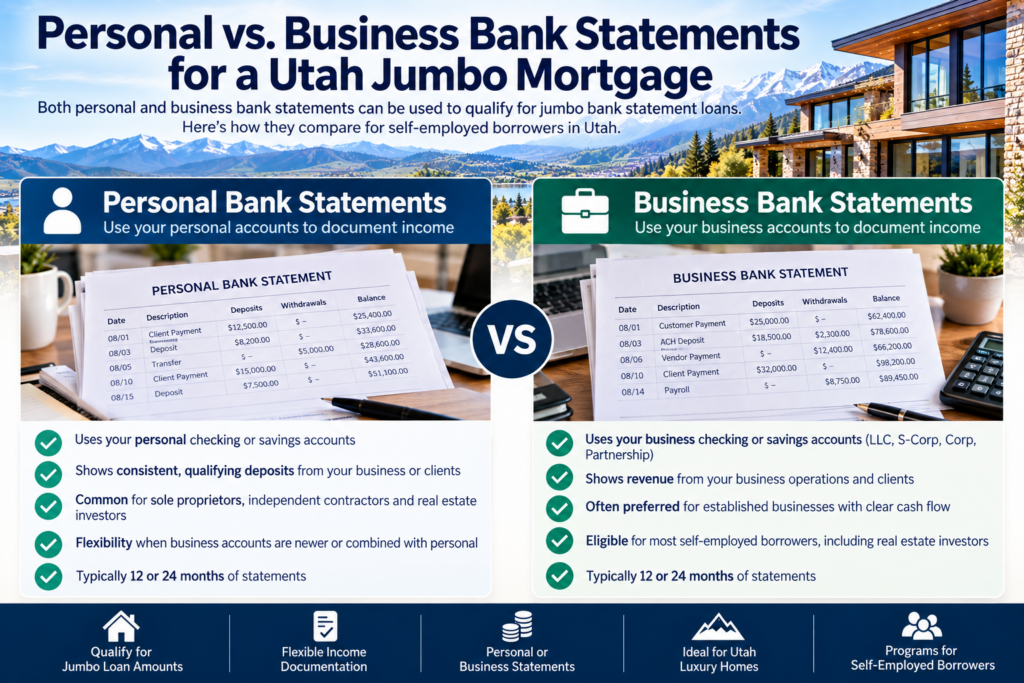
Choose the account history that accurately documents eligible self-employment income under the lender’s rules. A personal account may show owner distributions; a business account may show customer revenue before operating expenses. They should not automatically produce the same income figure.
If a customer pays your business $20,000 and you move $12,000 into your personal account, that movement does not create $32,000 of revenue. Provide records connecting the accounts and avoid counting the same earnings twice. Personal-account programs may still require business records to verify the source and sustainability of deposits.
Should you provide 12 or 24 months?
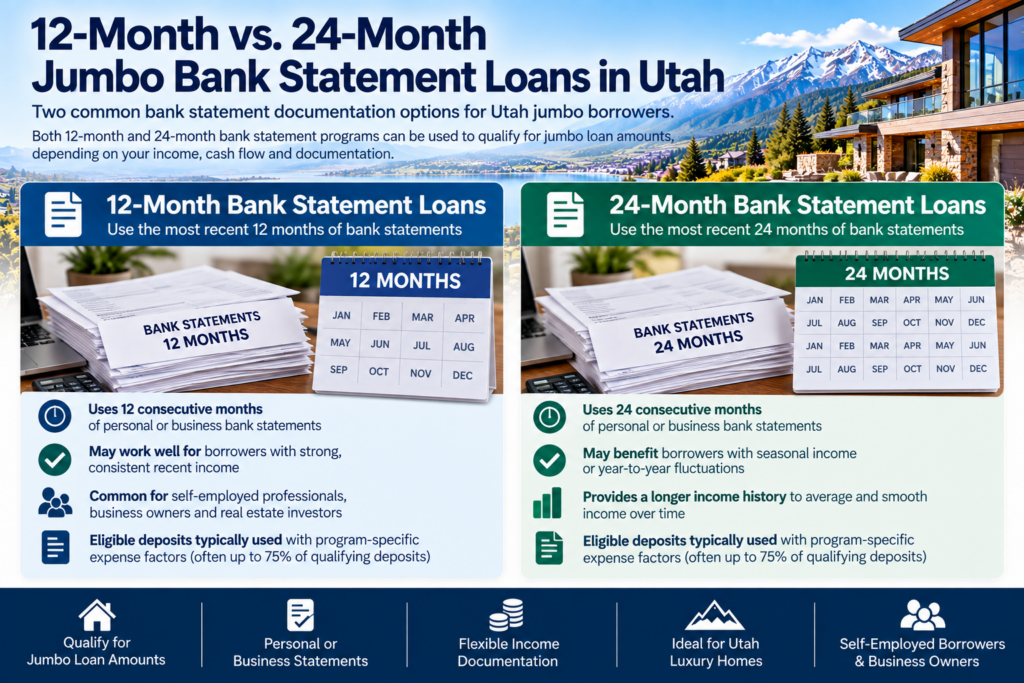
Twelve months can show recent performance when the program permits it. Twenty-four months can reveal recurring seasonal patterns. Neither period automatically provides better pricing or a higher approval. An older strong year does not eliminate concerns about declining current income.
Read the 12-month vs. 24-month bank statement comparison. Time in business is a separate requirement from the number of statements submitted.
Jumbo bank statement loan requirements: credit, LTV and reserves
What credit score do you need?
There is no universal minimum for jumbo bank statement financing. Credit history, housing-payment history, requested balance and equity all matter. A minimum advertised for a smaller bank statement loan should not be assumed to apply to a multi-million-dollar mortgage.
Daniel can compare your credit profile with the available wholesale programs. Review the bank statement loan requirements checklist before submitting documents.
How much down payment is required?
Loan-to-value, or LTV, compares the loan with the property value used by the lender. In a purchase, underwriting generally uses the lower of the purchase price and appraised value. Larger balances, second homes, cash-out and unusual properties can have different limits.
For illustration, 80% LTV on a $2 million purchase with an equal appraisal produces a $1.6 million loan and $400,000 down, before closing costs. At 75% LTV, the loan is $1.5 million and the down payment is $500,000. These examples explain the math and do not advertise either LTV as available for your scenario.
How do mortgage reserves work?
Reserves are eligible assets left after the down payment and closing costs. They are usually expressed as months of the housing payment the lender specifies, often principal, interest, taxes, insurance and association dues, or PITIA.
If a program requires six months of reserves and qualifying PITIA is $10,000, the reserve target is $60,000 after closing. Six months is an illustration here; a jumbo investor may require more. Other financed properties can add requirements. Retirement, brokerage and business assets may receive different treatment, so their statement balances are not automatically their eligible reserve values.
How do you compare jumbo bank statement loan rates?
A useful quote starts with the same loan amount, property use, credit assumptions, LTV, documentation period and lock period. Ask how discount points change the upfront cost and compare APR, lender fees, total payment and funds needed at closing.
Review Utah mortgage rate context, then request pricing for your actual bank statement scenario. A general jumbo or conventional rate is not a bank statement loan quote. The CFPB Loan Estimate explainer helps you review costs and terms.
Which mortgage approach fits your income?
| Approach | Income focus | Main comparison |
|---|---|---|
| Traditional jumbo | Tax returns and other required financial records | Does documented income support the loan at competitive total cost? |
| Jumbo bank statement | Eligible deposits and permitted expense method | Does the approved deposit calculation support the balance? |
| Asset-based qualification | Eligible assets under a specific program | Which assets qualify and how much liquidity must remain? |
| DSCR investment loan | Qualifying property rental cash flow | Does the rental property fit the investor’s rules? |
Self-employment alone does not establish which loan is best. For rentals, compare Utah DSCR mortgage loans with borrower-income financing.
Purchase, refinance, cash-out and occupancy options
Purchase: Review income and post-closing liquidity before making an offer. Ask whether the proposed property type and loan balance fit the program before relying on an estimated payment.
Rate-and-term refinance: Compare payment changes and closing costs with the existing mortgage. Extending the repayment term can lower the payment while increasing total interest over time.
Cash-out refinance: Ask about equity, ownership and mortgage seasoning, maximum cash-out, and reserve requirements. An estimated home value does not establish the lender’s usable value or your eligible cash proceeds.
Second homes and investments: Availability depends on occupancy and property eligibility. A resort condominium, nightly-rental arrangement or condo-hotel may require additional project review. Describe the intended use accurately; a rental does not become a second home simply because you occasionally visit it.
Jumbo bank statement mortgages across Utah
Local property details matter alongside your income. Daniel Paris works with self-employed borrowers statewide, including these higher-value home markets:
- Park City and Deer Valley: review resort project eligibility, occupancy and intended rental use early.
- Heber City, Midway and the Wasatch Back: describe acreage, accessory structures and any unusual property features.
- Salt Lake City and Salt Lake County: options for borrowers considering Holladay, Cottonwood Heights, Sandy, Draper and nearby communities.
- Alpine, Highland, Lehi and Utah County: compare documentation for established and growing self-employed businesses.
- St. George and Southern Utah: review primary-home, second-home and investment use for properties in Washington, Ivins and surrounding areas.

What documents should you prepare?
- Complete consecutive bank statements for the requested accounts and period.
- Evidence of business ownership, self-employment history and how the business earns revenue.
- Explanations and supporting records for unusual deposits and transfers.
- Asset statements showing closing funds and potential reserves.
- Existing mortgage, debt and other financed-property information.
- Property address, occupancy, purchase contract if applicable, and requested loan amount.
- Any accountant, profit-and-loss, identification or additional records required by the selected lender.
Five steps to a useful jumbo loan review
- Define the goal: purchase or refinance, property use, balance and available equity.
- Map the accounts: identify customer revenue and movement between accounts.
- Review income: compare permitted statement periods and expense methods.
- Check the whole file: credit, debts, closing funds, reserves and property eligibility.
- Compare offers: evaluate costs and terms, then complete underwriting and appraisal.
Common mistakes that delay approval
Missing statement pages, unexplained large deposits, duplicated transfers and treating gross revenue as take-home income can slow the review. Using all available assets at closing can leave a reserve shortage. New debt or large business withdrawals can change qualification; discuss those decisions before proceeding.
Jumbo bank statement loans Utah: frequently asked questions
Can I get a jumbo mortgage without using tax-return income?
Potentially. Selected programs use eligible bank deposits to establish self-employment income. The lender determines whether additional tax, business or financial records are needed, and full underwriting still applies.
Can I qualify after one year of self-employment?
Some alternative-documentation programs may consider a shorter business history, but availability for a jumbo balance must be checked separately. Prior work in the same field, credit, assets and the selected investor’s rules can affect eligibility.
Do lenders count every business deposit?
No. The lender identifies eligible revenue, removes non-income deposits and applies required expense and ownership adjustments. Transfers between your own accounts do not create additional earnings.
Can a CPA letter reduce the expense factor?
It may support a different expense method when the investor permits it. The letter must meet the lender’s requirements and accurately represent the business. It does not guarantee a lower expense deduction.
Can I get a $2 million or $3 million bank statement mortgage?
Selected specialty programs may offer multi-million-dollar financing. The available balance depends on approved income, credit, LTV, liquidity, occupancy and property eligibility. Request a review for the exact amount.
Are six months of reserves enough for a jumbo loan?
Not necessarily. The selected program determines the reserve requirement, and larger balances or additional financed properties may require more. Calculate reserves using the lender’s housing-payment and eligible-asset rules.
Can I refinance or take cash out using bank statements?
Selected programs allow rate-and-term or cash-out refinancing. Cash-out limits, equity, seasoning, income and property requirements differ by investor.
Can I use business funds for the down payment?
Possibly, if the lender accepts the source and verifies ownership, access and any effect on business operations. Ask before transferring funds because using business assets can require additional analysis.
All loans are subject to borrower qualification, complete underwriting, appraisal, property eligibility, investor guidelines and availability. Rates and requirements may change. Examples are educational and are not a commitment to lend or a guarantee of approval.

