
Content updated: .

Bank statement mortgages may provide an alternative income-documentation option for qualified self-employed Utah County homebuyers.
Bank statement loans in Utah County can give qualifying self-employed borrowers another way to document mortgage income when traditional tax-return calculations do not fully reflect their business cash flow. Instead of relying primarily on taxable income, eligible programs may analyze deposits shown on personal or business bank statements.
UtahLowRate.com helps business owners, entrepreneurs, independent contractors, consultants, 1099 professionals and other self-employed borrowers compare bank statement mortgage options throughout Lehi, Provo, Orem, American Fork, Pleasant Grove, Alpine, Highland, Saratoga Springs, Eagle Mountain, Spanish Fork and surrounding Utah County communities.
If you are just beginning your research, start with the Bank Statement Loans Utah statewide guide.
Daniel Paris | Utah Mortgage Broker | NMLS #243976
UtahLowRate.com | 801-604-4949
Request a Bank Statement Income Review
Quick Answer: How Do Bank Statement Loans Work in Utah County?
A bank statement loan in Utah County is an alternative-documentation mortgage that may allow an eligible self-employed borrower to establish qualifying income from recurring deposits shown on personal or business bank statements. Programs commonly review approximately 12 or 24 months of statements. Credit, assets, reserves, property, occupancy, loan amount and other underwriting requirements still apply.
Bank statement mortgages are fully underwritten loans. They should not be confused with no-documentation mortgages.
Utah County Bank Statement Loan Quick Facts
| Feature | General Guideline |
|---|---|
| Primary borrowers | Self-employed borrowers and business owners |
| Income documentation | Eligible bank statement deposits |
| Statement period | Commonly 12 or 24 months |
| Personal statements | May be permitted |
| Business statements | May be permitted |
| Purchase | Available under qualifying programs |
| Rate-and-term refinance | May be available |
| Cash-out refinance | May be available |
| Primary residence | Available under qualifying programs |
| Second home | Select programs |
| Investment property | Select programs |
| Jumbo financing | Available through select investors |
| Credit requirement | Investor-specific |
| Reserves | Often required |
| Underwriting | Full lender/investor underwriting |
Important: Guidelines vary by lender and investor. Credit requirements, LTV limits, down payments, reserves, loan amounts, interest rates and documentation requirements are subject to change.
For a detailed qualification breakdown, see Bank Statement Loan Requirements.
Who May Benefit From a Bank Statement Mortgage?
Traditional underwriting often uses tax returns when analyzing self-employed income. That approach can work well for many borrowers, but taxable income and actual business cash flow are not always the same.
A business owner may have legitimate deductions for equipment, advertising, employees, vehicles, office expenses or other operating costs.
Bank statement programs use an alternative method for evaluating income.
They may be worth reviewing for qualifying:
- Business owners
- Entrepreneurs
- Independent contractors
- Consultants
- 1099 professionals
- Technology contractors
- Real estate professionals
- Medical practice owners
- Construction company owners
- E-commerce business owners
- Agency owners
- Freelancers
- Owners of multiple businesses
Being self-employed does not automatically qualify someone for a bank statement loan. The complete borrower, property and transaction must meet the selected program's guidelines.
How Do Bank Statement Loans Calculate Income?
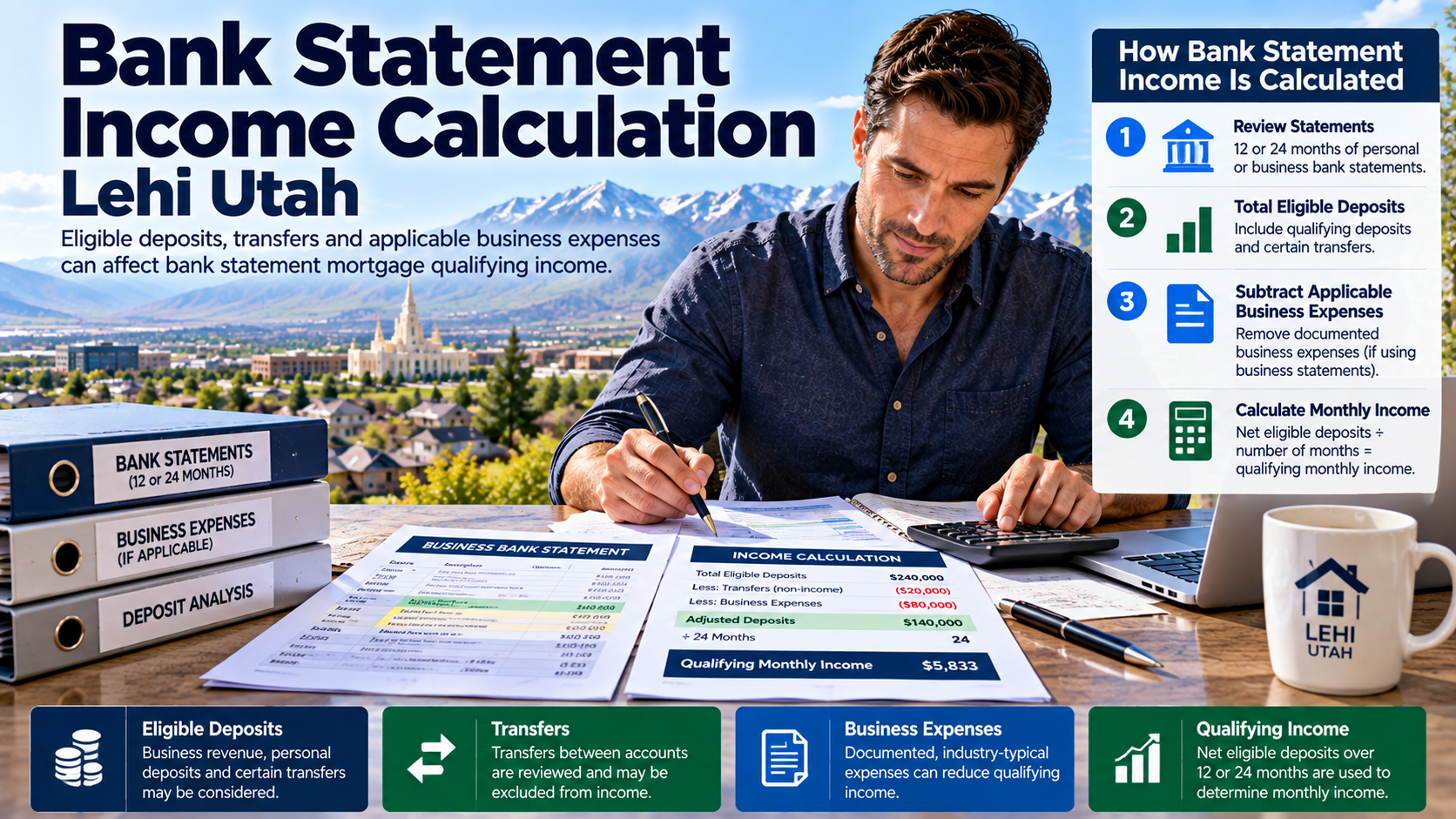
Eligible deposits, transfers and applicable business expenses can affect bank statement mortgage qualifying income.
A lender does not simply add every deposit in your account and call it mortgage income.
A typical analysis may include:
- Collecting the required 12 or 24 months of statements.
- Identifying recurring eligible deposits.
- Removing transfers between accounts.
- Excluding loans and other non-income deposits.
- Reviewing unusual or one-time deposits.
- Applying the program's business-expense methodology when business statements are used.
- Calculating average qualifying monthly income.
- Reviewing debts and credit.
- Verifying assets and required reserves.
- Evaluating the property, occupancy and LTV.
- Completing full underwriting.
Different mortgage investors can use different income-calculation methods. That means the same set of bank statements may not produce the same qualifying income with every program.
Simple Bank Statement Income Example
Assume a business has average eligible deposits of $30,000 per month.
If an illustrative program calculation recognizes 50% after its applicable expense methodology:
$30,000 × 50% = $15,000 estimated monthly qualifying income
Request a Bank Statement Income Review
That is only an educational example. It is not a universal bank statement mortgage formula.
Use the Bank Statement Loan Income Calculator to learn more about how deposits, transfers and business expenses may affect estimated qualifying income.
Personal vs. Business Bank Statements
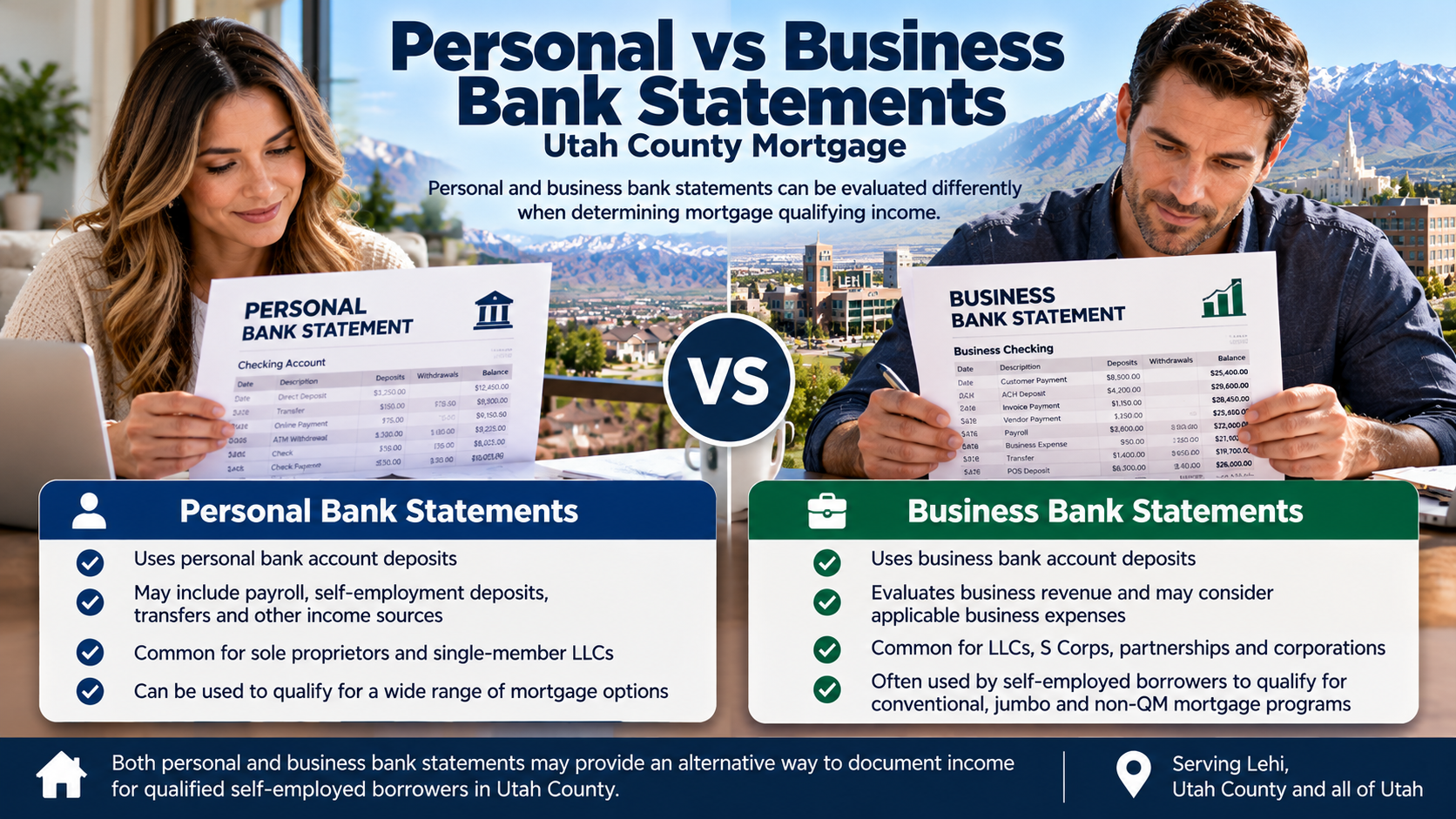
Personal and business bank statements can be evaluated differently when determining mortgage qualifying income.
Choosing the correct account type can make a meaningful difference in a bank statement mortgage analysis.
Personal Bank Statements
Certain programs permit personal bank statements when self-employment income is regularly deposited into the borrower's personal account.
The underwriter generally reviews the deposits to determine which transactions represent recurring eligible income.
Transfers, loans and unusual non-income deposits may need to be documented or removed.
Business Bank Statements
Business bank statements may be appropriate when most revenue flows through a business operating account.
Gross business revenue does not automatically equal the borrower's personal qualifying income. An approved expense methodology generally must be applied.
The treatment of business expenses can vary between investors, making program comparison particularly important for borrowers with significant gross deposits.
Can Multiple Accounts Be Used?
Potentially.
Some business owners operate more than one account or business. Whether multiple accounts can be included depends on the applicable program.
Transfers must be identified carefully so the same income is not counted twice.
12-Month vs. 24-Month Bank Statement Loans
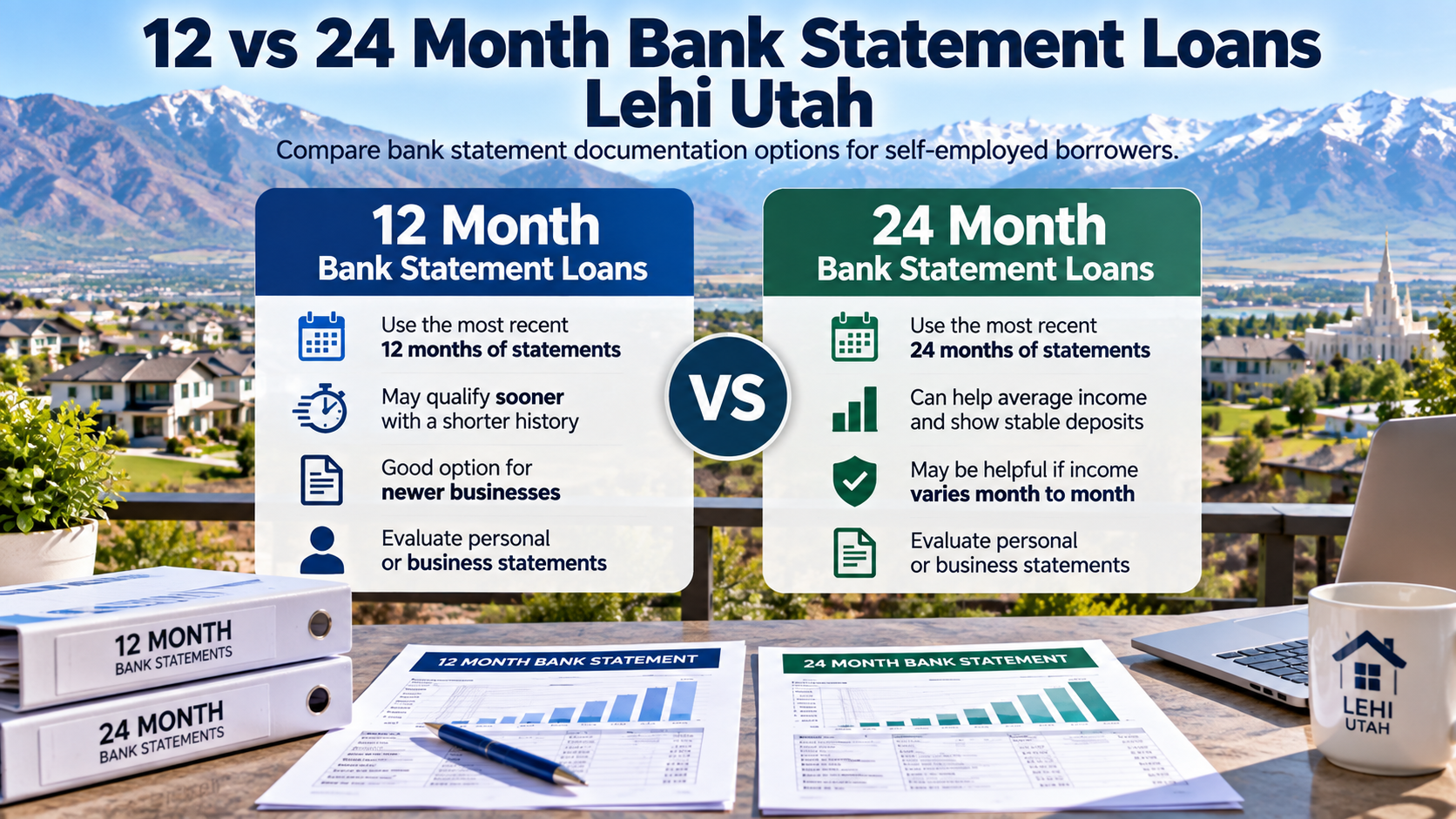
Compare 12- and 24-month bank statement documentation periods for qualifying self-employed borrowers.
Both documentation periods may be available.
12-Month Bank Statement Program
Certain investors may allow approximately 12 months of eligible statements.
This can be useful when recent deposits provide an appropriate representation of the borrower's current income and the borrower satisfies the remaining program requirements.
24-Month Bank Statement Program
Other programs analyze approximately 24 months.
A longer period can provide a broader view of a business with seasonal or variable revenue.
Which One Should You Use?
There is no universal answer.
The appropriate structure can depend on:
- Deposit consistency
- Business history
- Credit profile
- Loan amount
- Property type
- Occupancy
- Down payment or equity
- Available reserves
- Investor guidelines
A preliminary statement analysis can help determine which documentation period may provide the most supportable income calculation.
Bank Statement Loan Requirements in Utah County
Requirements vary, but lenders generally evaluate more than income.
A complete review can include:
Self-employment history. The borrower generally needs to document an eligible history of self-employment under the selected program.
Bank statements. Programs commonly use approximately 12 or 24 months of personal or business statements.
Credit. There is no single minimum credit score that applies to every bank statement program.
Down payment or equity. Maximum LTV varies with credit, loan amount, occupancy, property and program.
Assets. Funds used for the down payment, closing costs and reserves may need to be documented.
Mortgage reserves. Many programs require eligible assets remaining after closing.
Property. Property type, condition, appraisal, occupancy and marketability must satisfy applicable requirements.
Loan purpose. Guidelines can differ for purchases, rate-and-term refinances and cash-out refinances.
See the complete Utah Bank Statement Loan Requirements guide before applying.
Bank Statement Loans in Lehi, Utah
Lehi has become a major Utah County business and employment center. Local self-employed borrowers can include technology consultants, software contractors, agency owners, sales professionals, entrepreneurs, real estate professionals and construction business owners.
For a qualifying borrower whose taxable income does not fully represent recurring business cash flow, a bank statement loan in Lehi, Utah may provide an alternative method for documenting income.
The mortgage should still be evaluated as a complete transaction. Income, credit, down payment, reserves, property, occupancy and loan amount all matter.
Borrowers purchasing higher-value homes in Lehi, Traverse Mountain and nearby communities may also need to combine alternative income documentation with jumbo financing.
Bank Statement Loans in Provo and Orem
Self-employed borrowers in Provo and Orem may include business owners, independent professionals, consultants, contractors and entrepreneurs.
A bank statement mortgage may be considered when eligible recurring deposits provide a more useful way to document qualifying income than a traditional tax-return calculation.
Having the statements reviewed before making an offer can help estimate potential qualifying income, down payment, reserves and loan size.
American Fork and Pleasant Grove Bank Statement Loans
Business owners purchasing or refinancing in American Fork or Pleasant Grove may be able to use personal or business statements under qualifying programs.
The account structure matters.
If business revenue moves among several accounts, the mortgage analysis should identify transfers and avoid counting the same revenue more than once.
Bank Statement Loans in Alpine and Highland
Higher-priced properties in Alpine and Highland can create a need for both jumbo financing and alternative income documentation.
Select investors offer Jumbo Bank Statement Loans in Utah for qualified self-employed borrowers.
Jumbo underwriting can place additional emphasis on:
- Credit
- Loan amount
- Property value
- LTV
- Liquidity
- Mortgage reserves
- Bank statement income
- Occupancy
- Property type
The jumbo guidelines and bank statement income calculation should be evaluated together rather than separately.
Saratoga Springs and Eagle Mountain Bank Statement Mortgages
Saratoga Springs and Eagle Mountain continue to be important residential markets in western Utah County.
A qualifying self-employed borrower purchasing in these communities may use bank statement financing when an alternative income-documentation method better fits the borrower's financial profile.
Before making an offer, a preliminary review can help estimate potential income, loan amount, required down payment and reserves.
Spanish Fork and Southern Utah County
Bank statement mortgages may also be available for qualifying borrowers in Spanish Fork and other southern Utah County communities.
The same basic underwriting principles apply.
Eligible income, credit, assets, reserves, property eligibility, LTV and the overall ability to repay must all be considered.
Buying a Utah County Home With a Bank Statement Loan
One of the best times to analyze bank statements is before you begin making offers.
A preliminary review may help determine:
- Estimated qualifying monthly income
- Potential purchase range
- Down-payment requirements
- Reserve requirements
- 12-month versus 24-month documentation
- Personal versus business statements
- Potential jumbo financing needs
- Alternative programs worth comparing
This can help identify income-documentation issues earlier in the homebuying process.
Jumbo Bank Statement Loans in Utah County

Jumbo bank statement financing may provide alternative income documentation for qualified self-employed borrowers purchasing higher-value Utah County homes.
Self-employed borrowers purchasing higher-value homes may need a jumbo mortgage.
Select investors provide bank statement jumbo programs that combine alternative income documentation with larger mortgage amounts.
These programs can be particularly relevant for properties in:
- Alpine
- Highland
- Lehi
- Traverse Mountain
- Cedar Hills
- Other higher-value Utah County communities
Learn more in the Jumbo Bank Statement Loans Utah guide.
Can You Refinance With Bank Statements?
Potentially.
Bank statement programs may be available for both rate-and-term and cash-out refinances.
Rate-and-Term Refinance
A rate-and-term refinance generally restructures an existing mortgage without taking substantial equity from the property.
Cash-Out Refinance
Certain programs may allow qualifying homeowners to access a portion of their equity.
Cash-out guidelines can differ from purchase or rate-and-term requirements. Maximum LTV, credit, reserves and seasoning requirements depend on the applicable program.
Bank Statement Loan vs. 1099 Mortgage
Independent contractors may have more than one alternative-documentation option.
A bank statement mortgage generally analyzes eligible deposits.
A 1099 mortgage program may use qualifying 1099 income according to the selected investor's guidelines.
The appropriate documentation method depends on the borrower's actual income structure and program eligibility.
Bank Statement Loan vs. DSCR Loan
Real estate investors in Utah County may also compare bank statement financing with a DSCR loan.
A bank statement mortgage generally focuses on eligible borrower income documented through bank deposits.
A DSCR mortgage generally focuses more heavily on qualifying rental-property cash flow.
Investors buying rental properties in Lehi, Provo, Orem, Saratoga Springs, Eagle Mountain or elsewhere in Utah County should compare the qualification method that applies to the transaction rather than assuming the programs work the same way.
Documents to Prepare
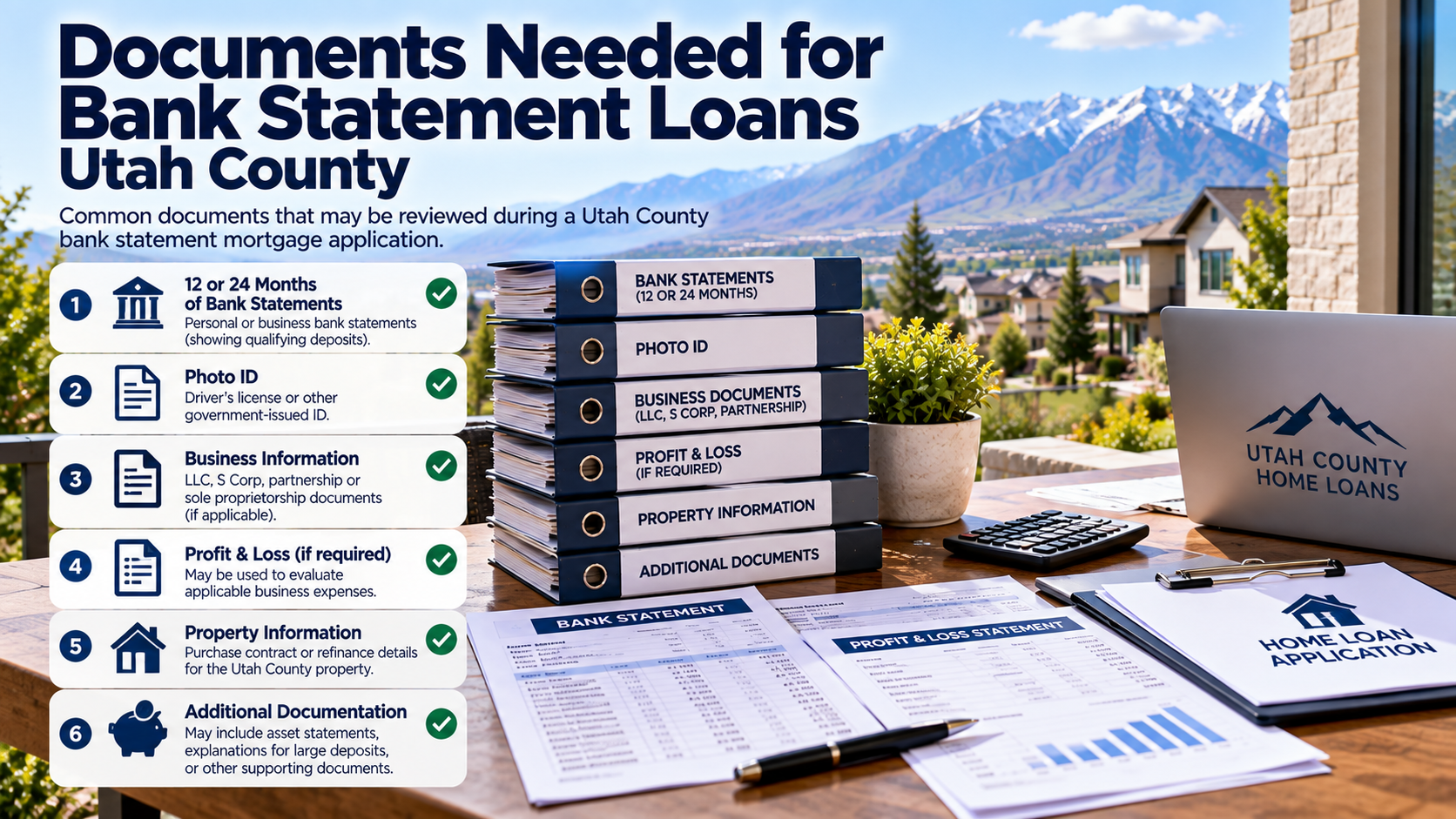
Common documents that may be reviewed during a Utah County bank statement mortgage application.
Depending on the program, borrowers may be asked for:
- 12 or 24 months of bank statements
- Identification
- Evidence of self-employment
- Business documentation
- Asset statements
- Documentation for large or unusual deposits
- Documentation of transfers
- Housing history
- Purchase contract, when applicable
- Property information
- Insurance information
- Additional documents requested during underwriting
For a complete checklist, visit Bank Statement Loan Requirements.
Common Bank Statement Loan Mistakes
Counting Transfers as Income
Moving money from one account to another does not create new income. Transfers should be identified so deposits are not counted twice.
Assuming Every Deposit Qualifies
Loans, refunds, asset transfers and other non-income transactions may need to be excluded.
Ignoring Business Expenses
Gross business revenue is not automatically personal qualifying income.
Waiting Until After Making an Offer
Reviewing statements before home shopping can uncover potential qualification issues earlier.
Assuming Every Lender Uses the Same Formula
Bank statement methodologies can differ among investors.
Choosing a Program Only Because It Says “No Tax Returns”
Alternative documentation does not mean no underwriting. The goal is to identify a mortgage structure supported by the borrower's complete financial profile.
Explore the Utah Bank Statement Loan Resource Center
Continue your research with these UtahLowRate.com guides:
Bank Statement Loans Utah — Statewide bank statement mortgage hub.
Bank Statement Loan Requirements — Documentation, credit, LTV, reserves and eligibility.
Bank Statement Loan Income Calculator — Learn how eligible deposits and expense calculations may affect qualifying income.
Bank Statement Loan FAQ — Answers to common self-employed mortgage questions.
Jumbo Bank Statement Loans Utah — Higher-balance alternative-documentation financing.
For other Utah markets, see Bank Statement Loans Salt Lake City, Bank Statement Loans Park City, Bank Statement Loans Heber City and Bank Statement Loans St. George.
Bank Statement Loan FAQ
What is a bank statement loan in Utah County?
A bank statement loan is an alternative-documentation mortgage that may allow an eligible self-employed borrower to establish qualifying income from eligible personal or business bank deposits rather than relying primarily on traditional tax-return income calculations.
Are bank statement loans available in Lehi?
Potentially. Eligible borrowers purchasing or refinancing property in Lehi may have access to bank statement mortgage programs, subject to complete lender and investor requirements.
Do I need 12 or 24 months of bank statements?
Both structures may be available. The appropriate statement period depends on the borrower, account structure and investor guidelines.
Can I use business bank statements?
Certain programs permit business bank statements. An applicable methodology is generally used to account for business expenses when determining qualifying income.
Can I use personal bank statements?
Potentially. Some programs permit personal statements when eligible self-employment income is regularly deposited into the personal account.
What credit score do I need?
There is no universal minimum credit score for every bank statement mortgage. Requirements can depend on LTV, loan amount, occupancy, property, reserves, mortgage history and the selected investor.
How much down payment is required?
There is no universal down-payment requirement. Maximum financing depends on the borrower, credit profile, loan amount, occupancy, property type and selected program.
Are jumbo bank statement loans available in Utah County?
Select investors offer jumbo bank statement mortgages for qualified self-employed borrowers. These programs can be particularly relevant for higher-value properties in Alpine, Highland and Lehi.
Can I refinance using bank statements?
Certain programs allow rate-and-term and cash-out refinancing, subject to the applicable credit, LTV, equity, reserve and underwriting requirements.
Are bank statement loans no-documentation mortgages?
No. Bank statement mortgages use alternative income documentation, but they remain fully underwritten mortgage loans.
Get a Utah County Bank Statement Loan Review
If you are self-employed and planning to purchase or refinance in Lehi, Provo, Orem, American Fork, Pleasant Grove, Alpine, Highland, Saratoga Springs, Eagle Mountain, Spanish Fork or another Utah County community, reviewing your bank statements before applying can help identify potential mortgage options.
Daniel Paris can help evaluate:
- Personal versus business statements
- 12-month versus 24-month documentation
- Eligible deposits
- Business-expense methodology
- Estimated qualifying income
- Credit and LTV
- Down payment
- Mortgage reserves
- Jumbo financing
- Purchase and refinance options
Daniel Paris
Utah Mortgage Broker — NMLS #243976
UtahLowRate.com
801-604-4949
CTA: Get My Bank Statement Income Reviewed
Mortgage programs, rates, terms, credit requirements, LTV limits, reserve requirements and underwriting guidelines vary by lender and investor and are subject to change. All loans are subject to qualification and approval.
Request a Bank Statement Income Review · Call Daniel Paris: 801-604-4949

