
Content updated: .

Bank statement mortgage options can help qualifying self-employed buyers document income for Park City properties.
Bank statement loans in Park City, Utah can give qualifying self-employed borrowers another way to document mortgage income. Instead of relying mainly on taxable income shown on traditional tax returns, eligible borrowers may qualify using deposits from personal or business bank statements.
These programs can be especially useful for business owners, entrepreneurs, independent contractors and other self-employed borrowers buying or refinancing homes in Park City, Deer Valley, Empire Pass, Old Town, Canyons Village, Promontory, Prospector, Kimball Junction and surrounding Summit County communities.
Daniel Paris of UtahLowRate.com helps self-employed borrowers compare available wholesale bank statement mortgage programs, including options for primary homes, second homes, investment properties and qualifying jumbo transactions.
Call Daniel Paris at 801-604-4949 to request a Park City bank statement loan review.
Request a Bank Statement Income Review
Quick Answer: How Do Bank Statement Loans in Park City, Utah Work?
A Park City bank statement loan may allow a qualifying self-employed borrower to document income using eligible deposits shown on personal or business bank statements.
Depending on the mortgage program, the lender may review 12 or 24 months of statements. The lender also reviews credit, assets, debts, reserves, down payment, property type, occupancy and the requested loan amount.
Bank statement mortgages are fully underwritten loans. They are not no-documentation mortgages.
For statewide information, see Bank Statement Loans Utah.
Park City Bank Statement Loan Quick Facts
| Feature | General Program Information |
|---|---|
| Primary borrower | Self-employed borrowers and business owners |
| Income documentation | Eligible bank statement deposits |
| Statement period | Commonly 12 or 24 months |
| Personal statements | May be available |
| Business statements | May be available |
| Tax returns | May not be the primary income-calculation method |
| Purchase | May be available |
| Rate-and-term refinance | May be available |
| Cash-out refinance | May be available |
| Primary residence | Available under qualifying programs |
| Second home | Select programs |
| Investment property | Select programs |
| Jumbo financing | Available through select investors |
| Credit requirements | Investor-specific |
| Down payment/LTV | Depends on the borrower and program |
| Reserves | Often required |
| Underwriting | Full underwriting required |
Important: Mortgage guidelines vary by lender and investor. Credit requirements, maximum LTV, reserves, loan amounts, documentation and program availability can change.
Who May Benefit From Bank Statement Loans Park City Utah?
Bank statement financing is generally designed for qualifying self-employed borrowers whose tax returns may not tell the whole story about their business cash flow.
Potential borrowers can include:
- Business owners
- Entrepreneurs
- Independent contractors
- Consultants
- Real estate professionals
- Medical and dental practice owners
- Professional-service business owners
- Commission-based self-employed professionals
- Partners in closely held businesses
- Other qualifying self-employed borrowers
A business owner may generate strong recurring cash flow while also claiming legitimate business deductions. Those deductions can reduce taxable income.
A bank statement mortgage uses a different approach. Instead of assuming taxable income is the only measure of repayment income, the lender may analyze eligible deposits.
This does not mean every deposit counts as income. Transfers, loan proceeds and other non-income deposits may need to be removed.
Learn more about the documentation process on the Bank Statement Loan Requirements page.
How Is Income Calculated for a Park City Bank Statement Loan?
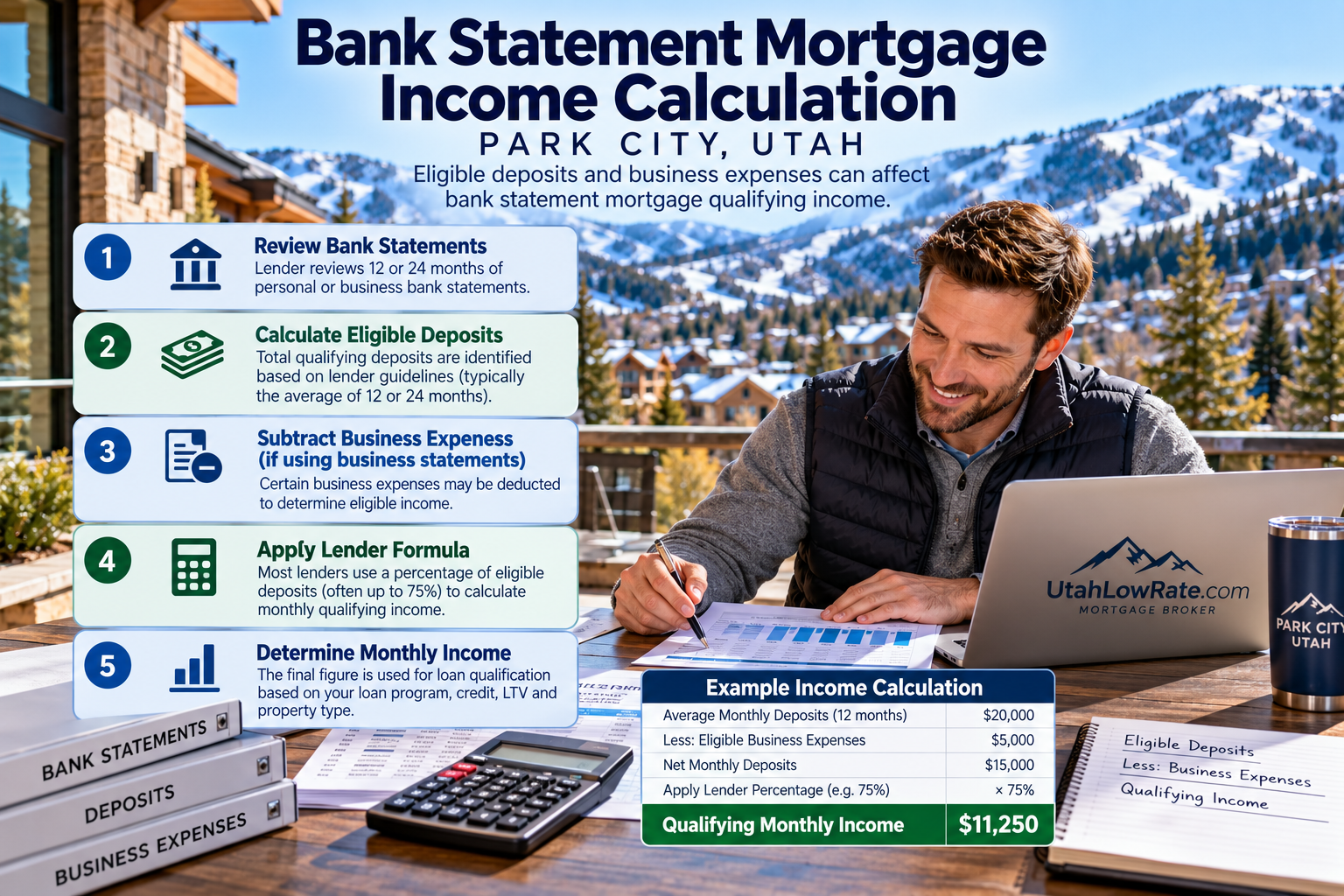
Income calculation is one of the most important parts of a bank statement loan in Park City, Utah.
The process can generally involve five steps.
1. Review the Required Bank Statements
The lender or investor may require 12 or 24 months of consecutive personal or business bank statements.
2. Identify Eligible Deposits
Deposits that represent recurring business or personal income are identified.
3. Remove Ineligible Deposits
Transfers between accounts, loan proceeds and other deposits that do not represent qualifying income may need to be excluded.
4. Account for Business Expenses
When business statements are used, the lender generally needs to account for business expenses using the methodology permitted by that particular investor.
5. Calculate Average Qualifying Income
Eligible income is generally averaged over the required statement period.
For a more detailed explanation and sample calculations, use the Bank Statement Loan Income Calculator.
Simple Example
Assume a Park City business owner has average eligible business deposits of $60,000 per month.
If the applicable program and documented business-expense analysis resulted in 50% of those deposits being treated as qualifying income, the preliminary calculation would be:
$60,000 × 50% = $30,000 estimated monthly qualifying income
Request a Bank Statement Income Review
That is only an educational example.
Another investor may calculate the same borrower's income differently. The actual result depends on the selected program, eligible deposits, business structure, expenses and supporting documentation.
12-Month vs. 24-Month Bank Statement Loans
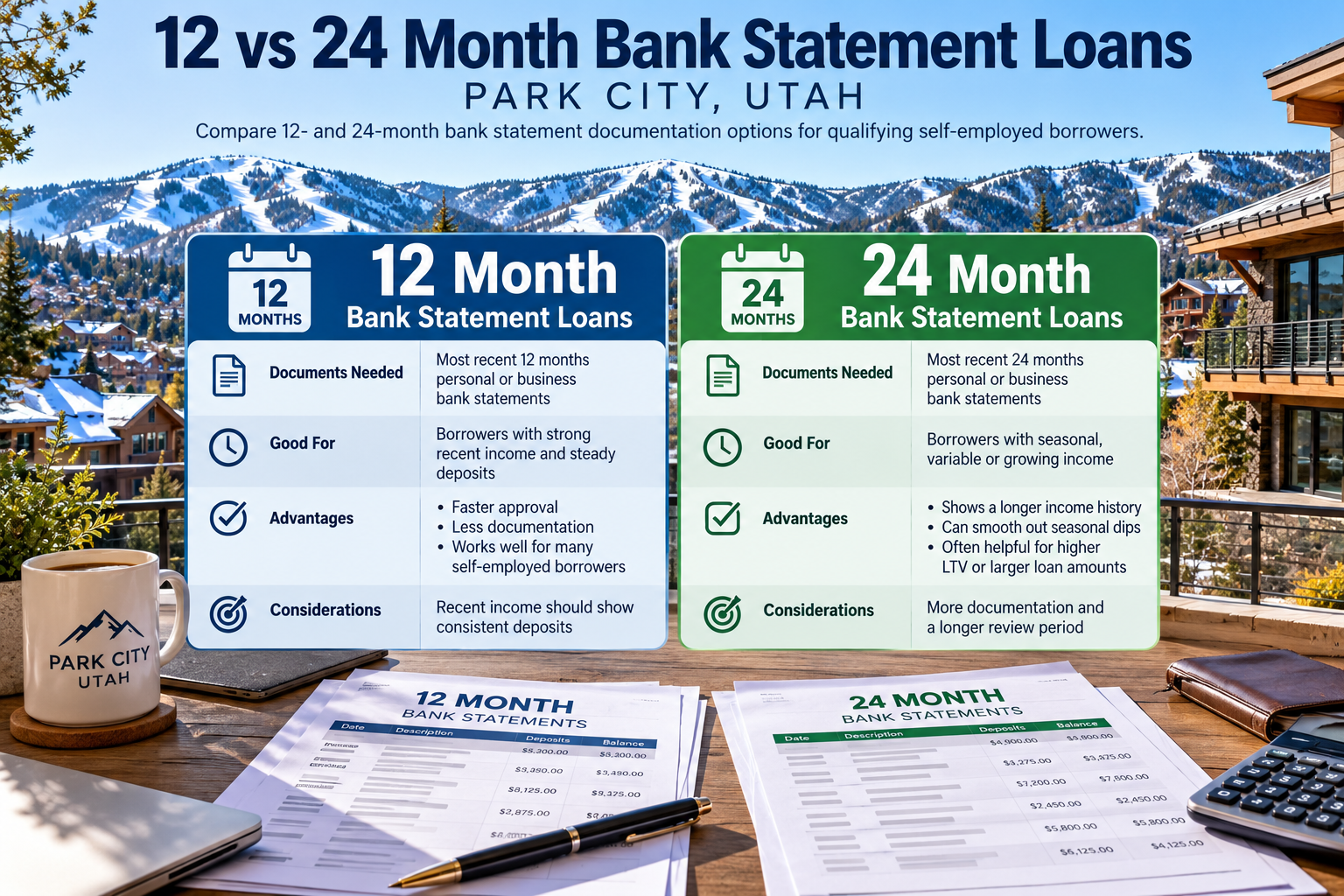
Compare 12- and 24-month bank statement documentation options for qualifying self-employed borrowers.
Both 12-month and 24-month bank statement programs may be available.
A 12-month program can provide a more recent view of business cash flow. A 24-month analysis provides a longer history.
Neither is automatically better.
For example, a business that has grown substantially during the past year could produce a different qualifying-income result under a 12-month analysis than under a 24-month analysis.
Seasonal businesses can create another issue. Park City and the surrounding resort economy can involve businesses with uneven monthly revenue. A longer statement period may provide a different picture of recurring cash flow.
The correct approach depends on the borrower's actual deposit history and available investor guidelines.
Personal vs. Business Bank Statements
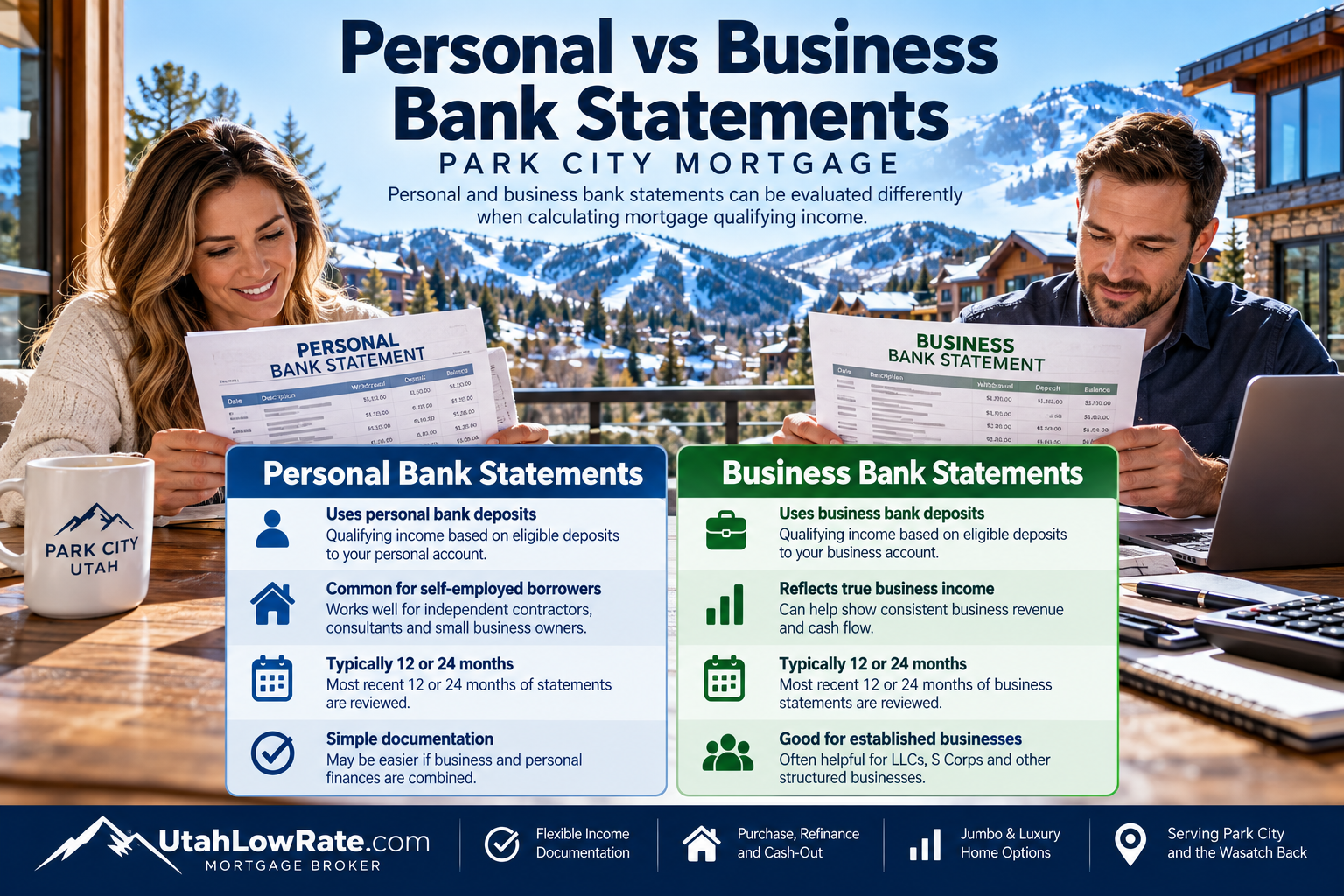
Personal and business bank statements can be evaluated differently when calculating mortgage qualifying income.
Bank statement loans Park City Utah may allow personal or business statements under qualifying programs.
Personal Bank Statements
Personal statements may be appropriate when qualifying business income is regularly deposited into a personal account and the selected investor permits that method.
Business Bank Statements
Business statements may work well when business revenue flows through a dedicated operating account.
The key issue is expenses.
Gross business revenue is not necessarily the same as qualifying mortgage income. The applicable lender methodology must account for business expenses.
That is why two borrowers with identical monthly deposits may have different qualifying incomes.
Bank Statement Loan Requirements in Park City
There is no universal set of requirements for every bank statement mortgage.
Underwriting may evaluate:
- Length of self-employment
- 12 or 24 months of statements
- Eligible deposits
- Business expenses
- Credit history
- Loan-to-value ratio
- Down payment
- Assets
- Mortgage reserves
- Existing debts
- Occupancy
- Property type
- Loan amount
- Appraisal
- Housing-payment history
- Overall borrower profile
See the complete Bank Statement Loan Requirements Utah guide before applying.
The Consumer Financial Protection Bureau also recommends that mortgage applicants organize current financial documents and notes that self-employed borrowers may need additional income documentation depending on the lender and situation.
What Credit Score Is Needed for a Park City Bank Statement Loan?
There is no single credit score that applies to every bank statement mortgage.
Credit requirements can change based on the requested loan amount, LTV, occupancy, property type, reserves and overall financial profile.
Credit and maximum LTV must be reviewed together against the selected lender's current matrix. A credit score alone does not establish available financing.
Those figures are examples of potential program structures. They are not universal approval thresholds.
Higher-balance Park City and Deer Valley transactions can also receive additional review of liquidity, reserves and overall financial strength.
How Much Down Payment Is Required?
Down payment is tied closely to the maximum loan-to-value ratio available for the transaction.
For example:
| Maximum LTV | Corresponding Equity/Down Payment |
|---|---|
| 90% | 10% |
| 85% | 15% |
| 80% | 20% |
| 75% | 25% |
This table simply illustrates the relationship between LTV and equity. It does not mean every Park City borrower will qualify for each LTV.
Available LTV can depend on credit, loan amount, occupancy, property type, reserves and investor guidelines.
Mortgage Reserve Requirements
Reserves are qualifying assets that remain after the down payment and applicable closing costs are completed.
Many bank statement mortgage programs require reserves.
This becomes particularly important with larger Park City transactions.
Reserve requirements can depend on:
- Loan amount
- Credit
- LTV
- Occupancy
- Number of financed properties
- Property type
- Investor guidelines
A borrower purchasing a higher-priced property should therefore evaluate both down payment and post-closing liquidity before making an offer.
Jumbo Bank Statement Loans Park City Utah
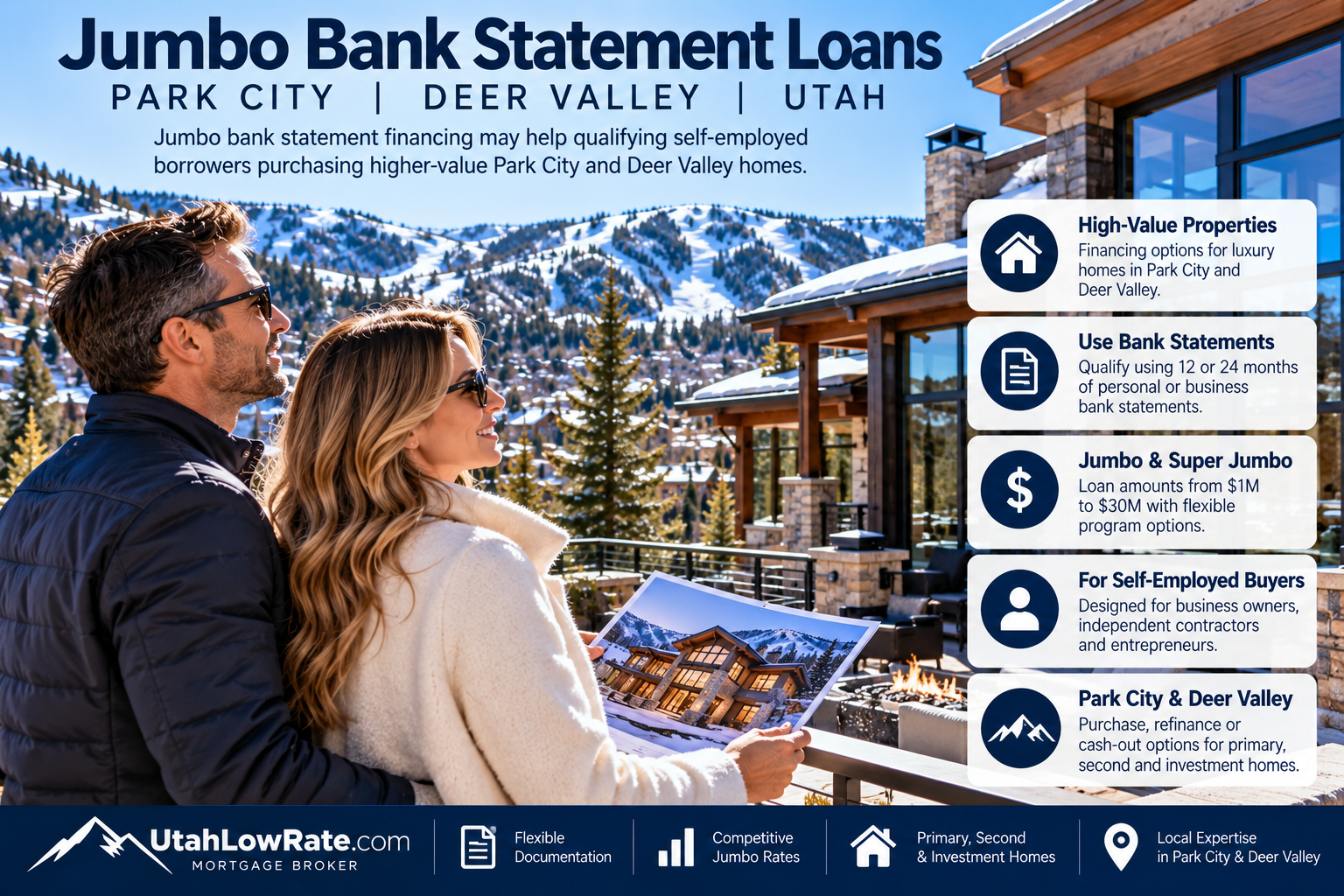
Jumbo bank statement financing may help qualifying self-employed borrowers purchasing higher-value Park City and Deer Valley homes.
Park City is a market where jumbo mortgages and alternative income documentation can intersect.
A self-employed buyer may need to solve two issues at the same time:
A larger mortgage amount + an alternative way to document qualifying income.
Select wholesale investors offer jumbo bank statement programs to qualifying borrowers.
Jumbo underwriting may review:
- Eligible bank deposits
- Business expenses
- Credit
- Down payment
- LTV
- Liquidity
- Mortgage reserves
- Property value
- Appraisal
- Occupancy
- Business history
- Requested loan amount
Certain specialized programs may accommodate multi-million-dollar transactions for qualified borrowers.
Program maximums are not guarantees of approval.
For a deeper look at high-balance alternative-documentation financing, visit Jumbo Bank Statement Loans Utah.
Bank Statement Loans Deer Valley Utah
Deer Valley's higher-value residential market can create a need for both jumbo financing and alternative income documentation.
A qualifying self-employed borrower buying or refinancing a Deer Valley property may need to coordinate:
- Bank statement income calculations
- Jumbo loan limits
- Property valuation
- Down payment
- Liquidity
- Mortgage reserves
- Primary or second-home occupancy
- Investment-property requirements
The right structure depends on the borrower and property.
The same considerations may apply to properties in Empire Pass, Old Town, Canyons Village, Promontory, Prospector, Kimball Junction and other Summit County communities.
Second-Home Bank Statement Loans in Park City
Certain bank statement programs may permit second homes.
This can be particularly relevant in Park City and Deer Valley.
However, the property must meet the selected investor's second-home requirements. A borrower should not assume that a property qualifies as a second home simply because it is located in a resort market.
Occupancy should be reviewed before choosing the mortgage program.
Investment-Property Bank Statement Loans
Select bank statement programs may finance qualifying investment properties.
However, investors should also compare a bank statement mortgage with a DSCR mortgage when appropriate.
The main distinction is the source of qualifying income.
A bank statement mortgage generally evaluates the borrower's qualifying income.
A DSCR mortgage generally places greater emphasis on the investment property's qualifying rental cash flow.
The appropriate structure depends on the borrower, property and available programs.
Purchase, Refinance and Cash-Out Options
Bank statement loans in Park City may be available for more than purchases.
Depending on the investor, potential uses can include:
Home Purchase
A qualifying self-employed borrower may use bank statements to document income when buying an eligible property.
Rate-and-Term Refinance
Select programs may allow an existing mortgage to be refinanced using bank statement income documentation.
Cash-Out Refinance
Certain programs may permit qualifying borrowers to access home equity.
Cash-out guidelines, maximum LTV, reserves, credit and loan amounts vary by investor.
Documents You May Need
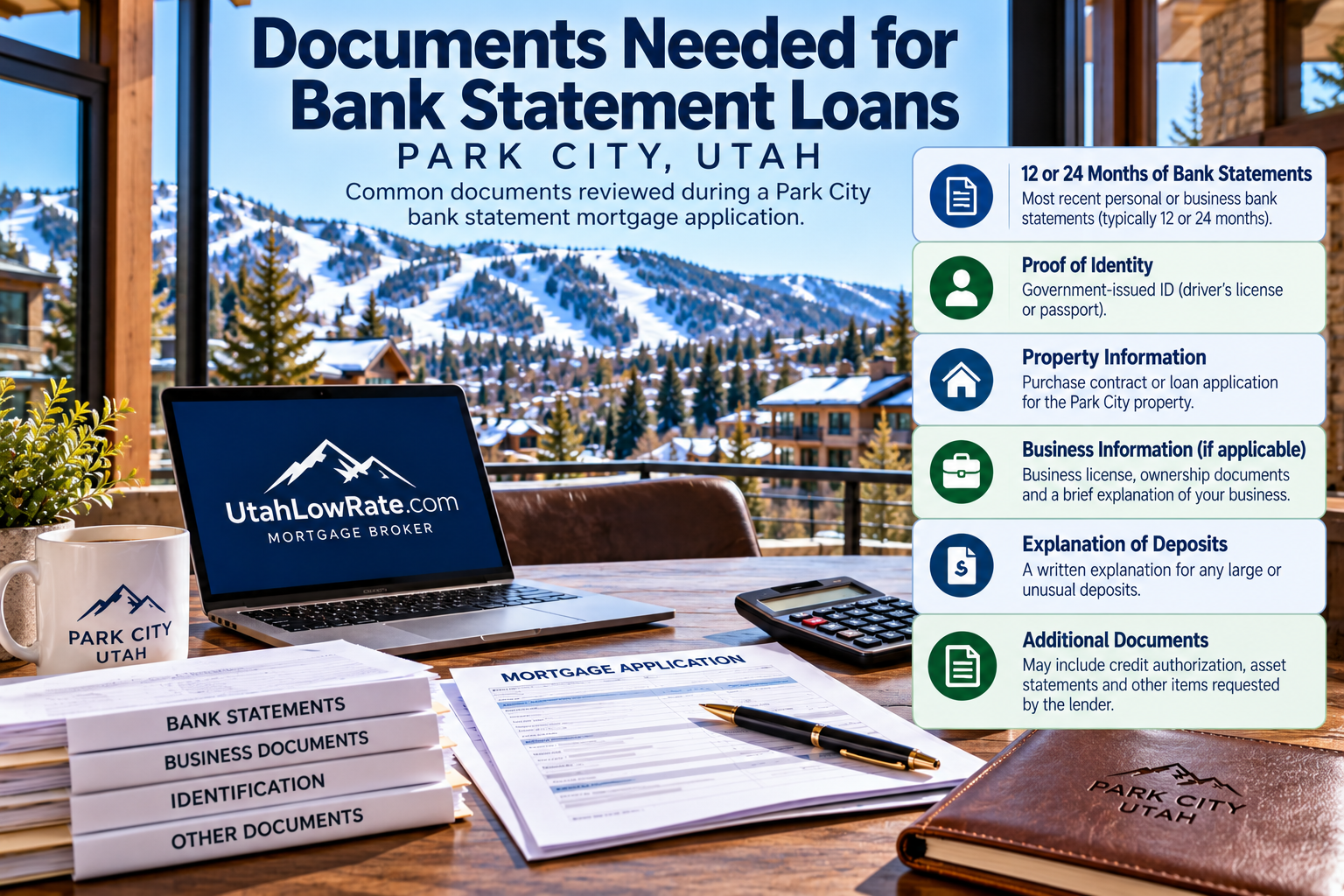
Common documents reviewed during a Park City bank statement mortgage application.
A preliminary Park City bank statement mortgage review may include:
- 12 or 24 months of bank statements
- Business information
- Proof of self-employment
- Identification
- Asset statements
- Current mortgage information for a refinance
- Purchase contract when applicable
- Property information
- HOA information when applicable
- Documentation explaining unusual or large deposits when required
Additional documentation may be required during underwriting.
The Consumer Financial Protection Bureau's mortgage application packet guide provides a useful general checklist for organizing mortgage documentation.
How to Get Pre-Approved for a Park City Bank Statement Loan
Step 1 — Determine Occupancy
Identify whether the property will be a primary residence, second home or investment property.
Step 2 — Estimate the Loan Amount
Determine the expected purchase price, down payment and mortgage amount.
This is especially important when jumbo financing is involved.
Step 3 — Review Your Bank Statements
Determine whether personal or business statements provide the appropriate documentation under available programs.
Step 4 — Estimate Qualifying Income
Identify potentially eligible deposits and determine how applicable business expenses may affect the calculation.
Step 5 — Review Credit and Assets
Credit, down payment and post-closing reserves should be evaluated together.
Step 6 — Compare Available Programs
Compare applicable bank statement programs rather than assuming every investor calculates income the same way.
Step 7 — Complete Underwriting
Final approval remains subject to complete underwriting, appraisal, title, insurance, documentation and investor requirements.
Why Compare Bank Statement Mortgage Programs?
Bank statement programs are not identical.
One investor may treat the same business differently from another.
Differences can include:
- 12 vs. 24 months of statements
- Personal vs. business accounts
- Eligible-deposit rules
- Business-expense methodology
- Self-employment history
- Credit requirements
- Maximum LTV
- Reserve requirements
- Maximum loan amount
- Occupancy
- Property eligibility
For a high-value Park City transaction, even a modest difference in qualifying-income calculation can materially change the available mortgage amount.
That is one reason to have the statements reviewed before selecting a loan program.
Bank Statement Loans Park City Utah: Local Areas Served
UtahLowRate.com works with qualifying self-employed borrowers throughout Park City and surrounding Summit County communities, including:
Park City • Deer Valley • Empire Pass • Old Town • Canyons Village • Prospector • Kimball Junction • Promontory • Snyderville • Summit Park • Jeremy Ranch • Pinebrook • Hideout • Kamas
Borrowers considering nearby Heber City, Midway, Jordanelle and Wasatch County can also review Bank Statement Loans Heber City Utah.
Explore the Utah Bank Statement Loan Resource Center
Use these guides to continue researching your options:
Bank Statement Loans Utah
Start with the statewide bank statement mortgage hub.
Bank Statement Loan Requirements
Review documentation, credit, deposits, reserves and qualification requirements.
Bank Statement Loan Income Calculator
See how eligible deposits and expense calculations may affect estimated qualifying income.
Jumbo Bank Statement Loans Utah
Explore higher-balance financing for qualifying self-employed borrowers.
Bank Statement Loan FAQ
Find answers to common bank statement mortgage questions.
Other Local Guides
Bank Statement Loans Salt Lake City
Bank Statement Loans Utah County & Lehi
Bank Statement Loans St. George Utah
Bank Statement Loans Park City Utah FAQ
What is a bank statement loan in Park City, Utah?
A bank statement loan is an alternative-documentation mortgage that may allow a qualifying self-employed borrower to establish income using eligible personal or business bank deposits rather than relying primarily on traditional tax-return income.
Do I need tax returns for a bank statement mortgage?
Certain bank statement programs may calculate qualifying income without relying primarily on traditional tax-return income. Other documentation and full underwriting are still required.
Do I need 12 or 24 months of bank statements?
Both options may be available. The appropriate statement period depends on the investor, business history and borrower profile.
Can I use business bank statements?
Yes, under qualifying programs. Business expenses generally must be considered when calculating qualifying income.
Can I use personal bank statements?
Certain programs permit personal bank statements when they meet the applicable investor's requirements.
Can I get a jumbo bank statement loan in Park City?
Potentially. Select investors offer jumbo bank statement financing for qualified self-employed borrowers purchasing or refinancing higher-value properties.
Can I use a bank statement loan in Deer Valley?
Potentially. Eligibility depends on the borrower, property, occupancy, appraisal, requested loan amount and applicable investor guidelines.
Are bank statement loans available for second homes?
Select programs permit qualifying second homes. Occupancy requirements must be satisfied.
Can I refinance a Park City home using bank statements?
Certain programs permit rate-and-term and cash-out refinancing using qualifying bank statement income.
Are bank statement loans easier to qualify for?
Not necessarily. They provide a different method of documenting income. Credit, assets, liabilities, reserves, property eligibility and other underwriting requirements still apply.
Get a Park City Bank Statement Loan Review
If you are self-employed and considering a home in Park City or Deer Valley, the first step is determining how an available mortgage program may calculate your income.
Daniel Paris can review your bank statement structure, eligible deposits, credit, assets, proposed down payment, reserves, property type and requested loan amount and compare applicable wholesale mortgage programs.
Daniel Paris
Utah Mortgage Broker
UtahLowRate.com
NMLS #243976
Call: 801-604-4949
Serving Park City, Deer Valley, Empire Pass, Old Town, Canyons Village, Promontory, Prospector, Kimball Junction and surrounding Summit County communities.
Important Mortgage Disclosure
Mortgage programs, interest rates, terms, loan amounts, credit requirements, LTV limits, reserve requirements, documentation requirements and investor guidelines are subject to change.
All loans are subject to borrower qualification, complete underwriting, acceptable property, appraisal, investor requirements and program availability. Examples on this page are educational and do not represent a commitment to lend or guarantee of approval.
Request a Bank Statement Income Review · Call Daniel Paris: 801-604-4949

