
Content updated: .

Self-Employed Mortgage Options in St. George and Southern Utah
Bank Statement Loans St. George Utah can give qualified self-employed borrowers another way to document mortgage income. Instead of relying mainly on tax returns, certain mortgage programs may use eligible deposits shown on personal or business bank statements.
This can be useful for business owners, entrepreneurs, independent contractors, consultants, real estate professionals, 1099 earners and other self-employed borrowers whose tax returns may not fully reflect the cash flow their businesses generate.
Daniel Paris of UtahLowRate.com helps self-employed borrowers compare bank statement mortgage programs for homes in St. George, Washington, Ivins, Santa Clara, Hurricane, Desert Color, Little Valley and surrounding Washington County communities.
Daniel Paris — Utah Mortgage Broker
NMLS #243976
Call: 801-604-4949
Request a Bank Statement Income Review
Quick Answer: How Do Bank Statement Loans St. George Utah Work?
A bank statement loan in St. George, Utah is an alternative-documentation mortgage designed primarily for qualified self-employed borrowers.
Depending on the program, a lender may review 12 or 24 months of personal or business bank statements and use eligible deposits to calculate qualifying income.
These mortgages may be available for purchases, refinances, primary residences, second homes, investment properties and select jumbo transactions.
Bank statement mortgages are still fully underwritten loans. Credit, assets, debts, reserves, property value, occupancy and other program requirements must also be reviewed.
St. George Bank Statement Loan Quick Facts
| Feature | General Guideline |
|---|---|
| Typical borrower | Self-employed business owner or professional |
| Income documentation | Eligible bank statement deposits |
| Statement period | Commonly 12 or 24 months |
| Personal statements | May be permitted |
| Business statements | May be permitted |
| Tax returns | May not be the primary income calculation |
| Purchase | Potentially available |
| Rate-and-term refinance | Potentially available |
| Cash-out refinance | Potentially available |
| Primary residence | Potentially available |
| Second home | Select programs |
| Investment property | Select programs |
| Jumbo financing | Available through select programs |
| Credit requirements | Program specific |
| Reserves | May be required |
| Final approval | Subject to full underwriting |
Important: Guidelines vary by lender and investor. Credit requirements, loan amounts, LTV limits, reserves, documentation and available programs can change.
Why Self-Employed Borrowers Consider Bank Statement Loans
Traditional mortgage underwriting often calculates self-employment income using tax returns.
That method can work well for many borrowers. But it may not always show the full financial picture of a business.
A business owner may have substantial recurring revenue while also taking legitimate deductions for expenses such as equipment, vehicles, advertising, employees, office costs and professional services.
A St. George bank statement mortgage uses a different approach.
Instead of relying primarily on taxable income, an eligible program may review recurring deposits flowing through the borrower's personal or business bank accounts.
For a statewide explanation of these programs, visit the Bank Statement Loans Utah guide.
Who May Consider a St. George Bank Statement Mortgage?
Bank statement financing is primarily designed for qualified self-employed borrowers.
That can include:
- Business owners
- Entrepreneurs
- Independent contractors
- Consultants
- 1099 professionals
- Real estate professionals
- Medical and dental practice owners
- Attorneys
- Contractors and tradespeople
- Construction company owners
- Freelancers
- Commission-based self-employed professionals
- Other qualified self-employed borrowers
A bank statement mortgage is not a no-documentation loan.
The lender still reviews the borrower's overall ability to qualify.
How Bank Statement Loans St. George Utah Work
The process generally starts by identifying the accounts that best document recurring business income.
Step 1 — Collect the Required Bank Statements
Depending on the program, the borrower may provide approximately 12 or 24 consecutive months of personal or business statements.
Step 2 — Identify Eligible Deposits
The lender reviews deposits and determines which transactions may represent recurring qualifying business or self-employment income.
Step 3 — Remove Transfers and Non-Income Deposits
Moving money between accounts does not create additional income.
Loan proceeds, refunds, reimbursements and other non-income deposits may also need to be excluded.
Step 4 — Apply the Appropriate Expense Method
When business bank statements are used, gross business deposits normally do not equal the business owner's qualifying personal income.
The lender applies the expense methodology allowed by the particular program.
Step 5 — Calculate Average Monthly Income
After eligible deposits and applicable expenses are determined, qualifying income is generally averaged over the applicable statement period.
Step 6 — Complete Mortgage Underwriting
The lender also evaluates credit, assets, liabilities, reserves, property, occupancy, LTV and the rest of the mortgage application.
For a detailed qualification checklist, see Bank Statement Loan Requirements Utah.
12-Month vs. 24-Month Bank Statement Loans
One of the most common questions is whether a borrower should use 12 or 24 months of statements.
12-Month Bank Statement Loans
Certain programs may allow approximately 12 months of consecutive statements.
This approach may be useful when the borrower's recent business activity provides an acceptable picture of current income and the borrower meets the program's remaining requirements.
24-Month Bank Statement Loans
Other programs use approximately 24 months of statements.
A longer review period can provide a broader view of recurring deposits. It may also help demonstrate income patterns for a seasonal business.
Is 12 or 24 Months Better?
Neither option is automatically better.
The appropriate choice can depend on:
- Deposit history
- Business seasonality
- Length of self-employment
- Credit
- Loan amount
- LTV
- Property type
- Occupancy
- Investor guidelines
Comparing the available calculations before selecting a program can help avoid choosing the wrong documentation method.
Personal vs. Business Bank Statements
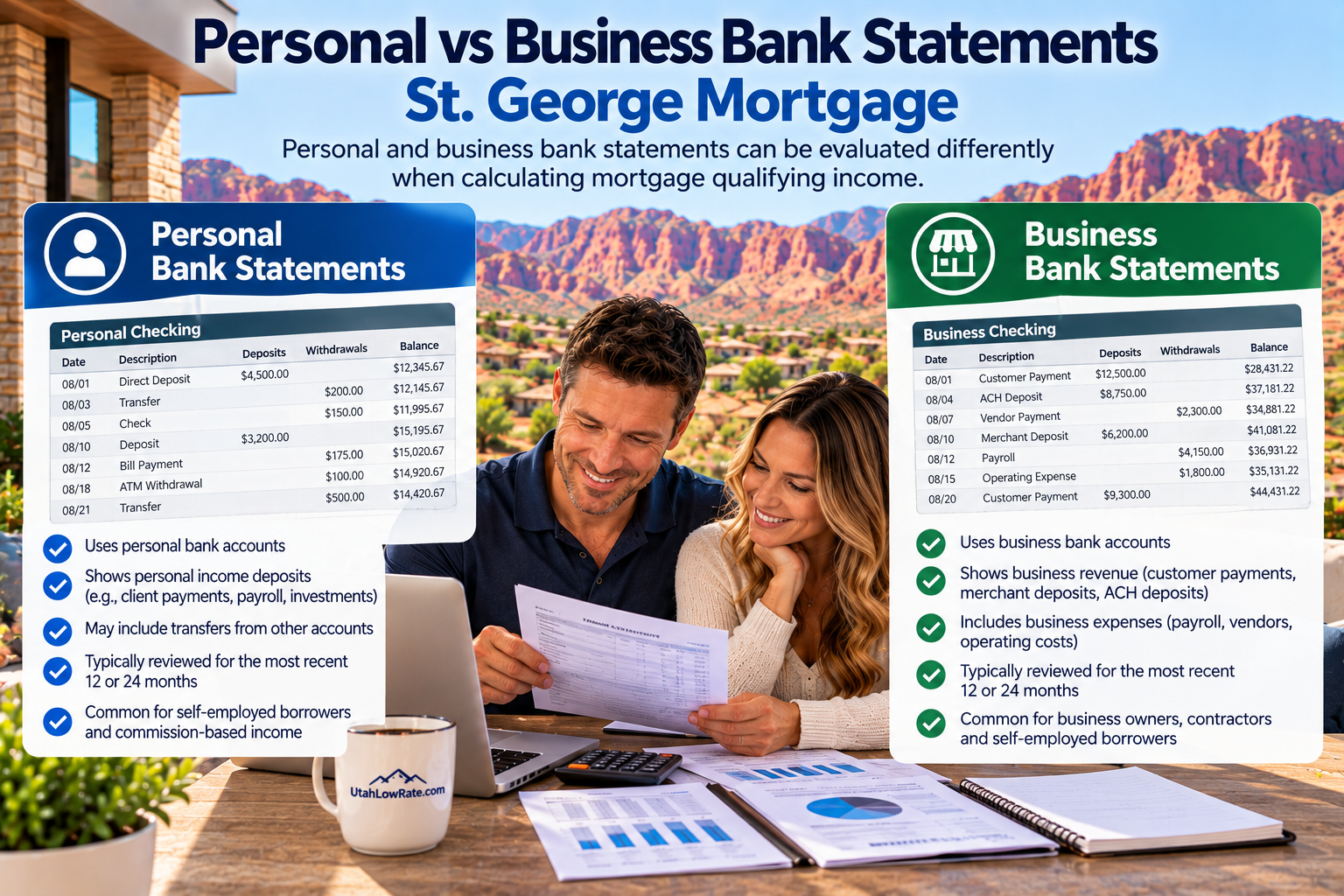
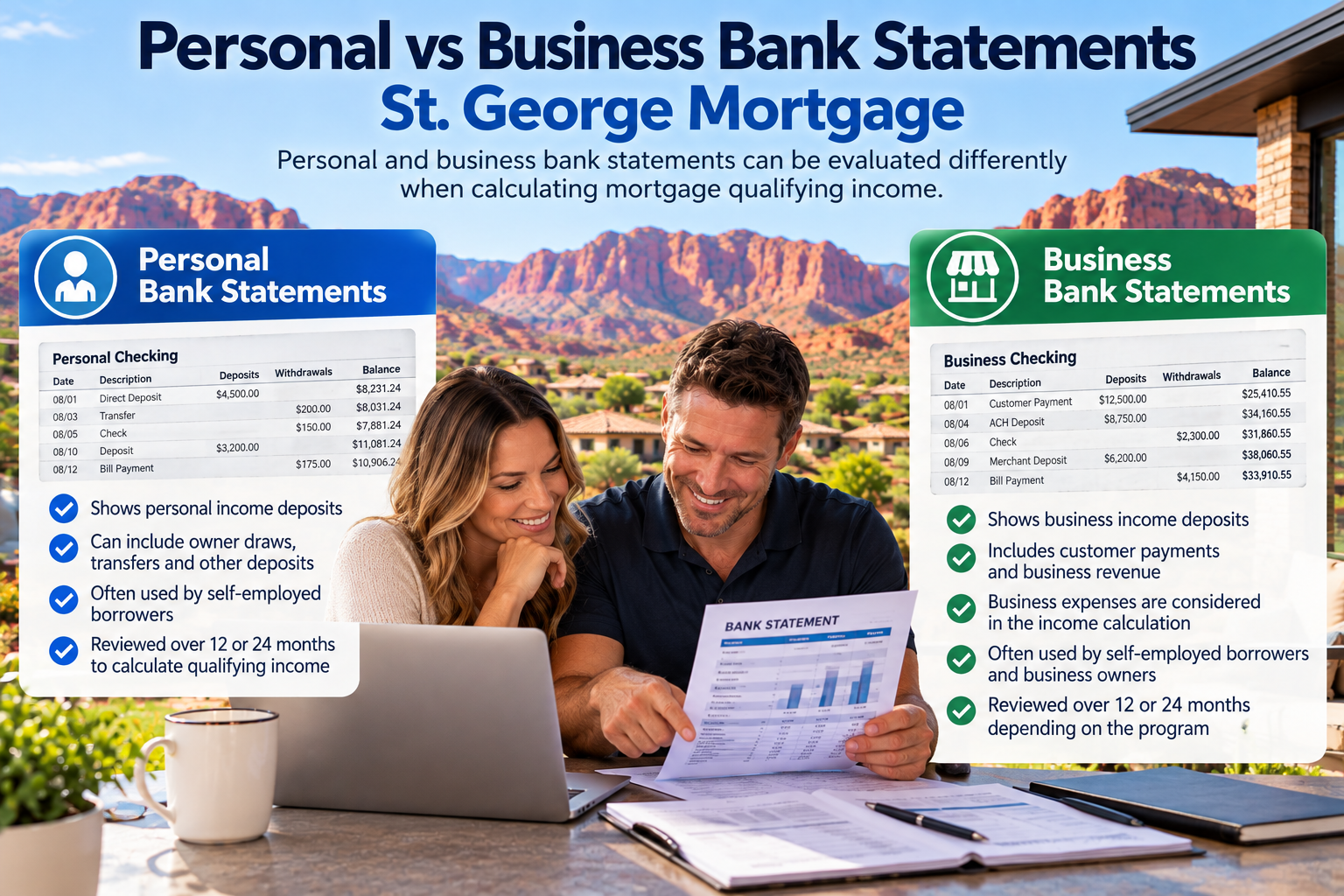
Bank statement mortgage programs can treat personal and business accounts differently.
Personal Bank Statements
Certain programs may allow personal statements when qualifying self-employment income is deposited regularly into a personal account.
The lender reviews the deposits and determines which transactions may represent qualifying recurring income.
Transfers and other non-income deposits generally need to be identified.
Business Bank Statements
Business bank statements may be appropriate when most company revenue flows through an operating account.
Because gross business revenue is not the same as personal income, business expenses generally must be considered.
The exact expense calculation depends on the program.
Can More Than One Account Be Used?
Potentially.
Some borrowers operate through several legitimate accounts.
The lender must carefully identify transfers so the same income is not counted twice.
How Is Bank Statement Mortgage Income Calculated?
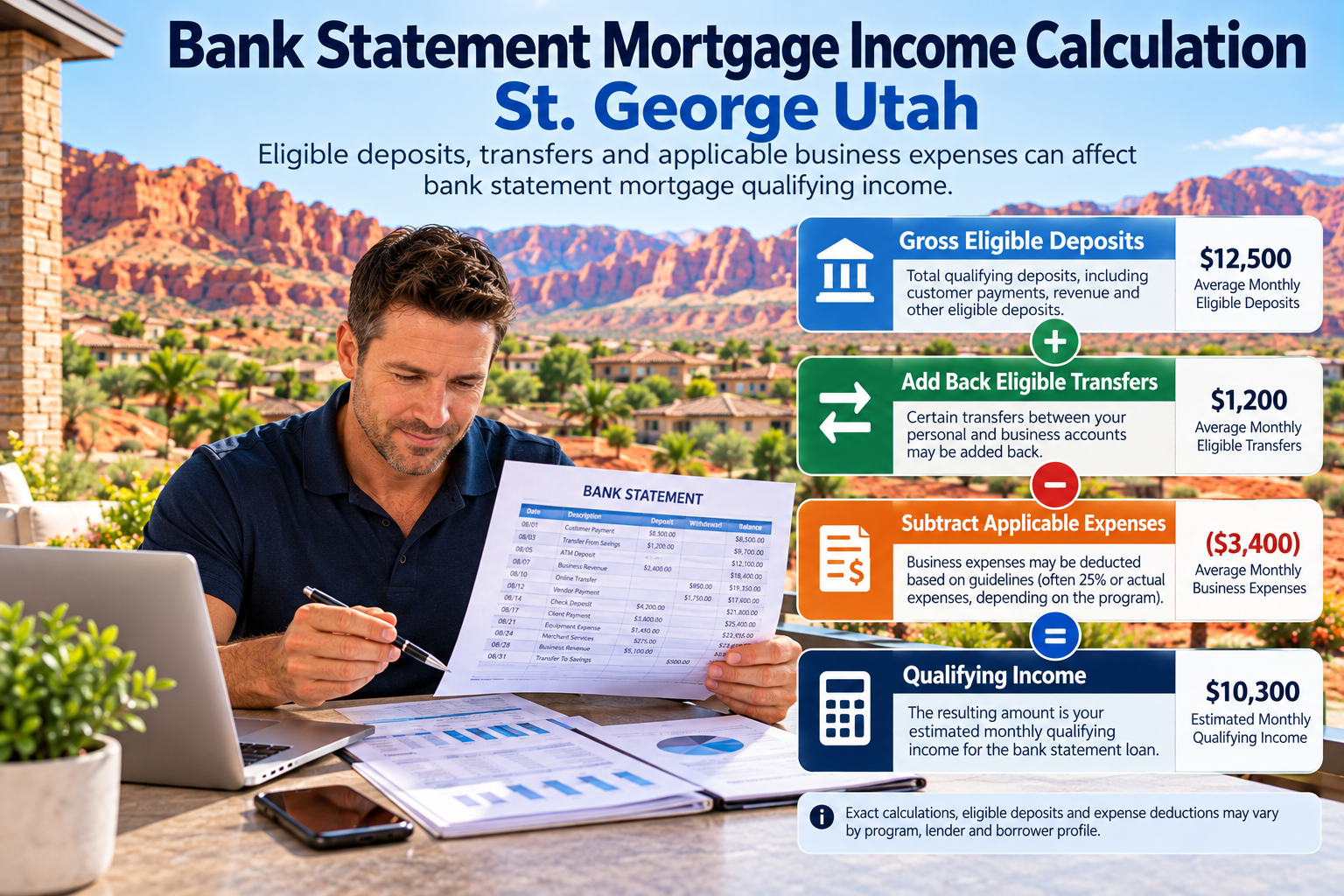
Income calculation is one of the most important parts of a bank statement loan in St. George.
A simplified process looks like this:
Eligible deposits → remove transfers and non-income deposits → apply applicable expense methodology → calculate qualifying deposits → average qualifying monthly income
For example, assume an eligible business averages $40,000 in monthly deposits.
If an applicable program's approved calculation results in 50% of those eligible deposits being treated as qualifying income:
$40,000 × 50% = $20,000 potential qualifying monthly income
Request a Bank Statement Income Review
That is only an illustration.
Another program could produce a different result from the same statements because lenders and investors may use different approved expense calculations.
Your calculation may depend on:
- Business type
- Eligible deposits
- Business expenses
- Ownership percentage
- Account structure
- Statement period
- Transfers
- Deposit consistency
- Investor guidelines
Use the Bank Statement Loan Income Calculator for a preliminary educational estimate before selecting a loan amount.
What Deposits Can Affect a Bank Statement Loan?
The goal of the income review is to identify recurring and supportable income.
Recurring Business Deposits
Deposits tied to legitimate recurring business revenue may potentially be included according to program guidelines.
Transfers
Moving money between your own accounts does not create additional income.
For example, depositing $15,000 into a business account and later moving that same $15,000 to a personal account does not automatically create $30,000 of income.
Large or Unusual Deposits
Large deposits may require additional review or documentation.
Examples can include:
- Loan proceeds
- Transfers
- Refunds
- Reimbursements
- Asset-sale proceeds
- Duplicate deposits
- Large one-time deposits
- Other non-recurring funds
Keeping clean financial records can make the mortgage review easier.
Bank Statement Loan Requirements St. George Utah
There is no single qualification standard that applies to every bank statement mortgage.
Requirements depend on the lender, investor and complete transaction.
Credit
There is no universal minimum credit score for every program.
Available options may change based on credit, LTV, occupancy, loan amount, property and reserves.
Down Payment and LTV
Maximum financing varies.
| Example LTV | Mathematical Down Payment or Equity |
|---|---|
| 90% LTV | 10% |
| 85% LTV | 15% |
| 80% LTV | 20% |
| 75% LTV | 25% |
These figures simply show the mathematical relationship between LTV and equity. They do not mean every borrower or transaction qualifies for each LTV.
Mortgage Reserves
Many alternative-documentation programs require eligible assets remaining after closing.
Reserve requirements can depend on the loan amount, credit profile, occupancy, property, number of financed properties and investor guidelines.
Self-Employment History
Requirements vary by investor.
Certain programs may consider qualified borrowers with a shorter self-employment history, while others require a longer operating history.
Property and Occupancy
Depending on the program, eligible transactions may include primary residences, second homes and investment properties.
Read the complete Bank Statement Loan Requirements Utah guide before applying.
Documents Commonly Needed for a St. George Bank Statement Loan
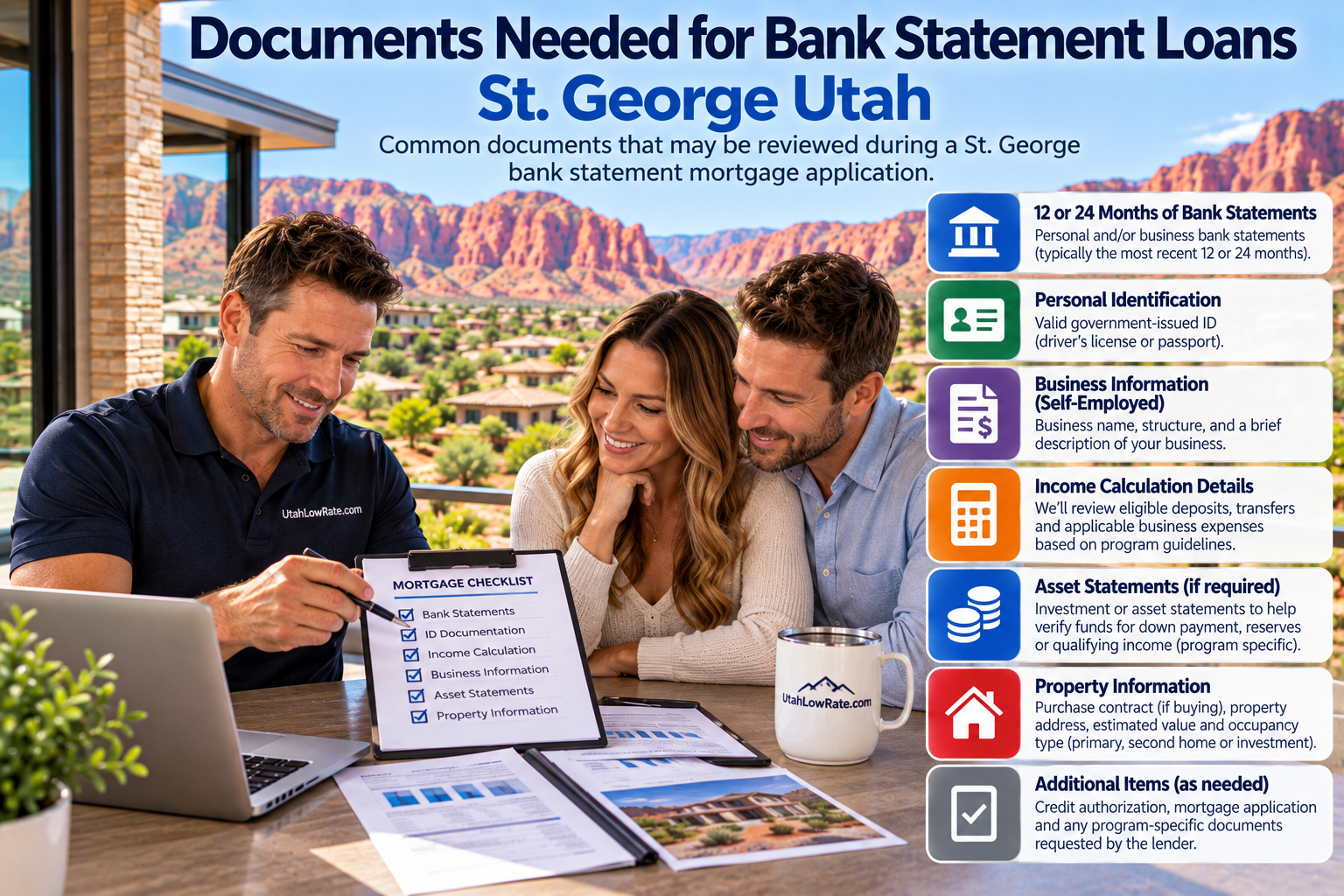
Your exact documentation will depend on the selected program.
A lender may request:
- 12 or 24 months of bank statements
- Identification
- Evidence of self-employment
- Business documentation
- Asset statements
- Down-payment documentation
- Closing-fund documentation
- Reserve documentation
- Explanations for unusual deposits
- Documentation of transfers
- Housing history
- Purchase agreement
- Property information
- Insurance information
- Additional underwriting documents
Alternative documentation does not mean no documentation.
Self-employed borrowers can be asked to provide additional records depending on their financial situation.
Buying a Home in St. George With Bank Statement Income
A preliminary income review can be especially useful before making an offer.
Knowing how an investor may calculate your deposits can help estimate:
- Qualifying monthly income
- Potential purchase range
- Approximate down payment
- Required reserves
- Appropriate statement period
- Personal versus business statement strategy
- Potential loan structure
- Jumbo financing needs
Gross business revenue and mortgage qualifying income are not necessarily the same number.
Having the statements reviewed first can provide a more realistic starting point.
Bank Statement Loans Across St. George and Washington County
Local relevance extends beyond St. George itself.
St. George
Self-employed buyers may use bank statement financing for qualifying primary residences, second homes, investment properties and higher-value homes.
Washington
Qualified borrowers purchasing or refinancing in Washington City may also have access to bank statement mortgage programs.
Ivins
Ivins includes custom and higher-value properties where a self-employed borrower may need both alternative income documentation and higher-balance financing.
Santa Clara
Bank statement programs may provide another qualification method for eligible business owners purchasing or refinancing in Santa Clara.
Hurricane
Self-employed borrowers considering Hurricane and surrounding communities may also qualify under eligible programs.
Desert Color and Little Valley
Growing residential areas such as Desert Color and Little Valley can attract business owners relocating to or purchasing additional property in Southern Utah.
Eligibility is based on the complete borrower, property and mortgage transaction—not simply the city in which the property is located.
Jumbo Bank Statement Loans St. George Utah

Higher-priced Southern Utah properties can create two qualification issues at the same time.
The borrower may need an alternative method of documenting self-employment income and a larger mortgage.
Select investors provide jumbo bank statement loans for qualified self-employed borrowers.
Higher-balance underwriting may place additional emphasis on:
- Credit
- Qualifying income
- Liquidity
- Assets
- Reserves
- Property value
- Appraisal
- Occupancy
- LTV
- Loan amount
Borrowers seeking a larger mortgage should review the income calculation and jumbo guidelines together.
See the Jumbo Bank Statement Loans Utah resource for more information about higher-balance alternative-documentation mortgages.
Bank Statement Loans for St. George Second Homes
Southern Utah can also attract borrowers purchasing second homes.
Select bank statement programs may permit second-home financing for eligible borrowers and properties.
Qualification can depend on:
- Credit
- Loan amount
- LTV
- Property type
- Reserves
- Qualifying income
- Occupancy
- Investor guidelines
A second-home transaction should be reviewed under the actual occupancy rules of the selected program.
Bank Statement Loans for St. George Investment Properties
Certain bank statement programs may finance investment properties.
However, real estate investors may have another option.
Bank Statement Mortgage
A bank statement mortgage generally qualifies the borrower based primarily on eligible personal or business deposit income.
DSCR Mortgage
A DSCR loan generally focuses more heavily on the rental property's qualifying cash flow rather than traditional personal-income documentation.
An investor buying a rental property in St. George, Washington, Ivins or Hurricane may benefit from comparing both structures.
Bank Statement Loan vs. Traditional Mortgage
| Feature | Bank Statement Mortgage | Traditional Mortgage |
|---|---|---|
| Primary income method | Eligible bank deposits | Traditional income documentation |
| Typical borrower | Self-employed | Traditionally documented borrower |
| Bank statements | May calculate income | Often primarily verify assets |
| Business expenses | Can affect calculation | Reflected through traditional income analysis |
| Credit review | Yes | Yes |
| Asset review | Yes | Yes |
| Property review | Yes | Yes |
| Full underwriting | Yes | Yes |
Bank statement financing is not automatically the right choice for every self-employed borrower.
If conventional income documentation supports the requested mortgage, a traditional loan may also deserve consideration.
Purchase, Refinance and Cash-Out Options
Home Purchase
Qualified borrowers may use bank statement financing to purchase an eligible home.
Reviewing income before making an offer can help establish a more realistic financing range.
Rate-and-Term Refinance
Certain programs may allow an existing mortgage to be refinanced using bank statement income.
Cash-Out Refinance
Cash-out bank statement programs may also be available.
Maximum LTV, credit, reserves, seasoning and other requirements can differ from purchase and rate-and-term refinance guidelines.
How to Prepare for a St. George Bank Statement Mortgage
1. Define the Transaction
Determine whether you are purchasing, refinancing or requesting cash out.
Identify the expected property use and approximate loan amount.
2. Gather Your Statements
Collect complete consecutive statements for the accounts most likely to document recurring income.
3. Review Deposits
Separate recurring business revenue from transfers, loan proceeds and other non-income deposits.
4. Estimate Qualifying Income
Apply the appropriate program methodology rather than assuming gross deposits equal mortgage income.
5. Review Credit and Assets
Income is only one part of mortgage qualification.
Credit, debts, reserves, down payment and property also matter.
6. Compare Available Programs
Different wholesale investors may calculate the same bank statements differently.
Comparing appropriate programs can therefore be especially important for self-employed borrowers.
Common Bank Statement Mortgage Mistakes
Counting Transfers as Income
Transfers between accounts can make deposits look larger than actual business revenue.
Assuming Every Deposit Qualifies
Not every deposit represents recurring income.
Using Gross Business Revenue as Personal Income
Business expenses generally must be considered when business statements are used.
Ignoring Reserve Requirements
Funds needed after closing can be separate from the down payment and closing costs.
Waiting Until After Making an Offer
A preliminary statement review can identify qualification issues before the borrower is under contract.
Choosing a Program Based Only on Rate
Interest rate matters, but so do qualifying income, LTV, reserves, fees, loan structure and underwriting requirements.
Explore the Utah Bank Statement Loan Resource Center
This St. George page should function as the Southern Utah location spoke within the larger bank statement mortgage cluster.
Continue with these resources:
Bank Statement Loans Utah
Statewide hub explaining how Utah bank statement mortgages work.
Bank Statement Loan Requirements Utah
Detailed information about statements, documentation, credit, LTV, reserves and underwriting.
Bank Statement Loan Income Calculator
Estimate how eligible deposits and expenses can affect potential qualifying income.
Bank Statement Loan FAQ
Answers to common self-employed mortgage questions.
Jumbo Bank Statement Loans Utah
Higher-balance bank statement financing for qualified self-employed borrowers.
Other Local Bank Statement Mortgage Guides
Borrowers researching other Utah markets can also visit:
- Bank Statement Loans Salt Lake City
- Bank Statement Loans Park City Utah
- Bank Statement Loans Heber City Utah
- Bank Statement Loans Utah County & Lehi
This internal-link structure connects the St. George page back to the statewide hub while also linking laterally to the most relevant supporting resources.
Frequently Asked Questions About Bank Statement Loans St. George Utah
Can I qualify using 12 months of bank statements?
Potentially. Certain programs allow approximately 12 months of consecutive statements when the borrower satisfies the remaining requirements.
Can I use 24 months of bank statements?
Yes. Some programs use approximately 24 months of statements to establish a longer income history.
Can I use personal bank statements?
Potentially. Certain programs permit personal statements when qualifying self-employment income is deposited into the account.
Can I use business bank statements?
Yes, under qualifying programs. Business expenses generally must be considered when calculating qualifying income.
Do I need tax returns for a bank statement mortgage?
Certain bank statement programs may calculate qualifying income primarily from eligible deposits instead of traditional tax-return income. Other documentation and full underwriting requirements still apply.
Are bank statement loans available for jumbo mortgages in St. George?
Yes. Select investors provide jumbo bank statement financing for qualified self-employed borrowers seeking larger mortgage amounts.
Can I use a bank statement mortgage to buy a home in Ivins?
Potentially. Eligibility depends on the borrower, property, loan amount, occupancy and program rather than the city alone.
Are bank statement loans available in Washington City?
Potentially. Qualified borrowers may have access to bank statement mortgage programs for eligible Washington City properties.
Can I refinance a St. George property using bank statement income?
Potentially. Select programs offer rate-and-term and cash-out refinance options subject to applicable guidelines.
What credit score do I need?
There is no single minimum credit score that applies to every bank statement mortgage. Requirements vary by investor and transaction.
Are bank statement mortgage rates different from conventional rates?
They can be. Pricing depends on market conditions and factors such as credit, LTV, occupancy, loan amount, property type and documentation.
How do I estimate my bank statement income?
Start by identifying recurring eligible deposits, removing transfers and non-income transactions, applying the appropriate expense methodology and averaging qualifying income over the required period.
For additional questions, visit the Bank Statement Loan FAQ.
Talk With a St. George Bank Statement Mortgage Broker
If you are self-employed and buying or refinancing in St. George, Washington, Ivins, Santa Clara, Hurricane, Desert Color, Little Valley or another Southern Utah community, a bank statement mortgage may be worth comparing with traditional financing.
Daniel Paris can review your personal or business bank statements and compare available mortgage programs based on your income structure, credit, assets, reserves, loan amount, property and occupancy.
Daniel Paris
Utah Mortgage Broker
NMLS #243976
UtahLowRate.com
801-604-4949
Get a Bank Statement Loan Review
Ask about Bank Statement Loans St. George Utah for purchases, refinances, higher-value properties and qualifying self-employed borrowers.
All mortgage programs are subject to borrower qualification, underwriting, investor guidelines, property eligibility and program availability. Rates, terms, credit requirements, LTV limits, reserve requirements and documentation requirements can change. This information is educational and is not a commitment to lend or guarantee of approval.
Request a Bank Statement Income Review · Call Daniel Paris: 801-604-4949

