
Bank statement mortgage options for self-employed Utah homebuyers and homeowners.
Content updated: .
Bank statement loans in Utah may offer another way to document income when tax returns do not fully reflect recurring business cash flow. Eligible programs analyze personal or business bank deposits alongside credit, debts, assets, and the property.
Daniel Paris at UtahLowRate.com helps business owners, entrepreneurs, contractors, and other self-employed borrowers compare wholesale mortgage options for purchases, refinances, and qualifying jumbo transactions throughout Utah.
Daniel Paris · Utah Mortgage Broker · NMLS #243976
801-604-4949
Request a Bank Statement Income Review
What Is a Bank Statement Loan in Utah?
A bank statement loan is an alternative-documentation mortgage for qualifying self-employed borrowers. A lender may analyze eligible deposits from 12 or 24 months of personal or business statements rather than rely primarily on tax-return income. Approval also depends on credit, debts, down payment or equity, reserves, and property eligibility. Full documentation and underwriting are required.
Utah Bank Statement Loan Quick Facts
| Feature | What to Expect |
|---|---|
| Borrower | Qualifying self-employed borrowers |
| Income records | Eligible personal or business bank deposits |
| Statement period | Commonly 12 or 24 months, depending on the program |
| Loan purposes | Purchase, rate-and-term refinance, or cash-out under eligible programs |
| Occupancy | Primary home, second home, or investment property under selected programs |
| Jumbo financing | Available through selected investors; loan limits vary |
| Credit, LTV, and reserves | Depend on the investor and complete transaction |
Program availability and requirements can change. Request a current, property-specific review before relying on a qualification estimate.

How Do Utah Bank Statement Loans Work?
Traditional self-employed mortgage underwriting often uses tax returns and established income calculations. Business deductions can reduce taxable income even when a business generates substantial recurring revenue. A bank statement program evaluates a different set of income records.
The lender identifies eligible deposits, excludes transactions that do not represent qualifying revenue, and applies its approved expense method when appropriate. The resulting income must support the requested loan alongside your other financial obligations.
Personal vs. Business Bank Statements
Personal statements may be appropriate when eligible self-employment income is regularly deposited into a personal account. Business statements may be appropriate when customers pay your business directly. Gross business revenue generally requires an expense analysis before it becomes qualifying income.
Some programs may allow multiple business accounts. Account ownership, business ownership, and transfers must be documented so the same funds are not counted twice.
How Is Bank Statement Mortgage Income Calculated?
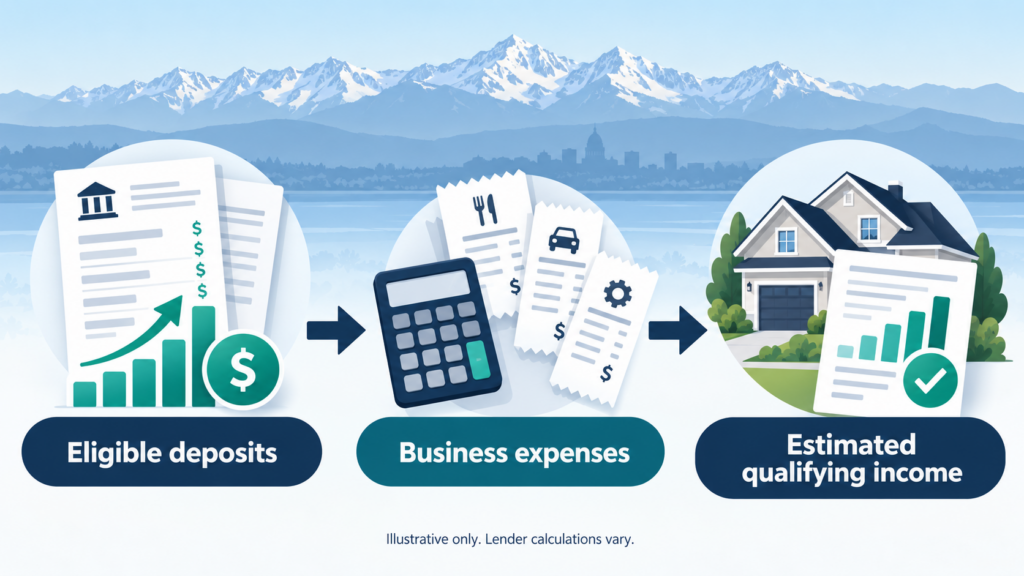
Start with eligible deposits rather than the account's total inflows. Lenders review where the money came from, whether it is recurring, and which expense calculation the program permits. Business type, ownership, statement history, and supporting records can affect the result.
Use the Bank Statement Loan Income Calculator to explore the math before requesting a lender review.
Illustrative Income Calculation
Suppose a business has $240,000 in eligible deposits over 12 months. Average eligible deposits are $20,000 per month. If a hypothetical program applies a 50% expense deduction, the estimated income after that deduction is $10,000 per month.
$240,000 ÷ 12 × 50% = $10,000 per month
This is a mathematical illustration, not an approved income figure or an advertised lender guideline. The actual calculation may differ and may require additional adjustments.
Request a Bank Statement Income Review
Are Transfers Counted as Income?
Moving money between your own accounts generally does not create new income. If a client pays $10,000 into your business account and you transfer it to your personal account, those transactions should not turn one payment into $20,000 of revenue.
Loan proceeds, asset-sale proceeds, refunds, and unusually large deposits may need separate review. Provide explanations and records that show the source of funds.
12-Month vs. 24-Month Bank Statement Loans
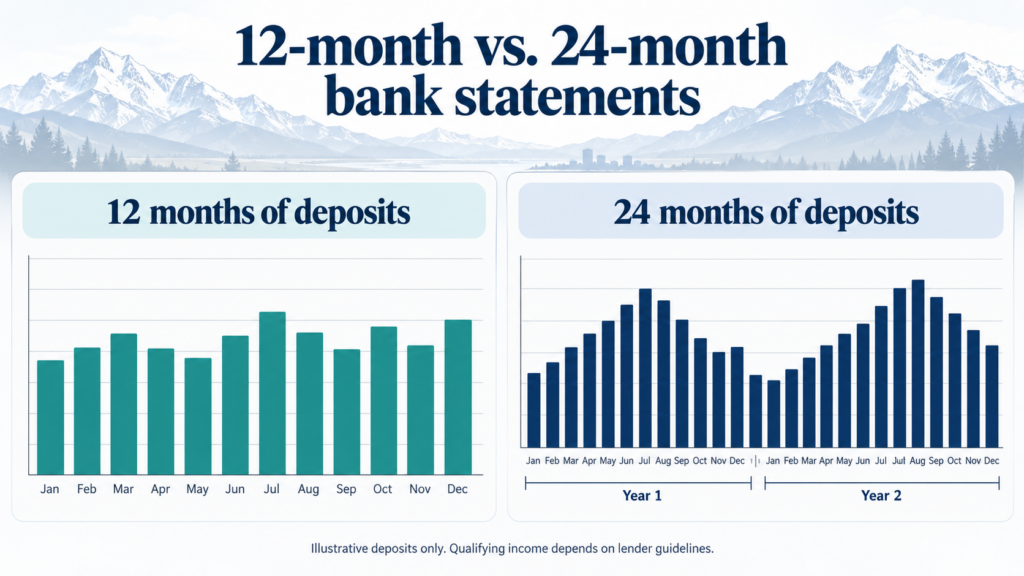
The right statement period depends on your business history, deposit trends, and available programs. Review the 12-month versus 24-month bank statement loan guide before choosing a documentation path.
| Situation | What to Compare |
|---|---|
| Revenue has grown | Whether the latest 12 months support a reliable current-income calculation |
| Revenue is seasonal | How a 24-month history shows repeated business cycles |
| Deposits are declining | Whether an older strong year overstates current income |
| Several accounts are used | Which accounts document eligible deposits without duplication |
A shorter period does not guarantee a larger approval. A longer period does not automatically overcome declining revenue. The lender must evaluate the trend and its own requirements.
Bank Statement Loan Requirements in Utah
Read the Bank Statement Loan Requirements guide for a detailed checklist. The lender evaluates the complete transaction, including income, liabilities, assets, and property.
Credit, Down Payment, and Reserves
There is no universal minimum credit score or maximum loan-to-value ratio for all bank statement loans. Requirements depend on loan amount, occupancy, property type, transaction purpose, mortgage history, and investor guidelines.
LTV compares the loan amount with the value used for underwriting. As a simple purchase illustration, an 80% LTV loan on a $500,000 value is $400,000, leaving $100,000 of down payment before closing costs. This explains the math; it does not establish program availability.
Reserves are eligible assets remaining after closing. Required amounts vary, and larger or more complex loans may require greater liquidity.
Documents for an Initial Review
- Complete statements for the account and period being evaluated
- A description of the business, ownership, and how clients pay
- Explanations and records for transfers and unusual deposits
- Evidence of self-employment and business history
- Information about debts, available down payment, equity, and assets
- Property location, purchase price or estimated value, and desired loan amount
Identification, housing history, asset statements, purchase contracts, and other records may also be required. An initial review does not replace complete underwriting.
Can You Qualify Without Traditional Tax-Return Income?
Some programs may establish income through bank deposits rather than primarily through tax-return calculations. The selected lender determines which additional records are required. Self-employment history must also meet that program's rules; a recently opened business needs an individual review.
Purchase, Refinance, and Occupancy Options
Buying a Utah Home
Have your income reviewed before making an offer. Business revenue and mortgage qualifying income can differ, so an early calculation helps establish a realistic price range.
Rate-and-Term and Cash-Out Refinancing
Eligible programs may refinance existing mortgage debt or allow access to home equity. Cash-out can involve different credit, LTV, reserve, and seasoning requirements. Compare the complete costs and terms before selecting a refinance.
Primary Homes, Second Homes, and Rentals
Occupancy eligibility varies by investor. For rental properties, also compare DSCR mortgage loans in Utah. Bank statement financing analyzes the borrower's eligible deposit income; DSCR financing generally focuses on the property's qualifying rental cash flow.
Jumbo Bank Statement Loans Utah
A larger loan and alternative income documentation may both be needed for a higher-value home. Review jumbo bank statement loans in Utah for purchases and refinances involving eligible self-employed borrowers.
These options can be relevant in Park City, Deer Valley, Salt Lake City, Holladay, Draper, Alpine, Highland, Heber City, and Midway. Investor review includes income, credit, down payment or equity, liquidity, reserves, occupancy, and appraisal.
Maximum loan amounts and available terms depend on the specific program and property. Request a current comparison for your actual loan amount.

Bank Statement Loans vs. Other Mortgage Options
Self-employment alone does not make alternative documentation the best choice. Compare conventional mortgage loans in Utah when traditional income records support qualification.
| Program | Income Approach | What to Review |
|---|---|---|
| Bank statement | Eligible deposits and approved expense analysis | Deposit quality, business history, and investor rules |
| Conventional | Traditional income documentation under applicable guidelines | Tax-return income and complete qualification |
| DSCR | Qualifying rental-property cash flow | Rent evidence, payment, property, and investor rules |
| Other alternative documentation | Approved 1099, P&L, or asset methodology | Documentation eligibility and total financing costs |
Compare rate, fees, required reserves, qualifying income, loan amount, and any prepayment terms. A program with a flexible income calculation may still be a poor fit if other requirements do not match your transaction.
Bank Statement Mortgage Loans Throughout Utah
UtahLowRate.com helps eligible borrowers statewide. Local resources explain considerations for different properties and financing needs.
- Salt Lake City bank statement loans — Salt Lake County, including Holladay, Millcreek, Murray, Sandy, Draper, and surrounding communities.
- Park City bank statement loans — Park City, Deer Valley, Old Town, Canyons Village, and nearby Summit County communities.
- Heber City and Wasatch Back bank statement loans — Heber City, Midway, Jordanelle, Hideout, and nearby markets.
- St. George bank statement loans — St. George, Washington, Ivins, Santa Clara, Hurricane, and Southern Utah.
- Utah County and Lehi bank statement loans — Lehi, Provo, Orem, American Fork, Alpine, Highland, and surrounding communities.
How Does Bank Statement Mortgage Preapproval Work?
- Define the transaction. Identify purchase or refinance, property, occupancy, and loan amount.
- Review the documentation. Determine which accounts and income method fit your business.
- Analyze eligible deposits. Identify income, transfers, and items needing explanations.
- Compare programs. Evaluate income calculations, credit, LTV, reserves, costs, and terms.
- Complete underwriting. Supply the required records and satisfy appraisal, title, insurance, and lender conditions.
Common Mistakes to Avoid
Do not count transfers twice, assume all deposits qualify, or treat gross revenue as personal income. Explain unusual transactions, organize business and personal records, and review income before shopping for a home.
Ask for the complete terms rather than comparing rate alone. Approval remains subject to the full borrower, property, and transaction review.
Bank Statement Loans Utah FAQ
What is a bank statement mortgage loan?
A bank statement mortgage is an alternative-documentation loan that may allow qualifying self-employed borrowers to establish income using eligible deposits from personal or business bank statements.
Can I qualify without using traditional tax-return income?
Potentially. Certain programs may use a bank-deposit analysis instead of relying primarily on traditional tax-return income. Full documentation and underwriting are still required.
How many months of bank statements do I need?
Many programs evaluate either 12 or 24 months of statements. Requirements depend on the investor and borrower profile.
Can I use business bank statements?
Yes, under qualifying programs. Business expenses generally must be considered when determining qualifying income.
Can I use personal bank statements?
Certain programs permit personal bank statements when they appropriately document qualifying income.
Is there a standard percentage of business deposits that counts as income?
No single percentage applies to every program. The lender identifies eligible deposits and applies the expense method permitted by the selected investor. Your business and supporting records can affect the result.
What credit score is needed?
There is no universal bank statement loan minimum. Credit requirements depend on LTV, loan amount, occupancy, property, reserves and investor guidelines.
Can I get a jumbo bank statement mortgage?
Yes. Select investors provide jumbo bank statement financing for qualified self-employed borrowers, including certain multi-million-dollar transactions.
Can I refinance with bank statements?
Certain programs offer rate-and-term and cash-out refinancing.
Are bank statement loans only for primary homes?
No. Depending on investor guidelines, programs may be available for primary residences, second homes and investment properties.
Read the complete Bank Statement Loan FAQ for additional questions.
Bank Statement Loan Planning Resources
Prepare your application with our Utah bank statement loan document checklist. Compare business expense factors and CPA letters to understand how eligible deposits become qualifying income. If your business is newer, review one-year self-employed bank statement loan options and the separate work-history requirements.
Get a Bank Statement Mortgage Review in Utah
Find out how your eligible deposits may be evaluated before choosing a mortgage. Daniel Paris can review your loan objective, business income records, credit, assets, and property and compare relevant wholesale options.
Request a Bank Statement Income Review
Prefer to call? 801-604-4949
Daniel Paris · Utah Mortgage Broker · NMLS #243976
All programs are subject to borrower qualification, underwriting, investor guidelines, property eligibility, and availability. Rates, terms, documentation, LTV, credit, and reserve requirements may change. Educational examples are not a commitment to lend or a guarantee of approval.

