
Content updated: .
Bank statement loan questions are common among self-employed borrowers because mortgage guidelines can vary significantly between lenders and investors. This Bank Statement Loan FAQ answers 50 common questions about bank statement mortgages, including income calculations, 12- vs. 24-month statements, personal and business accounts, credit, down payment, reserves, jumbo loans, refinancing and underwriting.
Bank statement loans are generally designed for qualifying self-employed borrowers whose recurring cash flow may not be fully represented by traditional tax-return income calculations.
Quick Answer: A bank statement mortgage may allow an eligible self-employed borrower to document qualifying income using deposits from personal or business bank statements rather than relying primarily on traditional tax-return income. Depending on the program, lenders may review 12 or 24 months of statements, eligible deposits, business expenses, credit, assets, reserves, property type and loan-to-value.
For the complete statewide overview, visit our Bank Statement Loans Utah guide.
Daniel Paris
Utah Mortgage Broker
NMLS #243976
UtahLowRate.com
801-604-4949
Request a Bank Statement Income Review
Bank Statement Mortgage Quick Facts
| Topic | General Answer |
|---|---|
| Primarily designed for | Self-employed borrowers |
| Income documentation | Eligible personal or business bank deposits |
| Common statement periods | 12 or 24 months |
| Personal statements | May be permitted |
| Business statements | May be permitted |
| Tax returns | May not be the primary income-calculation method |
| Transfers | Generally identified to prevent double counting |
| Business expenses | May affect qualifying income |
| Primary residence | May be eligible |
| Second home | Select programs |
| Investment property | Select programs |
| Purchase | May be available |
| Rate-and-term refinance | May be available |
| Cash-out refinance | May be available |
| Jumbo financing | Available through select programs |
| Credit requirements | Investor-specific |
| Reserves | Often required |
| Final approval | Subject to complete underwriting |
Important: Mortgage programs, credit requirements, LTV limits, loan amounts, reserves and documentation requirements vary by lender and investor and are subject to change.
Bank Statement Loan Basics
1. What is a bank statement mortgage?
A bank statement mortgage is an alternative-documentation mortgage that may allow an eligible self-employed borrower to establish qualifying income using deposits shown on personal or business bank statements.
Instead of relying primarily on traditional tax-return income calculations, the lender analyzes eligible recurring deposits over a specified period.
The exact calculation depends on the lender or investor.
2. Who are bank statement loans designed for?
Bank statement loans are primarily designed for qualifying self-employed borrowers whose tax returns may not fully represent the recurring cash flow available to support a mortgage.
Potential borrowers can include business owners, entrepreneurs, consultants, independent contractors, real estate professionals, medical professionals, attorneys, contractors and other self-employed individuals.
3. Do bank statement loans require tax returns?
Certain bank statement programs may calculate qualifying income without relying primarily on traditional personal tax-return income.
That does not mean every program eliminates every tax-related document.
Requirements depend on the lender, investor, business structure and borrower profile.
4. Are bank statement loans no-doc mortgages?
No.
A bank statement mortgage is not a no-documentation mortgage.
Borrowers still go through underwriting and may need to provide bank statements, identification, asset documentation, evidence of self-employment, property information and other supporting documents.
For a detailed qualification checklist, see our Bank Statement Loan Requirements Utah guide.
12-Month vs. 24-Month Bank Statement Loans
5. How many months of bank statements are usually required?
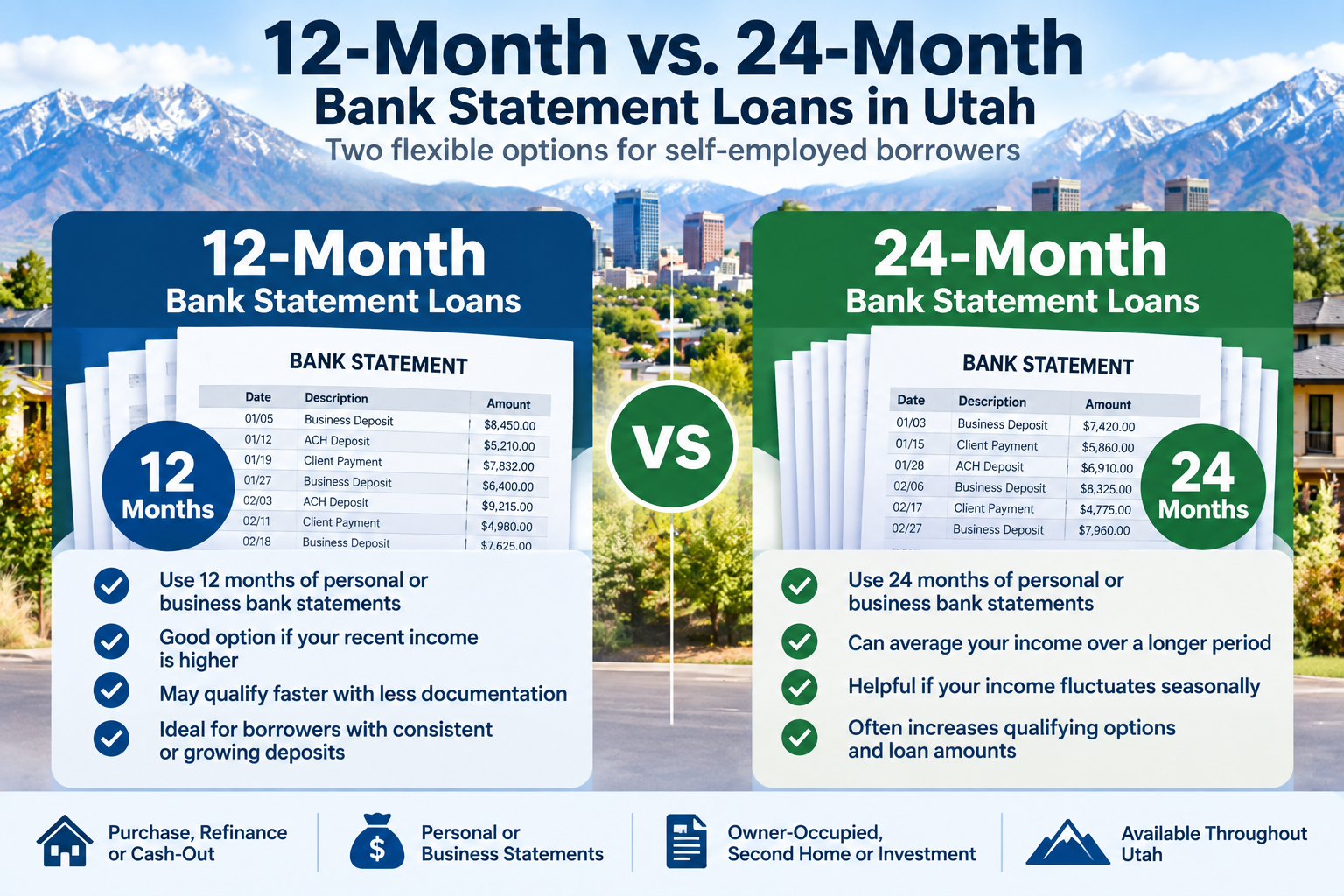
Many bank statement mortgage programs review either 12 or 24 months of consecutive bank statements.
The required period depends on the investor and loan program.
6. Is a 12-month bank statement loan better?
Not automatically.
A 12-month analysis can sometimes better represent recent business performance. A different investor may require or prefer a longer history.
The appropriate option depends on the borrower, business history and applicable program.
7. Why would a lender use 24 months of bank statements?
Twenty-four months can provide a broader view of:
- Business cash flow
- Seasonal income
- Deposit consistency
- Revenue trends
- Business stability
- Unusual fluctuations
A longer statement history does not automatically mean the borrower will qualify for more income.
Personal vs. Business Bank Statements
8. Can I use personal bank statements?
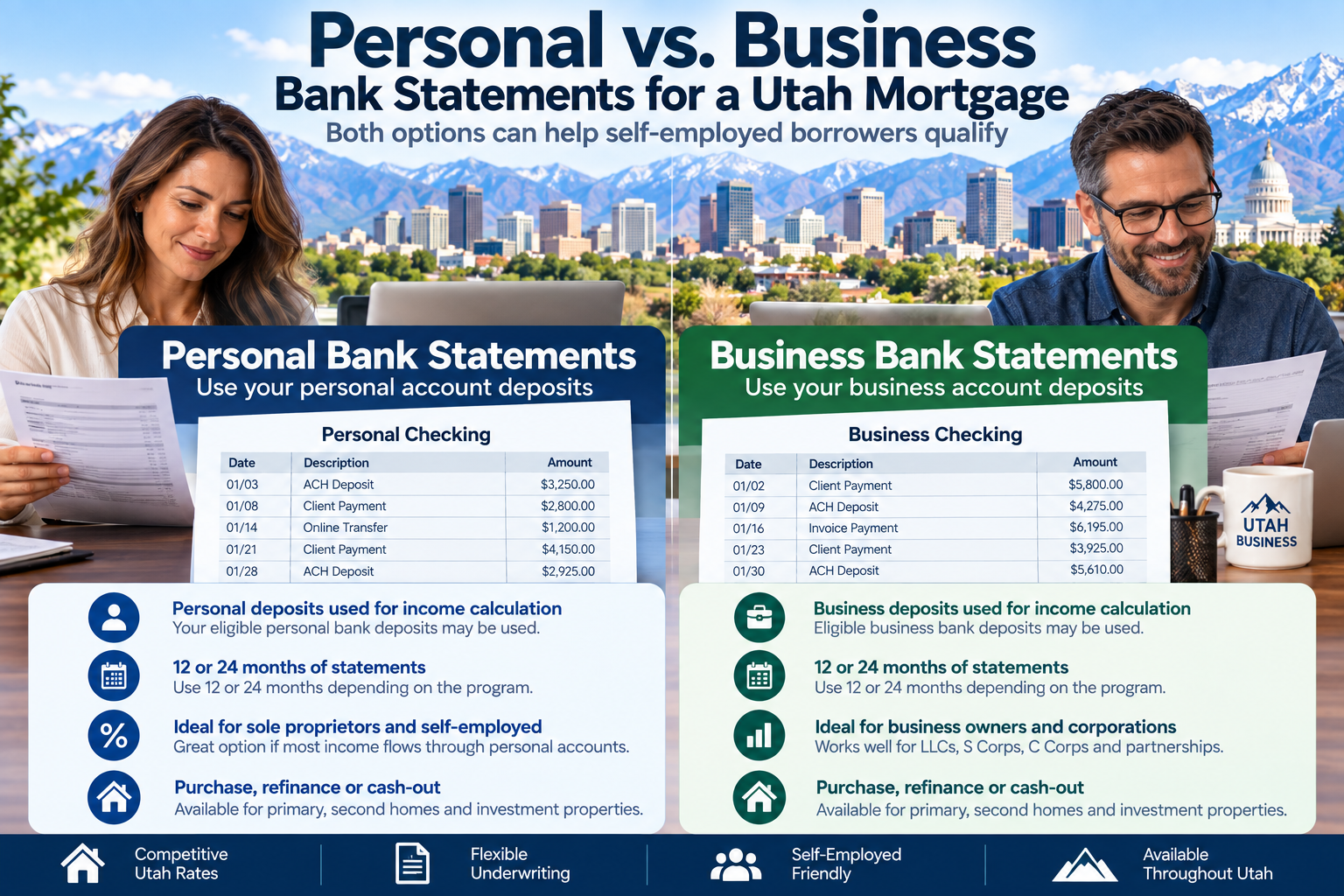
Certain bank statement mortgage programs permit qualifying borrowers to use personal bank statements.
The lender reviews the source, consistency and eligibility of deposits according to the program guidelines.
9. Can I use business bank statements?
Yes, under many qualifying bank statement programs.
Because business accounts generally reflect gross business revenue rather than the borrower's personal income, the lender typically applies an approved business-expense methodology.
10. Can I use multiple business bank accounts?
Potentially.
If multiple accounts are reviewed, transfers between those accounts generally need to be identified so the same money is not counted twice.
Eligible Bank Statement Deposit Questions
11. Does every deposit count as mortgage income?
No.
Not every deposit appearing on a bank statement necessarily represents recurring qualifying income.
A lender may identify or exclude transactions such as:
- Account transfers
- Loan proceeds
- Asset-sale proceeds
- Refunds
- Reimbursements
- Duplicate deposits
- Unusual one-time deposits
12. Do transfers count as income?
Generally, moving money between accounts owned by the same borrower does not create new income.
Transfers are normally identified to help prevent the same funds from being counted more than once.
13. What happens with large or unusual deposits?
Large or unusual deposits may need to be documented, explained or excluded.
Treatment depends on the source of the funds and the selected program.
14. Are loan proceeds counted as income?
Borrowed money generally does not represent recurring business income.
Loan proceeds may therefore be excluded from eligible deposits.
Bank Statement Loan Income Calculation Questions
15. How is income calculated for a bank statement mortgage?
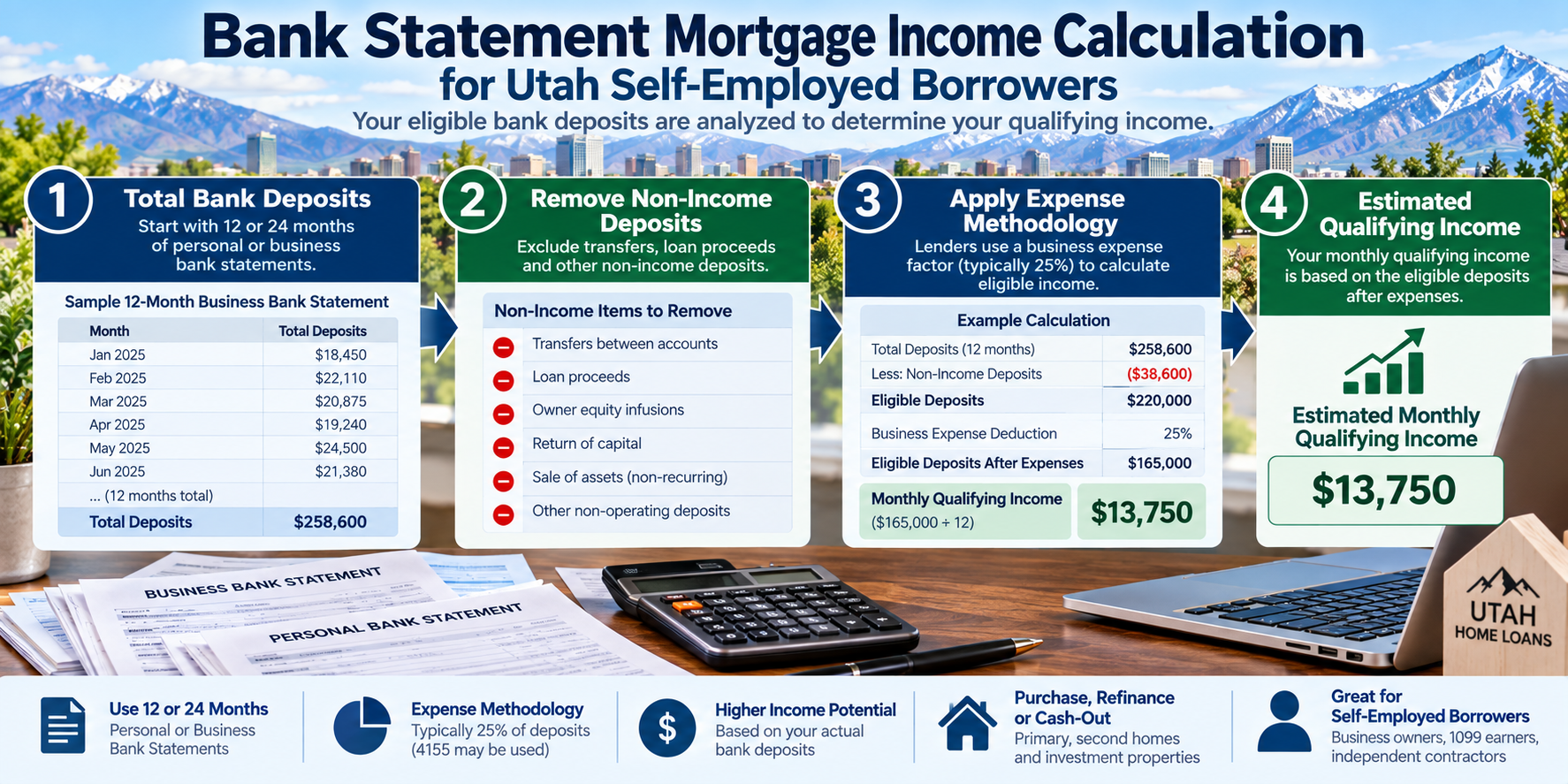
Although methods vary, the general process can include:
- Reviewing the required statement period.
- Identifying eligible recurring deposits.
- Removing transfers and other non-income transactions.
- Calculating average eligible monthly deposits.
- Applying the applicable business-expense methodology when required.
- Determining estimated qualifying monthly income.
Use our Bank Statement Loan Income Calculator for an educational example.
16. Can business expenses reduce qualifying income?
Yes.
Gross business deposits are not necessarily equivalent to personal income available for mortgage qualification.
The lender generally needs to account for applicable operating expenses.
17. Can a lender use an expense factor?
Certain investors use established expense methodologies, while other qualifying programs may permit another approach when supported by acceptable documentation.
The method is investor-specific.
18. Can 100% of business deposits be used?
Do not assume 100% of gross business deposits will become qualifying income.
Business revenue normally includes operating expenses. The lender must use the methodology permitted by the applicable program.
Bank Statement Loan Credit Score Questions
19. What credit score do I need for a bank statement loan?
There is no universal minimum credit score for every bank statement mortgage.
Credit requirements can depend on:
- Lender and investor
- Loan amount
- LTV
- Occupancy
- Property type
- Mortgage history
- Reserves
- Overall borrower profile
20. Can I qualify with a 680 credit score?
Potentially.
Certain programs may provide options for qualifying borrowers around this credit range, but credit score alone does not determine approval.
21. Can I qualify with a 660 credit score?
Potentially.
Some programs may offer options around this credit range subject to applicable LTV, loan amount, occupancy, reserves and other underwriting requirements.
Program availability changes and should be verified for the actual transaction.
Bank Statement Loan Down Payment and LTV Questions
22. How much down payment is required?
Down payment generally corresponds to the maximum LTV available under the selected program.
For example:
| Maximum LTV | Approximate Equity/Down Payment |
|---|---|
| 90% | 10% |
| 85% | 15% |
| 80% | 20% |
| 75% | 25% |
These are mathematical LTV examples, not guaranteed program offerings.
23. Can bank statement mortgages offer 90% LTV?
Maximum financing depends on the selected lender and the complete borrower, property and transaction. Request a current review of credit, LTV, loan amount, occupancy and reserves.
This is not a universal bank statement loan guideline.
Eligibility can depend on credit, loan amount, occupancy, property, reserves and current investor guidelines.
24. Are reserves required?
Many bank statement mortgage programs require post-closing reserves.
The required amount can depend on loan size, occupancy, property type, credit, number of financed properties and investor guidelines.
Jumbo loans may have additional liquidity requirements.
Purchase, Refinance and Cash-Out Questions
25. Can I purchase a home with a bank statement loan?
Yes, qualifying bank statement programs may be available for home purchases.
26. Can I refinance using bank statements?
Certain programs permit bank statement income documentation for eligible refinance transactions.
27. Can I get a bank statement cash-out refinance?
Potentially.
Select investors offer cash-out refinancing using qualifying bank statement documentation.
Cash-out LTV, credit, reserve and seasoning requirements can differ from purchase requirements.
28. Can bank statement loans be used to consolidate debt?
A qualifying cash-out refinance may provide proceeds that a borrower can choose to use for eligible purposes, subject to the applicable program and transaction requirements.
The mortgage should be evaluated based on the complete financial impact rather than the availability of cash alone.
Property and Occupancy Questions
29. Can I use a bank statement loan for a primary residence?
Yes, qualifying programs may be available for owner-occupied primary residences.
30. Can I finance a second home?
Certain bank statement programs permit qualifying second homes.
31. Can I finance an investment property?
Certain programs permit investment properties.
Real-estate investors may also want to compare a DSCR loan, which generally focuses on qualifying property cash flow rather than the borrower's bank-statement income.
32. Are condos eligible?
Potentially.
Condo eligibility depends on the property and investor guidelines in addition to borrower qualification.
33. Are unique or luxury properties eligible?
Potentially, although specialized or higher-value properties can require additional underwriting and appraisal review.
Jumbo Bank Statement Loan Questions

34. Can I get a jumbo bank statement loan?
Yes.
Select investors provide jumbo bank statement mortgages for qualifying self-employed borrowers needing larger loan amounts.
See our Jumbo Bank Statement Loans Utah guide for additional details.
35. How large can a jumbo bank statement loan be?
There is no single maximum amount applicable to every investor.
Maximum financing can depend on:
- Qualifying income
- Credit
- LTV
- Property value
- Occupancy
- Assets
- Liquidity
- Reserves
- Investor guidelines
36. Are jumbo bank statement loans available in Park City?
Select programs may be available for qualified self-employed borrowers purchasing or refinancing higher-value properties in Park City, Deer Valley and surrounding Summit County communities.
Visit Bank Statement Loans Park City Utah for local information.
37. Do jumbo loans require more reserves?
They can.
Larger mortgage transactions can carry greater liquidity and reserve requirements depending on the investor and overall borrower profile.
38. Can I use business statements for a jumbo mortgage?
Yes, under qualifying programs.
Business deposits generally require an applicable expense analysis before qualifying income is established.
Bank Statement Mortgage Rate Questions
39. Are bank statement mortgage rates higher than conventional rates?
They can be.
Mortgage pricing can be affected by:
- Current mortgage markets
- Credit
- LTV
- Occupancy
- Property type
- Loan amount
- Documentation type
- Investor
- Points and fees
- Mortgage structure
Compare actual available loan terms for your specific scenario rather than assuming a fixed difference between conventional and bank statement pricing.
40. Is a bank statement loan better than conventional financing?
Neither is automatically better.
If a borrower qualifies efficiently for conventional financing, it may provide attractive terms.
A bank statement mortgage may provide another option when traditional tax-return income calculations do not adequately represent the borrower's recurring self-employment cash flow.
Compare both structures when possible.
Bank Statement Loan Documentation Questions
41. What documents do I need?
Depending on the program, documentation may include:
- 12 or 24 months of bank statements
- Government-issued identification
- Asset documentation
- Evidence of self-employment
- Business documentation
- Housing history
- Property information
- Purchase agreement for a purchase
- Additional underwriting documentation
Review our complete Bank Statement Loan Requirements Utah guide before applying.
42. Why are transfers removed from the calculation?
Counting both the original deposit and a later transfer of the same money could artificially increase apparent income.
Identifying transfers helps prevent double counting.
Irregular and Seasonal Income Questions
43. What if my deposits change every month?
Variable monthly deposits do not automatically prevent qualification.
The lender may evaluate:
- Average deposits
- Recurring revenue
- Deposit trends
- Business consistency
- Unusual transactions
44. What if my business is seasonal?
A longer analysis period may provide a clearer picture of businesses with predictable high- and low-revenue seasons.
The lender evaluates whether the income pattern satisfies the applicable program requirements.
Business Expense Questions
45. Do business expenses matter?
Yes.
Gross business revenue is not automatically the same as qualifying personal income.
An approved methodology is generally used to determine the amount of business revenue reasonably available to the borrower.
46. Can a CPA help document business expenses?
Certain investor programs may permit qualifying third-party documentation when establishing a business expense factor.
Requirements vary by investor and should be verified before relying on a particular methodology.
Applying and Underwriting Questions
47. Should I have my bank statements reviewed before applying?
A preliminary review can be useful.
It may help identify:
- Eligible deposits
- Transfers
- Unusual deposits
- Estimated qualifying income
- 12- vs. 24-month options
- Personal vs. business statements
- Potential documentation problems
- Appropriate available programs
Use the Bank Statement Loan Income Calculator and then request an individualized statement review.
48. What causes a bank statement loan to fail underwriting?
Potential issues can include:
- Insufficient qualifying income
- Unidentified transfers
- Unexplained deposits
- Insufficient reserves
- Credit issues
- Excessive debt obligations
- Unacceptable LTV
- Ineligible property
- Insufficient self-employment history
- Documentation inconsistencies
- Failure to satisfy investor guidelines
A preliminary review can identify some issues before formal underwriting.
Utah Bank Statement Loan Questions
49. Can I use bank statement financing anywhere in Utah?
Bank statement mortgage programs may be available to qualifying borrowers throughout Utah, subject to licensing, lender availability, property eligibility and underwriting.
UtahLowRate.com has local resources for borrowers in several major markets:
- Salt Lake City: Bank Statement Loans Salt Lake City
- Park City and Deer Valley: Bank Statement Loans Park City Utah
- Heber City and Wasatch Back: Bank Statement Loans Heber City Utah
- St. George and Southern Utah: Bank Statement Loans St. George Utah
- Lehi, Provo and Orem: Bank Statement Loans Utah County & Lehi
50. Where can I learn more about bank statement mortgages in Utah?
Start with the Bank Statement Loans Utah statewide hub.
Then use the supporting Bank Statement Loan cluster:
Qualification and education
- Bank Statement Loan Requirements Utah
- Bank Statement Loan Income Calculator
- Bank Statement Loan FAQ
- Jumbo Bank Statement Loans Utah
Local guides
- Bank Statement Loans Salt Lake City
- Bank Statement Loans Park City Utah
- Bank Statement Loans Heber City Utah
- Bank Statement Loans St. George Utah
- Bank Statement Loans Utah County & Lehi
Each resource addresses a different part of the bank statement mortgage process while linking back to the statewide hub.
Have a Bank Statement Mortgage Question?
The fastest way to determine whether a bank statement mortgage may fit your situation is to review your actual income structure rather than assuming a generic guideline applies.
A preliminary review may help determine:
- Whether personal or business statements are more appropriate
- Whether 12 or 24 months should be analyzed
- Which deposits may qualify
- How business expenses may affect qualifying income
- Whether a jumbo bank statement mortgage is needed
- Which available mortgage structures may fit the transaction
Daniel Paris
Utah Mortgage Broker
NMLS #243976
UtahLowRate.com
801-604-4949
Request a Bank Statement Loan Review
Mortgage programs, rates, loan amounts, credit requirements, LTV limits, reserve requirements and documentation requirements vary by lender and investor and are subject to change. All loans are subject to borrower qualification, property eligibility, complete underwriting and applicable investor guidelines.
Request a Bank Statement Income Review · Call Daniel Paris: 801-604-4949

