
Content updated: September 29, 2026
Jumbo loans for self-employed borrowers Utah can help business owners, entrepreneurs, independent contractors, real estate professionals and other qualified borrowers finance higher-value homes when traditional income documentation does not tell the full financial story.
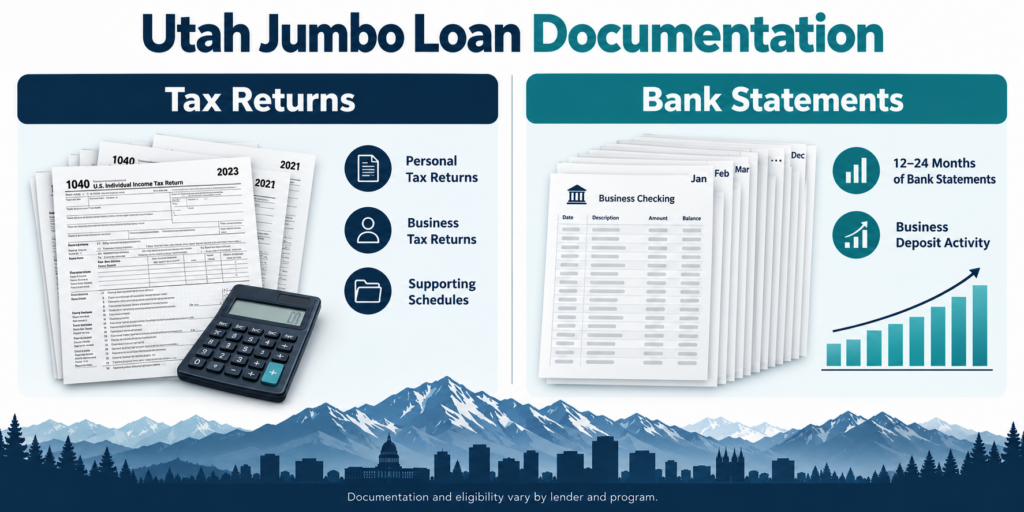
Self-employed borrowers may qualify for a jumbo mortgage using traditional tax returns. Depending on the loan program, other documentation methods may also be available, including personal or business bank statements, profit-and-loss statements, 1099 income, asset depletion and other alternative-documentation programs.
Check My Jumbo Options or call 801-604-4949.
UtahLowRate.com helps qualified self-employed borrowers compare jumbo mortgage options throughout Utah, including Salt Lake City, Park City, Deer Valley, Holladay, Cottonwood Heights, Draper, Sandy, Alpine, Highland, Lehi, Heber City, Midway and St. George.
Daniel Paris | Utah Mortgage Broker
27+ Years of Mortgage Experience
UtahLowRate.com | NMLS #243976
Call: 801-604-4949
Quick Answer: Self-employed borrowers can qualify for jumbo loans in Utah. Depending on the program, income may be documented with tax returns, 12 or 24 months of bank statements, 1099 income, profit-and-loss documentation or eligible assets. Credit, down payment or equity, reserves, property, loan amount and the complete financial profile also affect qualification.
Jumbo Loans for Self-Employed Borrowers Utah: Key Facts
Loan percentages, credit examples and payment calculations are illustrations unless linked to an identified current program. They do not establish available terms or approval.
| Feature | Potential Option |
|---|---|
| Borrower | Business owner or self-employed professional |
| Loan type | Jumbo / Super Jumbo |
| Purchase | Available |
| Rate-and-term refinance | Available |
| Cash-out refinance | Available on qualifying programs |
| Primary residence | Available |
| Second home | Available under qualifying programs |
| Investment property | Program dependent |
| Traditional tax returns | One qualification option |
| Bank statements | Select programs |
| 1099 income | Select programs |
| P&L documentation | Select programs |
| Asset depletion | Select programs |
| Loan amounts | Program and borrower dependent |
| Fixed or ARM | Program dependent |
| Utah properties | Available subject to underwriting |
Program requirements vary considerably by lender. Alternative documentation does not eliminate underwriting or the requirement to demonstrate an ability to repay.
Why Can Jumbo Mortgage Qualification Be Different When You Are Self-Employed?
Being self-employed does not prevent you from obtaining a jumbo mortgage.
The challenge is often determining how much income a lender can use for qualification.
Traditional underwriting generally analyzes income reported on tax returns. A successful business owner, however, may take legitimate deductions for equipment, depreciation, vehicles, employees, marketing, office expenses and other costs.
Those deductions can reduce taxable income.
As a result, the income appearing on a tax return may be significantly different from the borrower's actual business revenue or cash flow.
That is why comparing documentation methods can be especially important when applying for a large mortgage.
Example
Consider a Utah business owner purchasing a higher-value property.
The borrower may have:
- strong business revenue;
- substantial liquid assets;
- excellent credit;
- a significant down payment;
- several years in business; and
- significant legitimate business deductions.
A traditional tax-return calculation could produce one qualifying income number.
A bank statement, P&L or asset-based jumbo program could potentially produce a different result.
The appropriate method depends on the borrower's complete financial situation and the available lender guidelines.
What Jumbo Mortgage Options Are Available for Self-Employed Borrowers?

There is no single "self-employed jumbo loan."
Instead, there are several potential ways to qualify.
1. Full-Documentation Jumbo Mortgage
A traditional jumbo mortgage may work well when your tax returns support enough qualifying income.
Underwriting may evaluate items such as:
- personal tax returns;
- business tax returns when required;
- K-1s;
- W-2 income from your company;
- Schedule C income;
- partnership or S-corporation income;
- year-to-date financial statements;
- business history;
- assets and reserves; and
- credit and liabilities.
If tax-return income supports the requested mortgage, traditional jumbo financing can be an excellent starting point.
2. Jumbo Bank Statement Mortgage
A jumbo bank statement loan may allow an eligible self-employed borrower to establish qualifying income using deposits appearing on personal or business bank statements.
Programs commonly evaluate 12 or 24 months of statements, although guidelines vary.
Business statement programs generally require a method for determining legitimate business expenses before calculating qualifying income.
Learn more about Jumbo Bank Statement Loans Utah and Bank Statement Loans Utah.
3. 1099 Jumbo Mortgage Options
Independent contractors and professionals receiving substantial 1099 income may have another option.
Certain alternative-documentation programs can evaluate qualifying 1099 income without calculating income in the same way as a traditional tax-return mortgage.
This may be relevant to:
- consultants;
- sales professionals;
- independent medical professionals;
- technology contractors;
- real estate professionals;
- financial professionals; and
- other independent contractors.
See 1099 Mortgage Loans Utah for more information.
4. Profit-and-Loss Jumbo Programs
Some qualified self-employed borrowers may have access to mortgage programs using a profit-and-loss statement as part of the income documentation.
Requirements vary substantially.
The lender may require a P&L prepared or verified according to specific program standards along with other documentation.
5. Asset Depletion or Asset-Based Qualification
High-net-worth borrowers sometimes have significant assets but relatively little conventional employment income.
Certain jumbo mortgage programs may convert eligible assets into an income stream for underwriting purposes.
Eligible assets, calculation methods, seasoning requirements and required reserves depend on the lender.
6. Super Jumbo Financing
A self-employed borrower requiring a multimillion-dollar mortgage may need a specialized Super Jumbo mortgage rather than a standard jumbo program.
UtahLowRate.com works with qualified borrowers seeking specialized large-balance financing.
Learn more about Super Jumbo Mortgage Loans.
Self-Employed Jumbo Loan Documentation Comparison
| Qualification Method | Primary Documentation | May Be Useful For |
|---|---|---|
| Full documentation | Tax returns and financial records | Borrowers with strong taxable income |
| Personal bank statements | Eligible personal deposits | Self-employed borrowers receiving business income personally |
| Business bank statements | Eligible business deposits | Business owners with strong business cash flow |
| 1099 | Eligible 1099 income | Independent contractors |
| P&L | Qualifying profit-and-loss documentation | Established businesses |
| Asset depletion | Eligible liquid/investment assets | High-net-worth borrowers |
| DSCR | Rental-property cash flow | Real estate investors |
The best documentation method is not necessarily the one requiring the fewest documents. It is the method that most accurately fits the borrower's financial profile while satisfying applicable underwriting requirements.
Can You Get a Jumbo Loan Without Tax Returns in Utah?
Potentially.
Certain alternative-documentation jumbo mortgage programs may allow a qualified self-employed borrower to obtain financing without using traditional personal tax returns as the primary method for calculating income.
For example, eligible borrowers may be able to qualify using:
- personal bank statements;
- business bank statements;
- 1099 documentation;
- profit-and-loss documentation; or
- eligible assets.
These programs are not no-document or no-income-verification mortgages.
The lender still evaluates the borrower's ability to repay along with credit, assets, reserves, debts, property, appraisal, occupancy and other underwriting requirements.
How Do Business Bank Statements Work for a Jumbo Loan?
Business bank statements can be particularly useful for business owners whose companies generate substantial recurring revenue.
The lender generally reviews eligible deposits and determines how much of that revenue can reasonably be considered qualifying income after accounting for business expenses.
The exact expense methodology varies by lender.
For example, underwriting may consider:
- type of business;
- ownership percentage;
- recurring deposits;
- unusual or non-business deposits;
- transfers between accounts;
- business expenses; and
- supporting business documentation.
Depositing money into a business account does not automatically mean that the entire deposit can be treated as personal qualifying income.
That distinction is important when evaluating a jumbo mortgage.
What Credit Score Do You Need for a Self-Employed Jumbo Loan?
There is no universal minimum credit score for every self-employed jumbo mortgage.
Credit requirements depend on the lender, documentation method, loan amount, property, occupancy, loan-to-value ratio and overall borrower profile.
Higher credit scores can potentially provide:
- access to more programs;
- higher allowable LTVs;
- more favorable pricing; and
- greater flexibility on larger loan amounts.
Borrowers with lower credit scores may still have options, but available loan structures may be more limited.
How Much Down Payment Is Required?

There is no single down-payment requirement that applies to every jumbo loan.
The maximum loan-to-value ratio can change according to:
- credit score;
- loan amount;
- property type;
- occupancy;
- documentation method;
- reserves;
- transaction type; and
- lender guidelines.
A borrower seeking a very large loan may encounter lower maximum LTV requirements than someone requesting a smaller jumbo mortgage.
See our Jumbo Loan Down Payment Utah guide for a deeper explanation of how LTV affects jumbo financing.
How Much Can a Self-Employed Borrower Finance?
Loan size depends on the program and complete borrower profile.
Qualified borrowers may have access to traditional jumbo financing as well as specialized Super Jumbo financing reaching into multimillion-dollar loan amounts.
UtahLowRate.com works with qualified borrowers evaluating large residential mortgage structures, including transactions that may extend from approximately $1 million to $30 million+, depending on current lender availability, borrower qualifications and property eligibility.
The maximum advertised loan amount should never be interpreted as an automatic approval.
Large transactions receive detailed underwriting.
What Reserves Are Required?
Jumbo lenders frequently require borrowers to maintain post-closing reserves.
Reserves are funds remaining after the transaction closes.
Depending on the program, lenders may consider:
- checking accounts;
- savings;
- money-market accounts;
- stocks;
- bonds;
- eligible retirement accounts; and
- other acceptable liquid or semi-liquid assets.
Reserve requirements generally vary according to loan size, occupancy, number of financed properties and the borrower's complete risk profile.
Large jumbo and Super Jumbo transactions may require significant liquidity.
Jumbo Purchase Loans for Self-Employed Utah Borrowers
Self-employed borrowers can use jumbo financing to purchase higher-value Utah homes.
Before making an offer, it can be helpful to determine which documentation method will be used.
A preliminary review can identify whether the strongest option appears to be:
- traditional tax-return underwriting;
- bank statements;
- 1099 income;
- P&L documentation;
- asset depletion; or
- another jumbo mortgage structure.
This can be especially important when purchasing a luxury property with a short financing contingency.
Jumbo Refinance Loans for Business Owners
Existing homeowners may also use jumbo financing for a qualifying refinance.
Potential transactions include:
Rate-and-Term Refinance
Replace an existing mortgage with a new jumbo loan when the transaction satisfies applicable rate-and-term guidelines.
Cash-Out Refinance
Qualified homeowners may be able to access equity from a higher-value property.
Cash-out limits can vary considerably by loan amount, LTV, documentation method and lender.
Self-employed borrowers should compare how each lender calculates income before selecting a refinance program.
Jumbo Loans in Park City and Deer Valley for Self-Employed Borrowers
Park City and Deer Valley are important markets for specialized jumbo financing because property values can require significantly larger mortgage amounts.
Self-employed borrowers purchasing or refinancing properties in:
- Park City;
- Deer Valley;
- Empire Pass;
- Canyons Village;
- Old Town;
- Promontory;
- Prospector;
- Kimball Junction;
- Jeremy Ranch; and
- surrounding Summit County communities
may benefit from comparing multiple jumbo documentation strategies.
A business owner with substantial liquidity and business cash flow should not assume that the tax-return calculation offered by one bank represents every available jumbo mortgage option.
Salt Lake City and Wasatch Front Self-Employed Jumbo Loans
Jumbo financing is also relevant throughout the Salt Lake Valley and Wasatch Front.
UtahLowRate.com works with qualified self-employed borrowers in:
Salt Lake City, Holladay, Millcreek, Murray, Cottonwood Heights, Sandy, Draper, South Jordan, West Jordan, Riverton, Herriman and Bluffdale.
Business owners purchasing higher-value homes in these communities may be able to compare both traditional and alternative-documentation jumbo financing.
Alpine, Highland, Lehi and Utah County
Higher-value properties throughout northern Utah County can also require jumbo financing.
Self-employed borrowers purchasing or refinancing homes in Alpine, Highland, Lehi, American Fork, Pleasant Grove, Orem, Provo, Saratoga Springs and surrounding Utah County communities can compare available jumbo loan structures based on their income, assets and property.
Heber City, Midway and the Wasatch Back
Self-employed borrowers purchasing homes in Heber City, Midway, Jordanelle, Hideout and Kamas may encounter financing scenarios involving primary residences, vacation homes and investment properties.
The correct financing structure depends heavily on occupancy.
A primary residence may use a self-employed jumbo mortgage.
A qualifying rental property may instead be appropriate for a DSCR loan.
St. George and Southern Utah Jumbo Loans
Business owners and self-employed borrowers purchasing higher-value properties in St. George, Washington, Ivins, Santa Clara, Hurricane, Desert Color and surrounding Washington County communities may also need jumbo financing.
Available documentation can depend on whether the borrower operates a business, receives 1099 income, has substantial investment assets or owns additional real estate.
Self-Employed Jumbo Loan vs. DSCR Loan
These programs solve different problems.
A self-employed jumbo mortgage can potentially finance a primary residence, second home or other eligible property using the borrower's qualifying income or assets.
A DSCR loan is generally designed for an investment property and focuses primarily on the property's qualifying rental cash flow rather than traditional personal employment income.
| Feature | Self-Employed Jumbo | DSCR Loan |
|---|---|---|
| Primary residence | Potentially eligible | Generally no |
| Second home | Program dependent | Generally investment focused |
| Rental property | Select programs | Yes |
| Personal income | Usually evaluated | Often not the primary qualification method |
| Rental cash flow | Not necessarily primary | Central to qualification |
| Business owner | Yes | Yes |
| Tax returns | Depends on program | Generally not used for personal-income qualification |
Real estate investors can start with the DSCR Mortgage Loans Utah guide.
Documents to Prepare
The exact documents depend on the selected program, but a preliminary jumbo review may include:
- government-issued identification;
- credit authorization;
- property information;
- purchase contract when applicable;
- mortgage statement for refinances;
- personal bank statements;
- business bank statements;
- tax returns when applicable;
- 1099 forms when applicable;
- P&L documentation;
- business ownership documentation;
- asset statements;
- retirement or brokerage statements;
- real estate owned schedule; and
- documentation supporting the source of funds.
Providing the correct documents at the beginning can make the underwriting process much more efficient.
How to Apply for a Self-Employed Jumbo Loan in Utah
Step 1: Determine the Loan Amount
Start with the purchase price, expected down payment and approximate loan amount.
Step 2: Identify the Best Income Documentation
Compare tax returns, bank statements, 1099 income, P&L documentation and eligible assets.
Step 3: Review Credit and Liabilities
Credit and monthly obligations can materially affect available jumbo programs.
Step 4: Review Assets and Reserves
Determine the funds available for down payment, closing costs and post-closing reserves.
Step 5: Review the Property and Occupancy
Primary residences, second homes and investment properties can have very different underwriting requirements.
Step 6: Compare Jumbo Programs
Compare more than the interest rate.
Evaluate:
- documentation;
- LTV;
- points;
- lender fees;
- reserve requirements;
- prepayment provisions when applicable;
- fixed versus ARM structures;
- cash-out limits; and
- underwriting requirements.
Step 7: Complete Underwriting
The lender reviews the complete borrower and property file before final approval.
Common Mistakes Self-Employed Jumbo Borrowers Should Avoid
Assuming Tax Returns Are the Only Option
Alternative documentation may be available when traditional taxable income does not support the desired mortgage.
Moving Large Amounts of Money Without Documentation
Large transfers can create additional underwriting questions.
Changing Business Structure Before Closing
Major changes to ownership or business structure can complicate income analysis.
Taking on New Debt
A new vehicle loan, credit card balance or other liability can change qualification.
Comparing Only Interest Rates
The lowest advertised rate is not necessarily the best or even an available option for a particular borrower.
Documentation method, points, fees, LTV and underwriting flexibility all matter.
Waiting Until You Find the Property
Complex jumbo files benefit from early review, especially when the borrower owns multiple businesses or properties.
Jumbo Loans for Self-Employed Borrowers Utah FAQ
Can a self-employed person qualify for a jumbo loan in Utah?
Yes. Qualified self-employed borrowers can obtain jumbo mortgages in Utah. Depending on the program, income may be documented using tax returns, bank statements, 1099 income, P&L documentation, eligible assets or another approved method.
Can I get a jumbo mortgage without tax returns?
Potentially. Certain alternative-documentation jumbo programs may use bank statements, 1099 documentation, profit-and-loss information or eligible assets instead of relying primarily on personal tax returns. Complete underwriting still applies.
Can I use business bank statements for a jumbo mortgage?
Yes, under qualifying programs. The lender generally reviews eligible business deposits and applies an approved method for determining business expenses and qualifying income.
Are 12-month bank statement jumbo loans available?
Certain programs may accept 12 months of bank statements, while others require 24 months. Eligibility depends on the lender and complete borrower profile.
Can I get a multimillion-dollar mortgage if I am self-employed?
Potentially. Qualified self-employed borrowers may have access to Jumbo and Super Jumbo mortgage programs for multimillion-dollar properties. Loan amounts, documentation, LTVs, reserves and credit requirements vary.
Can a self-employed borrower get a jumbo cash-out refinance?
Yes, qualifying programs may permit jumbo cash-out refinancing. Maximum cash-out, loan amount and LTV depend on the lender, property and borrower profile.
Is a DSCR loan better for a self-employed real estate investor?
It can be when financing an eligible investment property. A DSCR loan generally focuses on the property's qualifying rental income rather than traditional personal employment income. It is generally not designed to finance an owner-occupied primary residence.
Do self-employed jumbo borrowers need perfect credit?
No universal credit score applies to every jumbo mortgage. Stronger credit can expand available programs and potentially improve pricing or LTV, but eligibility depends on the entire loan profile.
Compare Self-Employed Jumbo Mortgage Options
A self-employed borrower should not automatically assume that the income appearing on a tax return determines how much they can borrow.
The better question is:
Which available jumbo underwriting method most accurately represents your financial situation?
UtahLowRate.com can help qualified borrowers compare traditional jumbo, bank statement jumbo, 1099, P&L, asset-based and Super Jumbo mortgage options.
Check My Jumbo Options
Daniel Paris
Utah Mortgage Broker
27+ Years of Mortgage Experience
UtahLowRate.com
NMLS #243976
Call: 801-604-4949
Serving qualified borrowers throughout Utah, including Salt Lake City, Park City, Deer Valley, Holladay, Draper, Sandy, Alpine, Highland, Lehi, Heber City, Midway and St. George.
Related Resources
- Utah Jumbo Mortgage Loans
- Jumbo Bank Statement Loans Utah
- Bank Statement Loans Utah
- 1099 Mortgage Loans Utah
- Super Jumbo Mortgage Loans
- DSCR Mortgage Loans Utah
- Apply for a Utah Mortgage
Important Mortgage Disclosure
Mortgage programs, interest rates, APRs, loan amounts, credit requirements, documentation requirements, LTV limits, reserve requirements and underwriting guidelines are subject to change.
Alternative-documentation financing does not mean no-document or no-income-verification financing. All loans are subject to borrower qualification, acceptable property, appraisal, complete underwriting, lender/investor requirements and current program availability.
Information on this page is educational and does not constitute a commitment to lend or guarantee of approval.
Related guides: Utah jumbo mortgage guide · Jumbo loan requirements · Jumbo mortgage rates · Jumbo payment calculation guide · Jumbo mortgage questions and answers ·

