
Utah Mortgage Rates and Housing Market 2026: September
Published September 9, 2026 | Last Updated September 9, 2026
By Daniel Paris | Utah Mortgage Broker | UtahLowRate.com | NMLS #243976-3138 | 27+ Years of Mortgage Lending Experience
Utah homebuyers are entering fall 2026 with a housing market that looks very different depending on where—and what—they are buying.
Mortgage rates remain elevated, but Utah buyers have more inventory statewide than a year ago, homes are generally taking longer to sell, and statewide price growth has been relatively modest. At the same time, individual markets such as Salt Lake City, Utah County and Park City can behave very differently from the statewide average.
As of September 3, 2026, the average U.S. 30-year fixed-rate mortgage was 6.71%, according to Freddie Mac’s Primary Mortgage Market Survey. The average 15-year fixed mortgage was 6.04%.
For Utah buyers, sellers and homeowners considering a refinance, the key question isn’t simply whether mortgage rates are “high” or “low.” The better question is how today’s combination of mortgage rates, home prices, inventory, negotiating power and your personal financing options affects your decision.
Quick Answer: What Is the Utah Real Estate Market Like Right Now?
Utah’s September 2026 housing market is best described as mixed and increasingly balanced, rather than a uniform buyer’s or seller’s market.
The latest statewide data from Redfin shows a July 2026 median sale price of $530,963, up 1.1% from a year earlier. There were 18,826 homes for sale, up 2.4%, while statewide sales declined 4.6%. Median time on market increased to 53 days.
That combination—more inventory, slower sales and modest statewide appreciation—can create opportunities for qualified buyers, particularly on homes that have been listed longer or need to compete with newer inventory.
But real estate is local. Salt Lake County, Utah County, Park City and St. George are producing very different numbers.
Current Mortgage Rates: Where Rates Stand in September 2026
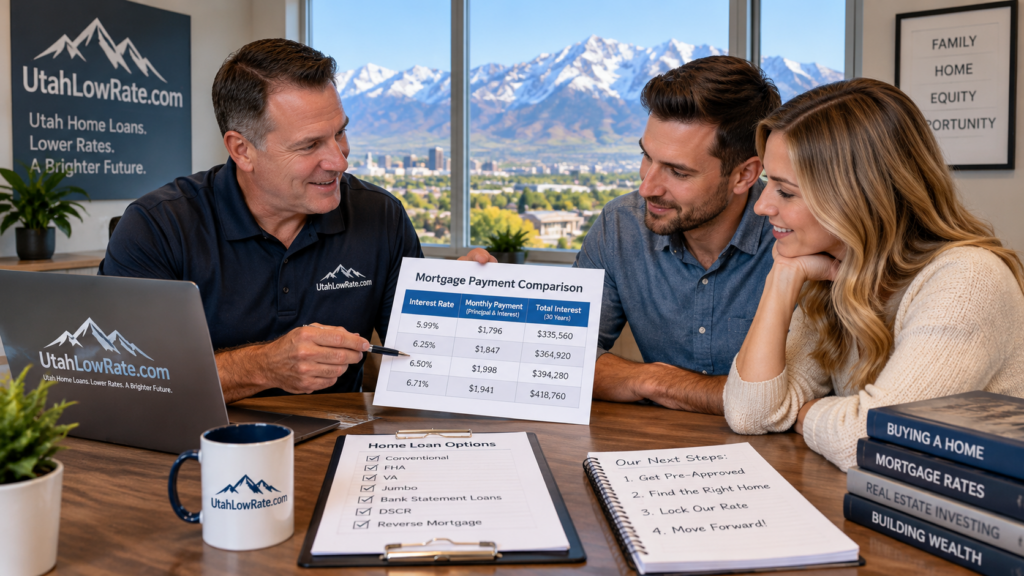
According to Freddie Mac, national mortgage averages as of September 3, 2026 were:
| Mortgage | Sept. 3, 2026 | Previous Week | One Year Earlier |
|---|---|---|---|
| 30-Year Fixed | 6.71% | 6.66% | 6.50% |
| 15-Year Fixed | 6.04% | 5.98% | 5.60% |
The 30-year average has moved upward from 6.43% on July 2 to 6.71% on September 3. Freddie Mac also reported that purchase demand has remained relatively stable as buyers adapt to changing market conditions.
Does that mean every Utah borrower gets 6.71%?
No.
The Freddie Mac figure is a national market benchmark, not a rate quote that applies to every borrower.
Your actual Utah mortgage rate can vary based on factors including:
- Credit score and credit profile
- Down payment or available equity
- Loan-to-value ratio
- Loan amount
- Property type
- Primary, second-home or investment occupancy
- Conventional, FHA, VA, jumbo or alternative-documentation financing
- Discount points or lender credits
- Current market pricing when you lock
This is why someone buying a primary residence in Sandy with strong credit and a substantial down payment may receive different pricing from someone purchasing a luxury second home in Park City or an investment property in St. George.
For a deeper rate update, see UtahLowRate.com 30-year mortgage rate analysis and compare it with the latest national Freddie Mac benchmark.
Utah Housing Market: More Choices, but Prices Aren’t Collapsing
One of the most important developments for Utah homebuyers is the amount of available inventory.
Redfin reported 18,826 Utah homes for sale in July 2026, an increase of 2.4% year over year. New listings totaled 4,635, up 1.2%.
At the same time:
- Utah median sale price: $530,963
- Year-over-year price change: +1.1%
- Homes sold: 3,038
- Year-over-year sales change: -4.6%
- Median days on market: 53 days
- Homes selling above asking price: 21.5%
- Sale-to-list ratio: 98.7%
These numbers do not suggest a statewide housing crash. Instead, they indicate a market in which buyers and sellers may have to work harder to find the right price.
For buyers, increased inventory can mean more selection and potentially more negotiating opportunities.
For sellers, pricing a property correctly from the beginning becomes increasingly important when buyers have alternatives.
Salt Lake City and Salt Lake County Tell Two Different Stories
This is where statewide statistics can become misleading.
In Salt Lake County, the median sale price over the three months ending July 2026 was approximately $558,352, down 0.29% year over year. Homes took a median 39 days to sell, and 27.5% experienced price reductions.
Salt Lake City itself was considerably stronger.
The city’s median sale price was approximately $642,678, up 9.9% year over year, while 643 homes sold in July—14.4% more than a year earlier. Median time on market was 31 days.
That difference illustrates an important lesson for anyone researching the Utah real estate market in 2026:
There is no single Utah housing market.
Conditions can vary considerably between Salt Lake City, Murray, Holladay, Cottonwood Heights, Sandy, Draper, South Jordan and other Wasatch Front communities—and even between neighborhoods within the same city.
A buyer should evaluate comparable sales and available inventory for the specific neighborhood and price range they are considering.
Utah County: Prices Are Still Showing Strength
Utah County continues to be an important market for buyers in Lehi, American Fork, Highland, Alpine, Orem, Provo, Saratoga Springs, Eagle Mountain and surrounding communities.
Over the three months ending July 2026, Redfin reported a Utah County median sale price of approximately $548,392, up 6.5% year over year. Homes spent a median 48 days on the market, while 825 homes sold in July.
The county’s sale-to-list ratio was 99.2%, and 24.4% of homes sold above list price.
That doesn’t mean every Utah County home is receiving multiple offers. Instead, it reinforces why buyers should examine the individual property.
A well-priced home in a desirable Lehi or Highland neighborhood may behave very differently from a property that has been sitting on the market for several weeks.
Park City Remains a Different Mortgage and Real Estate Market

Park City deserves to be evaluated separately from most of Utah because of its concentration of luxury homes, second homes, resort properties and jumbo mortgage transactions.
Redfin reported a Park City median sale price of approximately $2.8 million over the three months ending July 2026, up 27.2% from the same period a year earlier. Homes sold after a median 37 days, while the number of homes sold declined 8.2%.
Because Park City properties frequently require financing above conforming loan limits, buyers may need to compare jumbo mortgage and super-jumbo financing rather than relying solely on conventional mortgage assumptions.
Properties in Deer Valley, Old Town, Empire Pass, Canyons Village, Promontory and surrounding Summit County communities can also present unique considerations involving appraisals, property type, liquidity, reserves and loan structure.
St. George and Southern Utah Are Moving More Slowly
Southern Utah presents another distinct market.
In St. George, the median sale price over the three months ending July 2026 was approximately $539,730, up only 0.4% year over year. Median time on market increased from 47 days to 55 days, while July sales declined 3.5% from the previous year.
For buyers considering St. George, Washington, Ivins, Santa Clara, Hurricane, Desert Color and other Washington County communities, additional time on market can sometimes create negotiating opportunities.
That does not mean every seller will discount a property. Location, condition, price range, neighborhood inventory and seller motivation still matter.
Is Utah a Buyer’s Market or Seller’s Market in 2026?
Utah is increasingly a more balanced market statewide, but local conditions can favor buyers or sellers depending on the city, neighborhood and price range.
Statewide inventory has increased while sales have declined and homes are taking longer to sell. Those are generally positive developments for buyers seeking more choices.
However, only 20.7% of Utah homes had price drops in Redfin’s July data, while 21.5% still sold above asking price.
In other words, buyers may have more leverage than during Utah’s most competitive pandemic-era markets, but desirable homes can still attract competition.
The opportunity in today’s market may be less about waiting for every Utah home price to fall and more about identifying properties where seller motivation and financing strategy intersect.
Should Utah Homebuyers Wait for Mortgage Rates to Drop?

Waiting for lower rates is not automatically the best strategy because future mortgage rates and future home prices cannot be predicted with certainty.
Consider a buyer who waits for rates to fall but later encounters higher home prices or renewed competition from other buyers. The lower rate may not produce the expected savings.
The opposite can also happen: rates could decline while home prices remain relatively stable.
Instead of trying to perfectly time both markets, evaluate the transaction based on today’s numbers:
Purchase price + down payment + mortgage payment + taxes + insurance + HOA + closing costs + expected time in the property.
If those numbers work today, the purchase may deserve consideration.
If they don’t work, don’t force the transaction based on the assumption that appreciation or refinancing will solve the problem later.
Why Mortgage Shopping Matters More When Rates Are Higher
When rates are elevated, relatively small pricing differences can become meaningful over the life of a mortgage.
Utah homebuyers should compare more than the advertised interest rate. Review the interest rate, APR, discount points, lender fees, loan program and total closing costs together.
Borrowers may also have multiple financing options.
Depending on qualifications and property type, those could include conventional, FHA, VA, jumbo, bank-statement, DSCR or other mortgage programs.
Self-employed borrowers should be especially careful not to assume that taxable income is the only possible way to qualify. Alternative-documentation programs may be available for eligible borrowers, although rates, costs and underwriting requirements can differ from conventional financing.
What Should Utah Buyers Do Right Now?
Start with financing before falling in love with a property.
A strong mortgage pre-approval can help determine your realistic price range and show how different combinations of purchase price, down payment and interest rate affect your monthly payment.
Next, evaluate individual homes rather than assuming statewide headlines apply to every property.
A home that has been listed for 50 days may provide a different negotiation opportunity from a newly listed home with multiple offers.
Finally, compare mortgage scenarios before submitting an offer.
In some transactions, negotiating a lower purchase price may be most valuable. In others, seller-paid closing costs or an interest-rate buydown may produce a better short-term financial result.
The right strategy depends on the actual numbers.
What Should Utah Sellers Know About the Current Market?
Utah sellers should recognize that many buyers are highly payment-sensitive in a mortgage environment near the upper-6% range.
Overpricing a property can therefore be particularly costly.
Buyers can compare more listings than they could when inventory was extremely limited, and properties that sit on the market may eventually compete with new listings.
Sellers should evaluate recent comparable sales, active competition and financing conditions—not simply what a nearby home sold for during a stronger market.
Depending on the transaction, offering closing-cost assistance may also help expand the pool of potential buyers.
Frequently Asked Questions About Utah Mortgage Rates and Real Estate
What are mortgage rates in Utah right now?
Freddie Mac reported a national average 30-year fixed mortgage rate of 6.71% as of September 3, 2026. Actual Utah mortgage rates can be higher or lower depending on credit, down payment, loan type, property, occupancy, points and current lender pricing.
Is now a good time to buy a house in Utah?
It can be for buyers who find the right property at a sustainable monthly payment. Utah has more homes available than a year ago and homes are generally taking longer to sell, but market conditions vary significantly by location.
Are Utah home prices dropping in 2026?
Not statewide. Redfin reported Utah’s July 2026 median sale price at $530,963, up 1.1% year over year, although individual counties, cities, neighborhoods and price ranges can move in different directions.
Should I wait until mortgage rates go below 6% to buy a Utah home?
There is no guarantee mortgage rates will fall below 6% within a particular timeframe. Buyers should compare today’s payment and home price with their budget rather than making a purchase decision dependent on an uncertain future rate.
Is Utah a buyer’s or seller’s market right now?
Utah is becoming more balanced overall, with increased inventory and slower sales giving buyers more choices. Desirable, properly priced homes can still favor sellers and receive competitive offers.
How can I find out what Utah mortgage rate I actually qualify for?
Request a personalized mortgage quote based on your credit, down payment, loan amount, property and mortgage program. A personalized quote is more useful for planning than relying solely on a national average.
Utah Mortgage Help — Daniel Paris at UtahLowRate.com
Daniel Paris is a Utah mortgage broker with 27+ years of mortgage lending experience helping homebuyers, homeowners, self-employed borrowers and real estate investors evaluate mortgage options throughout Utah.
Utah Low Rate / UtahLowRate.com
Daniel Paris — Utah Mortgage Broker
NMLS #243976-3138
Phone: 801-604-4949
Service Area: Utah statewide, including Salt Lake City, Murray, Holladay, Sandy, Draper, South Jordan, Lehi, Provo, Park City, Heber City, St. George and surrounding communities.
Whether you’re comparing conventional financing for a Salt Lake County home, jumbo financing in Park City, a bank-statement mortgage for a self-employed borrower or financing for a Southern Utah property, the first step is determining what loan structure fits the actual transaction.
Mortgage rates can change daily, and the rate available to an individual borrower depends on multiple underwriting and pricing factors. Contact UtahLowRate.com for a personalized mortgage comparison rather than relying solely on national averages.
This article is for general educational purposes and does not constitute an offer, commitment or guarantee to lend. Mortgage rates, APRs, fees, loan programs and underwriting guidelines can change without notice. All loans are subject to lender/investor guidelines, underwriting approval, property eligibility and applicable regulations.

