
Profit and Loss Home Loan Guidelines Utah
By Daniel Paris, Utah Mortgage Broker | NMLS #243976 | Last reviewed: October 14, 2026
Profit and loss home loan guidelines Utah borrowers should confirm include the P&L period, preparer rules, supporting statements, business history, credit, LTV, reserves, and property eligibility. This guide is a review checklist rather than a universal approval matrix.
Quick answer
There is no single P&L guideline sheet for every lender. Match the complete borrower and property scenario to a current program. Confirm the rules in writing before ordering a P&L or assuming a down payment applies.

Request a scenario review • Apply online • Call 801-604-4949
Profit and loss home loan guidelines Utah: underwriting checklist
| Requirement | Confirm before applying |
|---|---|
| Business history | Minimum operating period, ownership percentage, and evidence of current operations. |
| P&L | Required coverage, year-to-date figures, preparation date, and format. |
| Preparer | Credentials, independence, and relationship requirements. |
| Income | Net profit, ownership allocation, averaging, adjustments, and trend. |
| Statements | Months and account types needed to support income or assets. |
| Credit and LTV | The combination applicable to loan size, occupancy, and transaction. |
| Debts | Personal obligations and treatment of business-paid liabilities. |
| Reserves | Required months, payment definition, eligible assets, and post-closing balance. |
| Property | Rural status, acreage, condo project, unit count, and actual use. |
| Refinance | Equity, cash-out restrictions, seasoning, and any prepayment terms. |
Why program labels are not interchangeable
A P&L-only option can have different credit and loan-size limits from a P&L-plus-statements option. A rule for a bank statement mortgage should not be presented as a P&L rule. Business history is separate from the financial-statement period.
Published lender examples—not Utah Low Rate offers
As researched October 14, 2026, Angel Oak describes separate P&L-only and P&L-with-statements routes. Its published page lists a 720 minimum score and $2 million maximum for P&L-only, versus a 640 minimum and $3 million maximum for its supporting-statement route; actual LTV tiers apply. Acra lists a 660 minimum score, up to 80% purchase LTV, and three supporting statement months, with rural properties excluded.
These examples illustrate why a program-specific review matters. They do not establish Utah Low Rate access to either lender, current borrower eligibility, or a personalized offer. Verify complete current guidelines and availability before relying on a number.
Income illustration and ownership
If an accepted 12-month statement shows $144,000 of net profit, dividing by 12 produces $12,000 monthly before adjustments. A 50% share would produce $6,000 under a proportional illustration. The lender decides the allowed calculation. Losses, trends, or other conditions can change the result.

Documents to organize
- Profit-and-loss statement covering the required period, plus year-to-date figures if requested.
- Preparer contact information and acceptable professional qualifications.
- Business history, ownership, and evidence of current operations.
- Supporting business bank statements if required for income verification.
- Asset statements showing funds for closing and eligible reserves.
- Identification, debt details, current housing costs, and purchase contract or refinance information.
Property screening across Utah
Urban condos can raise project-review issues. Mountain or resort homes can raise access and occupancy questions. Acreage or rural homes can be excluded by a particular program. Check these issues before relying on an income route for an outlying property. The actual home, rather than its county name alone, controls the review.
Purchase and refinance review
For a purchase, separate down payment, closing costs, and reserves. For a refinance, compare the current balance and remaining term with the proposed balance, APR, fees, and total payment. Cash-out proceeds are borrowed funds, not recurring qualifying income. Ask about seasoning and any prepayment condition.
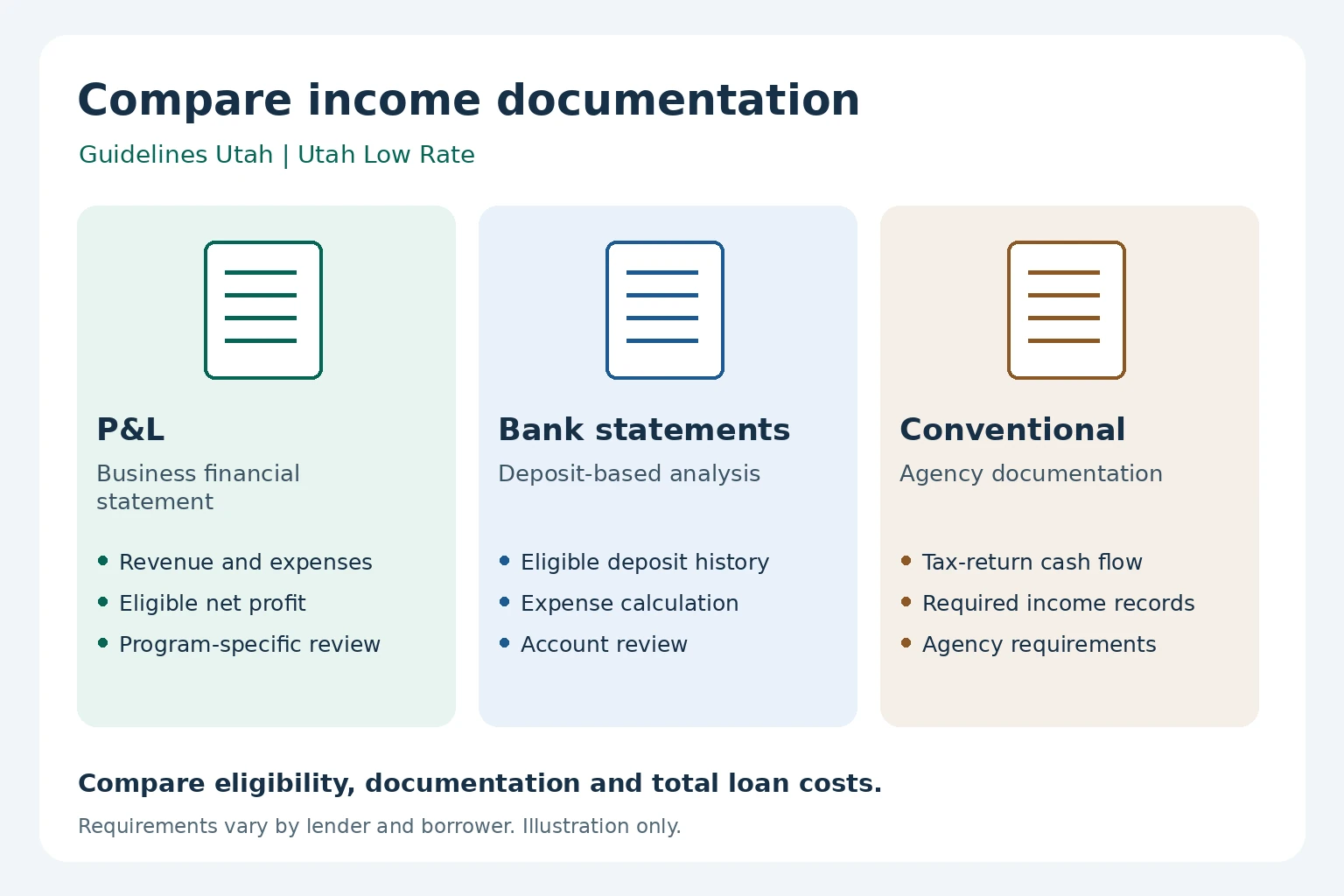
Compare costs with a dated written offer
Use the same loan amount, occupancy, term, and lock period when comparing options. Ask for rate, APR, points, lender fees, mortgage insurance if applicable, and cash to close. A national average or another borrower’s quote is not your price. Review the CFPB Loan Estimate guide.
Frequently asked questions
Can I rely on a published minimum score?
Use it as a starting point only. The full matrix, loan size, LTV, property, occupancy, and borrower history determine whether the tier applies.
Does one-year P&L mean one-year business history?
No. The statement period and minimum self-employment history are separate requirements. Confirm both.
Explore the Utah P&L cluster
Utah P&L home loan hub • Guidelines • FAQ • Scenario questions and answers
Request a scenario review • Apply online • Call 801-604-4949

