
Profit and Loss Home Loan FAQ Utah
By Daniel Paris, Utah Mortgage Broker | NMLS #243976 | Last reviewed: October 14, 2026
Profit and loss home loan FAQ Utah borrowers ask most often: how P&L income is documented, what other records are needed, and how the property affects eligibility. Use these concise answers to prepare for a review with Daniel Paris.
Quick answer
P&L financing is a lender-specific income-documentation option for eligible business owners. Credit, debts, assets, history, and the home still need review. Confirm the exact program before assuming a minimum score, down payment, or document list.

Request a scenario review • Apply online • Call 801-604-4949
How to use this profit and loss home loan FAQ Utah guide
Start with documents and income, then check property and transaction type. Save questions that apply to your business. A lender’s one-year P&L option does not automatically accept a business that has only operated for one year.

Frequently asked questions
What is a profit-and-loss home loan?
It is an alternative-documentation mortgage path that may use an acceptable business P&L to determine self-employed income. The lender applies its own rules and may request supporting records.
Who prepares the P&L?
The selected program determines whether a CPA, tax preparer, or another acceptable professional can prepare it. Ask about credentials, independence, relationship with your business, and required format first.
Can I prepare my own statement?
Do not assume a bookkeeping export or self-prepared statement is sufficient. Some lenders require a qualifying third party to prepare the P&L. Confirm before paying for or submitting documents.
How many months of P&L are needed?
The period is program-specific. A lender may request one or two years and year-to-date information. Confirm both coverage and how recently it must have been prepared.
Do P&L loans require bank statements?
Some do. Statements can support revenue or document assets even when tax returns are not used for income. P&L-only income documentation does not necessarily mean no bank statements anywhere in the file.
Are tax returns required?
Some alternative-documentation routes use an eligible P&L rather than tax returns for the income calculation. Requirements depend on the program and full application.
What credit score do I need?
There is no universal minimum. Ask for the matrix that applies to your amount, LTV, property, and occupancy. A score alone does not establish approval or pricing.
How much down payment do I need?
The lender’s LTV limit determines part of the equity requirement. Credit, occupancy, property type, and size can change the limit. Closing costs and reserves are additional considerations.
What are reserves?
Reserves are eligible assets left after closing, often measured in months of a lender-defined housing payment. Confirm the amount and whether retirement or other assets qualify.
Can I qualify with one year in business?
Do not assume so. Operating history is separate from the period covered by a P&L. Ask which history and prior experience the lender accepts.
Is gross revenue my qualifying income?
No. Business expenses must be considered. The lender uses eligible income under its method and may apply ownership, trend, and other adjustments.
Can I use a P&L loan for a primary home?
Some programs allow eligible owner-occupied homes. The borrower, property, documentation, and transaction must qualify under that program.
Can I finance a second home or rental?
Some programs permit them. Actual use matters, and investment transactions can have different terms. Compare rental-income or DSCR financing when appropriate.
Can I refinance or take cash out?
These transactions may be available under selected programs. Review equity limits, seasoning, costs, and the effect of the new term.
Are rural Utah homes eligible?
Some P&L programs exclude rural properties. Send the property details early. Income eligibility does not override a property restriction.
Can a P&L loan finance a jumbo mortgage?
Some programs accept larger loans up to their own limits. Confirm the maximum amount, property rules, LTV, and reserves for the actual scenario.
Are P&L rates the same as conventional rates?
Do not assume the pricing is the same. Compare dated offers using the same amount, term, lock period, and points. Include APR, fees, and any applicable prepayment terms.
Can first-time buyers apply?
Eligibility depends on the lender. Ask whether it permits first-time buyers and which housing-history or documentation conditions apply.
How long does closing take?
Timing depends on documents, appraisal, title, property review, and underwriting. A simple income description does not guarantee a fast closing.
Who can review my Utah scenario?
Contact Daniel Paris at UtahLowRate.com, 801-604-4949. Share business history, ownership, property location and use, loan amount, closing funds, and available documents.
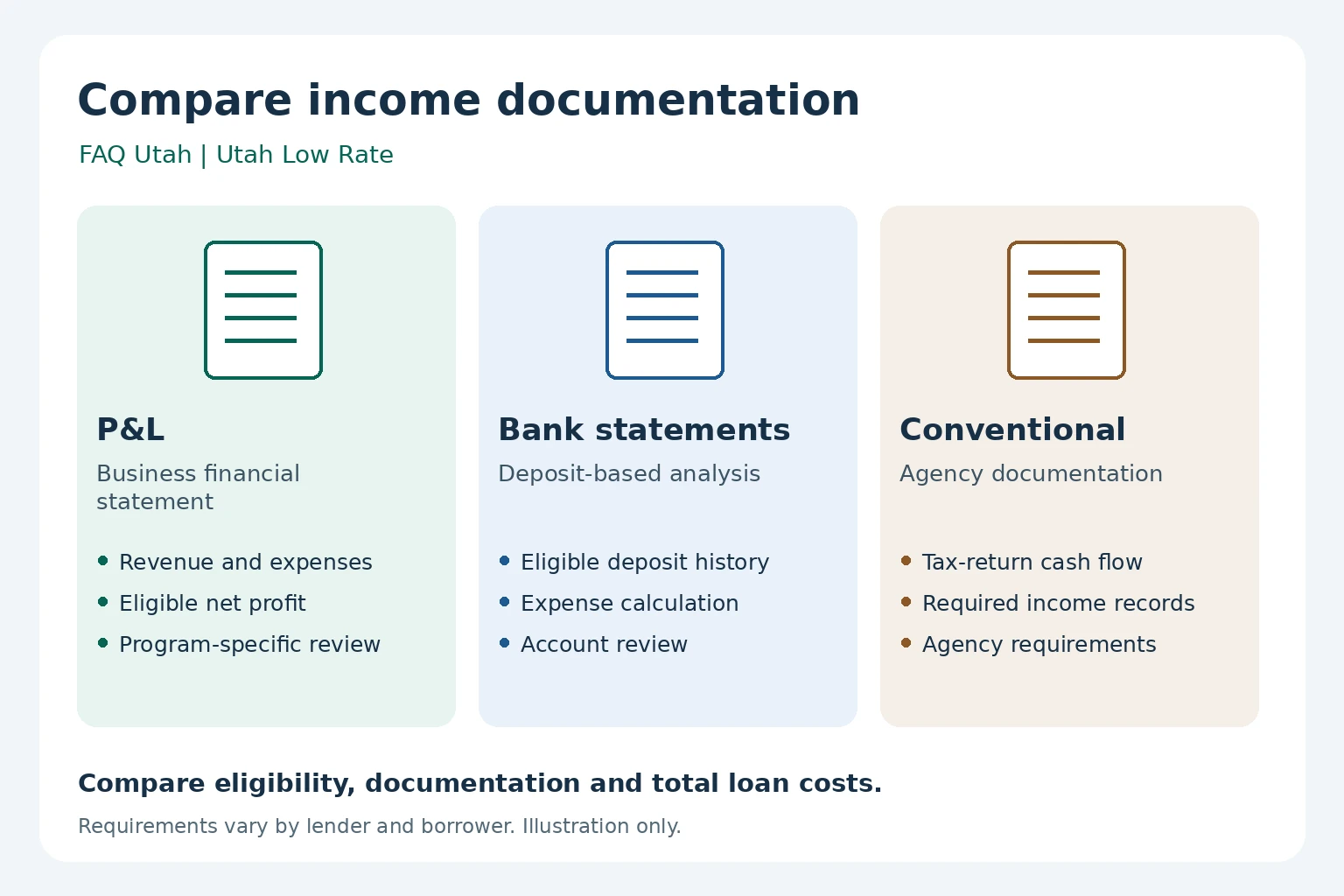
Explore the Utah P&L cluster
Utah P&L home loan hub • Guidelines • FAQ • Scenario questions and answers
Request a scenario review • Apply online • Call 801-604-4949

