
P&L Mortgage Loans for Self-Employed Borrowers and Utah Business Owners

If you are self-employed and your tax returns do not accurately reflect the financial strength of your business, a Profit and Loss Mortgage Loan in Utah may provide another way to qualify for home financing.
At UtahLowRate.com, Daniel Paris helps business owners, entrepreneurs, independent contractors and other self-employed borrowers explore traditional and alternative-documentation mortgage programs.
Depending on the program, a P&L mortgage loan may allow an eligible Profit and Loss statement prepared by a CPA, accountant, tax professional or other acceptable third party to play a central role in documenting business income instead of relying exclusively on the traditional income-documentation approach used for many conventional mortgages.
Talk With Daniel Paris About a Utah P&L Mortgage
Daniel Paris
Utah Mortgage Broker
NMLS #243976
UtahLowRate.com
801-604-4949
Call 801-604-4949 to discuss your self-employed income, property, down payment and available Utah mortgage options.
Program availability, documentation, credit, loan-to-value, reserves and underwriting requirements vary by lender and borrower.
What Is a Profit and Loss Mortgage Loan in Utah?
Quick Answer: A Profit and Loss mortgage loan, sometimes called a P&L mortgage loan, is an alternative-documentation mortgage option that may allow a qualified self-employed borrower to document business income using an eligible Profit and Loss statement rather than relying solely on traditional W-2 income documentation. Requirements vary by lender and program, and additional documentation may be required.

Utah Profit and Loss Mortgage Loans: Key Facts
| Feature | General P&L Mortgage Information |
|---|---|
| Primary Borrower Type | Self-employed borrowers and business owners |
| Income Documentation | Eligible Profit & Loss statement |
| Tax Returns | May not be required by certain alternative-documentation programs |
| Business Verification | Generally required |
| Credit | Program-specific requirements apply |
| Down Payment / LTV | Varies by borrower and program |
| Reserves | May be required |
| Property Eligibility | Varies by program |
| Purchase | May be available |
| Refinance | May be available |
| Cash-Out Refinance | May be available under certain programs |
| Jumbo Financing | May be available |
| Underwriting | Full lender/investor underwriting required |
| Utah Availability | Subject to lender and program availability |
Important: These are general characteristics of alternative-documentation P&L mortgages, not guaranteed terms. The actual program offered to you may have different requirements.
How Do Profit and Loss Mortgage Loans Work?
A traditional mortgage often evaluates self-employed income through personal and business tax returns and a detailed analysis of business cash flow.
For qualified borrowers, an alternative-documentation Profit and Loss mortgage program may use an eligible P&L statement to help establish qualifying income.
The general process may look like this:
- Review your mortgage goals. Determine whether you are purchasing or refinancing and identify the approximate loan amount you need.
- Verify self-employment. The lender determines whether you and your business meet the program's self-employment requirements.
- Prepare an acceptable P&L statement. Depending on the program, this may need to be prepared or verified by an acceptable CPA, accountant, tax preparer or other qualified third party.
- Determine eligible business income. The lender analyzes the P&L and applies the specific program's income-calculation requirements.
- Review credit, assets and debts. Alternative documentation does not eliminate normal mortgage underwriting.
- Evaluate the property and loan-to-value. Property type, occupancy, value, loan amount and equity/down payment can affect eligibility.
- Document required reserves. Some programs require borrowers to maintain a certain amount of liquid assets after closing.
- Complete underwriting. The lender verifies that the borrower, income documentation, property and transaction satisfy its guidelines.
A P&L mortgage is not a no-document mortgage and does not guarantee approval.
Who May Benefit From a P&L Mortgage Loan in Utah?
Profit and Loss mortgage programs are primarily designed for borrowers who earn income through a business rather than receiving a traditional salary from an unrelated employer.
Potential candidates may include:
- Small-business owners
- Entrepreneurs
- Independent contractors
- Consultants
- Realtors
- Construction-company owners
- General contractors
- Subcontractors
- Plumbers
- Electricians
- Landscapers
- Trucking and transportation business owners
- Medical-practice owners
- Attorneys with their own practices
- Technology consultants
- Marketing-agency owners
- Insurance professionals
- Commission-based business owners
- Freelancers
- Professional-service providers
- Restaurant and hospitality business owners
- Online and e-commerce business owners
The fact that you are self-employed does not automatically make a P&L mortgage your best option. Conventional, Bank Statement, 1099 or other Non-QM financing may provide a better solution depending on your circumstances.
Why Can Self-Employed Borrowers Have Difficulty Qualifying for a Mortgage?
Self-employed borrowers often structure their businesses differently from W-2 employees.
Business owners may legitimately deduct expenses such as equipment, vehicles, advertising, office expenses, insurance, professional services and other eligible business costs.
Those deductions can reduce taxable income.
That can create a situation where a borrower operates a successful business and has substantial cash flow but shows less qualifying income under a traditional tax-return calculation.
A Profit and Loss mortgage loan in Utah may be worth exploring when conventional documentation does not adequately fit the borrower's financial profile.
What Does a Profit and Loss Statement Show?
A Profit and Loss statement—often abbreviated as P&L—summarizes a business's financial activity during a specified period.
It generally includes information such as:
- Gross revenue
- Sales or business income
- Cost of goods sold, when applicable
- Operating expenses
- Payroll expenses
- Rent
- Advertising
- Insurance
- Professional expenses
- Other business expenses
- Net profit or loss
Mortgage lenders use the applicable documentation and underwriting methodology to determine what income may be considered for qualification.
Who Can Prepare the P&L Statement?
This depends on the specific mortgage program.
Some alternative-documentation programs may require the Profit and Loss statement to be prepared or verified by an independent CPA, accountant, enrolled agent, licensed tax preparer or other acceptable third-party professional.
Other requirements may apply to the preparer's relationship with the borrower, the period covered by the P&L and the documentation used to support the figures.
Do not have a P&L prepared specifically for a mortgage until you understand the lender's requirements. Ask which documentation and preparer qualifications are acceptable first.
Do P&L Mortgage Loans Require Tax Returns?
Not always.
Certain alternative-documentation P&L mortgage programs may permit qualified borrowers to establish income without using personal or business tax returns as the primary qualifying-income documentation.
However, this is program specific.
Traditional Conventional mortgages operate differently. Standard self-employed underwriting can require tax returns and a cash-flow analysis, and a Profit and Loss statement may be used as supporting documentation rather than as a substitute for the entire income analysis.
That distinction is important.
If your objective is specifically to obtain a P&L mortgage without tax returns, tell Daniel that at the beginning of the conversation so the appropriate available programs can be evaluated.
Can I Get a Mortgage Using Only a Profit and Loss Statement?
Potentially, depending on the alternative-documentation program.
But the phrase “P&L only mortgage” can be misleading.
Even when tax returns are not used to calculate qualifying income, lenders can still require other documentation to verify the borrower, business, assets, reserves, credit, property and source of funds.
A P&L mortgage should therefore be thought of as an alternative-income-documentation mortgage, not a mortgage with no underwriting.
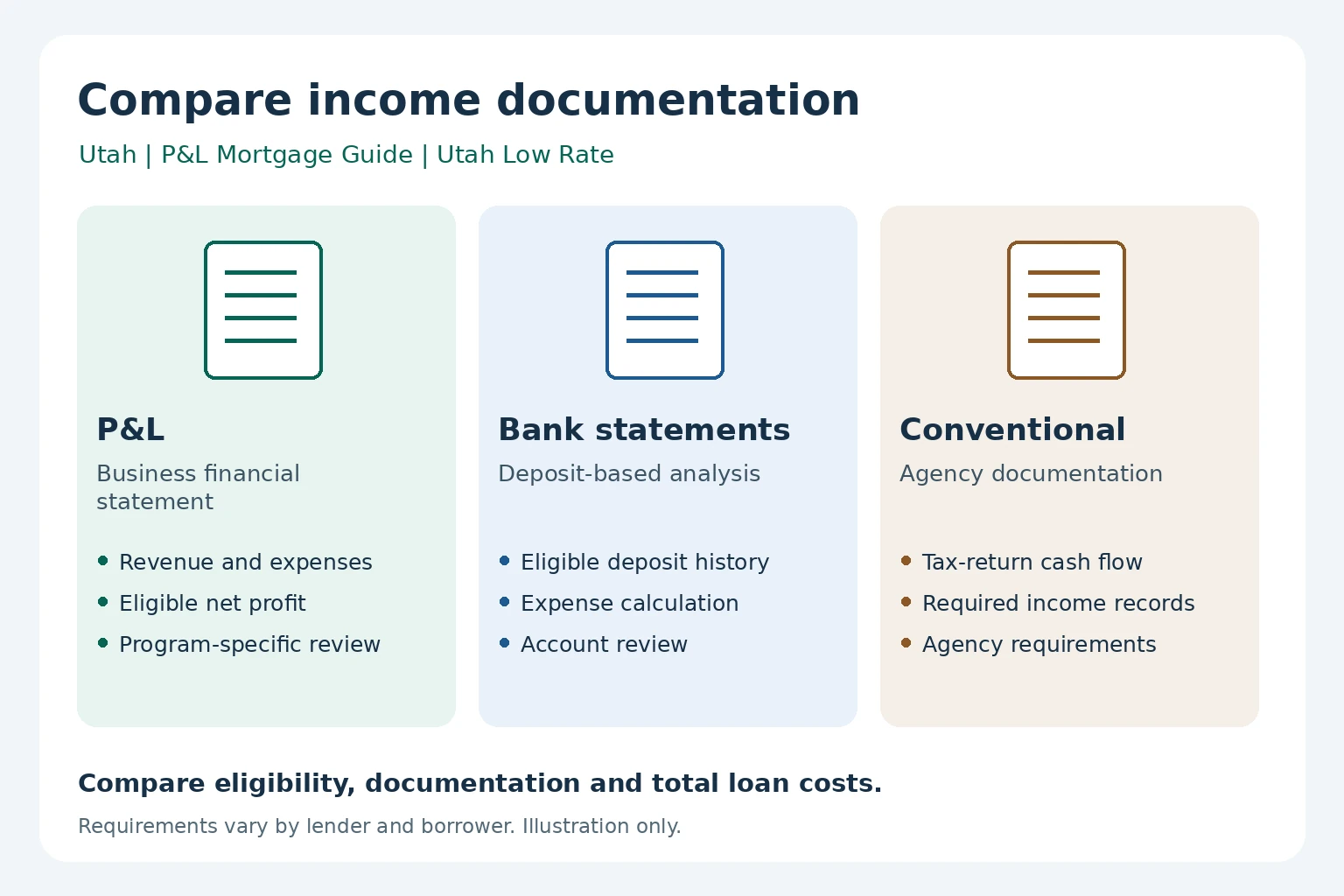
Profit and Loss Mortgage Loans vs. Conventional Mortgages
| Feature | P&L Mortgage | Conventional Mortgage |
|---|---|---|
| Best Suited for | Certain self-employed borrowers | Traditional and qualifying self-employed borrowers |
| Income Approach | Alternative Documentation | Standard agency documentation |
| P&L Statement | May be primary income document | May support income analysis |
| Tax Returns | May not be required by certain programs | Commonly used for self-employed income |
| Underwriting | non-QM/program specific | Agency guidelines |
| Pricing | May be higher than conventional financing | Often lower for well-qualified borrowers |
| Flexibility | Potentially greater | More standardized |
| Business Analysis | Program Specific | Detailed self-employment analysis may apply |
A conventional mortgage should not automatically be ruled out simply because you own a business.
If you qualify conventionally, compare that option against alternative-documentation financing before deciding.
Profit and Loss Mortgage vs. Bank Statement Loan
Both programs can help certain self-employed borrowers, but they document income differently.
P&L Mortgage Loan
A P&L mortgage generally focuses on an eligible Profit and Loss statement and the income calculated according to the program's requirements.
Bank Statement Mortgage
A Bank Statement Loan generally analyzes eligible deposits appearing on personal or business bank statements over a specified period and applies the lender's methodology for determining qualifying income.
Which Is Better?
That depends on your business.
A borrower with strong bank deposits may benefit from a Bank Statement Loan, while another borrower may present a stronger financial profile through an eligible P&L statement.
Daniel Paris can help compare the available approaches.
P&L Mortgage vs. 1099 Mortgage
A 1099 mortgage program may be appropriate for certain independent contractors or borrowers whose income is primarily documented through IRS Form 1099.
A P&L mortgage program is generally more closely tied to the borrower's business revenue and expenses as reflected on an eligible Profit and Loss statement.
Borrowers should compare both when their financial profile potentially qualifies for either approach.
P&L Mortgage vs. DSCR Loan
These two programs address very different borrower needs.
A P&L mortgage focuses on the borrower's business income.
A DSCR loan generally focuses more heavily on the cash flow generated by an eligible investment property rather than qualifying primarily from the borrower's personal employment income.
For a self-employed borrower buying a primary residence, a P&L or Bank Statement program may deserve consideration.
For a real estate investor buying a rental property, a DSCR program may be more appropriate.
Credit Requirements for Utah P&L Mortgage Loans
There is no single universal minimum credit score that applies to every Profit and Loss mortgage program.
Credit requirements can vary according to:
- Loan amount
- Loan-to-value ratio
- Down payment
- Property type
- Occupancy
- Mortgage history
- Bankruptcy or foreclosure history
- Cash reserves
- Overall borrower profile
- Specific lender guidelines
Generally, a stronger credit profile can provide access to more favorable financing options.
Call 801-604-4949 to discuss your credit profile and available programs rather than assuming you qualify—or do not qualify—based on a single credit score.
How Much Down Payment Is Required for a P&L Mortgage?
There is no universal down-payment requirement.
The amount can vary based on the lender, program, credit profile, property, occupancy and loan amount.
In general, the lender considers the loan-to-value ratio (LTV), which compares the mortgage amount with the property's value.
For example, a lower LTV means the borrower has more equity in the property.
Because alternative-documentation mortgages can have different LTV limits, ask for the current requirements that apply to your specific scenario.
Can P&L Mortgage Loans Be Used for Jumbo Mortgages?
Depending on current lender offerings, Jumbo P&L mortgage programs may be available to qualified self-employed borrowers seeking financing above standard conforming loan limits.
This can be especially relevant in higher-priced Utah markets such as:
Park City, Deer Valley, Salt Lake City, Holladay, Cottonwood Heights, Draper, Alpine, Highland, Heber City and Midway.
Large-loan underwriting can involve additional requirements for assets, reserves, credit and loan-to-value.

Documents You May Need for a Utah P&L Mortgage
Requirements vary, but borrowers should be prepared to discuss or provide documents such as:
- Profit and Loss statement
- Business verification
- Business license, when applicable
- CPA/accountant/tax-preparer information
- Personal identification
- Mortgage statements
- Asset statements
- Documentation of down-payment funds
- Reserve documentation
- Purchase contract for a home purchase
- Homeowners insurance information
- Property documentation
- Additional documents requested by underwriting
Your lender may request other documentation depending on your individual circumstances.
Can I Use a P&L Mortgage to Buy a Home in Utah?
Potentially, yes.
Qualified borrowers may be able to use an available Profit and Loss mortgage program for an eligible Utah home purchase, subject to the program's occupancy, property, credit, down-payment and underwriting requirements.
Before shopping for a property, determine how your P&L income may be evaluated and obtain an appropriate mortgage qualification.
Can I Refinance with a Profit and Loss Mortgage?
Potentially.
Depending on program availability and borrower eligibility, P&L mortgage financing may include rate-and-term refinancing and potentially cash-out refinancing.
A refinance should be evaluated based on the complete financial transaction—not merely the proposed interest rate.
Consider the new loan amount, rate, APR, closing costs, payment and long-term objectives.
Utah P&L Mortgage Loans for Business Owners
Utah has a diverse population of entrepreneurs, contractors and independently employed professionals.
Daniel Paris works with self-employed borrowers throughout Utah, including:
Salt Lake City, Holladay, Millcreek, Murray, Cottonwood Heights, Sandy, Draper, South Jordan, West Jordan, Riverton, Herriman, Bluffdale, Lehi, American Fork, Alpine, Highland, Orem, Provo, Park City, Deer Valley, Heber City, Midway, Layton, Ogden, St. George, Washington, Ivins, Santa Clara and surrounding Utah communities.
A self-employed borrower in Park City seeking a Jumbo mortgage can have very different financing needs from a contractor in Draper, an entrepreneur in Lehi or a business owner purchasing a home in St. George.
The objective is not simply to find a mortgage labeled “P&L.” It is to determine which available mortgage structure best fits your income, assets, credit, property and financing objectives.
How to Apply for a Profit and Loss Mortgage Loan in Utah
Step 1: Call Daniel Paris
Call 801-604-4949 and explain that you are self-employed and interested in a P&L mortgage.
Step 2: Discuss Your Business
Be prepared to discuss how long you have been self-employed, your ownership percentage, type of business and approximate revenue and expenses.
Step 3: Review Your Mortgage Goals
Discuss whether you are purchasing or refinancing, the property type, estimated value or purchase price, desired loan amount and occupancy.
Step 4: Compare Income-Documentation Options
Depending on your situation, compare P&L financing against Bank Statement, 1099, conventional and other available mortgage programs.
Step 5: Review Credit, Assets and Reserves
Income documentation is only one part of mortgage underwriting.
Step 6: Obtain the Required P&L
Once the appropriate program has been identified, follow that program's requirements for preparing or verifying the Profit and Loss statement.
Step 7: Complete Underwriting
Submit the required documentation for lender review and underwriting.
Advantages of Profit and Loss Mortgage Loans
For the right borrower, potential advantages can include:
- Alternative documentation for self-employed income
- Potential solution when traditional tax-return calculations do not fit
- May eliminate the need to use tax returns for qualifying income under certain programs
- Can provide another option for business owners
- Potential purchase and refinance options
- Potential Jumbo financing
- May provide an alternative to Bank Statement financing
Potential Disadvantages of P&L Mortgage Loans
P&L mortgages are not necessarily the best solution for every borrower.
Potential considerations include:
- Interest rates may be higher than comparable conventional financing
- Larger down payment or more equity may be required
- Reserve requirements may apply
- Credit standards still apply
- P&L preparation or third-party verification may be required
- Not every property or occupancy type will qualify
- Additional documentation can still be requested
- Program availability can change
Compare the total cost and terms against other mortgage options before choosing a program.
Frequently Asked Questions About Profit and Loss Mortgage Loans in Utah
What is a P&L mortgage loan?
A P&L mortgage is an alternative-documentation mortgage that may allow a qualifying self-employed borrower to establish business income using an eligible Profit and Loss statement. Exact documentation and underwriting requirements depend on the lender and program.
Can I qualify for a Utah mortgage with a Profit and Loss statement?
Potentially. Certain mortgage programs are specifically designed for self-employed borrowers and may use an eligible P&L statement to determine qualifying income.
Can I get a P&L mortgage without tax returns?
Certain alternative-documentation programs may not require tax returns to calculate qualifying income. This is lender- and program-specific, and other documentation and underwriting requirements still apply.
Are P&L loans only for self-employed borrowers?
They are primarily intended for borrowers whose qualifying income is derived from self-employment or business ownership. Eligibility depends on the particular program.
Does the P&L need to be prepared by a CPA?
Some programs may require a CPA, accountant, tax professional or other acceptable independent third party to prepare or verify the P&L. Requirements vary, so verify the program guidelines before ordering documentation.
Can I use a P&L loan for a Jumbo mortgage in Utah?
Potentially. Some alternative-documentation programs offer Jumbo financing to qualified self-employed borrowers, subject to current lender guidelines.
Is a P&L mortgage a non-QM loan?
Many mortgages marketed specifically as P&L alternative-documentation programs fall within the broader non-QM market. However, the exact classification depends on the loan and lender.
Is a P&L mortgage the same as a Bank Statement Loan?
No. A P&L mortgage generally uses an eligible Profit and Loss statement to document business income, while a Bank Statement Loan generally analyzes eligible deposits over a specified period.
Is a P&L loan better than a conventional mortgage?
Not necessarily. If you qualify for conventional financing, compare its rate, APR, costs and documentation requirements against a P&L program. Alternative-documentation financing is valuable when traditional underwriting does not adequately fit the borrower's circumstances.
Can a first-time homebuyer use a P&L mortgage?
Potentially, provided the borrower, business, property and transaction satisfy the applicable program requirements.
Can I refinance using a P&L mortgage?
Potentially. Rate-and-term and cash-out options may be available depending on the lender and program.
What credit score do I need for a P&L mortgage in Utah?
There is no universal credit-score requirement for all P&L programs. Requirements vary based on lender guidelines, loan amount, LTV, property, occupancy and the overall borrower profile.
How much can I borrow with a P&L mortgage?
Maximum loan amounts vary considerably among lenders and programs. Your qualifying income, credit, assets, loan-to-value, property and other underwriting factors can also affect the amount available.
Where are P&L mortgage loans available in Utah?
Subject to lender and program availability, borrowers may explore P&L mortgage options throughout Utah, including Salt Lake City, Sandy, Draper, Park City, Heber City, Lehi, Provo, Orem, St. George and other Utah communities.
Who should I contact about a Profit and Loss Mortgage Loan in Utah?
Contact Daniel Paris at UtahLowRate.com at 801-604-4949 to discuss your self-employed mortgage scenario and available financing options.
Why Work with Daniel Paris for a Utah Self-Employed Mortgage?
Self-employed mortgage qualification can be more complicated than a traditional W-2 mortgage application.
The important question is not simply:
“Can I qualify for a P&L mortgage?”
A better question is:
“Which mortgage program gives me the strongest overall financing option based on my actual financial profile?”
Daniel Paris can help you compare available options including:
Conventional Mortgages | Jumbo Loans | Super Jumbo Loans | Bank Statement Loans | P&L Loans | 1099 Mortgages | Stated Income Programs | DSCR Loans | Asset-Based Programs | Non-QM Mortgages
That comparison can be particularly important for business owners because different income-documentation methods can produce very different qualifying results.
Talk With Daniel Paris About a Profit and Loss Mortgage Loan in Utah
If traditional mortgage documentation does not accurately reflect your financial situation, explore whether a Profit and Loss Mortgage Loan in Utah or another self-employed mortgage program may be appropriate.
Daniel Paris
Utah Mortgage Broker
NMLS #243976
UtahLowRate.com
801-604-4949
Get a Utah P&L Mortgage Quote
Call Daniel Paris at 801-604-4949
Discuss your business, income documentation, home purchase or refinance goals and available Utah mortgage options.
About Daniel Paris
Daniel Paris has more than 27 years of mortgage lending experience helping Utah homebuyers, homeowners, business owners and self-employed borrowers explore traditional and alternative mortgage financing.
Through UtahLowRate.com, Daniel works with borrowers seeking Conventional, FHA, VA, Jumbo, Super Jumbo, Bank Statement, Profit & Loss, 1099, DSCR and other Non-QM mortgage options.
Important Disclosure
Mortgage programs, rates, APRs, fees, loan amounts, credit requirements, loan-to-value limits, reserve requirements, documentation standards and program availability are subject to change.
Alternative-documentation programs do not eliminate underwriting or the borrower's obligation to provide accurate information. All loans are subject to lender/investor guidelines, property eligibility and borrower qualification.
Nothing on this page constitutes a commitment to lend or a guarantee of approval, interest rate, loan amount, savings or closing.
Local Profit and Loss Home Loan Guides in Utah
- Profit and Loss Home Loans Salt Lake City Utah
- Profit and Loss Home Loans Utah County Utah
- Profit and Loss Home Loans Weber County Utah
- Profit and Loss Home Loans Washington County Utah
- Profit and Loss Home Loans Davis County Utah
- Profit and Loss Home Loans Tooele County Utah
- Profit and Loss Home Loans Iron County Utah
- Profit and Loss Home Loans Uintah County Utah
- Profit and Loss Home Loans Summit County Utah
- Profit and Loss Home Loans Duchesne County Utah
- Profit and Loss Home Loans St. George Utah

