
Jumbo Mortgage Loans for Self-Employed Borrowers: Use Bank Statements Instead of Tax Returns

By Daniel Paris | Mortgage Broker | 27+ Years of Mortgage Experience | UtahLowRate.com
Last Updated: September 24, 2026
Self-employed borrowers looking for jumbo mortgage loans for self-employed borrowers may have an alternative to qualifying with traditional tax-return income. Certain non-QM jumbo mortgage programs can evaluate 12 or 24 months of personal or business bank statements to calculate qualifying income.
This can be particularly useful for business owners, entrepreneurs, independent contractors and other self-employed borrowers whose tax returns do not fully reflect the cash flow available to support a mortgage.
At UtahLowRate.com, mortgage broker Daniel Paris works with self-employed borrowers throughout Utah, including Salt Lake City, Park City, Deer Valley, Draper, Sandy, Lehi, Heber City and St. George.
Quick Answer: Can You Get a Jumbo Mortgage Without Tax Returns?
Yes. Certain bank statement jumbo mortgage programs allow qualified self-employed borrowers to document income using eligible deposits from personal or business bank statements instead of relying on federal income tax returns to calculate qualifying income.
These are generally alternative-documentation or non-QM mortgages rather than standard conventional agency loans.
Program requirements vary by lender and can include credit score, loan-to-value ratio, property type, reserves, self-employment history, deposit history and loan amount.
For comparison, traditional Fannie Mae underwriting generally requires tax-return-based documentation when self-employment income is being used to qualify. Fannie Mae also requires lenders to analyze the stability and continuity of the borrower’s self-employed income.
Why Tax Returns Can Create Problems for Self-Employed Jumbo Borrowers

A successful business can generate substantial cash flow while reporting significantly less taxable income.
Legitimate business expenses, depreciation and other deductions can reduce taxable income. That can become an issue when a traditional mortgage program calculates qualifying income primarily from tax returns.
For example, a business owner may generate substantial annual gross receipts while reporting much lower taxable income after business deductions.
That does not automatically mean the borrower will qualify for a bank statement mortgage. It does explain why an alternative method of documenting cash flow may be worth evaluating.
Bank statement lending approaches the income calculation differently.
Instead of starting with taxable income, the lender reviews eligible deposits over a specified period and applies the lender’s bank-statement income methodology.
How Bank Statement Jumbo Loans Work
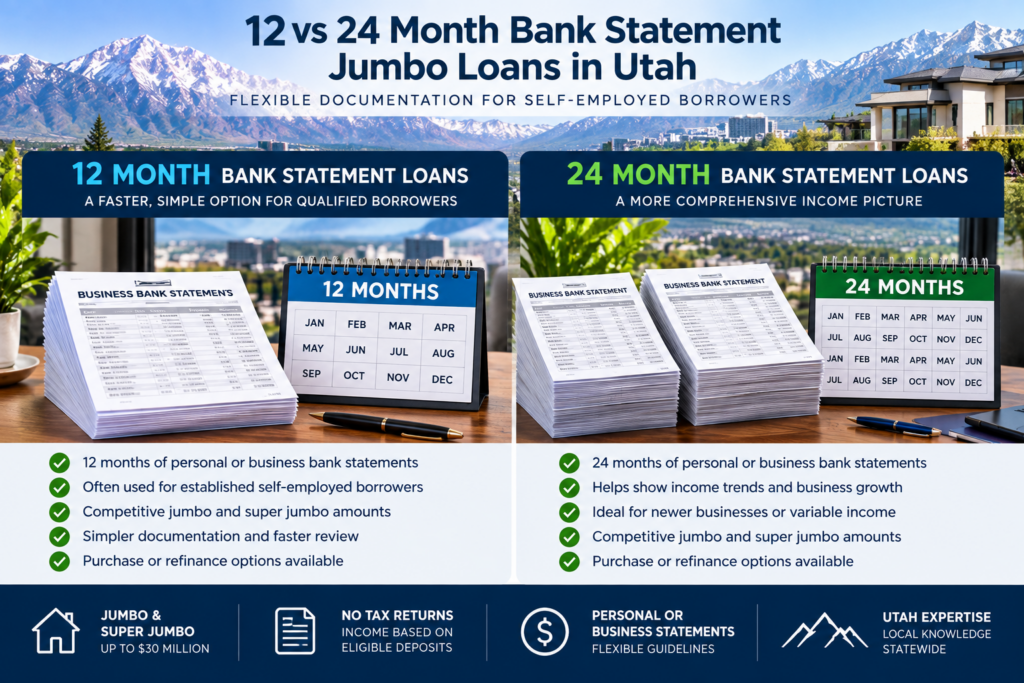
A self-employed jumbo mortgage using bank statements typically uses either personal or business statements to establish qualifying income.
Common documentation periods include:
12-Month Bank Statement Loans
Some programs allow the lender to review the most recent 12 months of eligible bank statements.
This can provide a relatively current picture of the borrower’s business or personal cash flow.
24-Month Bank Statement Loans
Other programs use 24 months of statements.
The longer period can help demonstrate the consistency of deposits and provide the underwriter with a broader history of the borrower’s income.
Neither method means every deposit is automatically counted as income.
Transfers between accounts, borrowed money, one-time deposits and other deposits that cannot reasonably be treated as recurring income may need to be excluded.
Personal vs. Business Bank Statements
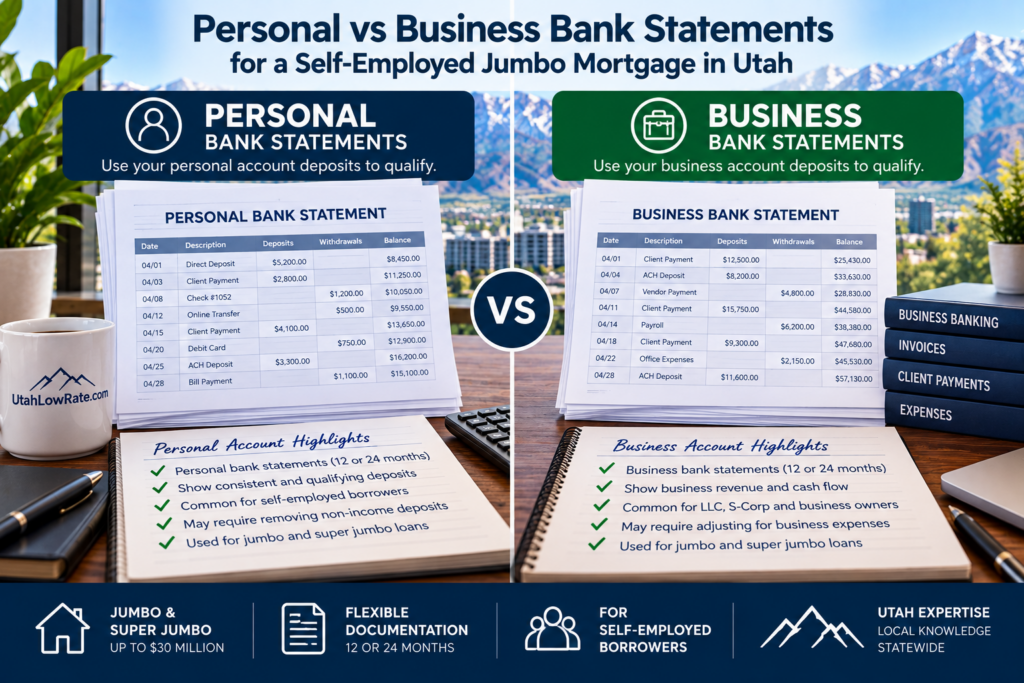
Self-employed borrowers may be able to qualify using personal bank statements, business bank statements or an eligible combination, depending on the mortgage program.
With personal statements, the lender generally evaluates qualifying deposits reaching the borrower’s personal accounts.
Business bank statements require additional analysis because gross business deposits are not the same thing as personal income.
The lender may apply an expense factor or another approved method to determine how much of the eligible business deposits can reasonably be treated as qualifying income.
For example, under a hypothetical 50% expense factor, $50,000 of average monthly eligible business deposits would produce approximately $25,000 of monthly qualifying income before other underwriting adjustments.
The actual expense factor is lender- and program-specific. Some programs may permit different expense calculations when supported by appropriate documentation.
How Is Bank Statement Mortgage Income Calculated?
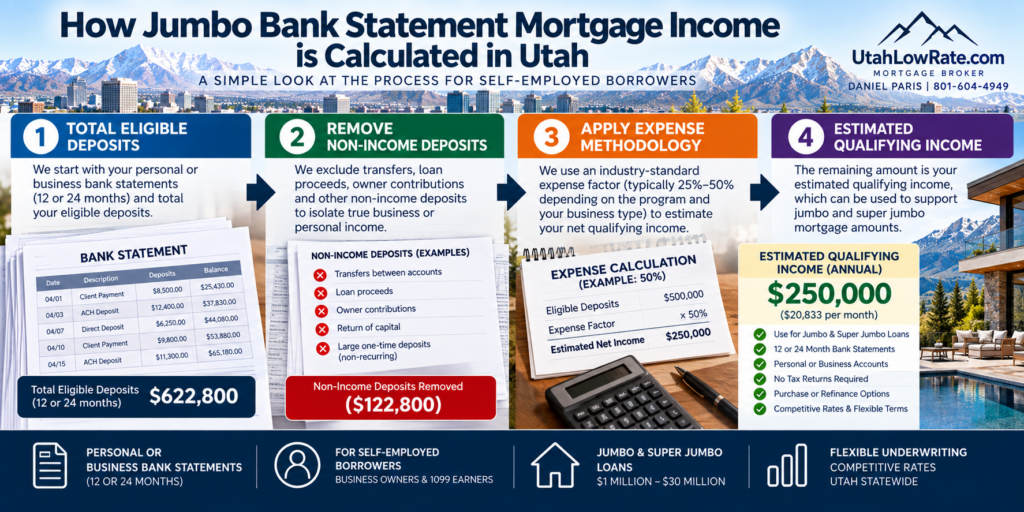
A simplified calculation can look like this:
Eligible deposits ÷ number of statement months = average monthly deposits
When business statements are being used, the applicable business-expense methodology is then applied:
Average eligible monthly business deposits × allowable income percentage = estimated qualifying monthly income
Suppose a business has $720,000 in eligible deposits during a 12-month review period.
$720,000 ÷ 12 = $60,000 average monthly deposits
If the applicable underwriting methodology allowed 50% of those deposits to be treated as qualifying income:
$60,000 × 50% = $30,000 estimated monthly qualifying income
This is only an illustration. A mortgage underwriter must determine which deposits are eligible and what expense calculation applies to the specific loan program.
How Much Can You Borrow With a Jumbo Bank Statement Loan?
Jumbo bank statement financing is designed for loan amounts above traditional conforming financing and may extend into multimillion-dollar loan sizes.
At UtahLowRate.com, Daniel Paris works with wholesale lending programs covering jumbo and super-jumbo financing, including programs that may reach substantially higher balances for qualified borrowers.
Available loan amount and maximum LTV depend on the lender, credit profile, occupancy, documentation, property, liquidity and overall risk profile.
A borrower seeking a $1.5 million mortgage in Draper will not necessarily receive the same terms as someone seeking a $5 million mortgage in Deer Valley or a $10 million super-jumbo mortgage in Park City.
That is why jumbo scenarios should be priced and underwritten individually rather than relying on a generic online mortgage chart.
Who May Benefit From a Self-Employed Jumbo Bank Statement Loan?
Bank statement jumbo financing may be worth considering for borrowers such as:
- Business owners
- LLC members
- S-corporation owners
- Sole proprietors
- Entrepreneurs
- Consultants
- Real-estate professionals
- Independent contractors
- High-income self-employed professionals
- Borrowers with substantial legitimate business deductions
The key issue is not simply whether someone is self-employed.
The lender must still establish acceptable qualifying income and determine that the borrower satisfies the program’s credit, asset, property, reserve and other underwriting requirements.
Jumbo Bank Statement Loans in Park City and Deer Valley

Alternative-documentation jumbo financing can be especially relevant in Park City, Deer Valley, Empire Pass, Canyons Village, Promontory, Old Town, Kimball Junction and surrounding Summit County communities, where property values can create financing needs well above conforming loan amounts.
Many buyers in these markets are entrepreneurs, executives or business owners whose finances do not fit neatly into traditional W-2 underwriting.
A borrower purchasing a luxury Park City residence may have strong liquidity and business cash flow but substantial deductions appearing on federal tax returns.
A bank statement jumbo program can provide another way to evaluate that borrower based on eligible documented cash flow, subject to underwriting.
Salt Lake City and Wasatch Front Self-Employed Jumbo Loans
Self-employed jumbo financing is also available for qualified borrowers throughout the Wasatch Front.
UtahLowRate.com works with borrowers in Salt Lake City, Holladay, Millcreek, Cottonwood Heights, Sandy, Draper, South Jordan, Herriman, Riverton, Alpine, Highland, Lehi and surrounding Utah communities.
The right documentation strategy can depend on how the business receives revenue.
For one borrower, personal statements may provide the clearest documentation. For another, business statements may be more appropriate.
Reviewing both possibilities before submitting the loan can help determine which wholesale program fits the scenario.
Bank Statement Jumbo Loans vs. Conventional Self-Employed Mortgages
The biggest difference is how qualifying income is documented and calculated.
Traditional agency underwriting generally evaluates self-employment income through tax-return documentation and cash-flow analysis. Fannie Mae’s current Selling Guide, for example, discusses individual and business federal tax returns and analysis of stable, continuous self-employment income.
Bank statement mortgages are alternative-documentation loans. Eligible deposits may be used to establish qualifying income according to the lender’s underwriting methodology.
That distinction matters.
A “no tax return mortgage” does not mean “no income verification.”
The lender is still verifying income. It is simply using an alternative documentation method.
What Documents May Be Required?
Although exact requirements vary, a jumbo bank statement mortgage may require documentation such as:
- 12 or 24 months of personal or business bank statements
- Proof of self-employment
- Business license or organizational documents when applicable
- Identification
- Mortgage application
- Asset statements
- Documentation of down payment and closing funds
- Reserve documentation
- Housing history
- Property appraisal
- Documentation explaining unusual or large deposits when required
Additional documentation may be requested based on the individual loan file.
Credit Score, Down Payment and Reserves
A bank statement loan does not eliminate normal mortgage risk factors.
Credit score can affect the available LTV, pricing and program eligibility. A larger down payment may improve available financing options, particularly as the loan amount increases.
Jumbo lenders may also require meaningful post-closing reserves.
Those requirements can become more significant for very large loan balances because the lender wants to establish that the borrower has sufficient liquidity after the transaction closes.
The strongest structure therefore depends on the combination of income, credit, assets, property, loan amount, occupancy and LTV rather than any single factor.
Are Bank Statement Jumbo Mortgage Rates Higher?
Bank statement jumbo loans may be priced differently from traditional full-documentation mortgages because the underwriting method and risk characteristics are different.
That does not mean there is one universal “bank statement rate.”
Pricing can change based on credit score, LTV, loan size, occupancy, property type, documentation method, reserves, points and broader financial-market conditions.
For market context, Freddie Mac reported an average 30-year fixed rate of 6.95% for the week ending September 17, 2026 in its national Primary Mortgage Market Survey. That survey is a broad conventional-market benchmark and should not be interpreted as a quote for a non-QM jumbo bank statement mortgage.
The best way to compare programs is to evaluate the same borrower scenario across multiple wholesale lenders.
Why Work With a Mortgage Broker for a Jumbo Bank Statement Loan?
Alternative-documentation jumbo guidelines can vary significantly from lender to lender.
One lender may be stronger for business bank statements. Another may handle larger loan balances more effectively. Another may offer a better structure at a particular credit score or LTV.
As a mortgage broker, Daniel Paris of UtahLowRate.com can compare eligible wholesale lending programs rather than limiting a borrower to a single bank’s mortgage menu.
That can be particularly important for unusual combinations involving self-employment, luxury property, large loan balances or complex income.
Frequently Asked Questions
Can I get a jumbo mortgage if I’m self-employed and don’t want to use tax returns?
Potentially, yes. Qualified self-employed borrowers may be able to use a bank statement jumbo mortgage that calculates income from eligible personal or business bank deposits instead of using tax returns to calculate qualifying income.
How many months of bank statements do I need for a jumbo mortgage?
Many bank statement mortgage programs use either 12 or 24 months of statements. The required period depends on the lender, loan program and borrower profile.
Can I use my business bank statements to qualify for a jumbo loan?
Yes, certain programs permit eligible business bank statements. The lender generally analyzes eligible deposits and applies the program’s required business-expense methodology to determine qualifying income.
Does a no-tax-return mortgage mean the lender doesn’t verify my income?
No. A no-tax-return bank statement mortgage still verifies income. The difference is that qualifying income may be calculated from eligible bank deposits rather than traditional tax-return income.
Can I use bank statements for a multimillion-dollar mortgage in Park City?
Potentially, yes. Jumbo and super-jumbo bank statement programs may be available for qualified self-employed borrowers purchasing or refinancing higher-value Utah properties, but maximum loan amounts and LTV limits vary significantly by program.
Are bank statement jumbo loans only available for primary residences?
No. Depending on the program, bank statement jumbo financing may be available for primary residences, second homes and certain investment-property scenarios. Eligibility and terms depend on the lender and transaction.
Talk With a Utah Jumbo Mortgage Broker

If your business produces strong cash flow but your tax returns do not accurately represent the income available for mortgage qualification, a bank statement jumbo loan may be worth evaluating.
Daniel Paris — UtahLowRate.com
Mortgage Broker | 27+ Years of Experience
Phone: 801-604-4949
Service Area: Utah statewide, including Salt Lake City, Park City, Deer Valley, Draper, Sandy, Lehi, Heber City and St. George
Specialties: Bank Statement Loans, Jumbo and Super Jumbo Mortgages, Non-QM Loans, DSCR Loans and alternative-documentation mortgages
Compare your bank-statement income, loan amount, credit, down payment and property with available wholesale programs before deciding which mortgage structure to use.
CTA: Check My Jumbo Bank Statement Loan Options

