

Utah Bank Statement Cash-Out Loans for Homeowners and Investors with 600 credit scores
Utah homeowners and real estate investors who need equity for another purchase, renovations, or debt consolidation may have a cash-out option even when agency guidelines do not fit. A non-QM bank statement cash-out program may consider one year of personal or business bank statements instead of tax returns for eligible owner-occupied and non-owner-occupied properties, with loan amounts up to $1.5 million in qualifying scenarios. The program details below reflect the scenario information supplied and a program matrix dated October 19, 2026; every loan remains subject to the current lender guidelines, underwriting, appraisal, title review, and final approval.
Daniel Paris of UtahLowRate.com is a Utah mortgage broker who helps homeowners, self-employed borrowers, and real estate investors review bank-statement, jumbo, and other non-agency financing options. Call 801-604-4949 to discuss a specific property and request a scenario review.
Quick answer: can I use bank statements for a Utah cash-out refinance?
Possibly. Qualified borrowers may be able to refinance an owner-occupied home or eligible investment property and document income with 12 months of bank statements rather than tax returns. The supplied scenario lists owner-occupied cash-out up to 60% LTV at 600 FICO, owner-occupied cash-out up to 75% LTV at 640 FICO when there are no 60-day mortgage late payments in the prior 12 months, and non-owner-occupied cash-out up to 75% LTV at 620 FICO. Loan amounts may reach $1.5 million in qualifying scenarios; these are maximums, not guaranteed terms or approval.
Eligibility depends on the exact credit, LTV, occupancy, mortgage-payment history, property, reserves, and transaction. Ask for a review before relying on a maximum score or LTV tier.
Utah cash-out loan highlights for homeowners and investors
- Bank statement history: one year of personal or business statements may be considered instead of tax returns.
- Occupancy options: cash-out refinancing may be available for eligible owner-occupied homes and non-owner-occupied investment properties.
- Owner-occupied cash-out: 600 FICO up to 60% LTV, or 640 FICO up to 75% LTV with no 60-day mortgage late payments in the prior 12 months.
- Non-owner-occupied cash-out: 620 FICO up to 75% LTV.
- Maximum loan amount: up to $1.5 million in qualifying scenarios.
- Tax returns: not required for the bank-statement documentation path, though other documents may still be needed.
- Reserves: the attached program matrix shows six months of reserves in selected tiers; requirements can vary.
“Up to” describes a maximum available only when all applicable requirements are met. A lower LTV, additional reserves, or other restrictions may apply. Rates, costs, prepayment terms, and availability are based on the full file and can change.
How one-year bank statement income is reviewed
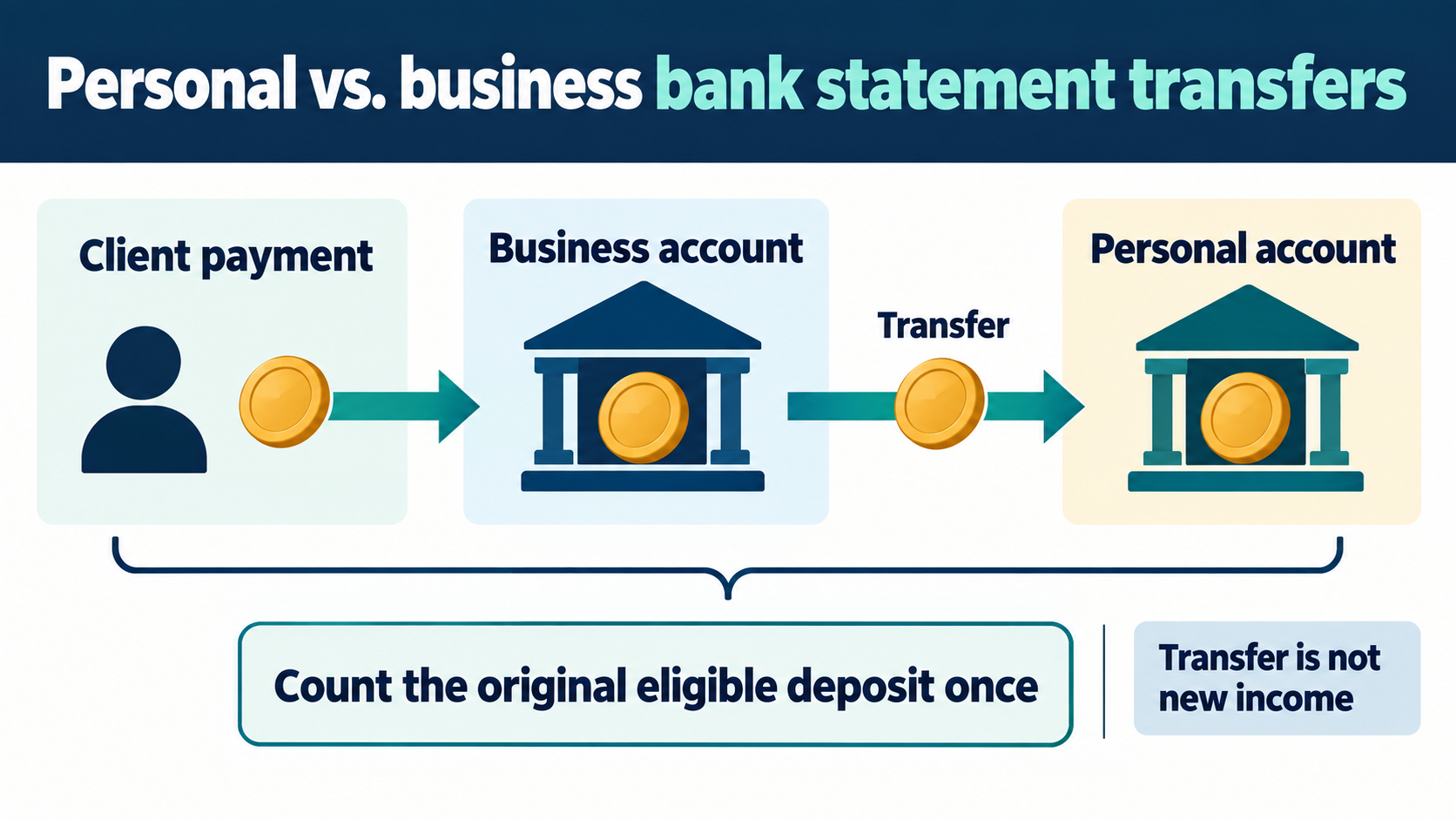
Bank statement underwriting reviews deposits and account activity to estimate qualifying cash flow. It does not automatically treat every deposit as income. Transfers between accounts, loan proceeds, refunds, returned items, and other non-business deposits may be excluded. A lender may request invoices, deposit explanations, a year-to-date profit-and-loss statement, or a letter from a tax professional to clarify the business and its deposits.
For business accounts, the underwriter may apply an expense factor or otherwise adjust deposits to account for operating costs and the borrower’s ownership share. Personal statements are evaluated differently. The actual method depends on the selected lender program, documentation, and business type. Strong deposits help build a case, but the amount of deposits alone does not determine approval.
What can cash-out funds be used for?
When approved, proceeds may give a homeowner or investor liquidity for another property purchase, planned renovations, or debt consolidation. A borrower should compare the total cost and risks of the refinance with the expected benefit. Cash-out increases or replaces debt secured by the property, and a longer loan term or different rate may change total interest paid. Consolidating unsecured debt into a mortgage can also put the property at risk if the new mortgage is not repaid.
Before moving forward, review the written loan terms and closing costs. The Consumer Financial Protection Bureau’s Loan Estimate guide explains how to review the loan amount, payment, costs, and cash to close. Request and compare written estimates when available.
Who may be a fit?
This option may be worth exploring for a homeowner or investor who owns an eligible property, has meaningful equity, receives consistent business or personal deposits, and needs capital for a documented purpose. It can also be relevant when tax returns do not show income in the same way as current bank activity. The program is not a fit for every borrower, and bank statements do not remove the need to document the source of funds or satisfy underwriting.
Typical scenario details to review include the property value, current lien balance, requested cash-out amount, credit score, recent housing history, monthly deposits, occupancy, property condition, and funds available after closing. A lender may also review rent, leases, insurance, taxes, HOA obligations, title, and appraisal information.
Information to prepare for a first review
- Borrower’s estimated FICO score and any recent mortgage late payments.
- Property address, estimated value, property type, and whether it is owner-occupied or non-owner-occupied.
- Current mortgage balance and any other liens.
- Requested cash-out amount and intended use of proceeds.
- Recent 12 months of personal or business bank statements for the account that best reflects eligible deposits.
- Approximate monthly deposits and an explanation of large or unusual credits.
- Current leases or rent information, if applicable, and estimate of post-closing assets or reserves.
For an initial scenario screen, send Daniel the FICO score, property value, current loan balance, cash-out amount requested, and approximate monthly bank deposits. Do not email account numbers, Social Security numbers, or complete unredacted statements through an unsecured channel. Secure document instructions can be provided if the scenario moves forward.
Utah service area
UtahLowRate.com can review owner-occupied and investment-property scenarios across Utah, including Salt Lake City and the Wasatch Front, Park City and Summit County, Heber and the Wasatch Back, Utah County, Weber and Davis counties, and St. George and Washington County. Property, appraisal, and lender availability can vary by location and property type.
To compare bank statement cash-out with other financing, see Utah mortgage options, today’s Utah mortgage rates, and the Utah bank statement mortgage guide. For a quote, call 801-604-4949 or visit UtahLowRate.com.
Frequently asked questions
Can I use one year of bank statements for an owner-occupied Utah cash-out refinance?
Possibly. Eligible owner-occupied cash-out scenarios may allow 600 FICO up to 60% LTV or 640 FICO up to 75% LTV when there are no 60-day mortgage late payments in the prior 12 months, subject to lender review of income, payment history, equity, reserves, and property.
What are the cash-out LTV limits for a Utah rental property?
The supplied non-owner-occupied cash-out scenario allows up to 75% LTV with a 620 FICO score. The lender must confirm the property, loan amount, credit, reserves, and other current program requirements.
What credit score do I need for a Utah bank statement cash-out loan?
The supplied tiers are 600 FICO up to 60% LTV for owner-occupied cash-out, 640 FICO up to 75% LTV for owner-occupied cash-out with no 60-day mortgage late payments in the prior 12 months, and 620 FICO up to 75% LTV for non-owner-occupied cash-out. These are scenario limits, and approval depends on full underwriting.
Do I need to provide tax returns for a one-year bank statement loan?
Tax returns are not required for the described bank-statement documentation path, but the lender may request other records to verify business activity, explain deposits, and complete underwriting.
What should I send to check whether my borrower may qualify?
Start with the FICO score, property value, current loan balance, requested cash-out, and average monthly bank deposits. Include whether the property is owner-occupied or non-owner-occupied, and avoid sending sensitive account or identity information until secure document instructions are provided.
About Daniel Paris: Daniel Paris is a Utah mortgage broker with more than 27 years of mortgage experience and NMLS #243976. UtahLowRate.com serves borrowers statewide. Call 801-604-4949.
Program information is subject to change and is for general informational purposes only. Eligibility, rates, fees, loan terms, and approval depend on current lender guidelines and the complete application. This is not a commitment to lend. Confirm all details with a licensed mortgage professional.

