
50 Mortgage Questions Answered
Stated Income Loan FAQ Utah answers common questions from Utah homebuyers and homeowners who are exploring stated income and alternative-documentation mortgage options. Learn about credit scores, down payments, LTV, assets, reserves, tax returns, self-employment, purchases, refinances and other ways to document a mortgage scenario.
Modern alternative-documentation mortgages still require underwriting. They are not guaranteed-approval loans.
If you are just starting your research, visit Stated Income Mortgage Loans Utah. For qualification details, see Stated Income Loan Requirements Utah.

Stated Income Loan FAQ Utah: Quick Answer
Yes, certain stated income and alternative-documentation mortgage programs may be available to qualified Utah borrowers.
These programs can be useful when traditional income documentation does not fit a borrower's financial situation. Depending on the program, underwriting may consider credit, assets, reserves, down payment or equity, property value, occupancy and loan-to-value ratio.
Requirements vary by lender and investor.
Stated Income Mortgage Quick Facts
| Topic | Quick Answer |
|---|---|
| Stated income programs available? | Certain alternative programs are available |
| Underwriting required? | Yes |
| Tax returns always required for income calculation? | Not necessarily |
| Credit reviewed? | Yes |
| Assets reviewed? | Yes |
| Reserves required? | Often |
| Appraisal required? | Generally yes |
| Purchase financing? | Available under qualifying programs |
| Refinance? | Available under qualifying programs |
| Cash-out refinance? | Available under qualifying programs |
| Approval guaranteed? | No |
For the complete program overview, visit Stated Income Mortgage Loans Utah.
Stated Income Loan FAQ Utah: General Questions
1. What is a stated income mortgage?
A stated income mortgage is a type of alternative mortgage financing. Traditional income documents may not be the primary way a borrower qualifies.
Modern programs still require underwriting and supporting documentation.
2. Do stated income mortgage loans still exist in Utah?
Yes. Certain alternative-documentation mortgage programs may be available to qualified Utah borrowers.
Availability and guidelines vary by lender and investor.
3. Are modern stated income loans the same as old stated income loans?
No.
Modern mortgage lending requires underwriting and compliance with applicable lending rules. A lender may use alternative methods to evaluate a borrower, but that does not mean the loan is unverified.
The Consumer Financial Protection Bureau explains that most mortgage lenders must make a reasonable, good-faith determination that a borrower can repay a mortgage.
Recommended outbound resource: Consumer Financial Protection Bureau — Ability-to-Repay Rule.
4. Are stated income loans the same as no-doc loans?
Not necessarily.
Terms such as “stated income,” “alternative documentation” and “no-doc” are sometimes used loosely. The actual documentation requirements depend on the mortgage program.
5. Are stated income loans Non-QM mortgages?
Many alternative-documentation programs fall within the broader Non-QM category.
Non-QM is not one mortgage product. It can include several different qualification methods.
Learn more at Utah Non-QM Mortgage Loans.
6. Can I state any income amount I want?
No.
Borrowers must provide truthful and accurate information. Alternative documentation does not permit false or misleading financial information.
Income and Employment Questions

7. Do stated income loans require tax returns?
Not every alternative program uses tax-return income as the primary way to qualify.
The exact documentation depends on the program.
8. Can I get a Utah mortgage without using tax returns to calculate income?
Potentially.
Depending on your circumstances, options may include stated income, Bank Statement, Profit & Loss, asset-based and other Non-QM programs.
9. Do I need W-2s?
Not every alternative-documentation mortgage relies on W-2 income.
Program requirements vary.
10. Do I need pay stubs?
Not necessarily.
Some alternative programs are designed for borrowers whose traditional employment documents do not provide the best way to evaluate their financial profile.
11. Is employment verification required?
It depends on the program.
Some alternative mortgage programs may use a different approach to employment or income documentation.
12. Can self-employed borrowers qualify?
Potentially.
Self-employed borrowers should compare several options rather than automatically choosing a stated income mortgage.
Those options can include Bank Statement loans, Profit & Loss loans, 1099 programs and other Non-QM financing.
13. Can Utah business owners qualify?
Potentially.
Business owners can have strong cash flow, assets and reserves while showing taxable income that does not fit traditional mortgage calculations.
14. Can entrepreneurs qualify?
Certain programs may work for qualified entrepreneurs.
Credit, assets, reserves, down payment or equity and the property can all affect eligibility.
15. Can I qualify after starting a new business?
Possibly.
A new business can make traditional mortgage qualification more difficult. Certain alternative programs may evaluate the situation differently.
16. Can I qualify if I recently became self-employed?
Potentially.
Your prior work history, business, credit, assets, reserves and property should all be reviewed.
17. Can I qualify while between jobs?
Certain borrowers may have alternative options.
Strong credit, assets, reserves and sufficient down payment or equity can be important.
18. Can I qualify while relocating to Utah?
Potentially.
A relocation can create an income-documentation issue when employment or business circumstances are changing at the same time as the home purchase.
Stated Income Loan FAQ Utah: Credit Requirements
19. What credit score is required for a stated income loan?
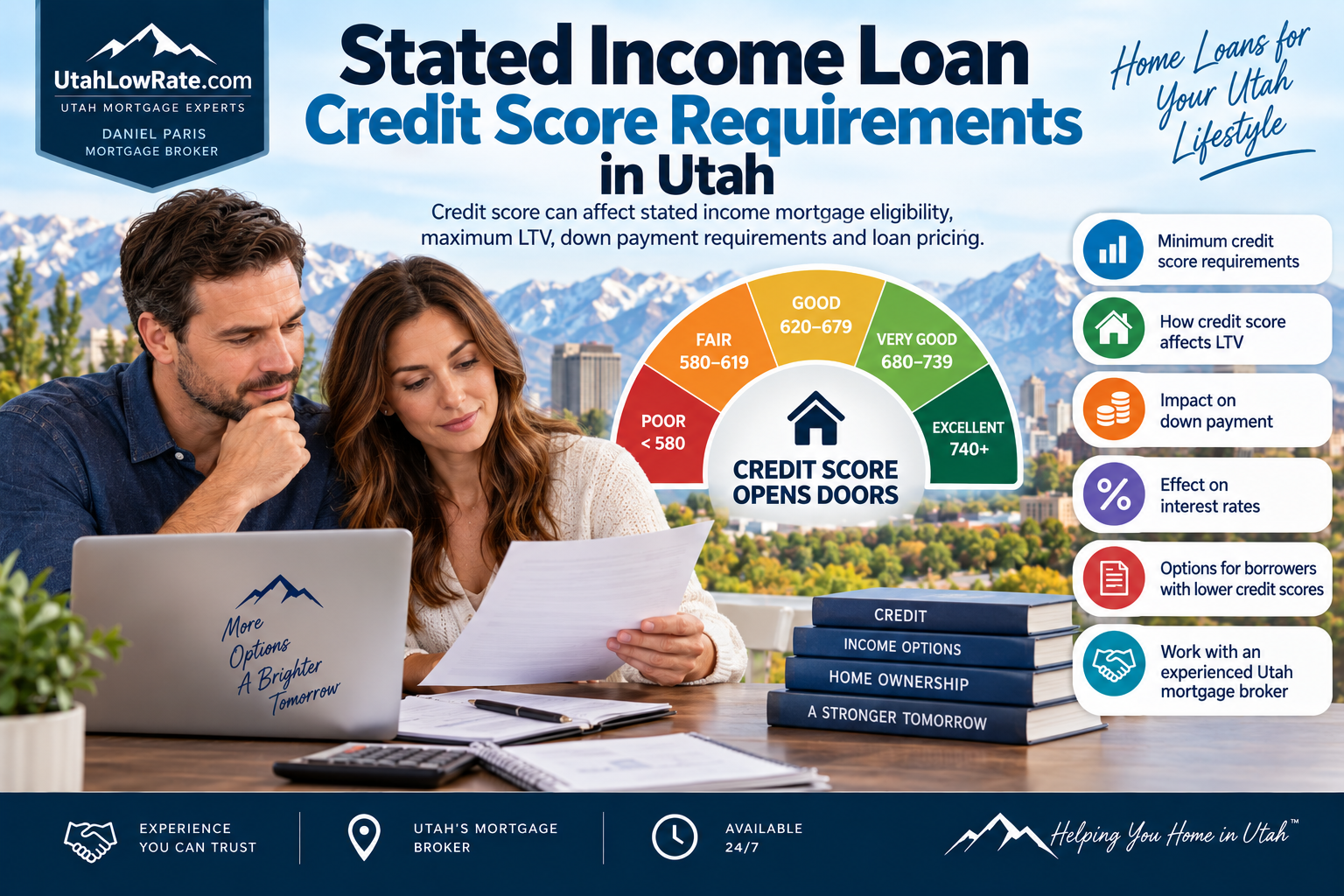
There is no universal minimum credit score for every stated income mortgage.
The specific program currently described by UtahLowRate.com includes credit tiers beginning around 640, with other tiers around 660, 680 and 720+.
See Stated Income Loan Requirements Utah for more details.
20. Does better credit help?
It can.
Credit may affect maximum LTV, eligibility and mortgage pricing.
21. Does a 720-credit score guarantee approval?
No.
Approval depends on the complete borrower, property and transaction.
22. Can someone with a 640-credit score qualify?
Potentially under certain programs.
Meeting a minimum credit tier does not guarantee approval. Assets, reserves, LTV, property and other requirements still apply.
Down Payment and LTV Questions
23. How much down payment is required?
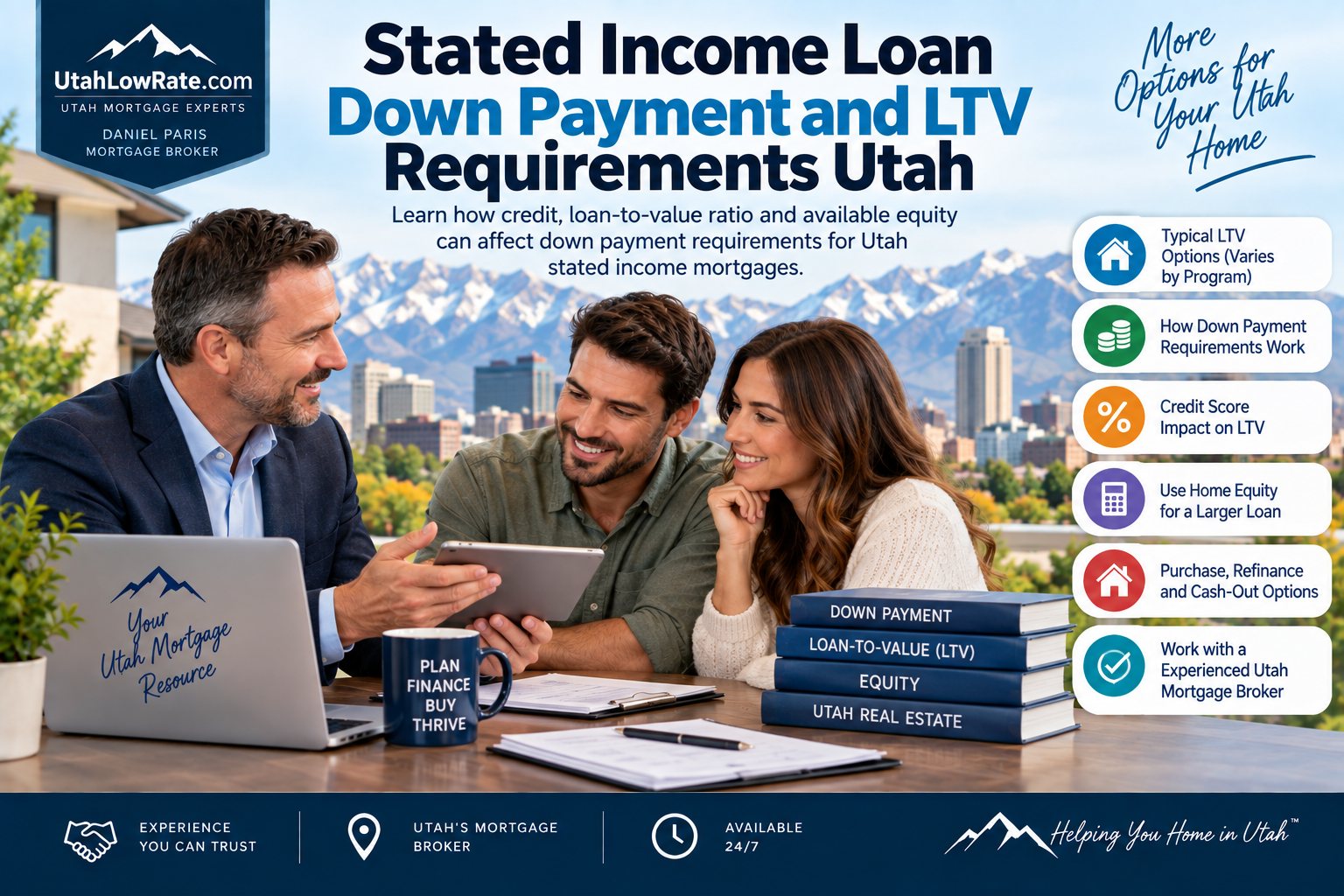
The required down payment depends on the maximum LTV available to the borrower.
For example, an 80% LTV purchase generally means the borrower has 20% equity/down payment, subject to program rules.
24. Can I get 80% financing?
The specific program currently described by UtahLowRate.com may allow approximately 80% LTV for qualifying purchase and rate-and-term transactions at its highest applicable tier.
That is not a universal guideline for every stated income mortgage.
25. Can I put 20% down?
Potentially.
The borrower must qualify for the applicable 80% LTV program tier.
26. Does a larger down payment help?
It can.
A larger down payment lowers the LTV. Lower LTV can improve the overall risk profile of a mortgage transaction.
27. What does LTV mean?
LTV means loan-to-value ratio.
For example:
$800,000 mortgage ÷ $1,000,000 property value = 80% LTV.
Lenders use LTV as one part of the underwriting process.
Assets and Reserve Questions

28. Are assets important?
Yes.
Assets can be especially important when traditional income documentation is not the primary qualification method.
29. Are mortgage reserves required?
Many alternative mortgage programs require reserves.
30. How many months of reserves are required?
The specific program currently described by UtahLowRate.com generally requires about six or nine months of reserves, depending on the qualifying tier.
Guidelines can change.
31. What are mortgage reserves?
Reserves are eligible assets that remain after closing.
They are often measured as a number of months of housing payments.
32. Can investment accounts count toward reserves?
Certain investment assets may qualify.
The lender determines how eligible assets are valued.
33. Can retirement accounts count?
Certain retirement assets may qualify under the program's rules.
34. Can gift funds be used?
Certain programs may allow eligible gift funds.
Confirm the rules before transferring money because documentation requirements can vary.
Purchase and Property Questions
35. Can I use a stated income loan to buy a primary residence?
Yes, qualifying owner-occupied alternative mortgage programs may be available.
36. Can I use this stated income program for an investment property?
The specific owner-occupied program described by UtahLowRate.com is not intended for investment-property occupancy.
Investors should compare investment-property financing, including DSCR Mortgage Loans Utah when appropriate.
37. Can I finance a second home?
It depends on the mortgage program.
Do not assume that an owner-occupied stated income program also permits second-home financing.
38. Is an appraisal required?
Generally, yes.
The property must meet the applicable lender and investor requirements.
39. Can I finance a luxury home?
Potentially.
Higher property values may require Jumbo or other alternative-documentation financing.
See Jumbo Mortgage Utah for additional information.
Stated Income Loan FAQ Utah: Refinance Questions

40. Can I refinance with a stated income mortgage?
Certain alternative mortgage programs may allow qualifying rate-and-term refinances.
Eligibility depends on the borrower, property and program.
41. Can I get cash out?
Certain programs may permit qualifying cash-out refinancing.
42. What is the maximum cash-out LTV?
The specific program currently described by UtahLowRate.com may permit up to approximately 75% LTV at its highest qualifying cash-out tier.
Actual maximum financing depends on the complete transaction.
43. How much can I borrow?
The particular program currently described by UtahLowRate.com includes loan amounts from approximately $100,000 to $2.5 million.
Larger transactions may require another Jumbo or Super Jumbo program.

