
Alternative mortgage options for self-employed borrowers, business owners, investors and borrowers with complex income
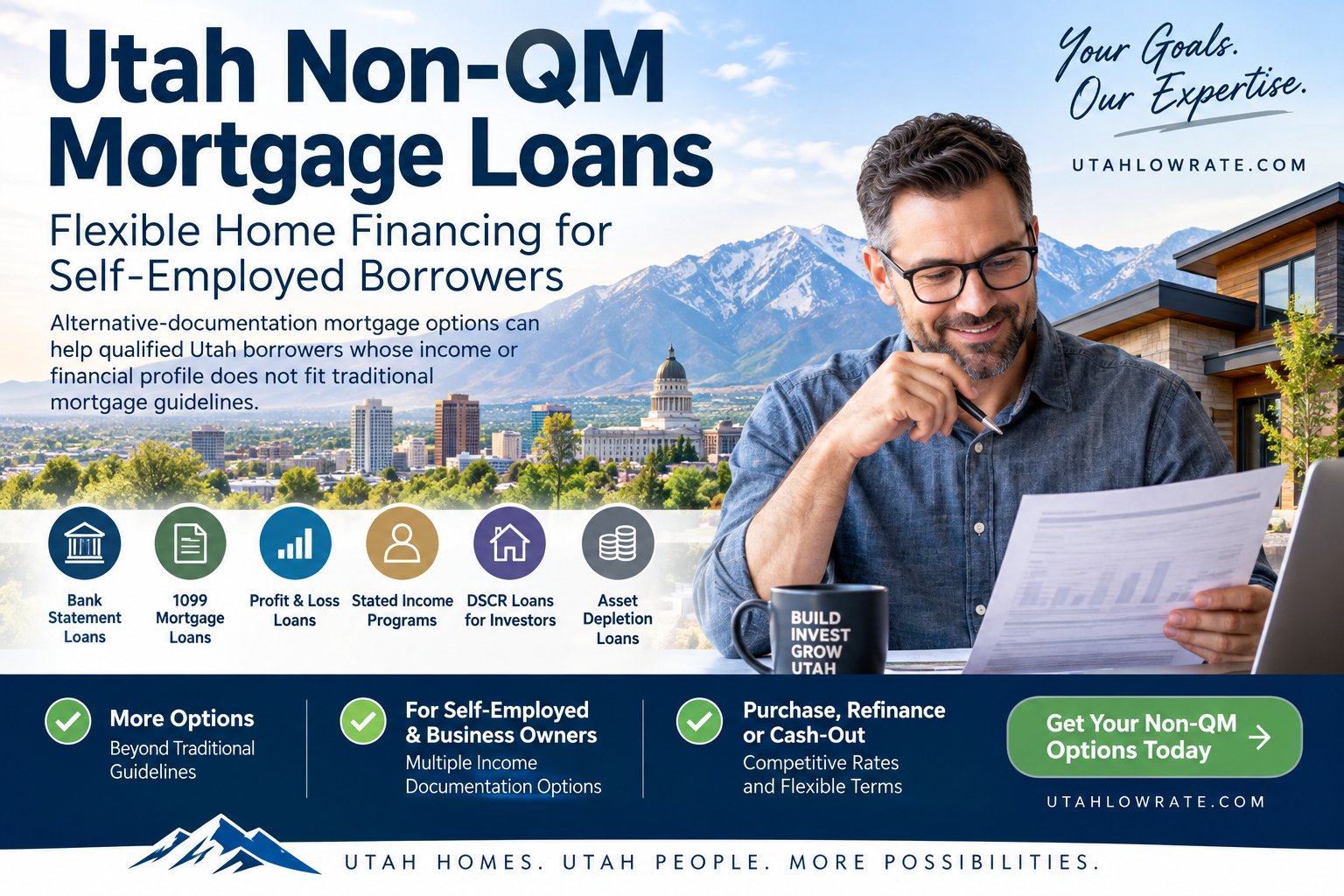
Utah Non-QM mortgage loans can provide alternative ways to qualify when conventional mortgage guidelines do not accurately reflect a borrower's income, assets or financial profile.
Depending on the program, qualified borrowers may be able to use bank statements, 1099 income, Profit & Loss statements, eligible assets, rental-property cash flow or other alternative documentation instead of relying solely on traditional tax-return income calculations.
UtahLowRate.com helps borrowers compare Non-QM mortgage programs throughout Utah, including Salt Lake City, Park City, Draper, Sandy, Lehi, Provo, Heber City, St. George, Ogden and surrounding communities.
Compare My Non-QM Mortgage Options
Quick Answer: What Is a Non-QM Mortgage in Utah?
A Non-QM mortgage is a home loan that does not fit all of the requirements used for a traditional Qualified Mortgage. Non-QM does not mean no documentation or no underwriting.
Instead, these programs may provide alternative ways for qualified borrowers to document income, assets or property cash flow.
Utah Non-QM options may include Bank Statement Loans, Stated Income or Community Mortgage programs, 1099 loans, Profit & Loss loans, Asset Depletion mortgages, DSCR investment-property loans and Non-QM Jumbo mortgages.
The appropriate program depends on factors such as income type, credit profile, assets, reserves, loan amount, property type, occupancy and loan purpose.
Utah Non-QM Mortgage Quick Facts
| Feature | Utah Non-QM Mortgage Options |
|---|---|
| Borrower types | Self-employed, business owners, 1099 earners, investors and borrowers with complex income |
| Income documentation | May include bank statements, 1099s, P&L statements, assets or other program-specific documentation |
| Loan purposes | Purchase, rate-and-term refinance and eligible cash-out refinance |
| Occupancy | Primary residence, second home or investment property depending on program |
| Property types | Program-specific residential properties |
| Jumbo financing | Alternative-documentation jumbo programs may be available |
| Traditional tax returns | May not be required for certain programs |
| Underwriting | Required; guidelines vary by lender and program |
| Availability | Subject to current lender/investor guidelines and borrower qualification |
Important: Non-QM does not mean “no verification,” “no documentation” or guaranteed approval. Income, assets, credit, reserves, property and other factors may still need to be documented and reviewed.
What Are Utah Non-QM Mortgage Loans?
Traditional mortgage underwriting typically evaluates income using established agency or government guidelines. That process works well for many borrowers, but it may not accurately represent every financial situation.
A business owner, for example, may have substantial cash flow while reporting lower taxable income after legitimate business deductions.
An independent contractor may receive most of their income on Form 1099 rather than a traditional W-2.
A real-estate investor may be more concerned with a property's rental income than personal employment income.
A borrower with significant liquid or investment assets may have substantial financial resources but relatively little traditional employment income.
Utah Non-QM mortgage loans can address some of these situations through alternative underwriting and documentation methods.
Depending on your circumstances, you may want to compare:
- Bank Statement Mortgage Loans
- Stated Income Mortgage Loans Utah
- 1099 Mortgage Loans Utah
- Profit and Loss Mortgage Loans Utah
- Asset Depletion Mortgage Loans
- DSCR Loans Utah
- Jumbo Mortgage Loans Utah
- Super Jumbo Mortgage Loans Utah & California
The goal is not to avoid underwriting. The goal is to identify a mortgage program whose documentation method better matches the borrower's actual financial profile.
Compare Utah Non-QM Mortgage Programs
Different Non-QM programs solve different documentation problems.
| Non-QM program | Potential fit | Qualification approach |
|---|---|---|
| Bank Statement Loan | Self-employed borrowers and business owners | Eligible personal or business bank deposits |
| Stated Income / Community Mortgage | Eligible borrowers with nontraditional income profiles | Program-specific alternative underwriting |
| 1099 Mortgage | Independent contractors and 1099 earners | Eligible 1099 income |
| Profit & Loss Mortgage | Business owners and self-employed borrowers | Qualifying P&L documentation |
| Asset Depletion | Borrowers with substantial eligible assets | Eligible assets converted to qualifying income under program guidelines |
| DSCR Loan | Real-estate investors | Property rental income compared with applicable housing expense |
| Non-QM Jumbo | Higher-value properties and complex borrowers | Alternative income or asset documentation depending on program |
Which Non-QM mortgage may fit my income?
A borrower receiving most income through a business may consider a Bank Statement or Profit & Loss mortgage.
A contractor receiving 1099 income may consider a 1099 mortgage program.
A borrower with significant eligible assets may consider Asset Depletion.
A real-estate investor may consider a DSCR loan.
Borrowers purchasing or refinancing higher-value homes may also have Non-QM Jumbo options.
The appropriate choice depends on the entire loan scenario rather than one qualification factor.
Compare My Non-QM Mortgage Options →
Bank Statement Loans Utah
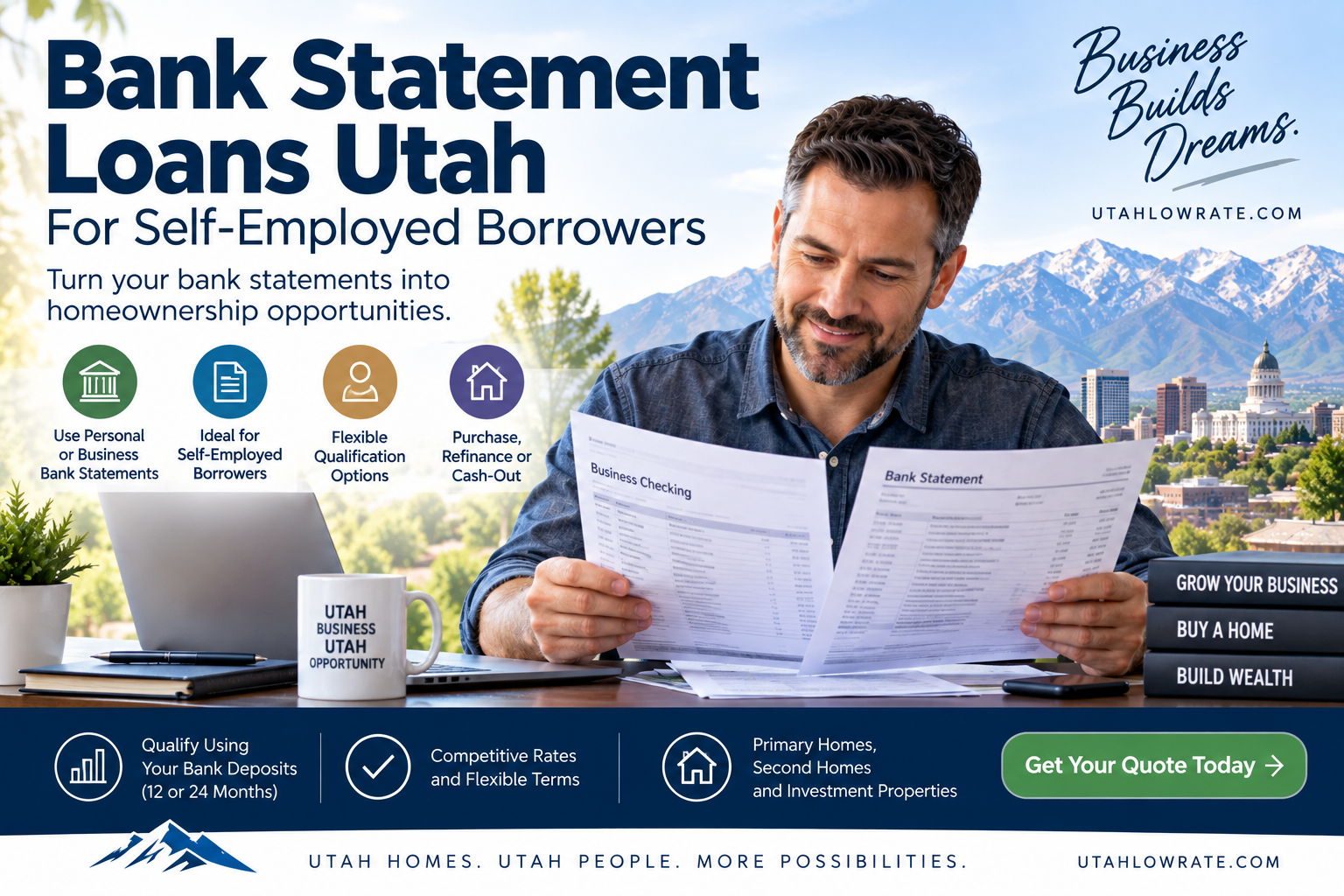
A bank statement mortgage loan may help qualified self-employed borrowers document income using eligible deposits rather than relying exclusively on adjusted taxable income shown on tax returns.
Depending on the program, underwriting may review personal bank statements, business bank statements or both.
For business statements, an expense factor may be applied when determining qualifying income. Requirements vary substantially among lenders and programs.
Bank Statement loans may be worth considering for:
- Business owners
- Independent professionals
- Consultants
- Commission-based borrowers
- Entrepreneurs
- Borrowers with substantial legitimate business deductions
Credit, reserves, loan-to-value, property type, occupancy and other requirements still apply.
Self-employed? Compare Utah Bank Statement Mortgage Options →
Stated Income Mortgage Loans Utah

The phrase stated income loan is commonly used when borrowers search for mortgages that do not rely on traditional tax-return income documentation.
Today's alternative-documentation programs should not be confused with historical no-documentation lending.
Modern programs still require underwriting and supporting documentation appropriate to the particular loan.
Qualified borrowers can start with our complete Stated Income Mortgage Loans Utah guide.
You can also review:
Stated Income Loan Requirements Utah
Stated Income Loan FAQ Utah
Stated Income Loans Park City Utah
Stated Income Mortgage Loans Salt Lake City Utah
These resources explain the program category in more detail without confusing stated-income searches with every other type of Non-QM financing.
Profit and Loss Mortgage Loans Utah

Some self-employed borrowers may have a business Profit & Loss statement that provides a more current picture of business performance than prior-year tax returns.
A Profit and Loss Mortgage Loan in Utah may allow qualifying income to be evaluated using eligible P&L documentation under applicable lender guidelines.
This type of financing may be useful for certain:
- Business owners
- Sole proprietors
- Independent professionals
- Entrepreneurs
- Self-employed borrowers
The lender may require supporting documentation, business history, verification of the business and other information.
A P&L mortgage is therefore an alternative documentation loan, not a no-documentation loan.
1099 Mortgage Loans Utah
Independent contractors and other borrowers whose earnings are reported primarily through Form 1099 can face a different documentation challenge.
Certain 1099 Mortgage Loans in Utah may allow eligible 1099 income to be evaluated under alternative-documentation guidelines.
Potential candidates can include:
- Independent contractors
- Real-estate professionals
- Consultants
- Freelancers
- Commission-based professionals
- Other eligible 1099 earners
Depending on the lender, requirements can include employment or business history, 1099 documentation, credit, reserves and additional supporting documentation.
Borrowers should compare a 1099 program against other available options rather than assuming that a 1099 mortgage is automatically the best fit.
Asset Depletion Mortgage Loans Utah
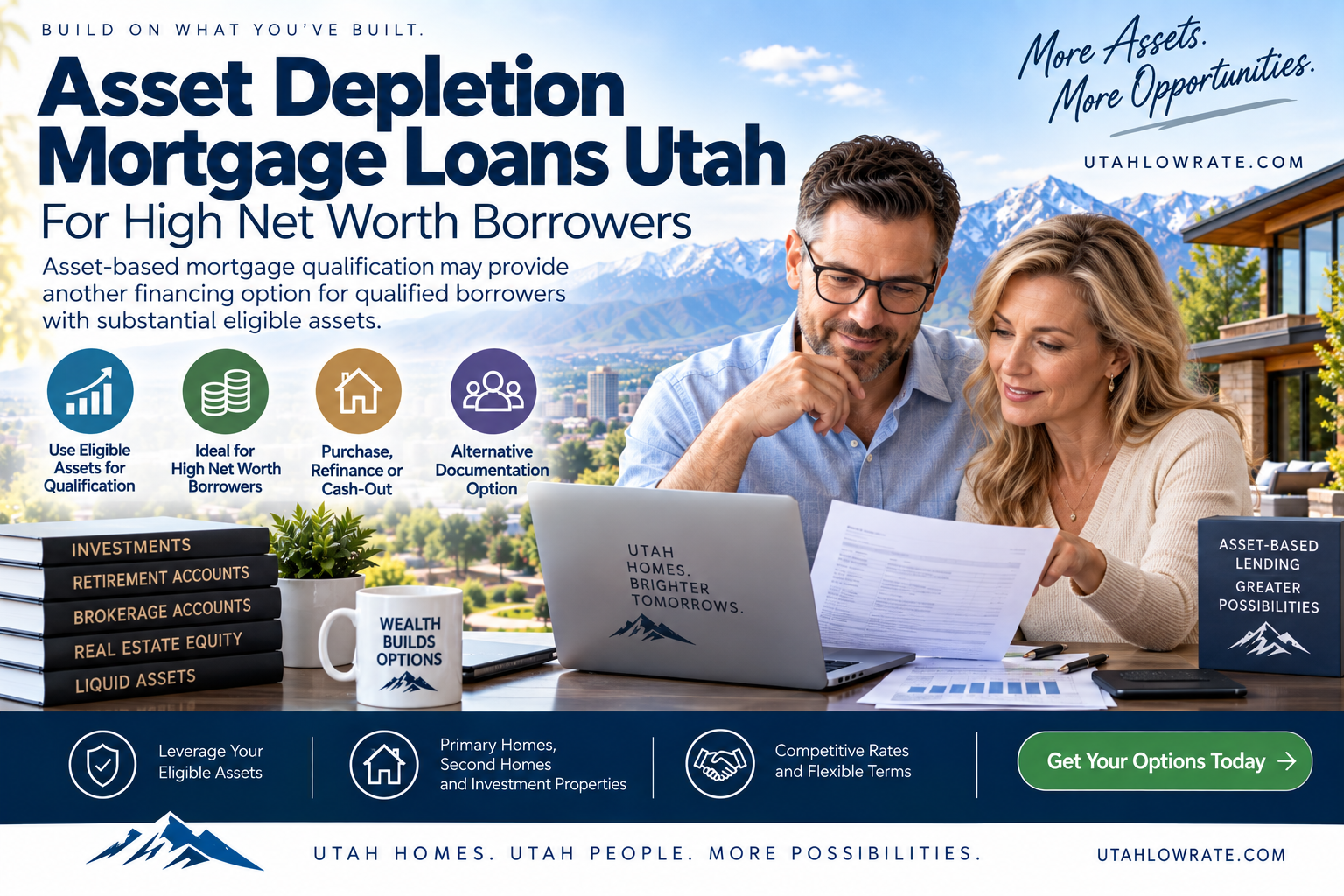
Some borrowers have substantial financial assets but do not receive enough traditional monthly employment income to qualify for the desired mortgage under conventional calculations.
An Asset Depletion Mortgage may allow certain eligible assets to be converted into qualifying monthly income using a lender's specified calculation.
Eligible assets and calculation methods vary by program.
This strategy can potentially help qualified:
- Retirees
- High-net-worth borrowers
- Business owners
- Investors
- Borrowers with substantial liquid or investment assets
- Borrowers transitioning between employment or income sources
Not every asset can necessarily be used, and lenders may apply reductions, seasoning requirements or other restrictions.
DSCR Loans for Utah Real-Estate Investors
Real-estate investors have another alternative that differs from most borrower-income-based Non-QM programs.
A Debt Service Coverage Ratio, or DSCR, compares qualifying rental income with the property's applicable monthly housing obligation under the lender's guidelines.
This means certain investment-property loans may focus primarily on the property's cash-flow characteristics rather than traditional personal employment-income calculations.
Visit our DSCR Loans Utah hub for detailed investor financing information.
DSCR programs are generally designed for eligible investment properties, not owner-occupied primary residences.
Non-QM Jumbo Mortgage Loans Utah
Alternative documentation is not limited to smaller mortgage balances.
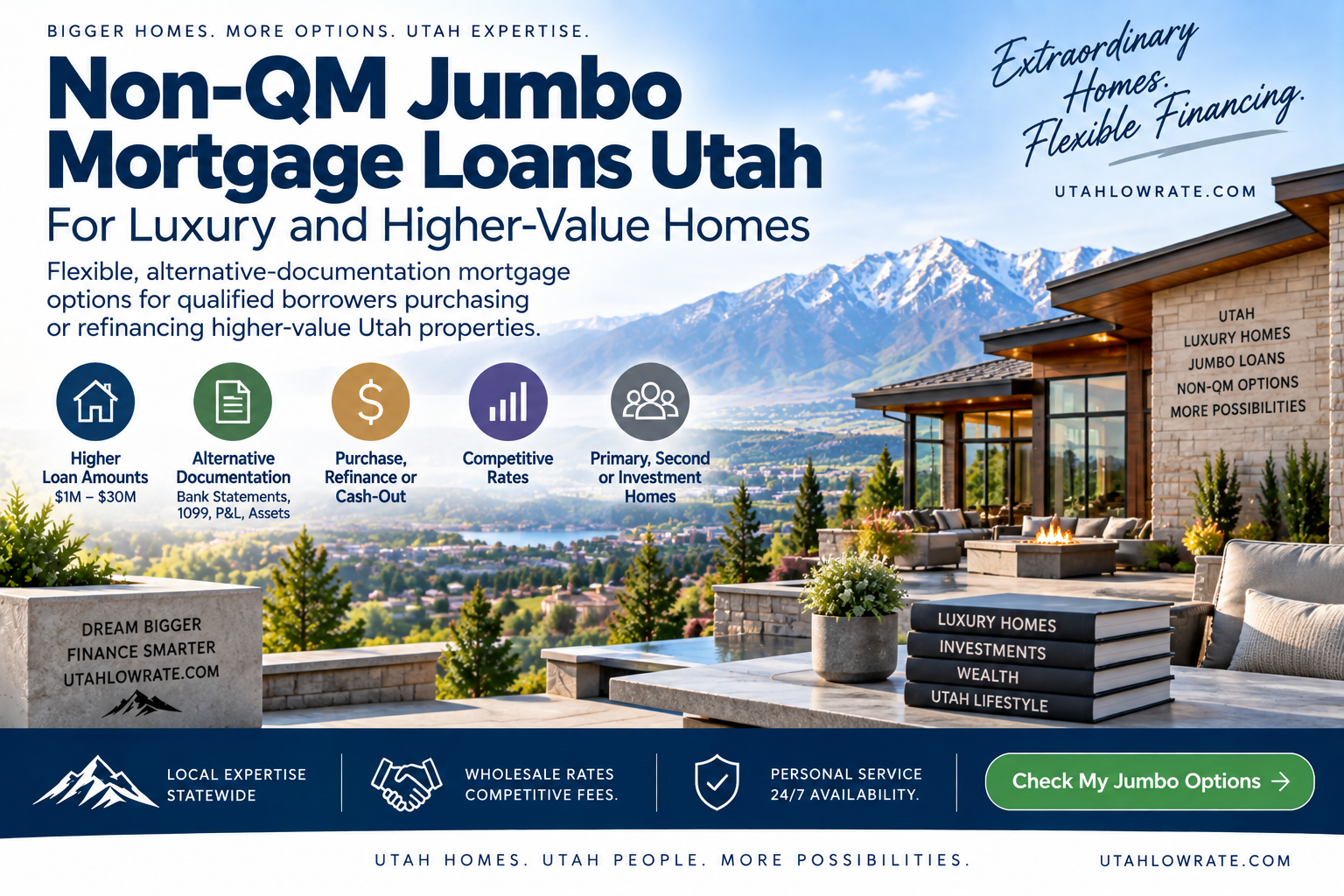
Qualified borrowers financing higher-value Utah properties may have access to Non-QM Jumbo mortgage programs using eligible alternative income or asset documentation.
These programs may be relevant for business owners, entrepreneurs, investors or high-net-worth borrowers purchasing or refinancing higher-priced properties.
Borrowers should compare:
Jumbo Mortgage Loans Utah →
and
Super Jumbo Mortgage Loans Utah & California →
Jumbo underwriting can place additional emphasis on liquidity, reserves, credit history, property characteristics and overall financial strength.
Who Are Utah Non-QM Mortgage Loans Designed For?
Non-QM financing can be useful when a borrower's financial circumstances do not fit neatly into conventional documentation rules.
Self-Employed Borrowers
Self-employed borrowers often have the greatest number of alternative-documentation options.
Depending on the scenario, these may include:
- Bank statements
- Profit & Loss statements
- 1099 income
- Asset depletion
- Alternative-documentation jumbo programs
See our complete Self-Employed Mortgage Utah guide for additional options.
Business Owners
Business owners may legitimately reduce taxable income through allowable business expenses.
The resulting tax-return income may therefore tell a different story from actual business cash flow.
Bank Statement and P&L programs may provide alternative ways of evaluating eligible income.
Independent Contractors
Contractors receiving Form 1099 income may benefit from comparing a dedicated 1099 mortgage with bank-statement, P&L and traditional financing options.
Real-Estate Investors
Investors may have access to DSCR Loans Utah and other investment-property programs where property cash flow plays an important role in qualification.
High-Net-Worth Borrowers
Borrowers with significant assets may have access to Asset Depletion, Jumbo, Super Jumbo and other portfolio or Non-QM solutions depending on their financial profile.
Non-QM Loans vs Conventional Mortgages
A Non-QM mortgage is not automatically better or worse than a conventional mortgage. The programs use different underwriting approaches.
| Conventional mortgage | Non-QM mortgage |
|---|---|
| Standard agency guidelines | Program-specific lender/investor guidelines |
| Traditional income documentation is common | Alternative documentation may be available |
| Tax returns may be required for self-employed borrowers | Certain programs may not require tax returns |
| Standard agency loan structure | Broader range of program structures may be available |
| Generally standardized underwriting | Greater variation among lenders and programs |
A borrower who qualifies comfortably for conventional financing should compare it with any Non-QM alternative.
The purpose of alternative financing is to solve a qualification or documentation issue—not to use a more complex program when a simpler option works.
Explore the broader Utah Mortgage Loans guide to compare conventional, FHA, VA, Jumbo, Non-QM and other available mortgage categories.
Can You Buy a Primary Residence With a Non-QM Loan?
Potentially, yes.
Certain Non-QM programs may finance eligible owner-occupied primary residences.
Other programs may allow second homes, while programs such as DSCR financing are generally intended for investment properties.
Occupancy requirements are program specific.
Never assume that a loan designed for investors can be used for an owner-occupied home.
Can You Refinance With a Utah Non-QM Mortgage?
Non-QM programs may be available for:
Rate-and-term refinance: replacing an existing mortgage while changing the loan structure, rate or term.
Cash-out refinance: refinancing an eligible property and accessing a portion of available equity, subject to lender requirements.
Maximum loan-to-value, cash-out limits, credit requirements and reserve requirements vary significantly by program.
What Credit Score Do You Need for a Utah Non-QM Loan?
There is no single minimum credit score that applies to every Non-QM mortgage.
Each lender and program establishes its own guidelines.
Credit can affect:
- Available loan-to-value
- Interest rate
- Loan amount
- Reserve requirements
- Cash-out eligibility
- Property eligibility
- Program availability
A stronger overall financial profile may create additional options, but credit score should always be evaluated together with income documentation, assets, reserves, loan purpose and property characteristics.
How Much Down Payment Is Required for a Non-QM Loan?
Down-payment requirements depend on the program and borrower profile.
Factors can include:
- Credit score
- Loan amount
- Property type
- Occupancy
- Documentation method
- Purchase versus refinance
- Reserve assets
- Prior mortgage or housing history
Instead of relying on a generic minimum-down-payment number, request a scenario-specific comparison.
Do Non-QM Loans Require Mortgage Reserves?
Many Non-QM programs require borrowers to demonstrate financial reserves.
A lender may calculate reserves using a specified number of months of the applicable housing payment.
Requirements can increase for larger loan amounts, investment properties, weaker credit profiles or more complex transactions.
Eligible reserve assets also vary by lender.
What Documents Are Needed for a Utah Non-QM Mortgage?
The documentation depends primarily on the program being used.
A borrower may be asked for some combination of:
- Identification
- Credit authorization
- Bank statements
- 1099 forms
- Profit & Loss statements
- Business documentation
- Asset statements
- Housing or mortgage history
- Purchase contract
- Property insurance
- Lease or rental documentation for investment properties
- Appraisal
- Reserve verification
- Additional underwriting documentation
The advantage of Non-QM financing is alternative documentation, not the absence of documentation.
How to Choose a Utah Non-QM Mortgage
Step 1: Identify how you earn your income
Determine whether your income is primarily W-2, self-employed business income, bank deposits, 1099 earnings, investments, rental income or another source.
Step 2: Identify the documentation problem
Ask why traditional financing is difficult.
Is taxable income too low because of business deductions?
Is most income reported on 1099s?
Do you have substantial assets but limited employment income?
Is the transaction for an investment property?
Step 3: Compare the appropriate programs
Once the documentation issue is clear, compare programs designed for that specific situation.
Step 4: Review the entire loan structure
Do not compare only the interest rate.
Consider the rate, APR, points, lender fees, prepayment provisions when applicable, loan term, interest-only options when available, reserves and total cash required.
Step 5: Obtain a scenario-specific review
Non-QM guidelines can differ considerably among wholesale lenders.
A mortgage broker can compare the scenario across multiple available lending sources rather than trying to fit every borrower into one program.
Utah Non-QM Mortgage Loans by Location
UtahLowRate.com works with qualified borrowers throughout Utah.
Salt Lake County
Non-QM mortgage options may be available in Salt Lake City, Holladay, Millcreek, Murray, Cottonwood Heights, Sandy, Draper, South Jordan, West Jordan, Riverton, Herriman, Bluffdale, Midvale and surrounding communities.
Borrowers specifically researching alternative-documentation loans in the Salt Lake area can also visit Stated Income Mortgage Loans Salt Lake City Utah.
Park City and Wasatch Back
Alternative-documentation and jumbo financing can be particularly relevant to borrowers purchasing higher-value primary residences, eligible second homes and investment properties in Park City, Deer Valley, Canyons Village, Empire Pass, Kimball Junction, Heber City, Midway, Jordanelle, Hideout and Kamas.
See Stated Income Loans Park City Utah for additional local information.
Utah County
Borrowers in Provo, Orem, Lehi, Alpine, Highland, American Fork, Pleasant Grove, Saratoga Springs, Eagle Mountain and Spanish Fork can compare Non-QM options for self-employed and alternative-income scenarios.
Southern Utah
Non-QM financing may also be available in St. George, Washington, Ivins, Santa Clara, Hurricane, Desert Color, Little Valley and surrounding Southern Utah communities.
Northern Utah
Borrowers in Ogden, Weber County, Davis County and surrounding areas can also compare available Non-QM and alternative-documentation mortgage programs.
Utah Non-QM Mortgage Pre-Approval
Getting reviewed before making an offer can help identify which documentation method is likely to work.
A Non-QM pre-approval review may examine:
- Loan amount and estimated property value
- Purchase, refinance or cash-out purpose
- Primary, second-home or investment occupancy
- Credit profile
- Income type
- Available documentation
- Assets and reserves
- Existing housing obligations
- Property type
Borrowers planning a home purchase can also review the Utah Mortgage Pre-Approval process.
See If I Qualify →
Why Work With a Utah Mortgage Broker for Non-QM Financing?
Non-QM guidelines can vary substantially from one wholesale lender to another.
One lender may calculate bank-statement income differently from another. Another may offer a better solution for a 1099 borrower, asset-depletion borrower, investor or jumbo transaction.
Working with a mortgage broker can provide access to multiple lending sources and make it easier to compare available programs for the same borrower profile.
Daniel Paris of UtahLowRate.com has more than 27 years of mortgage experience and works with borrowers across Utah on conventional, government, jumbo, super-jumbo and alternative-documentation mortgage scenarios.
Learn more about Daniel Paris and UtahLowRate.com.
Explore Utah Non-QM and Alternative Mortgage Programs
The appropriate alternative-documentation mortgage depends on how you earn income, your assets, credit profile, property, occupancy and financing goals.
Continue with the resource that most closely matches your situation:
- Stated Income Mortgage Loans Utah
- Stated Income Loan Requirements Utah
- Stated Income Loan FAQ Utah
- Stated Income Loans Park City Utah
- Stated Income Mortgage Loans Salt Lake City Utah
- 1099 Mortgage Loans Utah
- Profit and Loss Mortgage Loans Utah
- Self-Employed Mortgage Utah
- DSCR Loans Utah
- Jumbo Mortgage Loans Utah
- Super Jumbo Mortgage Loans Utah & California
- Utah Mortgage Pre-Approval
- Compare Utah Mortgage Loans
Utah Non-QM Mortgage Loan FAQ
What are Utah Non-QM mortgage loans?
Utah Non-QM mortgage loans are mortgage programs that may use alternative qualification or documentation methods for eligible borrowers whose financial profiles do not fit traditional Qualified Mortgage guidelines. Borrowers are still subject to lender and investor underwriting requirements.
Are Non-QM loans only for self-employed borrowers?
No. Depending on the program, Non-QM mortgages may be available to qualified self-employed borrowers, business owners, independent contractors, real-estate investors, high-net-worth borrowers and borrowers with complex income or asset profiles.
Can I qualify for a Utah mortgage using bank statements?
Potentially. Qualified self-employed borrowers may be able to use eligible personal or business bank statements to document qualifying income under certain bank-statement mortgage programs. Requirements vary by lender.
Can I get a mortgage using 1099 income?
Certain alternative-documentation programs may allow qualified independent contractors and other eligible borrowers to use 1099 income for mortgage qualification. See 1099 Mortgage Loans Utah for more information.
What if my tax returns show low income because of business deductions?
Depending on the borrower's circumstances and current lender guidelines, alternatives may include Bank Statement, Profit & Loss, 1099, Asset Depletion or other Non-QM programs.
Do Non-QM loans require tax returns?
Not always. Some programs are specifically designed to use eligible alternative documentation rather than traditional tax returns. Requirements depend on the program and borrower.
Are Non-QM loans no-documentation loans?
No. Non-QM borrowers still undergo underwriting. The difference is that certain programs can use alternative forms of documentation.
Can I use a Non-QM loan for an investment property?
Potentially. Several Non-QM programs can finance eligible investment properties. Investors should also compare DSCR Loans Utah, which may qualify an eligible property using its rental-income characteristics.
Are Non-QM loans available for jumbo homes in Utah?
Alternative-documentation and Non-QM Jumbo programs may be available for qualified borrowers financing higher-value Utah properties. Loan amount, credit, assets, reserves, occupancy and property requirements vary by program.
Can I use a Non-QM mortgage for a cash-out refinance?
Certain Non-QM programs permit eligible cash-out refinances. Maximum loan-to-value, credit, seasoning, reserve and cash-out requirements depend on the lender and program.
Are Non-QM mortgage rates higher than conventional mortgage rates?
They can be. Pricing depends on the program, credit profile, loan-to-value, property, occupancy, loan amount, documentation method and market conditions. Compare the complete loan structure rather than assuming every Non-QM loan carries the same pricing.
How do I know which Non-QM loan is right for my situation?
Start with the reason traditional mortgage qualification is difficult. A self-employed borrower may compare Bank Statement and P&L programs; a contractor may compare 1099 programs; an investor may evaluate DSCR financing; and a borrower with substantial eligible assets may consider Asset Depletion. A scenario review can then compare the available programs.
Talk With a Utah Non-QM Mortgage Broker
Alternative-documentation mortgages are highly scenario specific.
Instead of trying to determine which program applies based on a single guideline, provide the basic details of your transaction:
Property value or purchase price • desired loan amount • credit score range • occupancy • income type • available documentation • estimated assets/reserves
UtahLowRate.com can review the scenario and compare available mortgage options for qualified borrowers.
Daniel Paris
Utah Mortgage Broker — UtahLowRate.com
Serving borrowers throughout Utah
Compare My Non-QM Mortgage Options →
Important Mortgage Disclosure
Mortgage programs, underwriting requirements, interest rates, loan-to-value limits, credit requirements, reserve requirements, documentation requirements and product availability can change without notice. Information on this page is for general educational purposes and is not a commitment to lend or a guarantee of approval. Final eligibility is determined by the applicable lender or investor after review of the complete loan application, borrower documentation and property.

