
Utah Mortgage Rates and Housing Market This Week — September 2026
Published: September 15, 2026
Last Updated: September 15, 2026
By Daniel Paris | Utah Mortgage Broker | UtahLowRate.com | NMLS #243976-3138 | 27+ Years of Mortgage Lending Experience
Utah mortgage rates and the housing market are giving buyers an interesting combination this week: mortgage rates remain elevated, but Utah buyers have more homes to choose from than they did during the extremely tight housing markets of a few years ago.
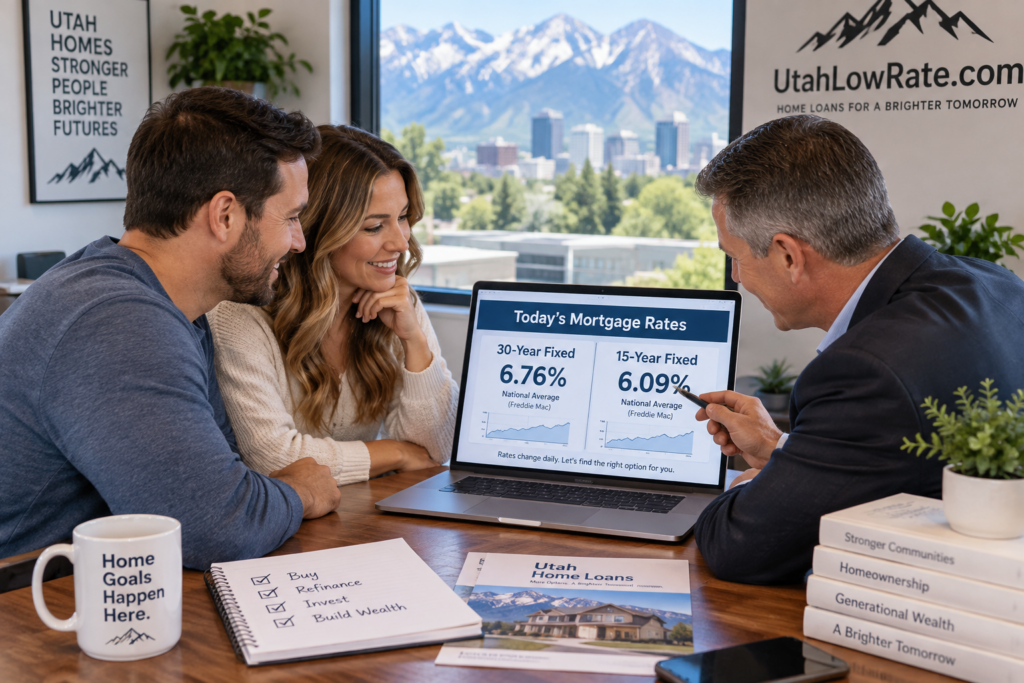
As of September 10, 2026, Freddie Mac reported a national weekly average of 6.76% for a 30-year fixed-rate mortgage and 6.09% for a 15-year fixed-rate mortgage.
Those are national market benchmarks, not advertised UtahLowRate.com interest rates. Your actual mortgage rate depends on factors such as credit, loan amount, down payment, property type, occupancy, loan program, discount points and market conditions when you lock.
At the same time, Zillow reported Utah’s typical home value at approximately $534,582 as of August 31, 2026, up 1.5% from a year earlier. Statewide inventory stood at 17,197 homes for sale, while the median time for a home to go pending was about 32 days.
For homebuyers in Salt Lake City, Murray, Sandy, Draper, South Jordan, Lehi, Provo, Park City, Heber City, St. George, Ogden and communities throughout the Wasatch Front, the key question isn’t simply:
“Are mortgage rates high?”
A more useful question is:
“Does buying a Utah home make financial sense for me at today’s rate, price and negotiating conditions?”
That answer can be very different from one borrower to another.
Utah Mortgage Rates This Week: Quick Answer
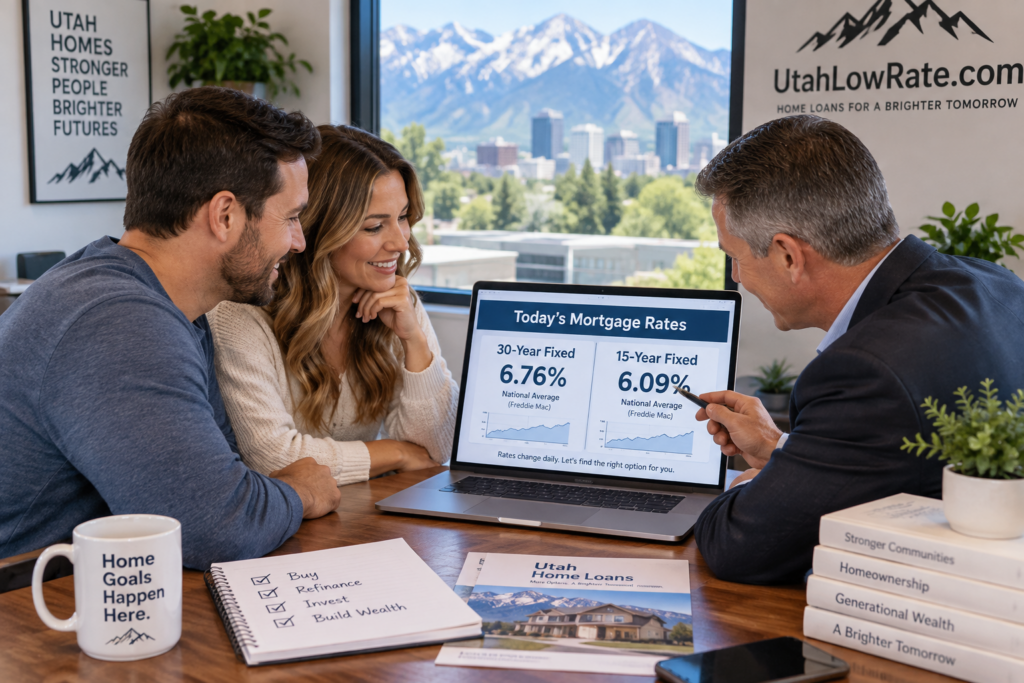
The national average 30-year fixed mortgage increased from 6.71% to 6.76% in Freddie Mac’s latest weekly Primary Mortgage Market Survey.
The average 15-year fixed mortgage increased from 6.04% to 6.09%.
Recent Freddie Mac Mortgage Rate Trend
| Week Ending | 30-Year Fixed | 15-Year Fixed |
|---|---|---|
| August 27, 2026 | 6.66% | 5.98% |
| September 3, 2026 | 6.71% | 6.04% |
| September 10, 2026 | 6.76% | 6.09% |
Source: Freddie Mac Primary Mortgage Market Survey.
For the latest national benchmark, visit the Freddie Mac Primary Mortgage Market Survey.
Utah borrowers should remember that a national weekly average is not the same thing as a personalized mortgage quote.
Mortgage pricing can change daily and sometimes during the same business day.
What determines your Utah mortgage rate?
Your individual mortgage rate can be affected by:
- Credit score and credit history
- Down payment
- Loan-to-value ratio
- Loan amount
- Debt-to-income ratio
- Property type
- Primary, second-home or investment occupancy
- Purchase or refinance transaction
- Rate-lock period
- Discount points
- Lender credits
- Conventional, FHA, VA, jumbo or Non-QM financing
Instead of relying only on a national average, Utah borrowers can review current Utah mortgage rates and compare available financing based on their specific scenario:
Internal link:
https://www.utahlowrate.com/utah-mortgage-rates/
Borrowers who already have a Loan Estimate or mortgage quote can also compare the rate, APR, points, lender fees and cash required at closing:
Internal link:
https://www.utahlowrate.com/utah-mortgage-rate-check-compare-before-you-sign/
What Is Happening in the Utah Housing Market in September 2026?
Utah’s housing market is showing considerably more balance than the extreme seller’s market experienced earlier in the decade.
According to Zillow’s August 31, 2026 data:
| Utah Housing Metric | Latest Data |
|---|---|
| Typical Utah Home Value | $534,582 |
| 1-Year Value Change | +1.5% |
| Homes for Sale | 17,197 |
| New Listings | 4,470 |
| Median List Price | $566,333 |
| Median Days to Pending | 32 days |
| Sales Under List Price* | 52.7% |
*Sales-under-list data reported through July 31, 2026.
These numbers provide an important signal for Utah buyers.
More than half of the transactions measured by Zillow were selling below their final list price.
That does not mean every seller will negotiate or that every Utah community is a buyer’s market. It does show why buyers should evaluate the individual property instead of assuming every home requires an aggressive above-list-price offer.
Utah real estate remains highly local.
A starter home in Salt Lake County can behave differently from a luxury property in Park City or Deer Valley. Lehi and northern Utah County can behave differently from St. George. Even neighboring cities such as Murray, Sandy, Draper, Cottonwood Heights and South Jordan can have different inventory and competition.
Salt Lake County Housing Market: More Choices for Buyers
Salt Lake County illustrates the changing Utah market particularly well.
Zillow reported a typical Salt Lake County home value of approximately $568,202 as of August 31, 2026, representing a 1.5% increase over the previous year.
The county also had approximately:
- 4,173 homes for sale
- 1,325 new listings
- 24 median days to pending
- $568,333 median list price
- $565,000 median sale price
Nearly 49.1% of measured sales were below the final list price in Zillow’s July data.
For buyers searching in Salt Lake City, Murray, Holladay, Millcreek, Cottonwood Heights, Sandy, Draper, South Jordan, West Jordan, Riverton, Herriman and surrounding communities, increased inventory can provide something buyers had very little of during the hottest housing markets:
options.
More choices may give buyers additional opportunities to compare homes, evaluate inspection issues, negotiate closing costs or consider seller concessions when the transaction allows them.
That doesn’t mean every property will be negotiable.
Well-priced homes in desirable Utah neighborhoods can still attract multiple buyers.
Is Utah a Buyer’s Market or Seller’s Market in 2026?
Utah in 2026 is better described as a more balanced and highly localized housing market than the extreme seller’s market experienced earlier in the decade.
Statewide inventory has increased, price appreciation has moderated, and many properties are taking longer to sell.
But statewide statistics should not be used to predict what will happen with a particular home.
The market for a $500,000 home in Salt Lake County can be completely different from the market for a multimillion-dollar property in Park City, Deer Valley, Draper or Alpine.
That’s why Utah buyers should look at:
- Recent comparable sales
- Current competing listings
- Days on market
- Price reductions
- Seller concessions
- Property condition
- Neighborhood inventory
- Local price trends
Then combine the real estate analysis with the financing.
Should I Buy a Utah Home Now or Wait for Mortgage Rates to Fall?
There is no single answer that applies to every Utah homebuyer.
Waiting could be beneficial if mortgage rates eventually decline.
But there is another side to the equation.
If rates fall enough to improve affordability significantly, buyers who have been waiting on the sidelines could return to the market. Increased demand could potentially increase competition for desirable Utah homes.
Rates could also remain elevated or move higher.
Mortgage rates cannot be predicted with certainty.
Instead of trying to identify the perfect week to buy, determine whether purchasing works using today’s numbers.
Ask yourself:
What monthly payment am I comfortable with?
How much cash will I have left after closing?
How long do I expect to own this property?
Could seller-paid closing costs improve the transaction?
Does paying discount points make sense?
Would conventional, FHA, VA or another program produce the better overall financing structure?
Could refinancing make sense later if rates decline sufficiently?
Getting a mortgage pre-approval before seriously shopping for a home can help answer these questions.
Learn about Utah mortgage pre-approval:
https://www.utahlowrate.com/utah-mortgage-pre-approval/
Why Comparing Mortgage Rates Matters More in Today’s Market
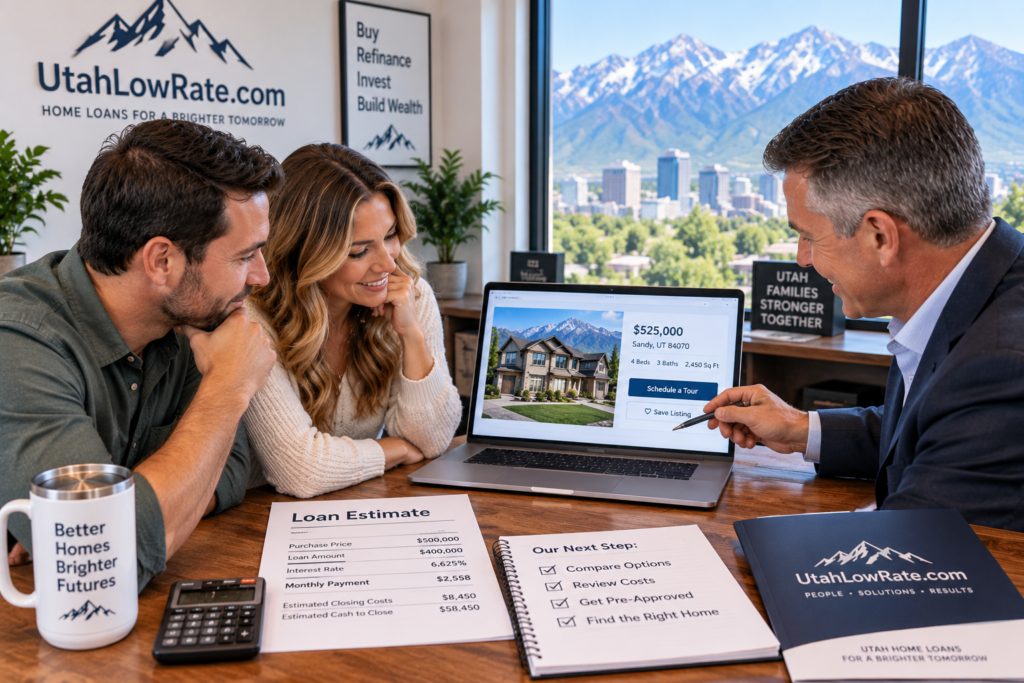
A mortgage comparison should involve much more than asking:
“What’s your rate?”
Borrowers should compare:
Interest Rate + APR + Discount Points + Lender Fees + Credits + Mortgage Insurance + Monthly Payment + Cash to Close
For example, one mortgage may advertise a lower interest rate but require substantial discount points.
Another could carry a slightly higher interest rate but have significantly lower upfront costs.
Neither structure is automatically better.
The right choice can depend on how long you expect to own the property and keep the mortgage.
The Consumer Financial Protection Bureau provides independent educational information about comparing Loan Estimates and mortgage costs.
External authority link:
https://www.consumerfinance.gov/owning-a-home/compare/
Conventional, FHA and VA Mortgage Options for Utah Buyers
The appropriate mortgage program can make as much difference as the interest rate.
Conventional Mortgage Loans
Conventional mortgages can work well for borrowers who meet applicable credit, income, asset and property requirements.
Utah buyers can learn more here:
Internal link — Conventional Mortgage Loans Utah:
https://www.utahlowrate.com/conventional-mortgage-loans-utah/
For independent information about conventional mortgages, borrowers can also review resources from Fannie Mae and Freddie Mac.
FHA Loans in Utah
FHA financing can provide another option for eligible Utah homebuyers, including buyers using lower down payments.
Internal link — FHA Loans Utah:
https://www.utahlowrate.com/loan-options/utah-fha-loans/
FHA is administered through the U.S. Department of Housing and Urban Development.
External authority link:
https://www.hud.gov/fha
VA Home Loans in Utah
Eligible veterans, active-duty service members and certain surviving spouses may be able to use VA-backed home-loan benefits.
VA financing can be particularly relevant throughout the Wasatch Front and communities near Hill Air Force Base.
For authoritative eligibility and program information, visit the U.S. Department of Veterans Affairs Home Loan Program:
Buying a Higher-Priced Utah Home? Consider Jumbo Financing
Utah’s higher-priced housing markets often require a different financing strategy.
This is especially relevant in areas such as:
- Park City
- Deer Valley
- Canyons Village
- Promontory
- Draper
- Alpine
- Highland
- Holladay
- Cottonwood Heights
- Heber City
- Midway
Borrowers purchasing homes above applicable conforming loan limits may need jumbo mortgage financing.
Jumbo underwriting can involve different requirements for reserves, assets, income documentation, loan-to-value ratios and credit.
Internal link — Utah Jumbo Mortgage Loans:
Link this section to your primary Utah jumbo mortgage hub.
For especially large transactions, UtahLowRate.com also works with qualified borrowers seeking Super Jumbo financing, including certain multimillion-dollar mortgage scenarios.
Self-Employed Utah Homebuyers Have Additional Mortgage Options
Traditional tax-return underwriting isn’t the only potential path to a mortgage for a self-employed borrower.
Depending on the borrower’s circumstances and lender guidelines, alternative-documentation programs may include:
- Bank statement mortgages
- Profit and Loss mortgages
- 1099 mortgage programs
- Asset-depletion programs
- Non-QM mortgages
For example, eligible self-employed borrowers may be able to use qualifying bank deposits rather than relying solely on traditional tax-return income calculations.
Internal link — Bank Statement Loans Utah:
Link to your main Utah Bank Statement Mortgage page.
Internal link — Profit and Loss Mortgage Loans Utah:
https://www.utahlowrate.com/profit-and-loss-mortgage-loans-in-utah/
These programs still require underwriting and borrower qualification. Alternative documentation does not mean no documentation.
Utah Real Estate Investors Can Compare DSCR Loans
Utah real estate investors may also have financing alternatives.
A Debt Service Coverage Ratio (DSCR) mortgage generally focuses on the investment property’s qualifying rental income and debt-service requirements rather than qualifying solely through the borrower’s traditional employment income.
DSCR financing can potentially be used by qualifying real estate investors purchasing or refinancing rental properties.
Internal link: Add your Utah DSCR Mortgage Loans page here.
This creates another useful topical connection between this market-update article and your site’s Utah investor-financing content.
What Should Utah Homebuyers Watch This Week?
Mortgage rates can respond rapidly to inflation reports, employment data, Treasury yields, financial-market expectations and Federal Reserve policy.
One common misconception is that the Federal Reserve directly sets mortgage rates.
It does not.
The Federal Reserve sets monetary policy and influences short-term interest rates and broader financial conditions. Mortgage rates are market rates influenced heavily by bond-market conditions and investor expectations.
That means a Federal Reserve rate decision does not automatically translate into an identical change in a 30-year mortgage rate.
Borrowers interested in monetary-policy announcements can follow the Federal Reserve directly:
External authority link:
https://www.federalreserve.gov/monetarypolicy.htm
For Utah buyers, the practical takeaway is simpler:
Don’t try to perfectly predict mortgage rates. Determine whether the home and mortgage work using the numbers available today.
What About Utah Homeowners Considering a Refinance?
A refinance should accomplish a specific financial objective.
That could include:
- Reducing an interest rate
- Lowering a monthly payment
- Changing the mortgage term
- Converting an adjustable-rate mortgage
- Eliminating certain mortgage insurance when eligible
- Accessing home equity
- Consolidating qualifying debt
- Changing the overall financing structure
A lower rate by itself doesn’t automatically make refinancing worthwhile.
Closing costs matter.
Compare the total cost of the new mortgage against the expected monthly savings and determine approximately how long it would take to recover the refinancing costs.
Quick Utah Mortgage and Housing Market Facts
What is the current national 30-year mortgage benchmark?
Freddie Mac reported an average 6.76% 30-year fixed mortgage as of September 10, 2026.
What is the typical Utah home value?
Zillow reported approximately $534,582 as of August 31, 2026.
Are Utah home values falling statewide?
Not on a year-over-year basis in Zillow’s latest statewide data. Typical values were 1.5% higher than one year earlier.
How many homes are currently listed for sale in Utah?
Zillow reported approximately 17,197 homes for sale as of August 31, 2026.
How quickly are Utah homes selling?
The statewide median was approximately 32 days to pending, according to Zillow.
What is the typical Salt Lake County home value?
Zillow reported approximately $568,202, up 1.5% year over year.
Frequently Asked Questions About Utah Mortgage Rates and Housing
What are mortgage rates in Utah right now?
There is no single mortgage rate available to every Utah borrower. Freddie Mac reported a national average 30-year fixed mortgage rate of 6.76% as of September 10, 2026, but individual Utah mortgage pricing depends on credit, property, loan amount, down payment, program, points and other factors.
Are Utah home prices going down in 2026?
Utah home values were still higher year over year in Zillow’s latest statewide data. The typical Utah home value was approximately $534,582 as of August 31, 2026, up 1.5% from one year earlier, although individual cities and neighborhoods can perform differently.
Is now a good time to buy a house in Utah?
Whether now is a good time to buy depends on your budget, available inventory, expected ownership period and financing. Utah buyers currently face relatively high mortgage rates but may have more inventory and negotiating opportunities than during the most competitive seller’s markets.
Should I wait until mortgage rates go down to buy a house?
Waiting could reduce your financing cost if mortgage rates decline, but lower rates could also attract additional buyers. Compare today’s mortgage payment and available homes with your personal financial situation rather than relying solely on a mortgage-rate forecast.
Can I refinance later if mortgage rates go down?
Potentially. If rates decline, eligible homeowners may be able to refinance, but future rates, property values, underwriting guidelines and borrower qualifications cannot be guaranteed.
How do I compare Utah mortgage rates correctly?
Compare the interest rate, APR, discount points, lender fees, credits, mortgage insurance, monthly payment and cash required at closing. Comparing the complete Loan Estimate gives you more useful information than comparing the advertised interest rate alone.
Compare Utah Mortgage Options With Daniel Paris
Daniel Paris is a Utah mortgage broker with UtahLowRate.com and more than 27 years of mortgage lending experience.
Daniel helps Utah homebuyers, homeowners, investors, self-employed borrowers and high-net-worth clients evaluate mortgage options from multiple wholesale lending sources.
Programs may include:
Conventional | FHA | VA | Jumbo | Super Jumbo | Bank Statement | 1099 | Profit & Loss | DSCR | Non-QM | Purchase | Refinance
Daniel Paris — UtahLowRate.com
Daniel Paris
Utah Mortgage Broker
NMLS #243976-3138
27+ Years of Mortgage Lending Experience
UtahLowRate.com
512 East Winchester Street
Murray, Utah 84107
Phone: 801-604-4949
Service Area: Salt Lake City, Murray, Holladay, Millcreek, Cottonwood Heights, Sandy, Draper, South Jordan, West Jordan, Riverton, Herriman, Lehi, Provo, Orem, Alpine, Highland, Park City, Deer Valley, Heber City, Midway, St. George, Ogden and communities throughout Utah.
Get Today’s Utah Mortgage Rate
Your rate should be based on your loan—not someone else’s advertised scenario.
Compare your Utah mortgage options with Daniel Paris at UtahLowRate.com.

