
Compare Utah Home Loan Rates

Mortgage rates in Utah can change daily—and sometimes during the same day. Your actual mortgage rate depends on much more than the number you see advertised online.
Credit score, down payment, loan-to-value ratio, loan amount, property type, occupancy, mortgage program, discount points and rate-lock period can all affect your pricing.
At UtahLowRate.com, Utah mortgage broker Daniel Paris helps homebuyers, homeowners, investors, Veterans and self-employed borrowers compare mortgage programs, rates, APRs, points and closing costs.
Looking for current pricing? Visit Today’s Utah Mortgage Rates or call Daniel Paris at 801-604-4949 for a personalized mortgage quote.
Quick Answer: What Are Mortgage Rates in Utah Today?
There is no single mortgage rate that applies to every Utah borrower.
As a national market benchmark, Freddie Mac reported average rates of 6.95% for a 30-year fixed mortgage and 6.26% for a 15-year fixed mortgage as of September 17, 2026.
Those are national survey averages—not UtahLowRate.com rate quotes.
The mortgage rate available to you may be higher or lower depending on your credit, loan amount, down payment or equity, property, occupancy, mortgage program, points and current market pricing.
For current UtahLowRate.com pricing: Compare Today’s Utah Mortgage Rates.
Utah Mortgage Rates: Quick Facts
| Question | Quick Answer |
|---|---|
| Is there one mortgage rate for Utah? | No. Mortgage pricing is borrower-, property- and program-specific. |
| Do credit scores affect mortgage rates? | Yes. Credit profile can materially affect conventional, jumbo and many other mortgage programs. |
| Does down payment affect the rate? | It can. Loan-to-value is an important mortgage-pricing factor. |
| Are FHA rates different from conventional rates? | Yes. FHA loans have their own pricing and mortgage-insurance structure. |
| Are VA rates different? | Yes. VA financing has separate eligibility, pricing and funding-fee considerations. |
| Are jumbo rates the same as conforming rates? | Not necessarily. Jumbo mortgages use different lender and investor guidelines. |
| Are bank statement rates higher? | They can be because these programs use alternative income documentation and different risk/pricing models. |
| Should I compare APR? | Yes. Compare rate, APR, points, lender fees and total costs. |
| Can mortgage rates change daily? | Yes. Market pricing can change during a business day. |
| Where can I check current pricing? | Visit Utah Mortgage Rates. |
What Determines Mortgage Rates in Utah?
Mortgage rates in Utah are influenced by national financial markets, but the rate available to an individual borrower is also affected by the specific loan.
Important pricing factors include:
- Credit score and credit history
- Loan amount
- Down payment
- Loan-to-value ratio
- Property value
- Property type
- Primary residence, second home or investment property
- Conventional, FHA, VA, jumbo or Non-QM financing
- Purchase versus refinance
- Cash-out amount
- Fixed-rate versus adjustable-rate mortgage
- Loan term
- Discount points
- Lender credits
- Rate-lock period
- Income documentation
- Reserve requirements
- Current mortgage-market conditions
This is why two people purchasing similarly priced Utah homes can receive different mortgage quotes.
30-Year Fixed Mortgage Rates in Utah
A 30-year fixed mortgage provides an interest rate that remains fixed for the scheduled term of the loan.
The longer repayment period generally produces a lower required principal-and-interest payment than a comparable 15-year mortgage, although total interest paid over the full term can be substantially higher.
A 30-year fixed mortgage may appeal to Utah buyers who value predictable principal-and-interest payments and want to preserve monthly cash flow.
For current pricing and additional information, see Utah Mortgage Rates.
15-Year Fixed Mortgage Rates in Utah
A 15-year fixed mortgage pays the loan balance down faster than a 30-year mortgage.
Rates may be lower than comparable 30-year financing, but monthly payments are typically higher because the principal is repaid over a shorter period.
When comparing a 15-year and 30-year mortgage, review:
Interest rate + APR + monthly payment + closing costs + total projected interest
The lowest interest rate does not automatically mean the loan best matches your financial goals.
Conventional Mortgage Rates in Utah
Conventional mortgages are commonly used by Utah homebuyers and homeowners who meet conventional underwriting requirements.
Pricing can depend heavily on credit, down payment, occupancy, property type and loan-to-value ratio.
Borrowers with strong credit and significant equity may receive different pricing from borrowers with smaller down payments or different credit profiles.
Learn more about Conventional Mortgage Loans in Utah or compare Conventional Mortgage Rates in Utah.
FHA Mortgage Rates in Utah
FHA loans can provide financing options for eligible Utah borrowers who may benefit from FHA's down-payment and credit guidelines.
The interest rate is only one part of an FHA mortgage comparison.
Borrowers should also consider:
APR, upfront mortgage insurance, annual mortgage insurance, down payment, loan term and total cash required at closing.
FHA loan limits also vary according to property location and number of units.
Learn more about FHA Loans in Utah and 2026 FHA Loan Limits in Utah.
VA Mortgage Rates in Utah
Eligible Veterans, active-duty service members and certain qualifying surviving spouses may have access to VA home financing.
VA mortgages can offer significant benefits, including financing that may not require a down payment in eligible situations and no monthly private mortgage insurance.
Pricing and total loan cost can still depend on credit, loan amount, transaction type, rate-lock period and other factors.
The VA funding fee may also apply unless the borrower qualifies for an exemption.
Compare VA Mortgage Rates in Utah when evaluating VA financing.
Jumbo Mortgage Rates in Utah
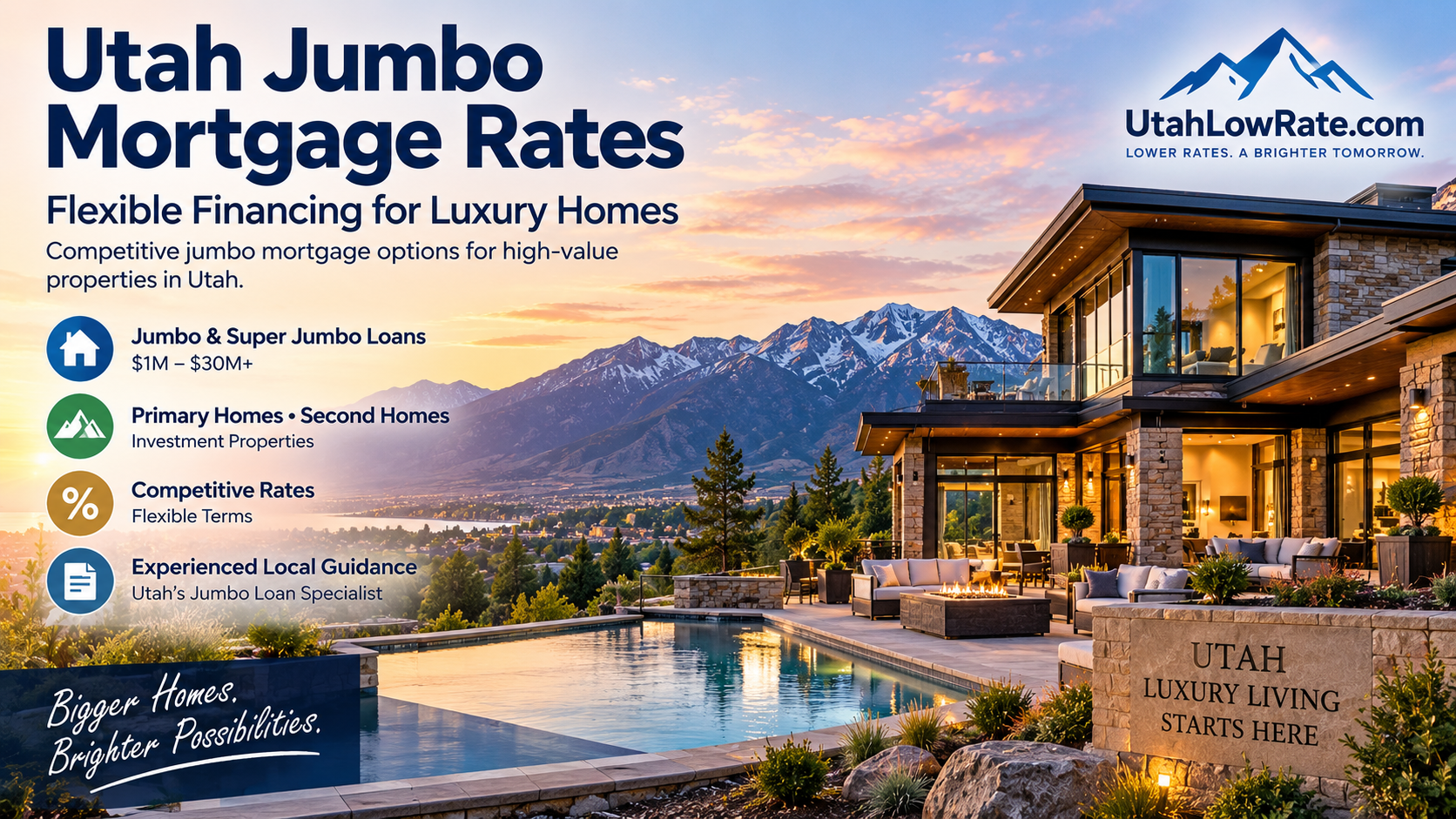
A jumbo mortgage is generally a mortgage exceeding the applicable conforming loan limit.
Jumbo financing is particularly relevant for higher-priced properties in areas such as:
Park City • Deer Valley • Salt Lake City • Holladay • Cottonwood Heights • Draper • Alpine • Highland • St. George
Jumbo mortgage pricing can be affected by loan amount, LTV, credit profile, liquidity, reserves, income documentation, occupancy and property characteristics.
A borrower seeking a $1 million mortgage may receive very different pricing and program options from someone seeking a substantially larger super-jumbo loan.
Explore Jumbo Mortgage Loans in Utah or compare Jumbo Mortgage Rates in Utah.
Super Jumbo Mortgage Rates in Utah
Large mortgage transactions require a different comparison strategy.
Depending on the lender, investor, property and borrower profile, super-jumbo financing may include fixed-rate mortgages, adjustable-rate mortgages, asset-based strategies, pledged-asset structures or other specialized financing.
UtahLowRate.com works with qualified borrowers seeking large mortgage amounts for eligible properties.
Learn more about Super Jumbo Mortgage Loans in Utah.
Bank Statement Mortgage Rates for Self-Employed Utah Borrowers
Traditional tax-return qualification does not work equally well for every self-employed borrower.
A bank statement mortgage may use eligible deposits from personal or business bank statements to help determine qualifying income rather than relying solely on traditional tax-return income.
Because bank statement mortgages generally fall within alternative-documentation or Non-QM lending, pricing is structured differently from standard agency financing.
Rates may be affected by:
Credit score • LTV • loan amount • reserves • property type • occupancy • bank statement type • calculated qualifying income
The lowest advertised conventional mortgage rate therefore may not be relevant to a borrower who needs alternative income documentation.
Learn more about Bank Statement Loans in Utah.
DSCR Mortgage Rates for Utah Investment Properties
Real estate investors may also qualify for certain mortgages using the property's rental cash flow rather than traditional personal-income qualification.
These are commonly called DSCR loans, or debt-service coverage ratio loans.
DSCR mortgage pricing can vary according to the property's cash flow, loan-to-value ratio, credit profile, loan amount, property type and program.
Learn more about DSCR Mortgage Loans in Utah.
How Does Your Credit Score Affect Your Utah Mortgage Rate?
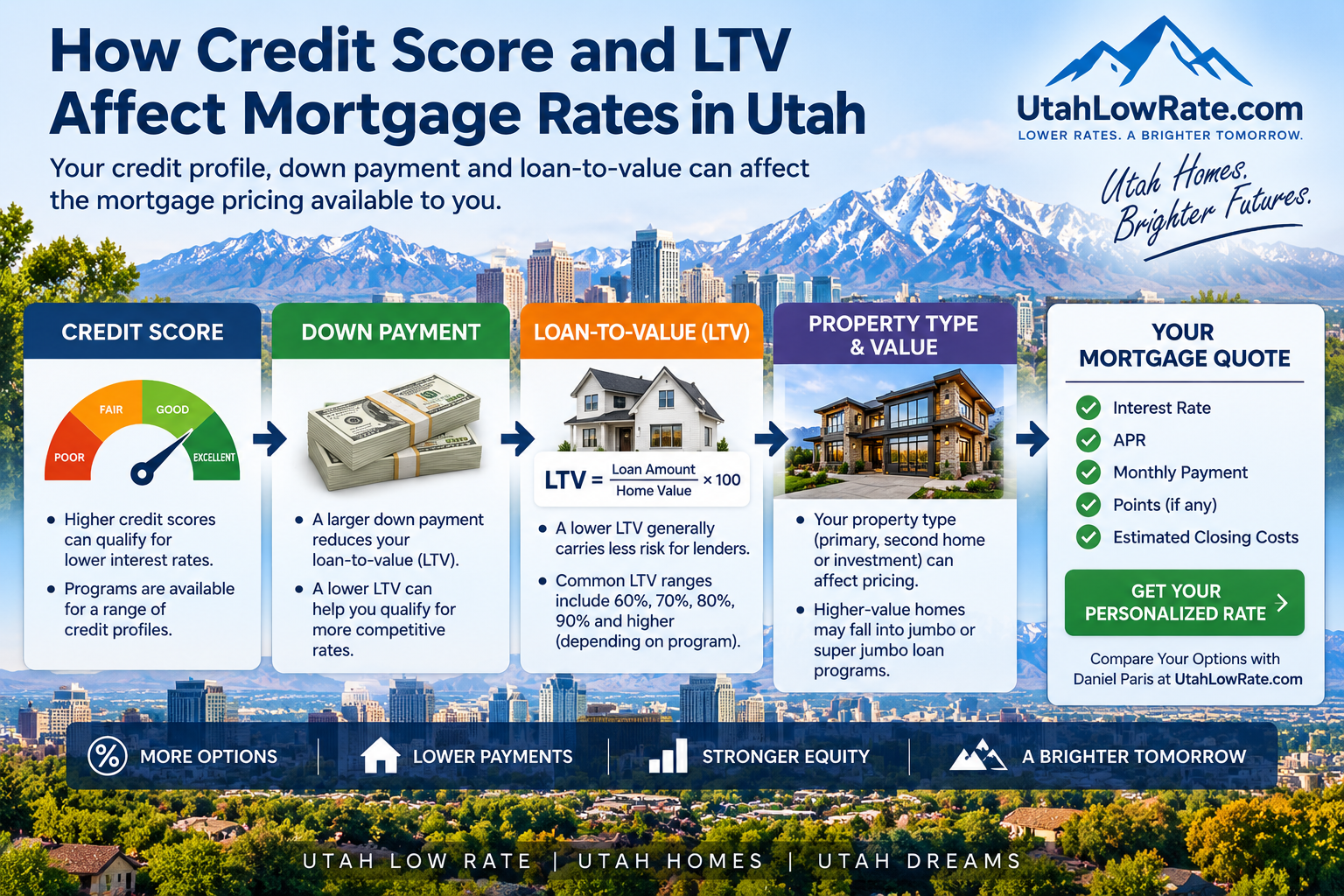
Credit is one of the factors lenders may use when determining mortgage eligibility and pricing.
In general, a stronger qualifying credit profile can provide access to more favorable pricing on many mortgage programs.
But credit should not be viewed in isolation.
For example, two borrowers with identical credit scores could still receive different mortgage pricing because their:
loan amounts, down payments, occupancy, property types, mortgage programs or rate-lock periods are different.
That is why an actual mortgage scenario is more useful than trying to determine your rate from credit score alone.
How Does Down Payment Affect Mortgage Rates?
Your down payment determines your initial loan-to-value ratio.
For example, a $500,000 purchase with $100,000 down would result in a $400,000 loan and an initial 80% LTV based on the purchase price.
Different LTV levels may produce different pricing.
The effect also varies by mortgage program.
Rather than automatically making the largest possible down payment, compare several scenarios when appropriate.
A useful mortgage comparison might examine:
10% down vs. 20% down vs. 25% down
and compare the resulting payment, mortgage insurance, interest rate, cash requirement and available reserves.
Mortgage Rate vs. APR: What's the Difference?
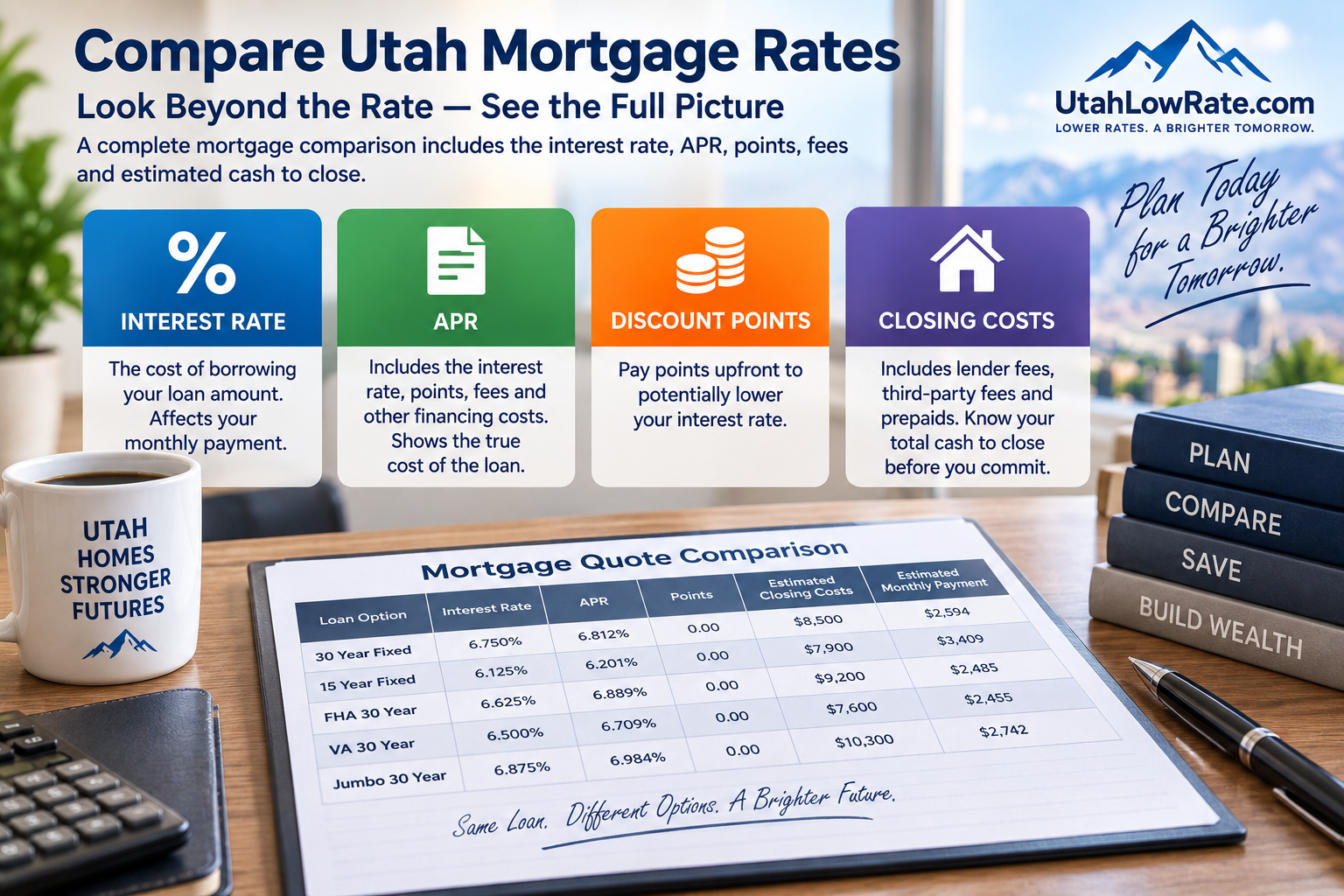
The interest rate is the percentage used to calculate interest on your mortgage.
The annual percentage rate (APR) is a broader measure designed to reflect the interest rate plus certain finance charges associated with obtaining the mortgage.
Suppose two lenders offer the same interest rate.
One could require substantially more discount points or lender fees.
The interest rates may appear identical, but the overall economics of the loans are not necessarily the same.
When comparing Utah mortgage offers, review:
Rate + APR + Points + Lender Fees + Credits + Monthly Payment + Cash to Close
Mortgage Points vs. No-Point Rates
A discount point generally equals 1% of the mortgage amount.
On a $500,000 mortgage:
1 point = $5,000
Paying discount points may allow a borrower to obtain a lower interest rate.
But paying points does not automatically make financial sense.
Simple Mortgage Point Break-Even Formula
Additional upfront cost ÷ estimated monthly payment savings = approximate break-even period
For example:
If additional points cost $4,000 and reduce the payment by approximately $100 per month, the simple break-even period would be:
$4,000 ÷ $100 = 40 months
If you refinance or sell before reaching the break-even point, paying the additional points may not produce the anticipated savings.
Why Do Mortgage Rates Change?
Mortgage rates are influenced by financial markets rather than being determined by one single government agency.
Important influences can include inflation expectations, economic growth, employment data, Treasury yields, mortgage-backed securities, investor demand, market volatility and expectations regarding Federal Reserve policy.
Does the Federal Reserve Set Mortgage Rates?
No.
The Federal Reserve does not directly set 30-year mortgage rates.
Federal Reserve policy can influence financial markets and borrowing costs, but mortgage rates can rise or fall before or after a Fed decision as markets react to economic information and expectations.
Freddie Mac Mortgage Rates vs. Your Utah Mortgage Quote
Freddie Mac's Primary Mortgage Market Survey is useful for understanding broad mortgage-market trends.
However, it should not be confused with an individual Utah mortgage quote.
As of September 17, 2026, Freddie Mac reported:
| Mortgage | Freddie Mac National Average |
|---|---|
| 30-Year Fixed | 6.95% |
| 15-Year Fixed | 6.26% |
These figures are national market benchmarks and are not UtahLowRate.com mortgage offers.
Your actual rate may be higher or lower.
For the newest national benchmark, visit the Freddie Mac Primary Mortgage Market Survey.
How Does a Mortgage Rate Lock Work?
A mortgage rate lock generally allows specified mortgage pricing to be held for a defined period while the loan moves toward closing, subject to the terms of the lock and continued qualification.
Available lock periods vary.
Before locking your mortgage rate, understand:
Rate • APR • Points • Credits • Lock Expiration • Extension Policy • Float-Down Terms, if available
A longer rate lock may have different pricing from a shorter lock.
If closing occurs after the rate-lock expiration, an extension may be required and could involve additional cost or different terms.
Purchase Mortgage Rates in Utah
Utah homebuyers should compare financing before focusing solely on the advertised interest rate.
A purchase mortgage analysis should consider the relationship between:
Home price → Down payment → Mortgage amount → Rate → APR → Payment → Closing costs → Cash reserves
Seller concessions, temporary buydowns and permanent discount points may also affect the transaction when permitted.
Getting pre-approved before making an offer can help establish an estimated price range and identify potential financing issues earlier.
Learn more about Utah Mortgage Pre-Approval.
Refinance Mortgage Rates in Utah
A lower interest rate alone does not necessarily mean refinancing makes financial sense.
A refinance comparison should evaluate:
Current mortgage balance • Existing rate • New rate • New APR • Closing costs • New payment • Remaining term • Break-even period
Cash-out refinances require additional analysis because the borrower is increasing the mortgage balance to access equity.
The objective should be understanding the complete transaction—not simply obtaining a different interest rate.
Mortgage Rates Across Utah
Mortgage pricing is driven largely by national capital markets and borrower-specific factors, but Utah property values and financing needs vary significantly by location.
Salt Lake County
Salt Lake City, Murray, Holladay, Cottonwood Heights, Sandy, Draper, South Jordan, Riverton and surrounding communities include everything from first-time-buyer properties to luxury homes requiring jumbo financing.
Utah County
Lehi, Alpine, Highland, American Fork, Pleasant Grove, Orem and Provo include conventional, FHA, VA, jumbo and alternative-documentation financing needs.
Park City and the Wasatch Back
Park City, Deer Valley, Canyons Village, Heber City, Midway, Hideout and surrounding areas frequently involve higher property values, second homes, investment properties and jumbo mortgages.
Southern Utah
St. George, Washington, Ivins, Santa Clara, Hurricane and surrounding Washington County communities include primary residences, retirement properties, second homes and investment properties.
Northern Utah
Ogden, Layton, Clearfield and communities throughout Davis and Weber counties include conventional, FHA, VA, jumbo and alternative mortgage scenarios.
Your location is only one part of the mortgage calculation. The borrower, property, loan program and market conditions ultimately determine available pricing.
How to Compare Mortgage Rates in Utah
Do not compare mortgage advertisements based on interest rate alone.
For an accurate side-by-side comparison, make sure each quote uses the same:
| Comparison Item | Why It Matters |
|---|---|
| Loan amount | Pricing can change by loan size |
| Property value | Determines LTV |
| Credit profile | Can materially affect pricing |
| Loan program | Conventional, FHA, VA and jumbo price differently |
| Loan term | 15-, 20- and 30-year pricing differs |
| Occupancy | Primary, second home and investment pricing can differ |
| Points | A lower rate may require higher upfront cost |
| Lock period | Longer locks may price differently |
| Transaction type | Purchase and refinance pricing may differ |
If you already have a Loan Estimate, consider a Utah Mortgage Rate Check before making your final decision.
How to Get an Accurate Utah Mortgage Rate Quote
A useful mortgage quote should be based on your actual scenario.
Be prepared to provide your approximate purchase price or property value, requested loan amount, down payment or equity, property location, occupancy, property type, estimated credit range, transaction type, documentation type and anticipated closing date.
Daniel Paris can then compare available mortgage programs and explain the differences between interest rate, APR, points, lender credits and estimated costs.
Get Today's Utah Mortgage Rate
Online mortgage averages are useful for tracking the market.
They cannot determine the exact mortgage rate available for your transaction.
Compare Your Utah Mortgage Options
Whether you're purchasing, refinancing, investing, buying a luxury property or qualifying with alternative income documentation, UtahLowRate.com can help you compare available financing.
Daniel Paris
Utah Mortgage Broker
801-604-4949
NMLS #243976-3138
UtahLowRate.com
Get Today’s Utah Mortgage Rate
Frequently Asked Questions About Mortgage Rates in Utah
What are mortgage rates in Utah today?
Mortgage rates in Utah vary according to the borrower, property, mortgage program and market conditions. Freddie Mac's September 17, 2026 national benchmark was 6.95% for a 30-year fixed mortgage and 6.26% for a 15-year fixed mortgage. Those averages are not personalized Utah mortgage quotes.
Are mortgage rates the same throughout Utah?
National financial markets affect mortgage rates statewide, but individual pricing depends on credit, loan amount, LTV, occupancy, property type, loan program, points and other factors.
What credit score gets the best mortgage rate in Utah?
There is no universal credit score that guarantees the lowest mortgage rate. Credit requirements and pricing adjustments vary by loan program, lender and other characteristics of the transaction.
Are FHA mortgage rates lower than conventional rates?
FHA rates can sometimes appear lower than conventional rates, but borrowers should compare APR, mortgage insurance, points, fees and total costs rather than the note rate alone.
Are VA mortgage rates lower in Utah?
VA mortgages may offer competitive pricing to eligible borrowers. Actual pricing depends on the transaction, credit profile, loan amount, points, market conditions and other factors.
Are jumbo mortgage rates higher than conventional rates?
Not always. Jumbo and conforming mortgages use different pricing models, and market conditions can cause their relative pricing to change.
Can self-employed borrowers get competitive mortgage rates?
Yes, depending on qualification. Self-employed borrowers may qualify conventionally or may use alternative programs such as bank statement, 1099 or Profit and Loss mortgages when available and appropriate.
Does a bigger down payment lower my mortgage rate?
It can. A larger down payment reduces LTV, which can affect pricing. The benefit varies by loan program and pricing tier.
Should I pay points to lower my mortgage rate?
It depends on the upfront cost, monthly savings and how long you expect to keep the mortgage. Calculate the break-even period before deciding.
Is APR more important than the mortgage rate?
Both are useful. The interest rate determines the interest charged on the loan, while APR incorporates certain additional finance charges. Compare both along with points, lender fees and cash required at closing.
Can mortgage rates change after I receive a quote?
Yes. Mortgage pricing can change until your rate is locked. Even after locking, the lock remains subject to its terms and the loan continuing to meet applicable requirements.
When should I lock my Utah mortgage rate?
The timing depends on your closing schedule, available lock period, market conditions, lock costs and risk tolerance. Trying to predict the exact bottom of the mortgage market is inherently uncertain.
How do I get the mortgage rate I actually qualify for?
Request a personalized quote using your actual loan amount, credit profile, property, down payment or equity, occupancy, mortgage program and closing timeline.
About Daniel Paris and UtahLowRate.com
Daniel Paris is a Utah mortgage broker with more than 27 years of mortgage lending experience.
Through UtahLowRate.com, he helps qualified borrowers compare conventional, FHA, VA, jumbo, super-jumbo, bank statement, Non-QM, DSCR and other mortgage programs throughout Utah.
Daniel Paris
Utah Mortgage Broker
NMLS #243976-3138
801-604-4949
UtahLowRate.com
Important Mortgage Rate Disclosure
Mortgage rates, APRs, points, lender credits, fees, loan programs and underwriting requirements are subject to change without notice. Rates displayed from third-party sources are market benchmarks and do not constitute an offer or commitment to lend from UtahLowRate.com. Actual rates and terms depend on borrower qualifications, property characteristics, market conditions and lender or investor requirements. All loans are subject to underwriting and final approval.
Last Updated: September 2026

