
Self-Employed Jumbo Mortgage Loans Utah: 11 Red Flags to Avoid

Last Updated: September 2026
Self-employed jumbo mortgage loans in Utah can create unique underwriting challenges, especially when a borrower uses bank statements instead of traditional tax-return income. A profitable business, excellent credit, substantial assets and a large down payment do not automatically guarantee approval. The lender still needs to determine how much income can actually be used to qualify.
This matters for business owners buying or refinancing higher-value homes throughout Park City, Deer Valley, Salt Lake City, Holladay, Cottonwood Heights, Draper, Alpine, Highland, Heber City, Midway and St. George.
A qualifying Utah bank statement mortgage may allow an eligible self-employed borrower to establish income using personal or business bank statements rather than relying primarily on traditional tax-return income.
However, bank statement loans are still fully underwritten mortgages.
The lender may review qualifying income, credit, debts, assets, reserves, loan-to-value ratio, property, appraisal, occupancy, business history and the source and consistency of deposits.
Borrowers seeking larger loan amounts should also review Jumbo Bank Statement Loans Utah.
Quick Answer: What Can Cause a Self-Employed Jumbo Mortgage Loan to Be Denied?
Common red flags for self-employed jumbo mortgage loans in Utah include unexplained deposits, transfers counted as income, declining business revenue, excessive overdrafts, insufficient reserves, high business expenses, mixed personal and business funds, inconsistent documentation and selecting the wrong bank statement program.
A business can generate substantial gross revenue and still produce less mortgage qualifying income than expected.
That is why these issues should be identified before formal underwriting whenever possible.
Self-Employed Jumbo Mortgage Loans Utah: Red Flags at a Glance
| Red Flag | Why It Matters |
|---|---|
| Unexplained large deposits | Deposits may not represent recurring income |
| Transfers between accounts | The same money could accidentally be counted twice |
| Declining deposits | May raise questions about income stability |
| High business expenses | May reduce qualifying income |
| Repeated overdrafts or NSFs | May require additional underwriting review |
| Mixed personal and business funds | Can complicate income calculations |
| Insufficient reserves | Jumbo programs may require significant post-closing liquidity |
| Wrong statement period | 12 vs. 24 months can produce different income results |
| Large down payment but weak income | Lower LTV does not replace income qualification |
| Inconsistent documentation | Can delay or complicate underwriting |
| Applying before income analysis | Problems may appear after an offer is made |
Review the complete Bank Statement Loan Requirements in Utah before applying.
1. Unexplained Large Deposits Can Cause Underwriting Problems
One of the biggest mistakes with self-employed jumbo mortgage loans in Utah is assuming every deposit shown on a bank statement counts as qualifying income.
It does not.
Suppose a business account receives:
- $90,000 in customer revenue
- $150,000 transferred from another account
- $75,000 from an asset sale
- $100,000 in loan proceeds
Total deposits are $415,000.
But that does not necessarily mean the business generated $415,000 of qualifying income.
The lender may need to separate legitimate recurring business revenue from transfers, borrowed funds, asset-sale proceeds, reimbursements and other non-income transactions.
This distinction becomes especially important when the requested mortgage is $1 million, $2 million or several million dollars.
Red Flag to Avoid
Do not estimate qualifying income by simply adding every deposit.
Identify unusual deposits before submitting the loan and determine whether supporting documentation may be needed.
2. Transfers Between Accounts Can Artificially Inflate Income
Moving money between accounts does not create new income.
Suppose your company receives $60,000 from customers into an operating account and then transfers $40,000 into another business account.
Looking only at total deposits could make it appear that the business received $100,000.
It actually generated $60,000 before other adjustments.
This issue becomes more complicated when a business owner maintains operating, payroll, savings, merchant, personal or multiple-company accounts.
Transfers generally need to be identified so the same funds are not counted more than once.
See the Bank Statement Loan Income Calculator for examples of how eligible deposits may be separated from transfers and other non-income transactions.
3. Declining Bank Deposits May Raise Income-Stability Questions
Average deposits matter, but the direction of revenue may matter too.
Consider a business showing:
Earlier months: $125,000–$140,000 per month
Recent months: $65,000–$80,000 per month
The overall average may still look strong, but an underwriter may need to understand why recent revenue is materially lower.
There may be reasonable explanations.
Construction, tourism, hospitality and other Utah businesses can experience seasonal fluctuations. Businesses connected to Park City’s tourism economy, for example, may not generate identical revenue every month.
The important question is whether the statement history supports the qualifying income being used.
4. Gross Business Deposits Are Not Mortgage Qualifying Income
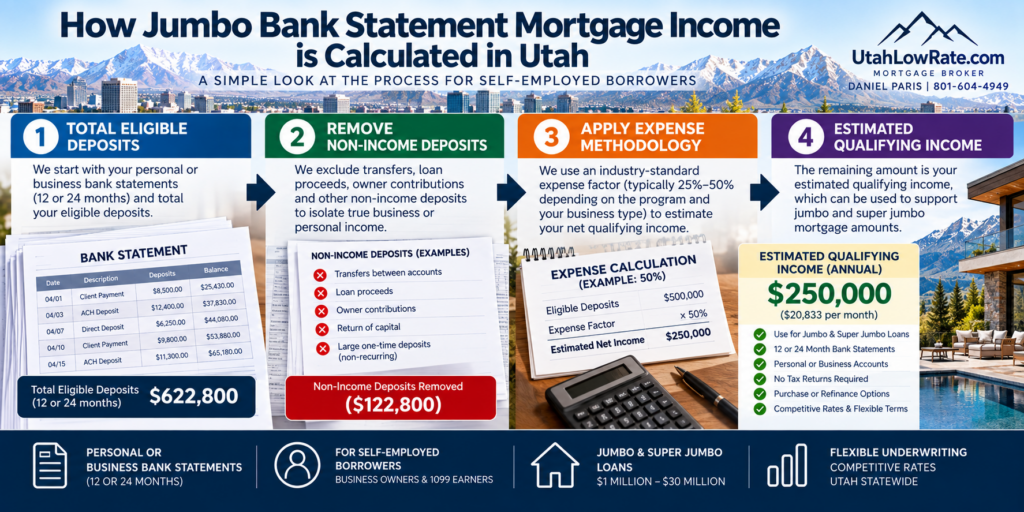
This is one of the most important concepts for self-employed borrowers.
$100,000 deposited into a business account each month does not automatically equal $100,000 of monthly qualifying income.
Businesses have expenses.
Depending on the investor and program, an approved expense methodology may be applied to eligible business deposits.
Example
Assume a business averages $100,000 in eligible monthly deposits.
If an applicable methodology results in 50% being treated as qualifying income:
$100,000 × 50% = $50,000 estimated monthly qualifying income
If another applicable methodology produces a 75% result:
$100,000 × 75% = $75,000 estimated monthly qualifying income
That is a $25,000 monthly difference.
On a jumbo mortgage, that difference can substantially affect qualification.
These percentages are examples only. Never assume a specific expense factor applies to a particular loan.
Use the Bank Statement Loan Income Calculator for additional examples.
5. Personal vs. Business Bank Statements Can Produce Different Results
The account used for qualification can matter.
Personal Bank Statements
Certain programs may permit personal statements when recurring self-employment income is deposited into the borrower’s personal account.
Business Bank Statements
Business accounts normally contain gross business receipts rather than personal net income. An approved method may therefore be required to account for business expenses.
Multiple Accounts
The analysis can become more complicated when business revenue enters one account and is later transferred to another.
The same money cannot simply become income twice.
A preliminary review can help determine whether personal statements, business statements or another available documentation method is appropriate.
6. Repeated Overdrafts and NSF Activity Can Create Questions
A profitable business can still experience cash-management problems.
Repeated overdrafts, negative balances, returned payments and nonsufficient-funds activity may require additional review.
One isolated overdraft can present a very different picture from recurring negative balances.
Review the statements that are likely to be submitted before underwriting begins.
The goal is simple: know what the underwriter is likely to see.
7. Mixing Personal and Business Funds Can Complicate Qualification
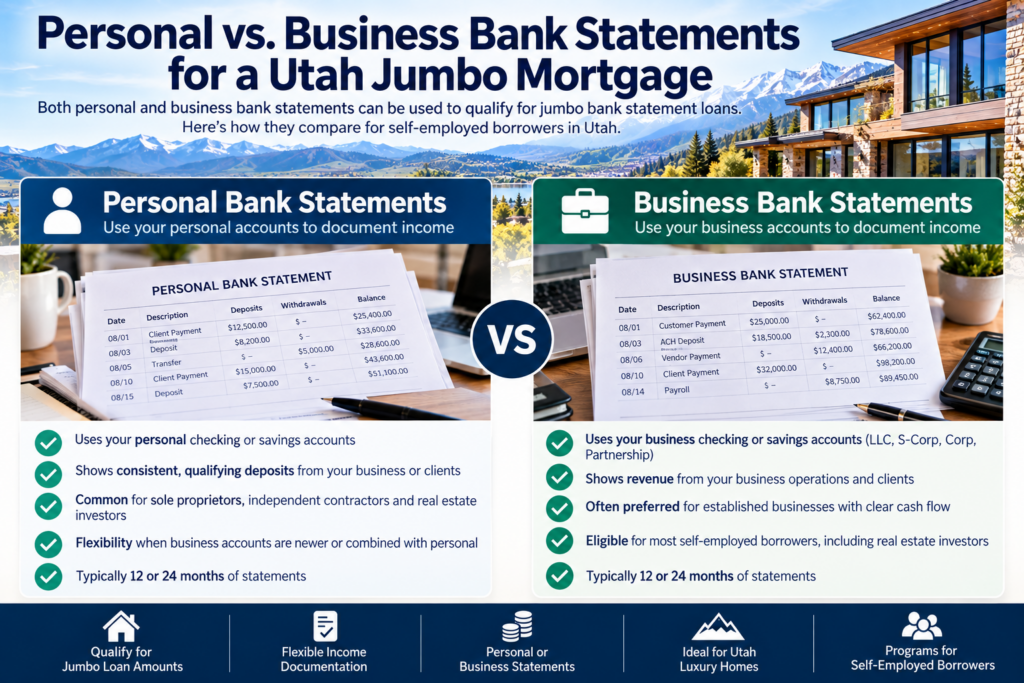
Many business owners transfer funds between business and personal accounts.
That does not automatically prevent mortgage qualification.
However, it can complicate the calculation.
For example, if $25,000 in customer revenue enters a business account and is later transferred into a personal checking account, that transfer does not create another $25,000 of income.
It is the same money.
Personal funds deposited into a business account can create the opposite issue because those funds may need to be separated from legitimate business revenue.
8. Insufficient Reserves Can Stop an Otherwise Strong Jumbo Loan
Qualifying income is only one part of a jumbo mortgage.
A borrower might have enough money for the down payment and closing costs but not enough eligible assets remaining after closing to satisfy the applicable reserve requirement.
Depending on the program, eligible reserves may include qualifying checking, savings and investment assets.
Reserve requirements can become particularly important on higher-balance properties in Park City, Deer Valley, Holladay, Cottonwood Heights, Alpine and Highland.
Planning Tip
Do not assume putting every available dollar toward the down payment is automatically the best structure.
A larger down payment can reduce LTV, but it can also reduce post-closing liquidity.
9. A Large Down Payment Does Not Eliminate Income Requirements
Putting 30% or 40% down does not necessarily eliminate the need to document sufficient qualifying income.
A lower LTV may strengthen the transaction, but borrowers generally must still satisfy applicable requirements involving income, credit, assets, reserves, existing debts, property eligibility, appraisal, occupancy and documentation.
Excellent credit works similarly.
A high credit score can strengthen an application, but it does not automatically replace insufficient qualifying income.
10. Choosing the Wrong 12-Month or 24-Month Program Can Reduce Income
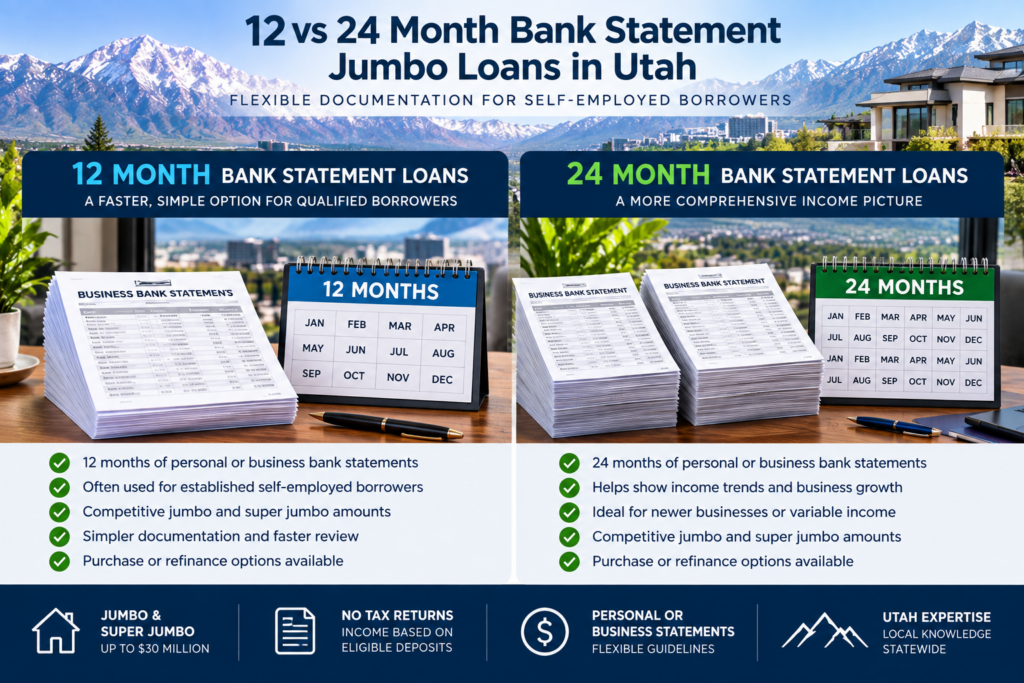
More documentation is not automatically better.
Suppose a business expanded significantly during the last year.
The most recent 12 months might average $120,000 in eligible monthly deposits.
Adding the previous year, before the expansion, could reduce the average.
Another business may have the opposite situation. A company with significant seasonal fluctuations may have a 24-month history that provides a clearer picture of recurring revenue.
Neither option is universally better.
The appropriate period depends on the available program and factors such as business history, revenue trends, seasonality, credit, loan amount, LTV, occupancy and property.
11. Applying Before Your Bank Statements Are Analyzed Can Be a Major Mistake
One of the most preventable mistakes is assuming:
“My company deposits $100,000 every month, so qualifying won’t be a problem.”
Before applying, determine:
- Which accounts should be analyzed?
- Should personal or business statements be used?
- Does the available program use 12 or 24 months?
- Which deposits represent recurring eligible income?
- Which transactions are transfers?
- Are there unusual or non-income deposits?
- What business-expense methodology applies?
- What is the estimated monthly qualifying income?
- What jumbo loan amount is requested?
- What is the proposed LTV?
- How much liquidity will remain after closing?
- Does the property satisfy applicable program requirements?
Start with the Bank Statement Loan Income Calculator and then review Bank Statement Loan Requirements.
Why Self-Employed Jumbo Mortgage Loans in Utah Require More Planning
Jumbo loans generally exceed the applicable conforming loan limit.
The Federal Housing Finance Agency publishes conforming loan limits each year. Borrowers can verify the current limits directly through the Federal Housing Finance Agency.
Jumbo mortgages may follow different underwriting standards from conventional conforming loans.
A jumbo bank statement mortgage adds another variable because investors may have different requirements involving income calculations, business-expense methodologies, credit, LTV, reserves, statement periods, property types, occupancy and maximum loan amounts.
The better question is therefore not simply:
“Do you offer bank statement loans?”
Instead, ask:
“How will this jumbo bank statement program calculate my income, and will that calculation support the mortgage I need?”
For higher-balance financing, see Jumbo Bank Statement Loans Utah.
Park City and Deer Valley Jumbo Bank Statement Loans

Self-employed borrowers financing luxury properties in Park City, Deer Valley, Empire Pass, Old Town, Canyons Village, Promontory and surrounding Summit County communities can face several underwriting considerations at once.
A borrower may have strong business revenue, excellent credit, significant assets and a substantial down payment while still requiring a carefully structured qualifying-income analysis.
These transactions can also involve second homes, investment properties, large loan balances and significant reserve requirements.
How to Reduce the Risk of a Jumbo Bank Statement Loan Denial
Start before formal underwriting.
Gather the bank statements likely to be used and review them for large unusual deposits, transfers, loan proceeds, asset-sale proceeds, overdrafts, negative balances, declining revenue and personal funds deposited into business accounts.
Next, estimate eligible deposits and apply the expense methodology permitted by the applicable program.
Then compare estimated qualifying income with the proposed housing payment, existing debts, loan amount, LTV and required reserves.
This analysis does not guarantee approval. Final approval remains subject to complete underwriting, acceptable property and appraisal, lender requirements, investor guidelines and current program availability.
Frequently Asked Questions About Self-Employed Jumbo Mortgage Loans in Utah
Why can a jumbo bank statement loan be denied if my business makes plenty of money?
Gross business revenue is not automatically mortgage qualifying income. Transfers, non-income deposits, business expenses, declining revenue, debts, reserves and other underwriting requirements can affect qualification.
Can I get a jumbo mortgage in Utah without using tax returns to calculate income?
Potentially. Certain bank statement programs may allow eligible self-employed borrowers to establish qualifying income using personal or business bank deposits. Other documentation and full underwriting still apply.
Do lenders count 100% of business bank deposits as income?
Not necessarily. Business accounts generally reflect gross receipts. An approved methodology may be needed to account for business expenses.
Is a 12-month or 24-month bank statement jumbo loan better?
Neither is universally better. The appropriate option depends on available programs, business history, income trends, seasonality and other underwriting factors.
Can I get a jumbo bank statement mortgage in Park City or Deer Valley?
Potentially. Select programs provide jumbo bank statement financing for eligible self-employed borrowers. Income, credit, assets, reserves, LTV, occupancy, loan amount and property requirements apply.
Should I have my bank statements reviewed before making an offer?
A preliminary review can help identify transfers, unusual deposits, declining revenue, expense-calculation issues and possible reserve requirements before formal underwriting. It is not an approval or guarantee of financing.

Have Your Utah Jumbo Bank Statement Scenario Reviewed
Self-employed borrowers should not assume gross deposits equal mortgage qualifying income.
A preliminary review can evaluate personal versus business statements, 12 versus 24 months, eligible deposits, transfers, expense methodology, estimated qualifying income, credit, LTV, down payment, reserves, jumbo loan amount, property and occupancy.
Daniel Paris
Utah Mortgage Broker
UtahLowRate.com
NMLS #243976
27+ years of mortgage lending experience
Phone: 801-604-4949
Service Area: Utah statewide
Continue Researching Utah Bank Statement Loans
Bank Statement Loans Utah — Statewide bank statement mortgage guide.
Jumbo Bank Statement Loans Utah — Higher-balance bank statement financing.
Bank Statement Loan Requirements — Documentation and qualification requirements.
Bank Statement Loan Income Calculator — Estimate how eligible deposits may translate into qualifying income.
Have Your Jumbo Bank Statements Reviewed
Call Daniel Paris at 801-604-4949 to discuss your Utah self-employed jumbo mortgage scenario.
Important Mortgage Disclosure
Mortgage programs, rates, credit requirements, LTV limits, loan amounts, reserve requirements, income calculations and documentation requirements vary by lender and investor and are subject to change.
Examples are educational and illustrative. They are not a commitment to lend, pre-approval, approval or guarantee of financing.
All mortgage loans are subject to borrower qualification, complete underwriting, acceptable property and appraisal, applicable lender and investor requirements, and current program availability.

