
Content updated: September 29, 2026
How Much Do You Need?
A Jumbo Loan Down Payment Utah borrowers need is not determined by one universal percentage. Depending on the jumbo program, loan amount, credit profile, property type, occupancy, reserves and overall financial strength, qualified borrowers may find options requiring 10%, 15%, 20% or more down.
Check My Jumbo Options or call 801-604-4949.
UtahLowRate.com works with multiple wholesale mortgage programs, allowing borrowers to compare jumbo financing instead of assuming one lender's down-payment requirement applies everywhere.
Quick Answer: Some qualified Utah borrowers may find jumbo financing with approximately 10% down, while other jumbo loans require 15%, 20%, 25% or more. Larger loan amounts and more complex properties may require lower LTVs. Credit, reserves, occupancy, property type and investor guidelines all affect the final requirement.
Important: The percentages on this page illustrate possible LTV/down-payment structures and are not guaranteed program terms. Jumbo guidelines vary by investor and can change.
Jumbo Loan Down Payment Utah Quick Facts
Loan percentages, credit examples and payment calculations are illustrations unless linked to an identified current program. They do not establish available terms or approval.
| Factor | What to Know |
|---|---|
| Typical question | Can I get a jumbo mortgage with 10% down? |
| 90% LTV | Equivalent to 10% down |
| 85% LTV | Equivalent to 15% down |
| 80% LTV | Equivalent to 20% down |
| 75% LTV | Equivalent to 25% down |
| Loan amounts | Above the applicable conforming limit may be jumbo |
| Primary residences | Multiple jumbo options may be available |
| Second homes | Guidelines may differ |
| Investment properties | Often evaluated under different guidelines |
| Credit | Higher LTV generally requires a stronger overall file |
| Reserves | Post-closing liquidity can be important |
| Very large loans | Compare Super Jumbo Mortgage Loans |
What Is the Minimum Jumbo Loan Down Payment in Utah?

There is no single minimum down payment that applies to every jumbo mortgage.
Unlike conforming mortgages, jumbo loans are generally underwritten using the guidelines of the lender or investor providing the program. That creates substantial differences among jumbo lenders.
A qualified borrower might find a higher-LTV jumbo option, while another transaction could require substantially more equity.
The required down payment may depend on:
- Mortgage amount
- Purchase price
- Credit score and credit history
- Primary residence, second home or investment property
- Property type
- Debt-to-income ratio
- Income documentation
- Liquid assets
- Post-closing reserves
- Number of financed properties
- Investor guidelines
This is one reason shopping wholesale jumbo programs can be especially useful.
For an overview of available financing, see Jumbo Mortgage Utah.
Can You Get a Jumbo Loan With 10% Down in Utah?
Potentially.
A 10% down jumbo loan corresponds to approximately 90% loan-to-value, or 90% LTV.
For example:
Purchase price: $1,500,000
10% down payment: $150,000
Mortgage amount: $1,350,000
LTV: 90%
That does not mean every lender will finance $1.35 million at 90% LTV.
Higher-LTV jumbo programs usually place greater emphasis on the complete borrower and property profile.
An investor may consider factors such as strong credit, stable qualifying income, reserves, property eligibility and satisfactory appraisal results.
10% Down Jumbo Example
| Purchase Price | Down Payment | Approx. Loan | LTV |
|---|---|---|---|
| $1,000,000 | $100,000 | $900,000 | 90% |
| $1,250,000 | $125,000 | $1,125,000 | 90% |
| $1,500,000 | $150,000 | $1,350,000 | 90% |
| $2,000,000 | $200,000 | $1,800,000 | 90% |
These calculations illustrate LTV only. They do not represent a commitment to lend or confirm program eligibility.
15% Down Jumbo Loans in Utah
Putting 15% down produces an 85% LTV.
For a $2 million property:
Purchase price: $2,000,000
Down payment: $300,000
Potential mortgage: $1,700,000
LTV: 85%
Moving from 90% to 85% LTV gives the lender a larger equity position.
That can matter because jumbo underwriting often evaluates several risk factors together. A borrower with more equity may have access to options that are unavailable at a higher LTV.
However, the maximum permitted loan amount at 85% LTV still depends on the individual investor.
20% Down Jumbo Loans in Utah
A 20% jumbo down payment equals an 80% LTV.
This is a common benchmark borrowers use when comparing jumbo financing.
For example:
| Home Price | 20% Down | Approx. Mortgage |
|---|---|---|
| $1,000,000 | $200,000 | $800,000 |
| $1,500,000 | $300,000 | $1,200,000 |
| $2,000,000 | $400,000 | $1,600,000 |
| $3,000,000 | $600,000 | $2,400,000 |
| $5,000,000 | $1,000,000 | $4,000,000 |
But 20% is not a universal jumbo requirement.
A borrower may qualify with less equity under one program or need substantially more under another.
Jumbo Loan Down Payment vs. LTV
Understanding loan-to-value makes jumbo down payments much easier to compare.
The basic calculation is:
LTV = Loan Amount ÷ Property Value × 100
On a purchase transaction, the lender generally considers the applicable property value under its underwriting requirements.
The mathematical relationship is straightforward:
| Maximum LTV | Corresponding Equity/Down Payment |
|---|---|
| 90% | 10% |
| 85% | 15% |
| 80% | 20% |
| 75% | 25% |
| 70% | 30% |
| 65% | 35% |
| 60% | 40% |
| 55% | 45% |
The important question is therefore not simply:
"What is the jumbo down payment?"
It is:
"What maximum LTV is available for my loan amount, property and borrower profile?"
How Loan Amount Affects a Jumbo Loan Down Payment in Utah

Jumbo financing is not one uniform category.
A $900,000 mortgage and a $9 million mortgage may both fall outside applicable conforming parameters, but the underwriting and maximum LTV can be dramatically different.
In general, investors may reduce maximum LTV as the loan amount becomes larger.
That makes the combination of these two numbers especially important:
Loan amount + LTV
For exceptionally large transactions, visit Super Jumbo Mortgage Loans to compare financing designed for multimillion-dollar properties.
2026 Utah Jumbo Loan Limits Matter
Before deciding that you need a jumbo mortgage, determine the conforming loan limit applicable to the property's county and number of units.
A mortgage becomes jumbo when it exceeds the applicable conforming loan limit.
The Federal Housing Finance Agency establishes conforming loan limits annually, and limits can differ by geographic area.
That distinction is especially important in Utah because high-cost counties may have higher conforming limits than many other parts of the state.
For example, Summit and Wasatch counties can have different conforming thresholds from counties such as Salt Lake, Utah, Washington and Weber.
Read our Jumbo Loan Limits Utah guide before assuming a mortgage automatically requires jumbo financing.
Does Credit Score Affect the Jumbo Down Payment?
Yes, it can.
Credit and LTV are frequently connected in jumbo underwriting.
Higher-LTV financing represents less borrower equity, so an investor may require a stronger overall credit profile.
Credit review may include more than a numerical score. Underwriters can evaluate:
- Mortgage payment history
- Revolving debt utilization
- Installment debt
- Recent inquiries
- Delinquencies
- Collections
- Bankruptcy or foreclosure history
- Overall depth and age of credit
A strong credit profile does not automatically guarantee a particular LTV.
Likewise, a lower credit score does not tell you the required down payment by itself.
The complete transaction has to be evaluated.
Do Jumbo Loans Require Cash Reserves?
Many jumbo programs require borrowers to have money remaining after closing.
These funds are known as post-closing reserves.
Reserves are separate from the down payment and closing costs.
For example, a borrower might have enough money for a $400,000 down payment but still need additional verified assets after closing to satisfy the selected jumbo program.
Reserve requirements may depend on:
- Loan amount
- Monthly housing payment
- Number of financed properties
- Occupancy
- Credit profile
- Property type
- Investor requirements
For high-net-worth borrowers, available assets can therefore be just as important as the down payment itself.
Should You Put More Than 20% Down on a Jumbo Loan?
Not automatically.
A larger down payment reduces LTV, but putting additional cash into the property also reduces the borrower's liquidity.
For example, suppose you are purchasing a $2 million Utah home.
You could compare:
10% down: $200,000
20% down: $400,000
30% down: $600,000
The larger down payment reduces the mortgage amount, but it also commits another $200,000 to $400,000 of capital to the property.
The better structure depends on factors such as:
- Available jumbo pricing
- Monthly payment
- Liquidity needs
- Investment opportunities
- Required reserves
- Financial goals
- Expected holding period
A mortgage broker can compare different LTV scenarios before you decide how much cash to use.
Jumbo Down Payments for Park City and Deer Valley
Luxury real estate in Park City, Deer Valley, Empire Pass, Canyons Village, Old Town, Promontory and surrounding Summit County communities frequently creates jumbo financing needs.
These transactions may involve:
- Multimillion-dollar purchase prices
- Second homes
- Luxury primary residences
- Condominiums
- Resort properties
- Complex income
- Significant investment assets
- Large reserve requirements
Because Summit County has its own applicable conforming loan limits, borrowers should first determine whether the requested mortgage is actually jumbo.
Once the loan crosses into jumbo territory, the next step is comparing available loan amounts and LTVs.
Jumbo Down Payments in Salt Lake County
Jumbo mortgages are also common throughout higher-priced areas of the Salt Lake Valley, including:
- Holladay
- Cottonwood Heights
- Sandy
- Draper
- Salt Lake City
- Millcreek
- South Jordan
- Bluffdale
The same principle applies: the property's price alone does not determine whether the mortgage is jumbo.
The loan amount must be compared with the applicable conforming loan limit.
A buyer making a substantial down payment on a high-priced property could potentially reduce the requested loan into conforming territory.
That comparison should be performed before selecting a loan program.
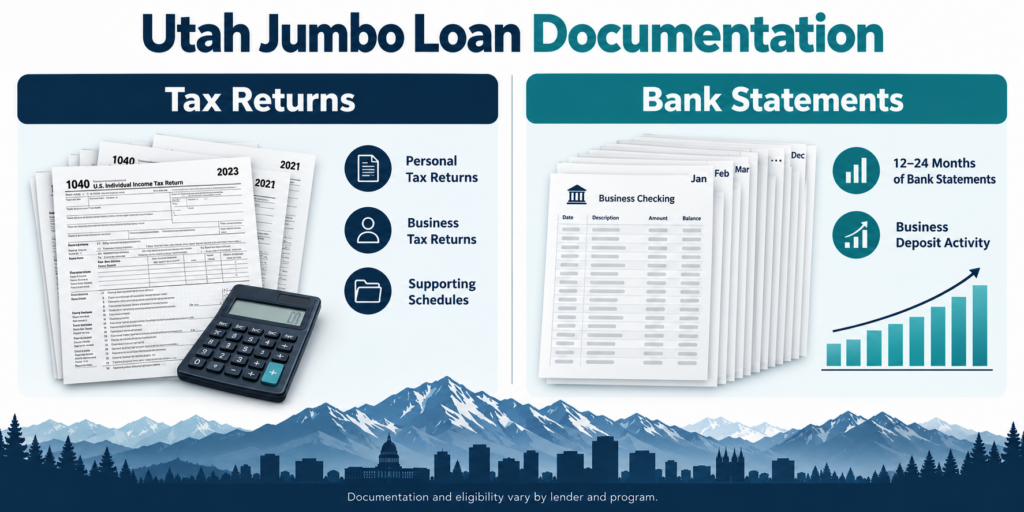
Jumbo Loans for Self-Employed Utah Borrowers
Self-employed borrowers may have substantial income and assets while showing less taxable income because of legitimate business deductions.
Traditional jumbo underwriting may work when tax returns support sufficient qualifying income.
When they do not, alternative-documentation programs may be worth evaluating.
UtahLowRate.com offers information about Bank Statement Loans Utah and Jumbo Bank Statement Loans Utah.
Bank statement programs may analyze eligible deposits rather than relying exclusively on traditional tax-return income.
The available jumbo down payment and LTV still depend on the investor, credit, loan amount, property, occupancy and overall transaction.
Jumbo vs. Super Jumbo Down Payment
There is no universal dividing line where every lender begins calling a mortgage "super jumbo."
The term generally describes particularly large non-conforming mortgage amounts.
As loan size increases, maximum LTV can become more restrictive.
For example, a specialized investor might have one maximum LTV for a lower jumbo tier and another for a substantially larger mortgage.
UtahLowRate.com works with programs designed for large mortgage scenarios, including qualified transactions involving multimillion-dollar financing.
Compare Super Jumbo Mortgage Options.
Can Gift Funds Be Used for a Jumbo Down Payment?
Potentially, depending on the program.
Jumbo investors establish their own requirements regarding:
- Gift funds
- Donor relationships
- Borrower contribution
- Documentation
- Transfer of funds
- Required reserves
Do not assume conforming gift-fund rules automatically apply to a jumbo mortgage.
Ask for the specific investor requirements before moving large sums of money.
Where Should Jumbo Down-Payment Funds Come From?
Jumbo transactions generally require acceptable documentation showing where the funds came from.
Potential sources may include qualifying:
- Checking accounts
- Savings accounts
- Brokerage accounts
- Investment accounts
- Proceeds from another property
- Sale of eligible assets
- Gift funds when permitted
Large deposits or recent transfers may require additional documentation.
For that reason, talk with your mortgage professional before moving money between multiple accounts during underwriting.
How to Determine Your Jumbo Down Payment Before Making an Offer
The best approach is to review the transaction before choosing an arbitrary down-payment percentage.
Step 1: Estimate the purchase price
Determine the approximate property price range.
Step 2: Determine the applicable conforming limit
Check the property's Utah county and current FHFA conforming loan limit.
Step 3: Choose your desired cash investment
Decide how much liquidity you want to commit to the purchase.
Step 4: Calculate the requested loan amount
Subtract the proposed down payment from the purchase price.
Step 5: Calculate LTV
Divide the proposed mortgage by the property value.
Step 6: Review credit, income and assets
These factors can determine which jumbo LTV tiers are realistically available.
Step 7: Compare multiple jumbo investors
Different investors can produce different results from the same borrower profile.
Jumbo Mortgage vs. Conventional Mortgage
A high-priced home does not necessarily require a jumbo mortgage.
Consider a hypothetical $1 million property.
If the buyer makes a sufficiently large down payment to bring the loan amount within the applicable conforming limit, conforming financing may remain possible.
Another buyer purchasing the same property with less money down could require jumbo financing.
This is why the mortgage amount, rather than just the home price, matters.
You can compare standard financing on our Conventional Mortgage Loans Utah page.
Common Jumbo Down-Payment Mistakes
Assuming 20% down is always required
It isn't. Jumbo programs vary considerably.
Assuming 10% down is always available
It isn't. A 90% LTV program may have tighter requirements or may not support the desired loan amount or property.
Using all available cash for the down payment
Doing so could leave insufficient reserves.
Ignoring county conforming limits
A borrower may assume a mortgage is jumbo when a higher county loan limit could allow conforming financing.
Moving assets immediately before underwriting
Large transfers can create additional documentation requirements.
Comparing only interest rates
Down payment, reserves, points, fees, loan structure and overall financing costs should also be compared.
Jumbo Loan Down Payment Utah FAQ
How much down payment do I need for a jumbo loan in Utah?
There is no universal minimum. Qualified borrowers may find programs at approximately 10%, 15% or 20% down, while larger or more complex transactions may require more equity. The requirement depends on loan amount, credit, property, occupancy, reserves and investor guidelines.
Can I get a jumbo loan with 10% down in Utah?
Maximum financing and required equity depend on the selected lender, credit, loan amount, property, documentation and transaction. Request a current program review before relying on an LTV percentage.
Is 20% down required for a jumbo mortgage?
No. Twenty percent down is not a universal jumbo requirement. Some programs may permit higher LTVs, while others require substantially more equity.
Does a larger jumbo loan require a bigger down payment?
It can. Maximum permitted LTV often becomes an important consideration as mortgage amounts increase. Very large super-jumbo loans may have lower maximum LTVs than smaller jumbo mortgages.
Are reserves part of my jumbo down payment?
No. The down payment is the borrower's equity contribution to the purchase. Reserves are qualifying assets remaining after closing. A jumbo program may require both.
Can self-employed borrowers qualify for jumbo mortgages?
Yes. Self-employed borrowers may qualify using traditional documentation or, under qualifying programs, alternative documentation such as bank statements. Credit, assets, reserves, LTV and property requirements still apply.
Are jumbo loan limits the same everywhere in Utah?
No. Conforming loan limits can vary by county. Because a mortgage generally becomes jumbo when it exceeds the applicable conforming limit, the property's location matters.
Compare Jumbo Loan Down Payment Options in Utah
The best jumbo structure is not necessarily the one requiring the largest down payment.
It is the financing structure that fits your loan amount, property, credit, income, assets, liquidity and financial goals.
As a wholesale Utah mortgage broker, Daniel Paris at UtahLowRate.com can compare multiple jumbo and super-jumbo programs for qualified borrowers throughout Utah, including Salt Lake City, Holladay, Cottonwood Heights, Sandy, Draper, Park City, Deer Valley, Heber City, Midway, Provo, Orem, Lehi and St. George.
Daniel Paris
Utah Mortgage Broker
UtahLowRate.com
NMLS #243976
801-604-4949
Apply for a Mortgage or request a jumbo scenario review before deciding how much money to put down.
Important Mortgage Disclosure
Mortgage programs, rates, LTV limits, loan amounts, reserve requirements, credit requirements and underwriting guidelines are subject to change. Examples on this page are for educational purposes and do not represent a commitment to lend. All loans are subject to borrower qualification, complete underwriting, acceptable appraisal and property, investor guidelines and program availability.
Related guides: Utah jumbo mortgage guide · Jumbo loan requirements · Jumbo mortgage rates · Jumbo payment calculation guide · Jumbo mortgage questions and answers ·

