
Content updated: September 29, 2026
If you are researching Super Jumbo Loan Requirements Utah, qualification depends on much more than income and credit score. Super jumbo lenders typically review the requested loan amount, loan-to-value ratio (LTV), credit history, income or alternative documentation, liquid assets, post-closing reserves, property type, occupancy, and the borrower’s complete financial profile.
UtahLowRate.com works with qualified borrowers seeking specialized financing for luxury homes and high-value properties throughout Utah, including Salt Lake City, Park City, Deer Valley, Holladay, Draper, Alpine, Highland, Heber City, Midway, and St. George.
Check My Jumbo Options or call 801-604-4949.
For borrowers who need larger financing, start with our Super Jumbo Mortgage Loans Utah & California overview.
Quick Answer: What Are Super Jumbo Loan Requirements in Utah?
Super Jumbo Loan Requirements Utah vary by lender and loan size. Qualified borrowers generally need acceptable credit, sufficient income or an eligible alternative qualification method, substantial assets and liquidity, required post-closing reserves, an acceptable LTV, and an eligible luxury property. Requirements often become more conservative as the requested mortgage amount increases.
Super Jumbo Loan Requirements Utah — Key Facts
Loan percentages, credit examples and payment calculations are illustrations unless linked to an identified current program. They do not establish available terms or approval.
| Requirement | What Lenders May Review |
|---|---|
| Loan amount | Requested mortgage size and program maximum |
| Credit | Score, history and mortgage payment performance |
| Down payment/equity | LTV based on loan size and property |
| Income | Traditional or eligible alternative documentation |
| Assets | Liquid and other eligible financial assets |
| Reserves | Funds remaining after closing |
| Property | Value, type, condition and marketability |
| Occupancy | Primary, second home or investment |
| Appraisal | High-value property valuation requirements |
| Debt | Existing obligations and total housing expense |
| Liquidity | Borrower's accessible post-closing assets |
| Loan purpose | Purchase, refinance or cash-out |
What Is a Super Jumbo Mortgage?

A super jumbo mortgage is a large residential mortgage used to finance high-value real estate beyond the range typically associated with ordinary conforming and many traditional jumbo loans.
There is no single federal definition establishing exactly where a mortgage becomes “super jumbo.” Individual lenders and investors establish their own loan-size ranges and underwriting standards.
For comparison, FHFA establishes annual conforming loan limits for mortgages acquired by Fannie Mae and Freddie Mac. Jumbo and super jumbo financing operates outside those standard conforming limits.
UtahLowRate.com works with qualified borrowers seeking financing for multimillion-dollar properties and mortgage amounts potentially ranging from approximately $1 million to $30 million or more, depending on the program, property, transaction and borrower qualifications.
Explore the main Utah Jumbo Mortgage page if you are comparing jumbo and super jumbo financing.
Super Jumbo Loan Requirements Utah: What Determines Approval?
A super jumbo approval is usually based on the complete transaction rather than one isolated guideline.
An underwriter may evaluate:
- Requested loan amount
- Property value
- Loan-to-value ratio
- Credit score and credit history
- Income and employment
- Business ownership
- Assets and liquidity
- Post-closing reserves
- Existing real estate
- Monthly liabilities
- Property type
- Occupancy
- Loan purpose
- Documentation method
- Overall financial strength
Two borrowers requesting the same mortgage amount can therefore receive very different financing options.
For example, a borrower seeking a $5 million mortgage with substantial liquid assets and conservative leverage presents a different profile from a borrower seeking the maximum available LTV on the same loan amount.
What Credit Score Is Required for a Super Jumbo Loan in Utah?
There is no universal minimum credit score that applies to every Utah super jumbo mortgage.
Credit standards depend on the investor, requested loan amount, LTV and overall transaction.
Lenders may review:
- FICO scores
- Mortgage payment history
- Revolving credit
- Installment debt
- Previous late payments
- Major derogatory credit events
- Credit utilization
- Number and age of accounts
- Overall credit depth
A stronger credit profile can improve available financing options, but credit score alone does not determine approval.
A borrower with substantial liquidity, a lower LTV and strong financial history may be evaluated differently from someone requesting significantly higher leverage.
How Much Down Payment Is Required for a Utah Super Jumbo Loan?
There is no single down-payment percentage for every super jumbo mortgage.
Instead, lenders typically establish a maximum loan-to-value ratio based on the requested loan amount and risk profile.
As the mortgage amount increases, maximum LTV may decline.
For example, UtahLowRate.com may have access to specialized programs where qualified transactions in certain loan ranges can be considered at different LTV levels. Exact limits depend on the current investor guidelines and borrower profile.
This is why borrowers should not assume that the down payment required for a $2 million mortgage will be the same percentage required for a $10 million, $20 million or $30 million mortgage.
Factors That Can Affect Super Jumbo LTV
The available LTV may depend on:
- Loan amount
- Property value
- Credit profile
- Primary residence versus second home
- Investment occupancy
- Property type
- Documentation method
- Liquidity
- Reserves
- Loan purpose
- Purchase versus refinance
- Cash-out amount
The best way to determine the potential LTV is to review the complete scenario.
How Much Cash Reserve Is Required?
Post-closing reserves can be especially important for super jumbo qualification.
Reserves are eligible assets that remain available after the down payment, closing costs and other required funds have been accounted for.
Depending on the program, lenders may calculate reserves in months of the proposed housing expense.
Reserve requirements may increase with:
- Larger loan amounts
- Higher monthly housing payments
- Multiple financed properties
- Higher LTVs
- Alternative income documentation
- Second-home or investment occupancy
- Complex financial profiles
A borrower financing a multimillion-dollar property should generally expect liquidity to receive significant underwriting attention.
What Assets Can Be Used for Super Jumbo Qualification?
Eligible assets depend on the lender and program.
Potential assets may include:
- Checking accounts
- Savings accounts
- Money market accounts
- Certificates of deposit
- Brokerage accounts
- Stocks
- Bonds
- Mutual funds
- Eligible retirement accounts
- Other qualifying financial assets
The lender determines whether an asset is eligible and what portion of its value can be used.
Assets may serve several purposes.
They can provide funds for the down payment and closing costs, satisfy reserve requirements, demonstrate liquidity, or—in certain programs—help establish qualifying income through an asset-depletion calculation.
Income Requirements for Super Jumbo Loans
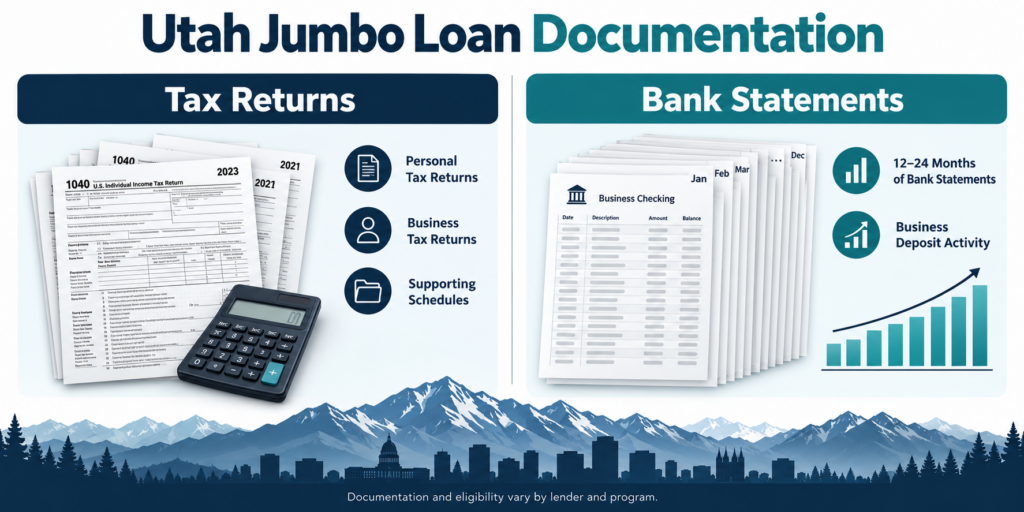
Traditional super jumbo underwriting may require detailed income documentation.
For a salaried borrower, documentation could include:
- Pay statements
- W-2 forms
- Tax returns when required
- Verification of employment
- Documentation of bonuses or commissions
- Evidence of other qualifying income
For self-employed borrowers, the lender may request:
- Personal tax returns
- Business tax returns
- Profit-and-loss statements
- Balance sheets
- Business documentation
- Bank statements
- CPA or tax-preparer documentation
However, traditional tax-return qualification is not the only possible approach.
Super Jumbo Loans for Self-Employed Borrowers

Business owners often have complex tax returns because legitimate deductions can reduce taxable income.
Depending on the program, eligible self-employed borrowers may have alternative documentation options.
Bank Statement Super Jumbo Loans
A bank statement mortgage may calculate qualifying income using eligible deposits rather than relying exclusively on traditional tax-return income.
Programs may review personal or business bank statements.
Learn more about Jumbo Bank Statement Loans Utah.
Profit and Loss Programs
Certain programs may allow eligible self-employed borrowers to qualify using a qualifying profit-and-loss statement.
Asset Depletion
High-net-worth borrowers with significant financial assets may qualify under programs that convert eligible assets into calculated monthly income.
This can be particularly useful for investors, retirees, entrepreneurs and other borrowers whose financial strength is concentrated in assets rather than W-2 income.
Debt-to-Income Requirements
Debt-to-income ratio compares qualifying monthly debt obligations with qualifying monthly income.
For super jumbo underwriting, lenders may evaluate obligations such as:
- Proposed mortgage payment
- Property taxes
- Homeowners insurance
- HOA dues
- Other mortgages
- Auto loans
- Student loans
- Credit cards
- Alimony or other qualifying obligations
Maximum DTI varies by investor and program.
Significant liquid assets do not automatically eliminate the need to satisfy applicable income and debt requirements unless the borrower qualifies through a program specifically designed around assets or another alternative qualification method.
Property Requirements for Utah Super Jumbo Loans
The property itself is a major part of super jumbo underwriting.
Lenders may evaluate:
- Property value
- Property condition
- Location
- Marketability
- Comparable sales
- Lot size
- Acreage
- Unique features
- Construction quality
- Property type
- Intended occupancy
Unique luxury properties can require additional analysis because comparable sales may be limited.
This is particularly relevant in Utah luxury markets such as Park City, Deer Valley, Empire Pass, Promontory, Holladay, Alpine, Highland and high-value Wasatch County communities.
Appraisal Requirements for Super Jumbo Mortgages
High-value properties can receive more detailed valuation review than typical residential transactions.
Depending on the lender and loan amount, the transaction may require:
- A full appraisal
- Additional appraisal review
- A second appraisal
- Automated or desk review
- Additional comparable-sale analysis
- Review of unique property characteristics
Requirements depend on the investor and transaction.
Borrowers purchasing highly customized luxury properties should allow adequate time for the valuation process.
Primary Residence Super Jumbo Requirements
Super jumbo financing may be available for an eligible primary residence.
A primary-residence transaction may provide different financing options than a second home or investment property.
Qualification still depends on credit, assets, income, reserves, LTV, property and the lender's underwriting requirements.
Second-Home Super Jumbo Requirements
Utah has a substantial luxury second-home market, particularly around Park City, Deer Valley, Midway, Heber City and other Wasatch Back communities.
Qualified borrowers may use super jumbo financing for eligible second homes.
Second-home guidelines may differ from primary-residence guidelines for:
- LTV
- Reserves
- Property usage
- Income documentation
- Loan amount
- Pricing
The property must satisfy the selected lender's occupancy and eligibility requirements.
Investment Property Super Jumbo Requirements
Select lenders may provide jumbo or super jumbo financing for high-value investment properties.
Investment transactions may have more conservative requirements for LTV, reserves and underwriting.
Real estate investors should also compare traditional jumbo financing with investor-focused alternatives.
For qualifying rental properties, visit DSCR Loans Utah to compare another potential financing method.
Purchase vs. Refinance Requirements
Super jumbo programs may be available for both purchases and refinances.
Super Jumbo Purchase
Purchase qualification may focus on:
- Purchase price
- Down payment
- Source of funds
- Assets
- Reserves
- Credit
- Income
- Property valuation
Rate-and-Term Refinance
A rate-and-term refinance may allow a qualified borrower to restructure an existing luxury mortgage.
Super Jumbo Cash-Out Refinance
Cash-out programs may allow eligible homeowners to access equity in a high-value property.
Cash-out guidelines may differ from purchase and rate-and-term transactions, particularly regarding maximum LTV and available cash proceeds.
Requirements for $2 Million to $30 Million Mortgages
Super jumbo requirements can change substantially as loan size increases.
A useful way to think about the process is:
Larger loan amount → greater lender exposure → potentially more conservative underwriting.
UtahLowRate.com can evaluate specialized financing for qualified borrowers seeking multimillion-dollar mortgages.
Explore the applicable loan-size pages when comparing options:
- $2 Million Mortgage Loans Utah
- $5 Million Mortgage Loans Utah
- $10 Million Mortgage Loans Utah
- $20 Million Mortgage Loans Utah
- $30 Million Mortgage Loans Utah
These pages should link back to this requirements guide and the main Super Jumbo Mortgage hub.
Super Jumbo Loan Requirements in Park City and Deer Valley
Park City and Deer Valley contain some of Utah's highest-value residential real estate.
Luxury properties can include:
- Ski-in/ski-out residences
- Custom mountain estates
- Luxury condominiums
- Second homes
- Vacation residences
- Properties in private communities
- High-value primary residences
A Park City super jumbo scenario should be reviewed using the exact property value, desired mortgage amount, occupancy and borrower financial profile.
Property uniqueness can also make appraisal and valuation requirements especially important.
Super Jumbo Loan Requirements in Salt Lake City
Salt Lake County has numerous markets where jumbo financing can become relevant, including Salt Lake City, Holladay, Cottonwood Heights, Sandy and Draper.
Borrowers purchasing high-value primary residences may have access to traditional jumbo, super jumbo, asset-based or alternative-documentation financing depending on their circumstances.
Super Jumbo Loan Requirements in Alpine and Highland
Luxury homes in Alpine and Highland can require larger mortgage amounts because of property size, land, location and custom construction.
Utah County borrowers seeking multimillion-dollar financing should compare available LTV, reserve, documentation and property requirements before choosing a program.
Super Jumbo Loan Requirements in St. George
Southern Utah also has a growing market for luxury homes and second residences.
Qualified borrowers financing higher-value properties in St. George, Ivins, Santa Clara, Washington and surrounding communities may be able to use jumbo or super jumbo mortgage programs.
How to Prepare for a Super Jumbo Mortgage
Preparing before submitting a super jumbo application can make the underwriting process more efficient.
1. Determine the Desired Loan Amount
Establish the approximate purchase price or property value and desired mortgage amount.
2. Calculate the Approximate LTV
Divide the proposed loan amount by the property's purchase price or applicable value.
3. Review Your Credit
Identify your current credit profile and any issues that may need explanation.
4. Organize Assets
Gather recent bank, brokerage, retirement and other relevant asset statements.
5. Determine Your Income Documentation Method
Decide whether traditional income documentation is appropriate or whether an eligible bank statement, P&L, asset depletion or other alternative program should be evaluated.
6. Calculate Post-Closing Liquidity
Determine how much liquid capital will remain after the down payment and closing.
7. Review the Property
Provide the location, property type, occupancy and estimated value.
8. Compare Multiple Super Jumbo Programs
Large mortgages can vary considerably between investors.
A wholesale mortgage broker can compare multiple potential lending sources rather than limiting the borrower to one bank's guidelines.
Documents to Prepare
A super jumbo borrower may be asked to provide some combination of:
- Government-issued identification
- Mortgage application
- Purchase contract, if applicable
- Pay statements
- W-2s
- Tax returns
- Business returns
- Bank statements
- Brokerage statements
- Retirement statements
- Profit-and-loss statement
- Business documentation
- Existing mortgage statements
- Property tax information
- Homeowners insurance
- HOA information
- Real estate schedules
- Documentation for other income
The exact documentation package depends on the program.
Common Super Jumbo Qualification Mistakes
One mistake is assuming every lender has the same requirements.
They do not.
Other potential problems include:
- Moving large amounts of money without documentation
- Changing financial structures during underwriting
- Opening substantial new debt
- Underestimating reserve requirements
- Assuming an online home value is sufficient
- Waiting too long to document complex assets
- Assuming maximum advertised LTV applies to every loan size
- Failing to disclose all financed properties
- Choosing a lender before comparing program guidelines
With a multimillion-dollar mortgage, small structural differences can have a substantial financial impact.
Why Use a Mortgage Broker for a Super Jumbo Loan?
Super jumbo lending is highly specialized.
One bank may offer excellent terms at one loan amount but become less competitive when the requested mortgage increases.
Another investor may be better suited for:
- Self-employed borrowers
- High-net-worth borrowers
- Large asset portfolios
- Bank statement qualification
- Asset depletion
- Second homes
- Luxury properties
- Complex income
- Large cash-out requests
Working with a broker allows the scenario to be matched with an appropriate lending source.
Utah mortgage broker Daniel Paris has more than 27 years of mortgage lending experience and works with qualified borrowers seeking specialized jumbo and super jumbo financing.
Super Jumbo Loan Requirements Utah FAQ
What are the basic Super Jumbo Loan Requirements in Utah?
Requirements typically include acceptable credit, sufficient income or an eligible alternative qualification method, adequate down payment or equity, documented assets, required post-closing reserves and an eligible property. Exact guidelines depend on the lender and requested loan amount.
What credit score do I need for a Utah super jumbo mortgage?
There is no universal minimum credit score for all super jumbo loans. Requirements depend on the lender, loan amount, LTV, occupancy, property and complete borrower profile.
How much do I need to put down on a super jumbo loan?
There is no single required percentage. Maximum LTV typically varies by loan amount, credit, occupancy, property type, liquidity and investor guidelines.
How much money do I need in reserves?
Reserve requirements vary considerably. Large super jumbo loans may require substantial post-closing liquidity, and requirements can increase as the loan amount or monthly housing expense rises.
Can I qualify for a super jumbo mortgage if I am self-employed?
Potentially. Self-employed borrowers may qualify through traditional documentation or eligible alternative programs such as bank statement, P&L or asset-based qualification.
Can assets help me qualify for a super jumbo loan?
Potentially. Certain asset-depletion programs allow eligible assets to be converted into calculated qualifying income. Assets can also be important for down payment, closing costs and reserve requirements.
Can I get a $10 million mortgage in Utah?
Potentially. Specialized super jumbo programs may provide multimillion-dollar financing to qualified borrowers. Maximum LTV, credit, documentation, property and reserve requirements depend on the selected program.
Can I get a $20 million or $30 million mortgage in Utah?
Potentially. Specialized lending sources may consider exceptionally large mortgage amounts for qualified high-net-worth borrowers and eligible properties. These transactions generally require detailed review of leverage, liquidity, assets, income and property.
Are super jumbo loans available for Park City and Deer Valley properties?
Yes, qualified borrowers may have access to jumbo and super jumbo financing for eligible Park City and Deer Valley primary residences, second homes and certain investment properties.
Is a super jumbo pre-approval possible?
Potentially. A preliminary review of credit, income, assets, reserves, proposed property value and requested loan amount can help identify available programs before an offer is submitted. Learn more about Utah Mortgage Pre-Approval.
Compare Utah Super Jumbo Mortgage Options
Super jumbo financing should be structured around the borrower, property and complete financial picture, not simply the requested loan amount.
UtahLowRate.com can help qualified borrowers compare options for:
- Super jumbo purchase loans
- Super jumbo refinance loans
- Super jumbo cash-out loans
- Luxury second homes
- High-value primary residences
- Investment properties
- Bank statement jumbo loans
- Asset depletion mortgages
- Self-employed jumbo financing
- $2 million mortgages
- $5 million mortgages
- $10 million mortgages
- $20 million mortgages
- $30 million+ mortgages
Check My Super Jumbo Options
Daniel Paris
Utah Mortgage Broker
UtahLowRate.com
27+ Years of Mortgage Lending Experience
801-604-4949
Apply for a Utah Mortgage or review Super Jumbo Mortgage Loans Utah & California.
Mortgage programs, rates, maximum loan amounts, LTVs, documentation requirements and eligibility are subject to change. All loans are subject to borrower qualification, property eligibility, underwriting approval, investor guidelines and applicable licensing requirements.
Related guides: Utah jumbo mortgage guide · Jumbo loan requirements · Jumbo mortgage rates · Jumbo payment calculation guide · Jumbo mortgage questions and answers ·

