
Content updated: September 29, 2026
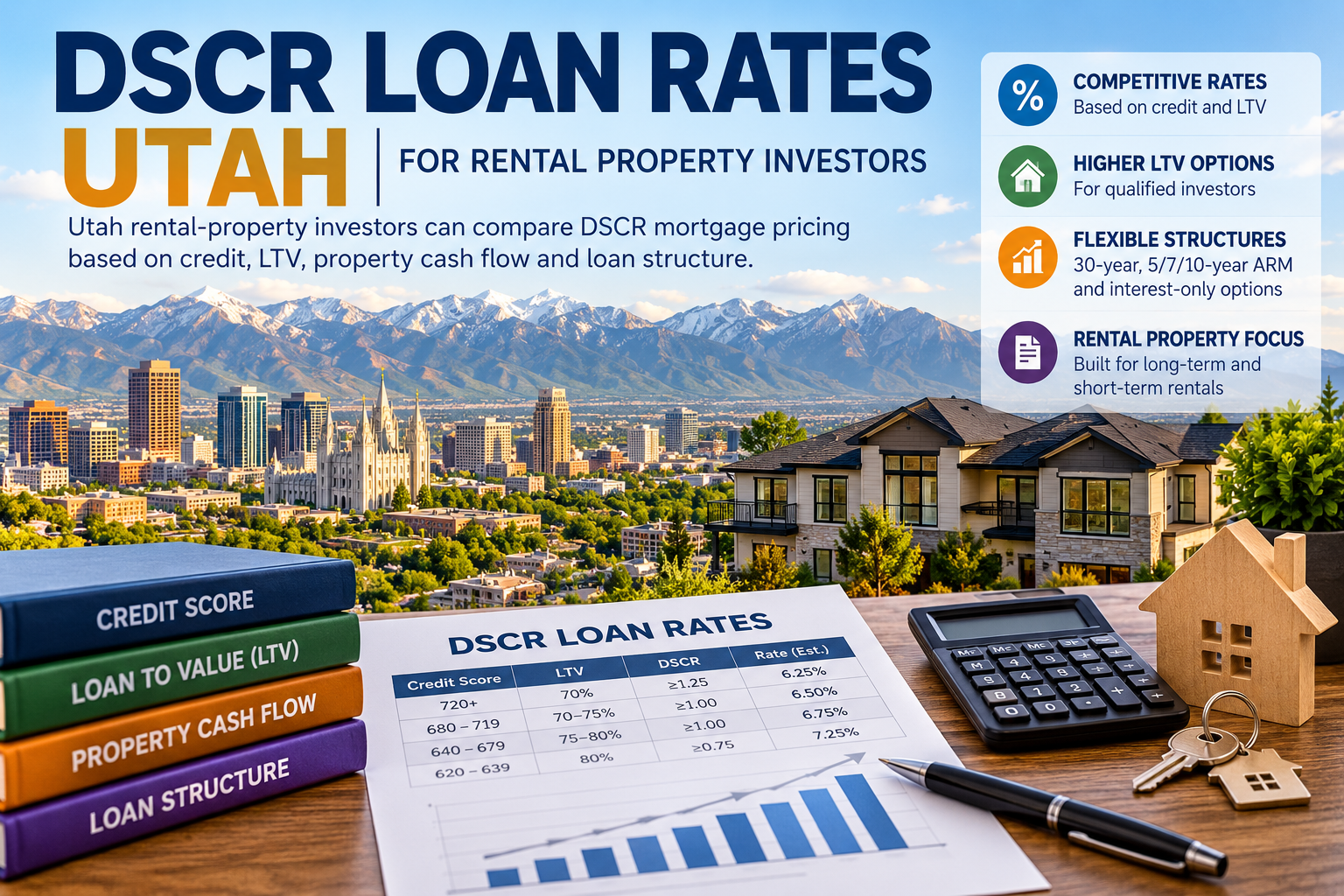
Check My DSCR Scenario or call 801-604-4949.
Compare Utah DSCR Mortgage Pricing for Rental Properties
DSCR loan rates in Utah depend on much more than current mortgage-market conditions. Credit score, loan-to-value ratio (LTV), the property's debt service coverage ratio, loan amount, property type, transaction type, points, interest-only features and prepayment structure can all affect the rate and total cost of a DSCR mortgage.
Unlike a conventional owner-occupied mortgage, a DSCR loan is generally designed for investment property. Qualification focuses heavily on the rental property's cash flow rather than relying primarily on the borrower's traditional employment income.
Daniel Paris at UtahLowRate.com helps Utah real estate investors compare DSCR loan programs for purchases, refinances and qualifying cash-out transactions.
Call Daniel Paris: 801-604-4949
Rates, APRs, points, lender fees, DSCR requirements, LTV limits, credit requirements, interest-only options, prepayment provisions and program availability vary by lender and can change without notice.
Quick Answer: What Determines DSCR Loan Rates in Utah?
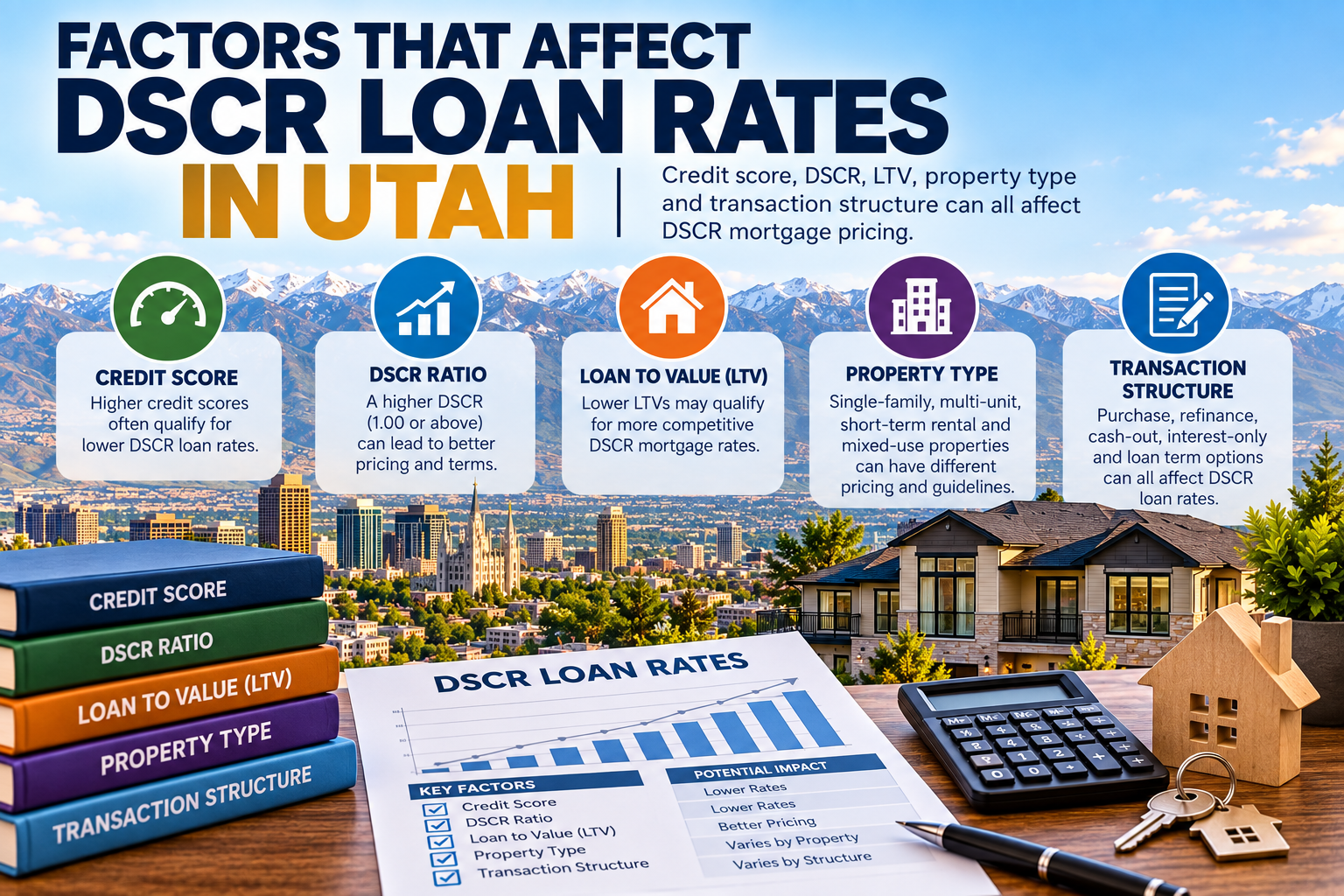
Utah DSCR mortgage rates are primarily affected by the combination of the property's DSCR, borrower credit profile, LTV, loan amount, property type and transaction structure.
In general, a stronger overall risk profile may qualify for more favorable pricing. A higher LTV, weaker DSCR, lower credit score, cash-out transaction or certain property characteristics may result in different pricing or fewer available programs.
The important point is that there is no single DSCR loan rate that applies to every Utah investment property.
A current quote should be based on the actual property and transaction.
Utah DSCR Loan Rate Quick Facts
Loan percentages, credit examples and payment calculations are illustrations unless linked to an identified current program. They do not establish available terms or approval.
| Pricing Factor | Why It Matters |
|---|---|
| DSCR | Measures qualifying rent relative to the property's qualifying debt obligation |
| Credit score | Can affect rate, price adjustments and available programs |
| LTV | More borrower equity can affect lender risk and pricing |
| Loan amount | Pricing may vary by balance |
| Purchase vs. refinance | Transaction type can affect pricing |
| Cash-out refinance | Often has different pricing and LTV rules |
| Property type | SFR, condo, 2–4 unit and other properties may price differently |
| Rental strategy | Long-term and qualifying short-term rentals may be treated differently |
| Interest-only | Availability and pricing depend on the lender |
| Points | Paying points may reduce the note rate |
| Prepayment structure | May materially affect pricing and overall economics |
| Investor experience | May matter under certain programs |
| Reserves | Requirements vary by program |
| Market conditions | DSCR pricing can move with capital and mortgage markets |
How Are DSCR Loan Rates Determined?
A DSCR lender does not normally look at one number and assign an interest rate.
Pricing is generally built from a combination of the base program and risk adjustments.
Those adjustments can include:
- Credit score
- DSCR
- LTV
- Loan amount
- Property type
- Number of units
- Purchase, refinance or cash-out
- Rental-income methodology
- Short-term-rental characteristics
- First-time versus experienced investor status
- Interest-only structure
- Prepayment terms
- Points or lender credits
- Current lender and capital-market pricing
This is why two Utah investors requesting the same loan amount can receive different pricing.
It is also why comparing only the advertised interest rate can be misleading.
How Does DSCR Affect Your Utah DSCR Loan Rate?
DSCR stands for Debt Service Coverage Ratio.
A simplified calculation is:
DSCR = Qualifying Monthly Rental Income ÷ Qualifying Monthly Property Debt Obligation
Suppose an investment property has $4,000 of qualifying monthly rent and a $3,200 qualifying monthly property obligation.
$4,000 ÷ $3,200 = 1.25 DSCR
That means the qualifying rental income is approximately 125% of the debt obligation used in the calculation.
Why DSCR Matters to Pricing
The DSCR gives the lender one measure of the property's ability to support its financing.
A property with stronger qualifying cash flow may fit a different pricing tier than a property whose rent barely covers its qualifying monthly obligation.
The exact breakpoints are lender specific.
Some programs may distinguish among scenarios such as:
- DSCR above 1.25
- DSCR between 1.00 and 1.24
- DSCR equal to 1.00
- DSCR below 1.00
- No-ratio or zero-ratio scenarios
These are not universal pricing tiers. Each lender establishes its own eligibility and pricing rules.
Investors who want to understand the calculation in detail should also review the DSCR Loan Calculator Utah guide.
Does a Higher DSCR Get a Better Mortgage Rate?
It can.
A stronger DSCR may improve the overall risk profile of the transaction and may produce better pricing or more program choices with some lenders.
But DSCR does not work in isolation.
Consider two properties:
Property A
- 1.30 DSCR
- 760 credit
- 65% LTV
Property B
- 1.30 DSCR
- 680 credit
- 80% LTV
Although the properties have the same DSCR, they do not have the same overall loan profile.
Credit and leverage can materially change the available pricing.
This is why the best way to compare DSCR loan rates in Utah is to price the entire transaction rather than focusing on one qualification factor.
How Does LTV Affect DSCR Loan Rates?
Loan-to-value ratio measures the requested mortgage balance compared with the property's applicable value.
For example:
| Property Value | Loan Amount | LTV |
|---|---|---|
| $500,000 | $400,000 | 80% |
| $500,000 | $375,000 | 75% |
| $500,000 | $350,000 | 70% |
| $500,000 | $325,000 | 65% |
Lower LTV means the borrower has more equity in the transaction.
LTV can affect:
- Interest rate
- Points
- Maximum loan amount
- Minimum credit requirements
- DSCR requirements
- Cash-out eligibility
- Available lender choices
A Utah investor should therefore compare more than the maximum available LTV.
Sometimes contributing additional equity can improve pricing enough to justify the larger initial investment. In other cases, preserving cash for reserves or another acquisition may be more important.
The correct comparison depends on the investor's objectives.
How Does Credit Score Affect DSCR Mortgage Rates?
Credit remains important even though a DSCR mortgage generally does not qualify the borrower primarily through traditional personal income.
Lenders may use credit-score tiers when determining both eligibility and pricing.
For example, a lender may price borrowers differently at various credit levels.
A stronger credit profile may potentially provide:
- More lender choices
- Higher available LTV
- Better pricing
- Lower required points
- More flexible program combinations
Lower credit does not automatically mean that a DSCR loan is unavailable.
Instead, lower-credit scenarios may have different LTV limits, rates, fees, reserve requirements or other conditions.
For a detailed explanation, see DSCR Loan Credit Score Utah.
DSCR + Credit + LTV Work Together
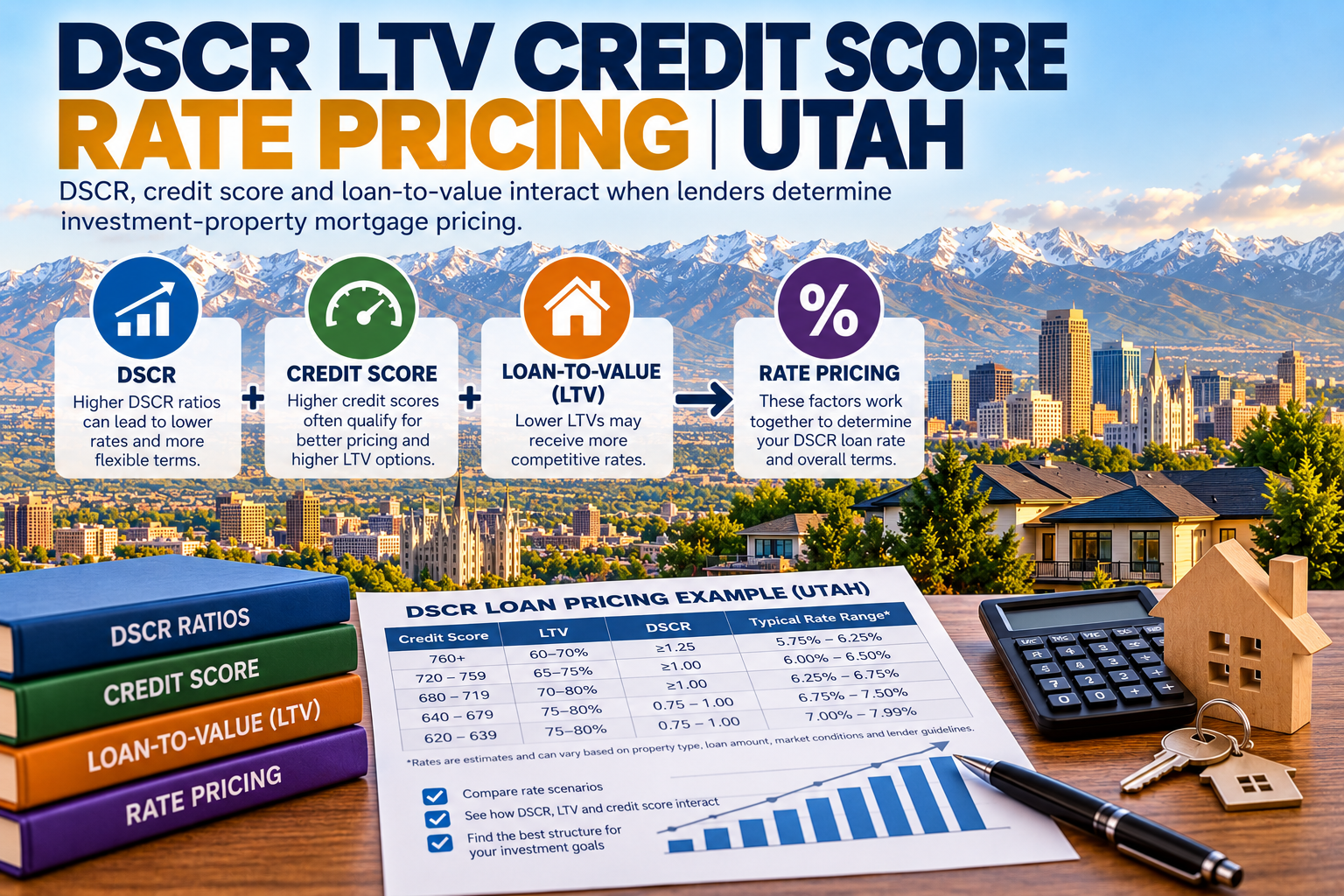
One of the biggest mistakes investors make is looking at these factors independently.
Think of DSCR pricing as a matrix.
| Scenario | DSCR | Credit | LTV | General Pricing Profile |
|---|---|---|---|---|
| A | Stronger | Stronger | Lower | Generally stronger overall risk profile |
| B | Stronger | Lower | Higher | More pricing adjustments may apply |
| C | Lower | Stronger | Lower | Equity and credit may help compensate |
| D | Lower | Lower | Higher | Fewer programs or additional adjustments may apply |
This table illustrates the relationship between the factors. It is not a lender rate sheet or a guarantee of pricing.
The best available combination depends on current wholesale lender guidelines.
Do Points Affect DSCR Loan Rates?
Yes.
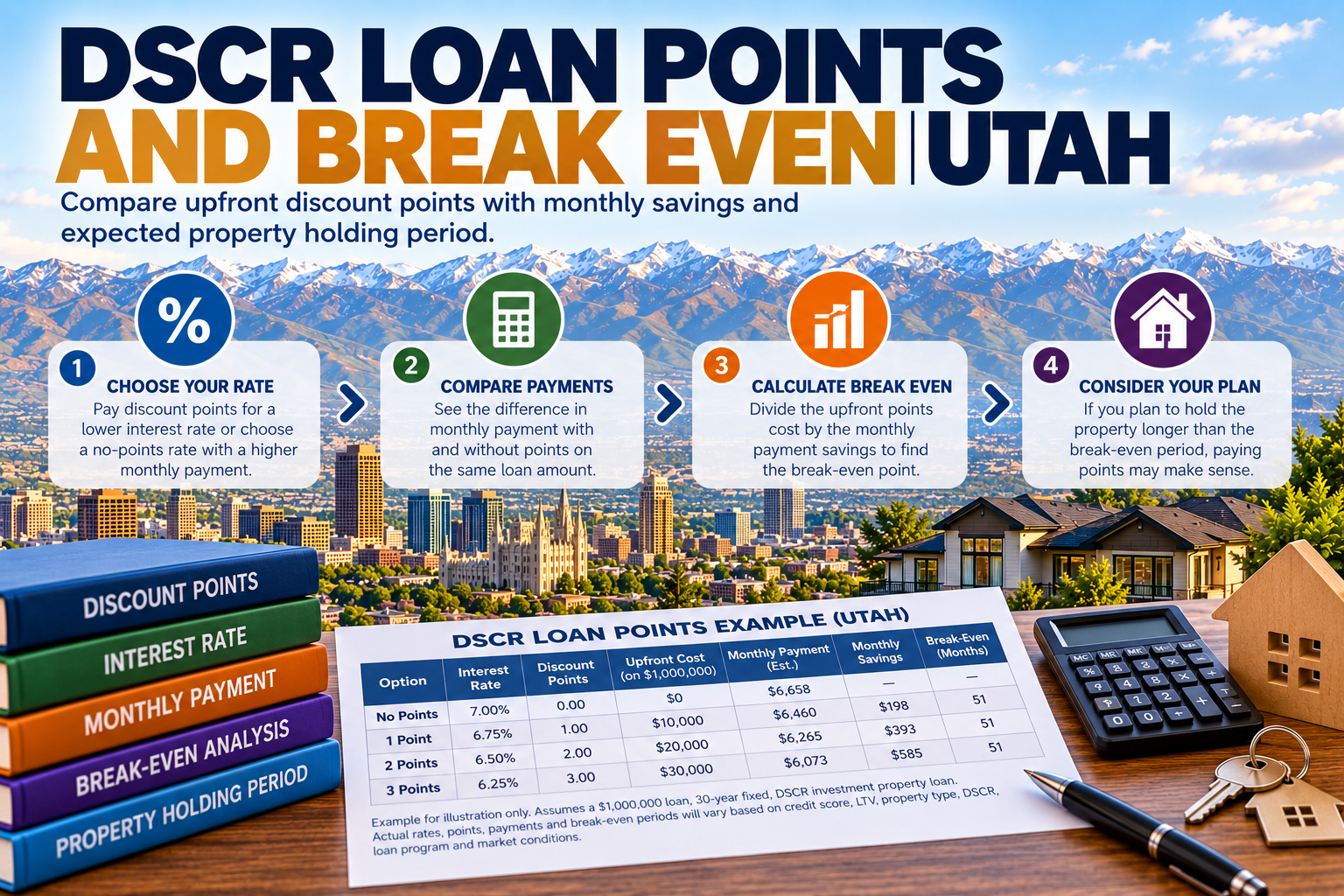
A mortgage point generally equals 1% of the loan amount.
On a $500,000 loan:
1 point = $5,000
On a $1,000,000 loan:
1 point = $10,000
Discount points may be paid to obtain a lower interest rate. However, the amount by which a point reduces the rate is not fixed.
It varies according to lender pricing, the loan program and market conditions.
That makes the correct question:
How long will it take for the monthly savings from the lower rate to recover the cost of the points?
Simple Points Break-Even Example
Suppose paying additional points costs $6,000 and reduces the mortgage payment by $100 per month.
$6,000 ÷ $100 = 60 months
The simple break-even period is approximately five years.
An investor planning to refinance or sell in two years may view that tradeoff differently from an investor planning to hold the property for ten years.
Compare:
- Interest rate
- Points
- Lender fees
- Monthly payment
- Expected holding period
- Potential refinance horizon
- Prepayment provisions
- Total cash required at closing
Do not choose a DSCR loan based solely on the lowest note rate.
Zero-Point vs. Lower-Rate DSCR Financing
A lower advertised rate may require additional upfront points.
A zero-point or lower-cost structure may carry a higher note rate but require less cash at closing.
Neither structure is automatically better.
Lower Rate + More Points
May make more sense when:
- The investor expects a long holding period
- Monthly cash flow is a priority
- The break-even period is reasonable
- The investor does not anticipate refinancing soon
Higher Rate + Lower Upfront Cost
May make more sense when:
- The expected holding period is shorter
- The investor expects to refinance
- Preserving liquidity is important
- The property is part of a short-term investment strategy
Ask for multiple pricing combinations when available.
Are Interest-Only DSCR Loans Available in Utah?
Potentially.
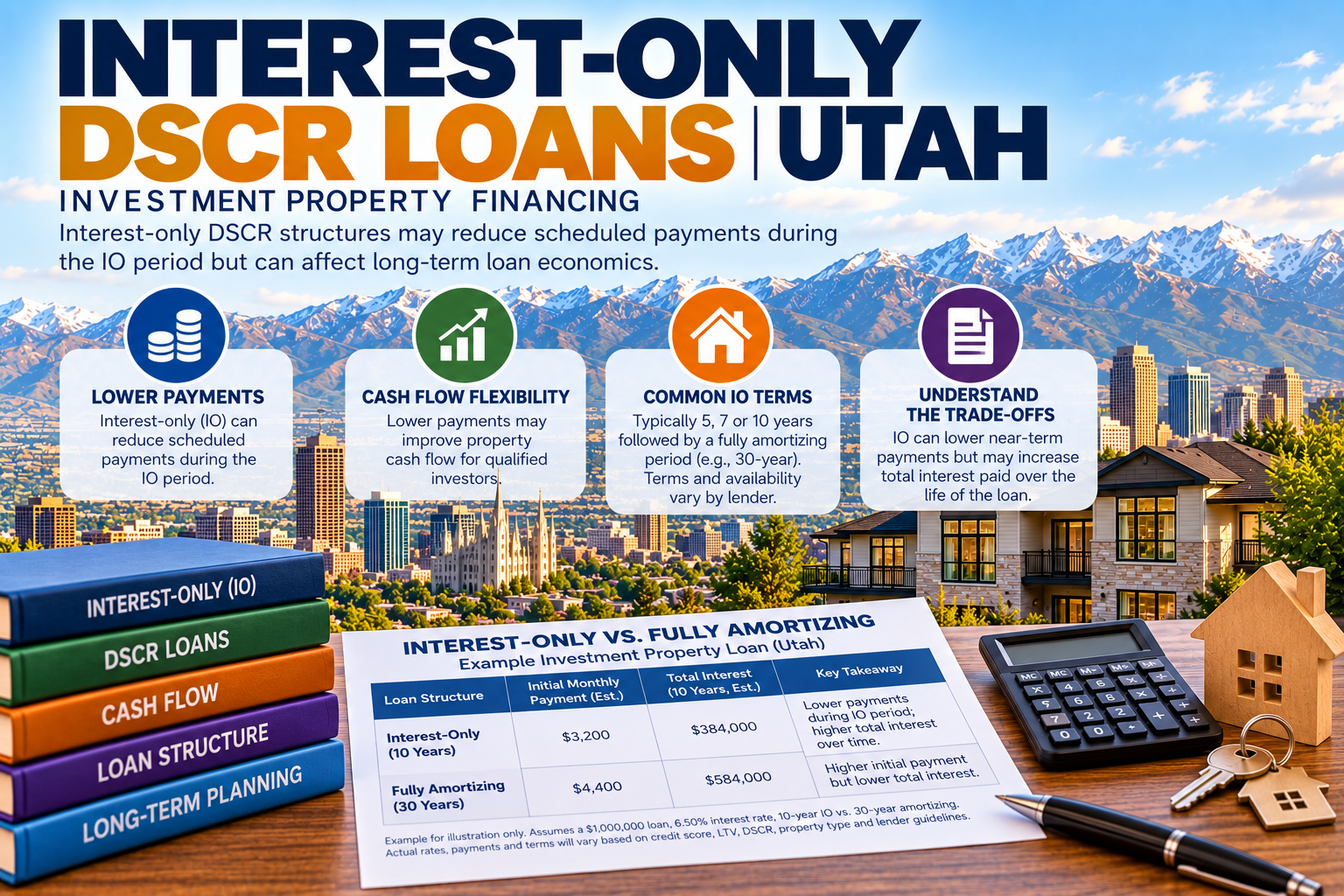
Some DSCR lenders offer qualifying interest-only (IO) structures.
During the interest-only period, the scheduled mortgage payment generally does not include scheduled principal amortization.
That can lower the required monthly mortgage payment during the IO period compared with an otherwise similar fully amortizing payment.
However, interest-only financing involves an important tradeoff:
The loan balance generally does not decline through scheduled principal payments during the interest-only period.
When the IO period ends, payments can increase because the remaining principal must be amortized over the remaining loan term, depending on the specific loan structure.
Interest-only availability, qualification, rate and pricing vary by lender.
Investors should compare both the short-term cash-flow benefit and the longer-term financing cost.
Can Interest-Only Financing Improve DSCR?
Potentially, depending on the lender's DSCR calculation methodology.
If a lender uses the qualifying interest-only payment when calculating the property's applicable debt obligation, a lower qualifying payment can produce a higher calculated DSCR.
However, lenders do not all calculate or qualify interest-only DSCR transactions in exactly the same manner.
Do not assume that selecting an IO loan automatically improves qualification.
The lender's current guidelines must be reviewed.
DSCR Prepayment Penalties and Rate Pricing
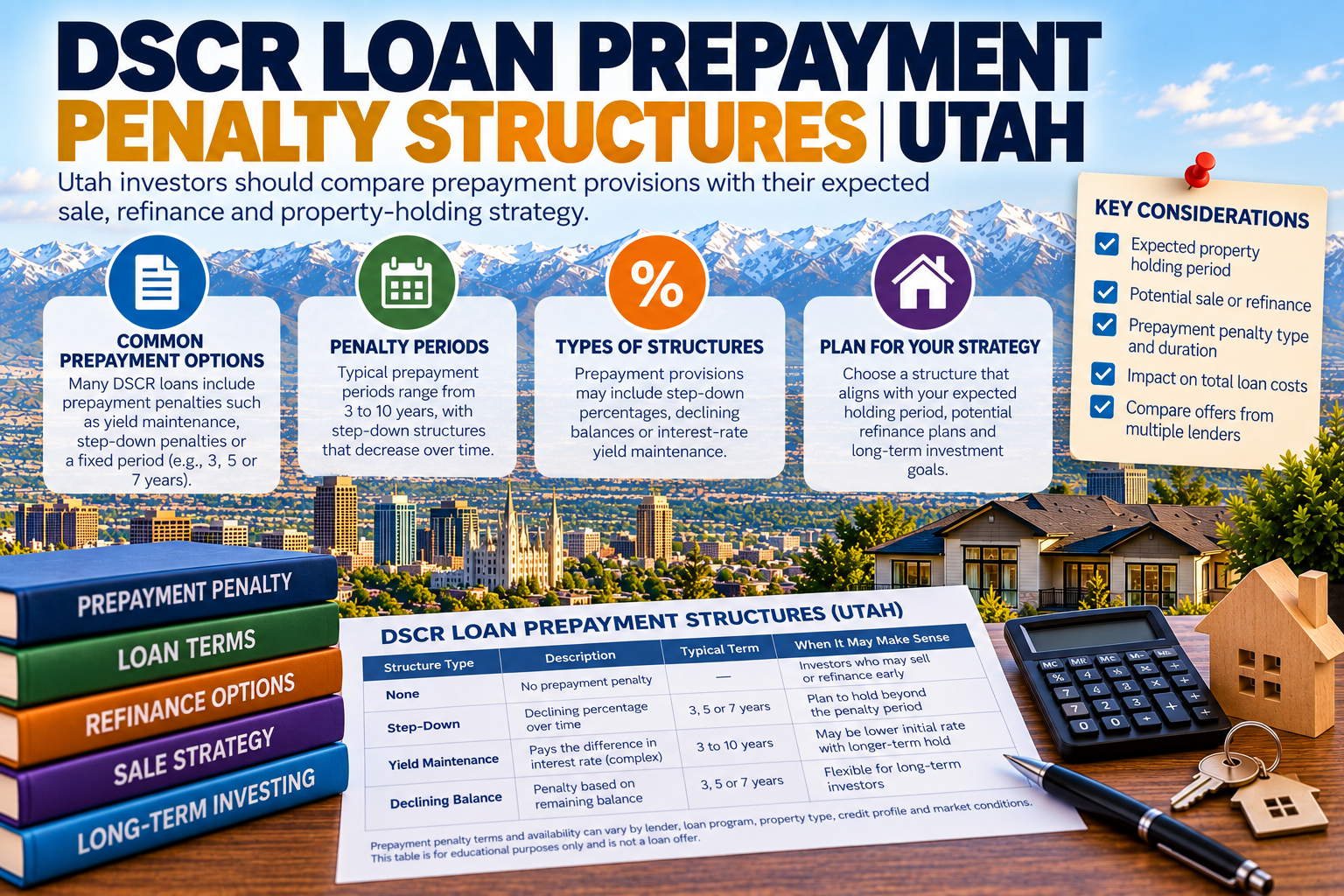
Prepayment structure can be a major part of DSCR loan pricing.
A prepayment penalty may require the borrower to pay an additional charge if the mortgage is paid off during a specified period, subject to the loan documents and applicable law.
Depending on the DSCR lender and transaction, structures can include:
- No prepayment penalty
- Shorter prepayment periods
- Longer prepayment periods
- Step-down structures
- Other lender-specific provisions
Availability and enforceability depend on the transaction, loan structure, property, borrower and applicable law.
Why Prepayment Terms Matter
A lender may offer different pricing depending on the prepayment structure.
That means a lower rate does not necessarily mean the loan is economically better for a particular investor.
An investor expecting to hold a rental for ten years may evaluate a prepayment provision differently from an investor who expects to:
- Sell quickly
- Complete renovations and exit
- Refinance when rates change
- Pull additional equity out later
- Reposition the property
- Move into another financing structure
Always compare the prepayment provision with your expected exit strategy.
DSCR Purchase vs. Cash-Out Refinance Rates
Purchase and cash-out DSCR transactions may receive different pricing.
Cash-out transactions can involve:
- Different maximum LTV
- Different seasoning requirements
- Different credit requirements
- Different reserve requirements
- Different pricing adjustments
- Limits on proceeds
- Additional underwriting requirements
If your goal is accessing equity from a Utah rental property, review the dedicated DSCR Cash-Out Refinance Utah guide.
What About No-Ratio DSCR Loan Pricing?
Some lenders may consider DSCR scenarios below 1.00 or specialized no-ratio structures.
Availability varies significantly.
A weaker property cash-flow ratio can affect:
- Rate
- Points
- LTV
- Minimum credit
- Reserves
- Property eligibility
- Loan amount
- Available lender choices
A low-DSCR or no-ratio scenario should therefore be evaluated separately from a stronger cash-flow property.
See No-Ratio DSCR Loans Utah for a more detailed explanation.
Short-Term Rental DSCR Loan Rates in Utah
Short-term rentals can require specialized underwriting.
This is particularly relevant in Utah markets with significant tourism and recreation activity, including portions of:
- Park City
- Deer Valley
- Heber City
- Midway
- Hideout
- Kamas
- St. George
- Washington County
- Southern Utah recreation markets
Lenders may have specific requirements regarding short-term-rental income documentation, appraisals and qualifying rents.
Financing eligibility does not establish that a property may legally operate as a short-term rental.
Investors should independently verify city and county regulations, zoning, licensing requirements, HOA restrictions and property-specific limitations.
For more information, see DSCR Loans for Short-Term Rentals Utah.
DSCR Rates in Salt Lake City and Salt Lake County
Salt Lake County contains a broad range of rental properties, from Salt Lake City residences to suburban investment properties in Murray, Millcreek, Holladay, Sandy, Draper, South Jordan, West Jordan, Riverton and surrounding communities.
The property's location alone does not establish the DSCR mortgage rate.
Pricing still depends on the complete scenario, including:
DSCR + credit + LTV + property + loan amount + transaction type + loan structure.
Investors in this market should also review DSCR Loans Salt Lake City Utah.
DSCR Rates in Park City and Summit County
Park City and surrounding Summit County markets can involve higher property values, vacation rentals, condominiums and specialized rental strategies.
Those characteristics make property-specific underwriting especially important.
An investor considering a property in Park City, Deer Valley, Canyons Village, Old Town, Empire Pass, Prospector or surrounding areas should determine:
- How qualifying rent will be calculated
- Whether the property type is eligible
- Whether short-term-rental income can be used
- The resulting DSCR
- Maximum available LTV
- Required reserves
- Available interest-only structures
- Applicable prepayment provisions
See DSCR Loans Park City Utah for local financing considerations.
DSCR Rates in St. George and Southern Utah
St. George and Washington County attract investors interested in long-term rentals, second-home markets and qualifying short-term-rental opportunities.
DSCR financing may be available for eligible investment properties in St. George, Washington, Ivins, Santa Clara, Hurricane and surrounding Southern Utah communities.
Investors relying on vacation-rental income should independently confirm local zoning and rental rules before purchasing.
See DSCR Loans St. George Utah for local information.
How to Compare Utah DSCR Loan Quotes
Do not compare only the headline interest rate.
Ask for the complete financing structure.
Compare:
- Interest rate
- APR or applicable cost disclosures
- Points
- Origination and lender charges
- Monthly payment
- Required cash to close
- LTV
- DSCR requirement
- Interest-only terms
- Prepayment provisions
- Reserve requirements
- Cash-out restrictions
- Property eligibility
- Loan term
- Expected break-even period
A slightly higher interest rate with materially lower upfront costs may sometimes fit an investor's strategy better than the lowest advertised rate.
Conversely, paying additional points for a lower rate may make sense for a long-term hold.
The numbers should determine the comparison.
What Information Is Needed for a DSCR Rate Quote?
To obtain useful DSCR pricing, be prepared to provide:
- Property address
- Purchase price or estimated value
- Requested loan amount
- Estimated credit score
- Expected or current monthly rent
- Existing lease information, when applicable
- Purchase, refinance or cash-out
- Property type
- Number of units
- Long-term or short-term rental strategy
- Investor experience
- Desired fixed or interest-only structure
- Entity ownership information, when applicable
- Desired prepayment structure
With this information, a broker can compare programs more accurately.
Why Compare Multiple DSCR Wholesale Lenders?
DSCR programs are not standardized across every lender.
One lender may be more competitive for strong-DSCR, high-credit transactions.
Another may be better for:
- Higher LTV
- Lower DSCR
- Lower credit
- Cash-out
- Short-term rentals
- Condominiums
- First-time investors
- LLC ownership
- Larger loan amounts
- Interest-only financing
- No-ratio scenarios
Comparing wholesale programs can therefore matter just as much as watching the overall mortgage market.
Daniel Paris at UtahLowRate.com helps Utah real estate investors compare available DSCR programs based on the actual property and investment strategy.
DSCR Loan Rates vs. Conventional Investment Property Rates
DSCR and conventional investment-property loans use different qualification methods.
A conventional investment-property mortgage typically evaluates traditional borrower income, employment, debts and debt-to-income requirements.
A DSCR loan focuses heavily on the rental property's qualifying cash flow.
That difference can make DSCR financing useful for investors with:
- Multiple rental properties
- Complex tax returns
- Significant business deductions
- Self-employment income
- Multiple LLCs
- Substantial depreciation
- Portfolio income
The lowest nominal rate is not necessarily the most useful financing option if the borrower cannot qualify under that program's income methodology.
Compare qualification, rate, points, closing costs, payment and long-term economics together.
Frequently Asked Questions About DSCR Loan Rates in Utah
What are DSCR loan rates in Utah?
There is no single Utah DSCR rate. Pricing depends on current markets plus the borrower's credit, property DSCR, LTV, loan amount, transaction type, property characteristics, points and loan structure.
Does a higher DSCR lower my rate?
It may improve pricing with some lenders because stronger rental coverage can represent a stronger overall risk profile. Exact DSCR pricing tiers vary by lender.
Does putting more money down improve a DSCR rate?
It can. A lower LTV reduces leverage and may improve pricing or expand available programs. The actual benefit should be compared with the investor's need to preserve cash.
Can I pay points to lower a DSCR mortgage rate?
Potentially. Discount points can reduce a mortgage rate, but the amount of rate reduction per point varies. Calculate the break-even period before deciding whether additional points make financial sense.
Are interest-only DSCR loans available in Utah?
Some DSCR programs offer interest-only structures for qualified transactions. Availability, rates, qualification and IO periods vary by lender.
Do DSCR loans have prepayment penalties?
Some DSCR programs may include prepayment provisions where permitted, while other structures may offer shorter terms or no prepayment penalty. Review the exact provision before closing.
Can I get a DSCR loan if the ratio is below 1.00?
Potentially. Some lenders may consider lower-DSCR or no-ratio scenarios. These loans may involve different credit, equity, reserves, pricing or property requirements.
Are DSCR cash-out refinance rates different?
They can be. Cash-out transactions may have different pricing, LTV limits, seasoning rules and underwriting requirements than purchase or rate-and-term transactions.
Related Utah DSCR Loan Resources
Continue researching the Utah DSCR loan cluster:
DSCR Mortgage Loans Utah — Complete overview of Utah rental-property DSCR financing.
DSCR Loan Requirements Utah — Credit, DSCR, reserves, documentation and property requirements.
DSCR Loan Calculator Utah — Calculate DSCR using qualifying rent and property obligations.
DSCR Loan FAQ Utah — Answers to common Utah investor questions.
DSCR Cash-Out Refinance Utah — Access rental-property equity using qualifying DSCR financing.
No-Ratio DSCR Loans Utah — Learn about programs that may consider DSCR below 1.00.
DSCR Loans for Short-Term Rentals Utah — Financing considerations for qualifying vacation rentals.
DSCR Loan Credit Score Utah — How credit can affect eligibility, LTV and pricing.
DSCR Loan Down Payment Utah — Compare equity requirements.
DSCR Loan LTV Utah — Understand leverage limits for purchases and refinances.
Get a Current Utah DSCR Loan Rate Quote
DSCR pricing can change with mortgage markets, wholesale lender pricing and the characteristics of the individual transaction.
Instead of asking only, “What is today's DSCR rate?”, compare the rate available for your actual investment property.
Provide the property value, requested loan amount, estimated rent, credit score and transaction type, and Daniel Paris can evaluate available DSCR structures.
Daniel Paris
Utah Mortgage Broker
UtahLowRate.com
NMLS #243976
27+ Years of Mortgage Lending Experience
Call: 801-604-4949
Ask about: DSCR Loans • Rental Property Loans • DSCR Cash-Out Refinancing • Short-Term Rental Financing • Interest-Only DSCR Loans • No-Ratio DSCR Programs • Jumbo Investment Property Financing
Important: Loan programs, interest rates, APRs, points, lender fees, DSCR calculations, credit requirements, LTV limits, reserve requirements, interest-only features, prepayment provisions and property eligibility can change. All financing is subject to applicable lender/investor guidelines, underwriting, property eligibility and borrower qualification. This page is for educational purposes and is not a commitment to lend.
Related guides: Utah DSCR loan guide · DSCR loan requirements · DSCR calculation guide · DSCR questions and answers ·

