
Content updated: September 29, 2026
DSCR loan requirements Utah investors need to meet can vary by lender, property and transaction. In general, lenders review the rental property's cash flow, DSCR, credit score, loan-to-value ratio, down payment or equity, cash reserves and property eligibility. Many DSCR programs qualify the investment property mainly from rental income instead of the borrower's traditional employment income.
Check My DSCR Scenario or call 801-604-4949.
Quick Answer: DSCR loan requirements in Utah generally include an eligible investment property, acceptable rental income, sufficient credit and equity, an appraisal, cash reserves and required property documents. The minimum DSCR, credit score, LTV and reserve requirement can vary by lender. Some programs may also allow DSCR below 1.00, LLC ownership, short-term rentals and interest-only payments.
New to this type of financing? Start with our complete DSCR Mortgage Loans in Utah guide.
Utah DSCR Loan Requirements at a Glance
Loan percentages, credit examples and payment calculations are illustrations unless linked to an identified current program. They do not establish available terms or approval.
| Requirement | What Utah Investors Should Know |
|---|---|
| Property use | Generally a non-owner-occupied investment property |
| Main qualification | Rental-property cash flow |
| DSCR | Minimum varies by lender and program |
| Personal DTI | Often not the primary qualification method |
| Credit score | Minimum and pricing tiers vary |
| Down payment | Depends on credit, DSCR, property and program |
| LTV | Varies by transaction and lender |
| Cash reserves | Commonly required |
| Appraisal | Generally required |
| Rental income | Must meet the lender's documentation rules |
| LLC ownership | Available through many DSCR programs |
| Short-term rental | May be eligible |
| Purchase | Available |
| Refinance | Available through eligible programs |
| Cash-out | Available subject to separate requirements |
| Interest-only | Available through certain programs |
Important: There is no single set of DSCR loan requirements that applies to every lender. Program guidelines and pricing can change.
What Is a DSCR Loan?
A DSCR loan is an investment-property mortgage.
DSCR stands for Debt Service Coverage Ratio.
Instead of qualifying mainly from salary, W-2 income or personal tax-return income, many DSCR programs focus on the rental property's ability to support its housing expense.
This can make DSCR financing useful for:
- Real estate investors
- Self-employed investors
- Business owners
- Investors with several rentals
- Investors with large tax deductions
- LLC-owned properties
- Long-term rental properties
- Eligible short-term rentals
DSCR loans are generally used for investment properties rather than owner-occupied homes.
For a broader explanation, visit DSCR Mortgage Loans in Utah.
How Do DSCR Loan Requirements Work?

A lender usually looks at three areas.
1. Rental-property cash flow
The lender determines the property's qualifying monthly rent.
That income is compared with the property obligation required by the lender's DSCR calculation.
2. The property
The lender may review:
- Property value
- Property type
- Condition
- Rental use
- Appraisal
- Insurance
- Title
- HOA information when applicable
3. The investor and transaction
The lender may also review:
- Credit score
- Loan amount
- LTV
- Down payment or equity
- Cash reserves
- Housing history
- Investor experience
- LLC or entity structure
- Purchase versus refinance
- Cash-out request
A strong DSCR does not automatically guarantee approval. The complete loan still needs to meet the lender's guidelines.
How Is DSCR Calculated?
A simple way to understand DSCR is:
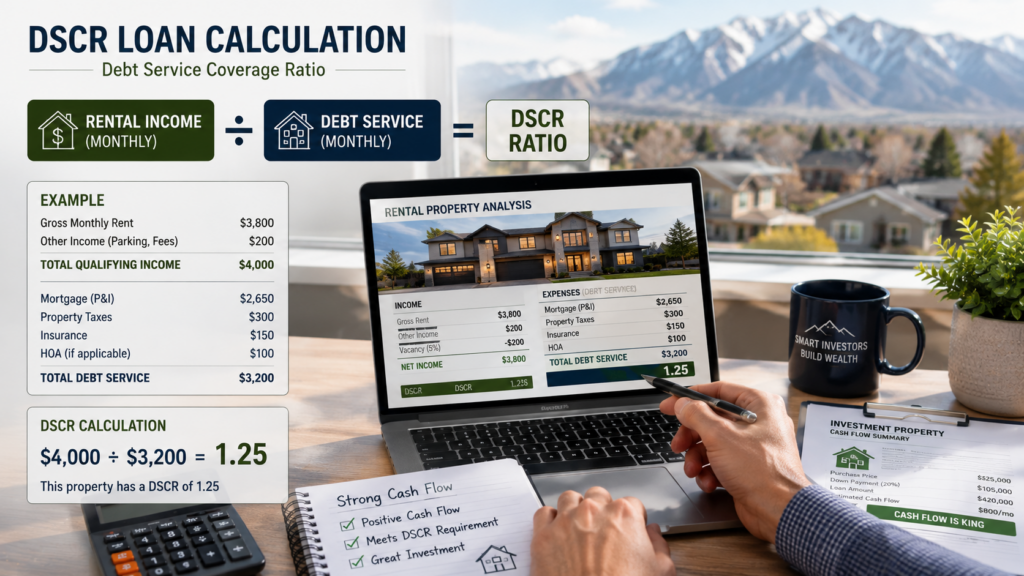
DSCR = Qualifying Monthly Rental Income ÷ Qualifying Monthly Property Obligation
The exact expenses and income used can vary by lender.
Example: 1.25 DSCR
Monthly qualifying rent: $4,000
Monthly qualifying property obligation: $3,200
$4,000 ÷ $3,200 = 1.25 DSCR
In this example, qualifying rent equals 125% of the property obligation used in the calculation.
Example: 1.00 DSCR
Monthly qualifying rent: $2,900
Monthly qualifying property obligation: $2,900
$2,900 ÷ $2,900 = 1.00 DSCR
The qualifying rent and property obligation are equal.
Example: 0.90 DSCR
Monthly qualifying rent: $2,900
Monthly qualifying property obligation: $3,223.75
$2,900 ÷ $3,223.75 ≈ 0.90 DSCR
The property has less qualifying rent than the obligation used in this example.
That does not mean every financing option disappears.
Certain programs may consider DSCR below 1.00 or no-ratio scenarios. These programs can have different credit, equity and pricing requirements.
Learn more on our No-Ratio DSCR Loans Utah page.
Want to run your own numbers? Use the DSCR Loan Calculator Utah.
What DSCR Ratio Is Required in Utah?
There is no universal minimum DSCR for every Utah investment-property lender.
Programs may treat these ranges differently:
- Above 1.25
- 1.00 to 1.24
- Exactly 1.00
- Below 1.00
- No-ratio scenarios
The required ratio may also depend on the rest of the file.
For example, lenders can consider:
- Credit
- LTV
- Loan amount
- Property type
- Reserves
- Investor experience
- Purchase versus refinance
- Cash-out
- Short-term rental use
A property with lower cash flow may require more equity or receive different pricing.
This is why DSCR loan requirements in Utah should be reviewed as a complete package, not as a single ratio.
What Credit Score Is Required for a DSCR Loan in Utah?
There is no single credit-score minimum across the entire DSCR market.
Each lender sets its own guidelines.
Credit can affect more than approval. It may also affect:
- Maximum LTV
- Required down payment
- Interest rate
- Points
- Cash reserves
- Cash-out eligibility
- Loan amount
- Interest-only availability
For example, two investors buying the same rental property could receive different program options because their credit profiles differ.
Read DSCR Loan Credit Score Utah for a detailed explanation.
How Much Down Payment Does a Utah DSCR Loan Require?
DSCR loans are investment-property loans. They generally require more equity than low-down-payment owner-occupied mortgages.
Maximum financing and required equity depend on the selected lender, credit, loan amount, property, documentation and transaction. Request a current program review before relying on an LTV percentage.
That does not mean every DSCR loan requires exactly 20% down.
The actual requirement may depend on:
- Credit score
- DSCR
- Loan amount
- Property type
- Investor experience
- Short-term rental use
- Interest-only structure
- Lender guidelines
See DSCR Loan Down Payment Utah for a deeper explanation.
What LTV Is Allowed on a Utah DSCR Loan?
LTV means loan-to-value ratio.
Suppose an investment property has an applicable value of $500,000 and the loan is $400,000.
$400,000 ÷ $500,000 = 80% LTV
Maximum LTV can differ for:
- Purchases
- Rate-and-term refinances
- Cash-out refinances
- Lower-credit borrowers
- Lower-DSCR properties
- Condominiums
- Multi-unit properties
- Short-term rentals
- Larger loan amounts
- Interest-only loans
LTV, credit and DSCR often work together.
For more information, visit DSCR Loan LTV Utah.
Are Cash Reserves Required for a DSCR Loan?

Many lenders require post-closing reserves.
Reserves are eligible assets the investor still has after closing.
A lender might express the requirement as a certain number of months of the property's payment.
Reserve requirements may depend on:
- Credit
- Loan amount
- DSCR
- LTV
- Number of financed properties
- Property type
- Investor experience
- Cash-out amount
The type of asset a lender accepts can also vary.
Confirm the reserve requirement before moving, transferring or liquidating assets.
Do DSCR Loans Require Tax Returns?
Many DSCR programs do not use personal tax returns to establish qualifying income.
Instead, underwriting focuses mainly on the rental property's qualifying cash flow.
This may help investors whose tax returns include:
- Depreciation
- Business expenses
- Schedule E properties
- K-1 income
- Partnerships
- Multiple LLCs
- Multiple businesses
However, a DSCR loan is not necessarily a no-document loan.
A lender can still require documentation for credit, assets, reserves, identity, property, appraisal, insurance, title and entity ownership.
What Documents Are Needed for a Utah DSCR Loan?
The exact list varies by lender.
Common items can include:
Investor documents
- Identification
- Credit authorization
- Bank or asset statements
- Reserve documentation
- Housing or mortgage history when required
Property documents
- Purchase agreement for a purchase
- Existing lease when applicable
- Appraisal
- Market-rent documentation
- Current mortgage statement for a refinance
- Insurance
- HOA information when applicable
LLC documents
An entity transaction may require items such as:
- Articles of Organization
- Operating Agreement
- EIN documentation
- Ownership information
- Authorized signer information
- Good-standing documentation when required
Planning to use an entity? Read DSCR Loans for LLCs Utah.
How Is Rental Income Documented?
The lender decides which rental income can be used.
Depending on the program and transaction, documentation might include:
- Existing lease
- Market-rent analysis
- Appraisal rent schedule
- Appraiser-supported rent
- Eligible short-term rental information
- Other lender-approved documentation
Do not assume an online rental estimate or seller projection will automatically become qualifying income.
For comparison, conventional agency underwriting uses its own detailed rental-income rules. Fannie Mae currently requires specific documentation for subject investment properties and uses different calculations depending on the transaction and circumstances. Those conventional requirements are not DSCR lender guidelines.
Can Short-Term Rentals Qualify for DSCR Loans in Utah?
Certain DSCR programs may finance eligible short-term rental properties.
This can be important in markets such as:
- Park City
- Deer Valley
- Canyons Village
- Heber City
- Midway
- St. George
- Washington
- Ivins
- Hurricane
But there are two separate questions:
Can the property qualify for the mortgage?
And:
Can the property legally operate as a short-term rental?
Investors should independently verify:
- Zoning
- Licensing
- City rules
- County rules
- HOA restrictions
- Subdivision restrictions
- Property-specific restrictions
This distinction also appears in conventional agency guidance. Fannie Mae's September 2026 short-term-rental rules require an eligible property to be legally permitted to operate as a short-term rental, including applicable local registration and licensing. Again, that is conventional guidance rather than a DSCR underwriting rule, but it illustrates why legal STR status should be verified separately.
See DSCR Loans for Short-Term Rentals Utah for more information.
Can an LLC Get a DSCR Loan in Utah?
Many DSCR programs permit eligible business entities to hold title to an investment property.
That can include certain LLCs.
However, using an LLC does not necessarily eliminate individual requirements.
Owners or guarantors may still need to meet requirements for:
- Credit
- Assets
- Reserves
- Ownership
- Personal guarantees
An investor should also speak with qualified legal and tax professionals about the right ownership structure.
Mortgage eligibility alone should not determine how you own real estate.
Read DSCR Loans for LLCs Utah.
Can First-Time Investors Get DSCR Loans?
Potentially.
Some lenders allow first-time real estate investors. Others may have different requirements.
A lender may look more closely at:
- Credit
- Reserves
- Housing history
- DSCR
- LTV
- Property type
- Loan amount
Tell your mortgage broker if this will be your first investment property. That makes it easier to identify programs that fit the transaction.
What Property Types Can Qualify?
Depending on the lender, DSCR financing may be available for certain:
- Single-family rental homes
- Condominiums
- Townhomes
- Duplexes
- Triplexes
- Fourplexes
- Long-term rentals
- Eligible short-term rentals
Unusual properties can have additional restrictions.
Verify property eligibility before assuming a specific program will work.
DSCR Purchase Loan Requirements in Utah
Buying an investment property?
A DSCR purchase review can include:
- Purchase price
- Appraised value
- Qualifying rent
- DSCR
- Credit
- Down payment
- Reserves
- Property type
- LLC or ownership structure
- Insurance and title
See DSCR Purchase Loans Utah for purchase-specific information.
DSCR Refinance Requirements in Utah
Investors can also use DSCR financing to refinance an existing rental property.
The lender may review:
- Current property value
- Existing mortgage balance
- Rental income
- Proposed payment
- DSCR
- Credit
- LTV
- Reserves
- Property eligibility
Learn more at DSCR Refinance Loans Utah.
DSCR Cash-Out Refinance Requirements
Cash-out refinancing allows an investor to borrow against property equity, subject to lender guidelines.
A lender may review:
- Property value
- Existing liens
- Requested cash out
- Resulting LTV
- DSCR
- Credit
- Reserves
- Ownership history
- Seasoning requirements
Cash-out limits can differ from purchase and rate-and-term refinance limits.
Visit DSCR Cash-Out Refinance Utah.
Are Interest-Only DSCR Loans Available?
Some DSCR lenders offer interest-only payment structures.
During the interest-only period, the scheduled payment generally does not include principal amortization.
Investors should understand:
- Length of the IO period
- Interest rate
- Payment during the IO period
- Payment after the IO period
- Remaining amortization
- Prepayment provisions
- Total borrowing cost
See Interest-Only DSCR Loans Utah.
DSCR vs. Conventional Investment Loans
DSCR and conventional investment-property loans use different qualification methods.
| Feature | DSCR Loan | Conventional Investment Loan |
|---|---|---|
| Main income approach | Property cash flow | Borrower qualification plus eligible rental income |
| Personal DTI | Often not primary method | Generally part of qualification |
| Tax returns | Often not used to establish qualifying income | May be required depending on circumstances |
| Rental-income rules | Lender/program specific | Agency guidelines when applicable |
| LLC closing | Available through many DSCR programs | Agency/title rules differ |
| Investment property | Yes | Yes |
| DSCR test | Central to DSCR underwriting | Not the same qualification framework |
Fannie Mae's current conventional guidance, for example, includes specific rules for documenting and calculating rental income from investment properties. Its September 2026 guidance addresses appraisal rent schedules, leases, tax returns, PITIA and borrower property-management experience.
Read DSCR vs Conventional Investment Loan Utah for a complete comparison.
DSCR Loan Requirements Across Utah
The basic concept is statewide. The property numbers are not.
Salt Lake County
Investors may finance eligible rentals in Salt Lake City, Holladay, Millcreek, Murray, Cottonwood Heights, Sandy, Draper, South Jordan, West Jordan, Riverton and Herriman.
Property price, rent, taxes, insurance and HOA dues can affect DSCR.
Utah County
Investment markets include Provo, Orem, Lehi, Alpine, Highland, American Fork, Pleasant Grove, Saratoga Springs, Eagle Mountain and Spanish Fork.
Park City and the Wasatch Back
Park City, Deer Valley, Canyons Village, Old Town, Kimball Junction, Heber City, Midway, Jordanelle, Hideout and Kamas can have very different property values and rental patterns.
Investors considering short-term rentals should verify local rental rules before relying on projected STR income.
St. George and Southern Utah
Investors may also consider St. George, Washington, Ivins, Santa Clara and Hurricane.
Again, confirm property-specific short-term-rental rules when applicable.
How to Qualify for a DSCR Loan in Utah
Step 1 — Identify the property
Have the property address, purchase price or estimated value ready.
Step 2 — Determine the transaction
Is this a purchase, refinance or cash-out refinance?
Step 3 — Estimate the rent
Gather the existing rent and any available market-rent information.
Step 4 — Calculate the DSCR
Use our DSCR Loan Calculator Utah.
Step 5 — Review credit
See how your credit profile could affect program options at DSCR Loan Credit Score Utah.
Step 6 — Determine your equity
Review DSCR Loan Down Payment Utah and DSCR Loan LTV Utah.
Step 7 — Verify reserves
Determine how much eligible liquidity will remain after closing.
Step 8 — Compare complete loan terms
Do not compare DSCR loans by rate alone.
Review:
- Interest rate
- Points
- Lender fees
- DSCR requirement
- LTV
- Reserves
- Interest-only terms
- Prepayment provisions
- Property eligibility
- Cash-out rules
For pricing information, visit DSCR Loan Rates Utah.
Frequently Asked Questions About DSCR Loan Requirements in Utah
What is the minimum DSCR for a Utah DSCR loan?
There is no universal minimum for every lender. Some programs require a specific DSCR, while others may consider ratios below 1.00 or no-ratio scenarios.
Can I qualify for a DSCR loan without tax returns?
Many DSCR programs do not use personal tax returns to establish qualifying income. The lender may still require credit, asset, reserve, property and entity documents.
Is 20% down required for a Utah DSCR loan?
Maximum financing and required equity depend on the selected lender, credit, loan amount, property, documentation and transaction. Request a current program review before relying on an LTV percentage.
Can I get a DSCR loan below 1.00?
Potentially. Some lenders offer programs for below-1.00 or no-ratio properties. Those programs may have different LTV, credit, reserve and pricing requirements.
Can an LLC get a DSCR loan?
Many DSCR programs permit eligible LLC ownership. Entity and guarantor requirements vary by lender.
Can a short-term rental qualify?
Certain programs may finance eligible short-term rentals. Investors should separately verify zoning, licensing, HOA rules and other restrictions.
Can a first-time investor qualify?
Potentially. Some programs accept first-time investors, while others impose additional requirements.
Utah DSCR Loan Resource Center
This requirements guide is part of the UtahLowRate.com DSCR loan cluster.
Main Guide:
DSCR Mortgage Loans in Utah
Qualification Guides:
DSCR Loan Credit Score Utah
DSCR Loan Down Payment Utah
DSCR Loan LTV Utah
No-Ratio DSCR Loans Utah
DSCR Loans for LLCs Utah
Pricing and Calculation Guides:
DSCR Loan Rates Utah
DSCR Loan Calculator Utah
Interest-Only DSCR Loans Utah
Purchase and Refinance Guides:
DSCR Purchase Loans Utah
DSCR Refinance Loans Utah
DSCR Cash-Out Refinance Utah
Investor Guides:
DSCR Loans for Short-Term Rentals Utah
DSCR vs Conventional Investment Loan Utah
DSCR Loan FAQ Utah
Compare Your Utah DSCR Loan Options
The same Utah rental property can receive different results from different DSCR lenders.
Credit, DSCR, LTV, reserves, property type, loan amount and transaction type can all affect the available options.
UtahLowRate.com can review the property and compare available wholesale DSCR programs.
Daniel Paris
Utah Mortgage Broker
UtahLowRate.com
801-604-4949
Have These Numbers Ready
- Property address
- Purchase price or estimated value
- Monthly rent
- Estimated credit score
- Requested loan amount
- Purchase, refinance or cash-out
- Long-term or short-term rental
- Individual or LLC ownership
CTA: Check My DSCR Scenario
Important Disclosure
Loan programs, interest rates, pricing, credit requirements, DSCR requirements, LTV limits, reserve requirements, property eligibility and underwriting guidelines are subject to change and lender approval. Examples are for educational purposes and are not a commitment to lend or a guarantee of approval.
Related guides: Utah DSCR loan guide · DSCR calculation guide · DSCR loan rates · DSCR questions and answers ·

