
Content updated: September 29, 2026
Purchase, Refinance & Cash-Out Guide
A DSCR loan LTV in Utah can affect how much an investor may borrow, how much equity or down payment may be required, the interest rate and points offered, and whether a rental-property transaction fits a particular lender's guidelines.
Check My DSCR Scenario or call 801-604-4949.
For Utah rental-property investors, loan-to-value should not be viewed by itself. Lenders may evaluate LTV, DSCR, credit score, property type, loan amount, reserves, rental income and transaction type together.
That means the maximum LTV available for one Utah investment property may be different from the maximum available for another.
If you are evaluating a rental property, start with our DSCR Mortgage Loans in Utah guide, then use this page to understand how leverage and equity can affect your financing.
Quick Answer: What Is DSCR Loan LTV in Utah?
DSCR loan LTV in Utah is the percentage of an investment property's value being financed with the mortgage. On a purchase, LTV generally compares the loan amount with the applicable property value or purchase-price basis used by the lender. On a refinance, it compares the new loan amount with the lender's accepted property value.
Lower LTV means the investor has more equity in the property. Higher LTV means the lender is financing a larger percentage of the property's value.
Maximum LTV varies by lender and can change based on DSCR, credit, property type, loan size and whether the transaction is a purchase, rate-and-term refinance or cash-out refinance.
DSCR Loan LTV Utah: Key Facts

Loan percentages, credit examples and payment calculations are illustrations unless linked to an identified current program. They do not establish available terms or approval.
| Factor | Why It Matters |
|---|---|
| LTV | Measures the loan relative to property value |
| Purchase | Determines required investor equity/down payment |
| Rate-and-term refinance | Determines how much existing debt may be refinanced |
| Cash-out refinance | Determines available leverage and potential equity access |
| DSCR | Measures qualifying rent relative to the applicable property debt obligation |
| Credit score | May affect maximum LTV, eligibility and pricing |
| Property type | Condos, 2–4 units and other properties may receive different treatment |
| Short-term rental | Additional income/property requirements may apply |
| Loan amount | Larger balances can have different LTV limits |
| Reserves | Higher-risk transactions may require additional liquidity |
| Pricing | Higher leverage may result in different rates, points or adjustments |
| Lender | Each DSCR investor can have a different LTV matrix |
Important: There is no single universal maximum DSCR LTV that applies to every Utah borrower, property or lender. Program guidelines and pricing can change.
What Does LTV Mean on a Utah DSCR Loan?
LTV means loan-to-value.
The basic formula is:
LTV = Loan Amount ÷ Property Value × 100
For example, assume an eligible Utah rental property is valued at $750,000 and the proposed DSCR mortgage is $562,500.
$562,500 ÷ $750,000 = 75% LTV
The remaining 25% represents equity in this simplified example.
For a purchase transaction, lenders may apply additional rules concerning the purchase price, appraised value and the value used to determine maximum financing.
Why does DSCR loan LTV matter?
LTV measures lender exposure.
A lower LTV generally means the investor has more of their own equity in the property. A higher LTV means the lender is financing more of the property's value.
Because of that difference, LTV can affect:
- Eligibility
- Interest rate
- Discount points
- Required credit score
- Required DSCR
- Reserve requirements
- Maximum loan amount
- Cash-out availability
- Property eligibility
Investors should therefore compare the complete financing structure rather than simply asking for the highest possible LTV.
DSCR Purchase LTV in Utah
When buying an investment property with a DSCR mortgage, purchase LTV determines how much of the transaction can potentially be financed.
Consider a simplified example:
Purchase price: $800,000
Loan amount: $600,000
LTV: 75%
Investor equity: $200,000 before closing costs and other required funds
An investor seeking more leverage may prefer a higher LTV because it reduces the initial equity requirement.
But maximum leverage is not necessarily the best financing structure.
Higher LTV may affect:
- Mortgage pricing
- Required DSCR
- Credit requirements
- Cash reserves
- Available loan programs
- Monthly debt service
- Property cash flow
This creates an important relationship between LTV and DSCR.
Increasing the loan amount can increase the mortgage payment. If the qualifying rental income stays the same, the property's DSCR can decline.
Learn more about the equity side of the transaction in our DSCR Loan Down Payment Utah guide.
How LTV Can Change the DSCR
LTV and DSCR measure different things, but they can interact.
LTV measures leverage.
DSCR measures property cash-flow coverage.
Suppose two investors are evaluating the same Utah rental property.
One uses a smaller loan and makes a larger down payment. The other uses a larger loan.
If the larger mortgage creates a higher qualifying monthly debt obligation while rent remains unchanged, the property's calculated DSCR may be lower.
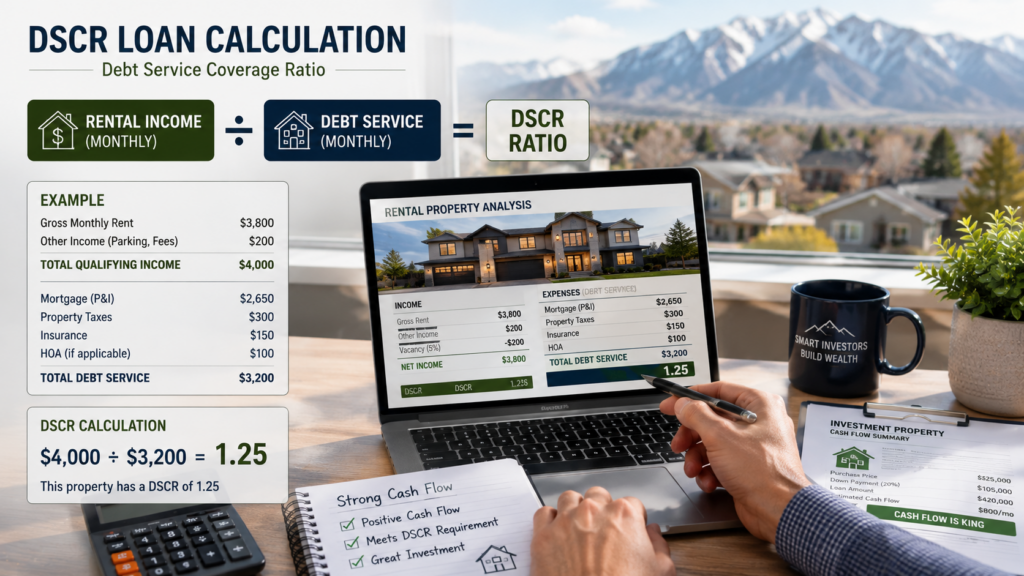
Example
Assume qualifying monthly rent is:
$4,000
Scenario A has a qualifying monthly property obligation of:
$3,000
DSCR:
$4,000 ÷ $3,000 = 1.33
Now assume a larger loan increases the qualifying obligation to:
$3,400
DSCR:
$4,000 ÷ $3,400 = 1.18
The rent did not change.
The financing structure did.
This is why Utah investors should evaluate LTV and DSCR together.
Use our DSCR Loan Calculator Utah page to test different rent and payment scenarios.
DSCR Loan LTV and Credit Score in Utah
Credit can also interact with maximum leverage.
A lender may offer one maximum LTV at a stronger credit tier and a lower maximum LTV at another credit tier.
For example, an investor with stronger credit may have access to financing structures that are unavailable to a borrower with a lower score.
Credit can also affect:
- Rate
- Points
- Maximum loan amount
- Required reserves
- Cash-out eligibility
- Interest-only eligibility
- Overall program selection
This does not mean a particular credit score automatically qualifies for a particular LTV.
The complete transaction matters.
See DSCR Loan Credit Score Utah for a detailed explanation of how credit tiers can interact with LTV and pricing.
DSCR Rate-and-Term Refinance LTV in Utah
A DSCR rate-and-term refinance can allow a Utah rental-property owner to replace existing financing while qualification remains focused primarily on the property's rental-income characteristics and applicable program requirements.
Potential reasons include:
- Replacing short-term financing
- Refinancing an adjustable-rate loan
- Changing the loan term
- Restructuring investment debt
- Moving into a fixed-rate structure
- Changing an interest-only structure
- Improving the property's financing strategy
Maximum refinance LTV can differ from purchase LTV.
The lender may also review:
- Property value
- Existing liens
- Ownership history
- Loan seasoning
- DSCR
- Credit
- Reserves
- Property type
- Loan amount
Investors should not assume that a lender offering a particular purchase LTV will automatically allow the same leverage on a refinance.
DSCR Cash-Out Refinance LTV in Utah

A DSCR cash-out refinance may allow a qualified Utah investor to convert part of the equity in a rental property into available funds.
Cash-out transactions often receive different treatment from purchases and rate-and-term refinances.
For example, assume a qualifying rental property is valued at:
$1,000,000
If a particular loan structure allowed a new loan of $700,000, that would represent:
70% LTV
If the existing mortgage payoff were $450,000, the difference between the new loan and existing payoff would be $250,000 before applicable closing costs, payoff adjustments and other transaction expenses.
That does not mean the borrower automatically receives $250,000.
Actual proceeds depend on the lender's maximum LTV, existing liens, closing costs, prepaid items, seasoning requirements and other underwriting conditions.
Read DSCR Cash-Out Refinance Utah before estimating available proceeds.
Why Is Cash-Out DSCR LTV Sometimes Lower?
Cash-out financing can represent greater lender risk because the borrower is increasing debt while removing equity from the property.
A lender may therefore apply more conservative guidelines to a cash-out refinance.
Factors may include:
- Maximum LTV
- Credit score
- DSCR
- Property ownership seasoning
- Loan amount
- Cash-out amount
- Property type
- Investor experience
- Reserves
- Recent property listing
- Recent acquisition
- Source of original purchase funds
- Appraisal and value history
Guidelines vary considerably between DSCR lenders.
DSCR Loan LTV Below a 1.00 DSCR
What happens when the property's DSCR is below 1.00?
A DSCR below 1.00 generally means the qualifying rental income is less than the applicable monthly debt obligation used in the calculation.
Some programs may decline that transaction.
Other programs may consider a lower-DSCR or no-ratio structure under their current guidelines.
When available, compensating factors could include:
- Lower LTV
- More investor equity
- Stronger credit
- Larger reserves
- Eligible property type
- Acceptable loan size
- Investor experience
- Other lender-specific factors
There is no guarantee that adding equity will make an otherwise ineligible property qualify.
Investors researching this structure should read No-Ratio DSCR Loans Utah.
Does a Lower LTV Get a Better DSCR Mortgage Rate?
It can.
LTV is one of several risk factors that may affect DSCR mortgage pricing.
A lower LTV can sometimes produce more favorable pricing because the lender has less exposure relative to the property's value.
However, DSCR rates can also depend on:
- Credit score
- DSCR
- Loan amount
- Property type
- Purchase versus refinance
- Cash-out
- Fixed versus adjustable rate
- Interest-only option
- Prepayment structure
- Short-term rental use
- Investor experience
- Current capital-market conditions
Therefore, dropping from one LTV tier to another does not guarantee a specific interest-rate improvement.
Compare actual pricing at several leverage levels when possible.
For example, an investor might compare a proposed transaction at 70%, 75% and 80% LTV when those structures are available.
Visit DSCR Loan Rates Utah to learn how LTV, DSCR and credit can affect pricing.
DSCR LTV for Short-Term Rentals in Utah
Short-term rentals can require additional analysis.
This is especially relevant in Utah markets with significant tourism and recreation activity, including:
- Park City
- Deer Valley
- Heber City
- Midway
- Jordanelle
- St. George
- Washington
- Hurricane
- Southern Utah recreation markets
A lender may have separate requirements concerning how short-term rental income is established.
Maximum LTV can also depend on the property and program.
Most importantly, mortgage eligibility does not establish whether short-term rental activity is legally permitted.
Before purchasing a property based on projected nightly rental income, independently investigate:
- City rules
- County rules
- Zoning
- Licensing
- HOA restrictions
- Condominium restrictions
- Rental restrictions
- Property-specific requirements
Read our DSCR Loans for Short-Term Rentals Utah guide for more information.
Property Type Can Affect DSCR Loan LTV
Not every rental property receives the same maximum leverage.
Depending on the lender, DSCR financing may be available for eligible:
- Single-family rental homes
- Condominiums
- Townhomes
- 2–4 unit residential properties
- Long-term rentals
- Short-term rentals
- Properties held in qualifying LLCs or entities
Certain property characteristics may result in lower maximum LTV, additional reserves, different pricing or complete ineligibility.
Examples can include unusual properties, non-warrantable condominiums, rural properties, high loan balances and properties with other lender-defined risk characteristics.
Program-specific review is essential.
DSCR Loan LTV vs. Down Payment
LTV and down payment describe opposite sides of the same purchase transaction.
In a simplified transaction:
| LTV | Investor Equity |
|---|---|
| 60% | 40% |
| 65% | 35% |
| 70% | 30% |
| 75% | 25% |
| 80% | 20% |
These percentages are mathematical examples, not promises of available DSCR financing.
For example:
75% LTV = 25% investor equity
on a simplified purchase before considering closing costs, reserves and other required funds.
Investors therefore need to budget for more than the down payment.
They may also need:
- Closing costs
- Discount points
- Prepaid expenses
- Escrows when applicable
- Required reserves
- Entity expenses
- Property improvements
- Post-closing liquidity
See DSCR Loan Down Payment Utah for a deeper discussion.
Higher LTV vs. Lower LTV: Which Is Better?
Neither is automatically better.
Higher LTV
A higher-LTV structure can preserve investor capital.
That can be attractive when the investor wants liquidity available for:
- Additional acquisitions
- Renovations
- Reserves
- Property improvements
- Other investments
But higher leverage can increase the monthly payment and potentially reduce DSCR.
It can also affect pricing.
Lower LTV
A lower-LTV structure requires more investor equity but can potentially:
- Reduce the loan amount
- Reduce monthly debt service
- Improve DSCR
- Open different pricing tiers
- Strengthen the overall transaction
The better choice depends on the investor's objectives.
A Better Way to Choose Your DSCR LTV
Do not ask only:
“What is the maximum LTV?”
Instead, ask:
“Which LTV produces the best combination of cash flow, financing cost and retained capital for this property?”
Consider comparing several scenarios.
For example:
| Scenario | Loan Amount | LTV | Payment | DSCR | Cash Required |
|---|---|---|---|---|---|
| Lower leverage | Lower | Lower | Lower | Potentially higher | Higher |
| Moderate leverage | Moderate | Moderate | Moderate | Moderate | Moderate |
| Higher leverage | Higher | Higher | Higher | Potentially lower | Lower |
The exact result depends on actual rate, rent, taxes, insurance, HOA expenses when applicable and the lender's DSCR methodology.
DSCR Loan Requirements Beyond LTV
Meeting a maximum LTV does not mean the loan is automatically approved.
A lender may still review:
- Credit
- DSCR
- Property value
- Rental income
- Property type
- Loan amount
- Assets
- Reserves
- Title
- Entity documents
- Investor experience when applicable
- Appraisal
- Transaction history
- Prepayment structure
- Other underwriting requirements
Review the complete DSCR Loan Requirements Utah guide before assuming a property qualifies.
DSCR Loan LTV in Salt Lake City and Salt Lake County
Salt Lake County investors may use DSCR financing for eligible rental properties throughout communities including:
Salt Lake City, Murray, Holladay, Millcreek, Cottonwood Heights, Sandy, Draper, South Jordan, West Jordan, Riverton, Herriman, Bluffdale and Midvale.
Property values, expected rent and financing needs can differ considerably across these markets.
A Salt Lake City investor purchasing a smaller rental property may have a very different LTV strategy from an investor financing a larger property in Draper or Holladay.
The correct structure should be based on the actual property and available lender guidelines.
DSCR Loan LTV in Park City and Summit County
Park City transactions can present additional considerations because of:
- Higher property values
- Larger loan amounts
- Condominiums
- Second-home and resort-area characteristics
- Short-term rentals
- HOA restrictions
- Seasonal rental patterns
DSCR LTV should therefore be evaluated together with property eligibility and qualifying rental income.
See DSCR Loans Park City Utah for local considerations.
DSCR Loan LTV in St. George and Southern Utah
Rental investors in St. George, Washington, Ivins, Santa Clara, Hurricane and surrounding Washington County communities may also use DSCR financing for eligible investment properties.
Short-term rental investors should pay particular attention to local rental rules and property-specific restrictions before relying on projected short-term rental income.
See DSCR Loans St. George Utah for Southern Utah DSCR information.
DSCR Financing Throughout Utah
UtahLowRate.com works with qualifying real estate investors throughout Utah, including:
Salt Lake County • Utah County • Davis County • Weber County • Summit County • Wasatch County • Washington County and other eligible Utah markets.
Local property values matter, but the core underwriting relationship remains:
Property Value + Loan Amount + LTV + Rent + DSCR + Credit + Reserves + Property Type = Overall DSCR Financing Profile
How to Improve a DSCR Loan Scenario
If a proposed transaction does not fit a lender's maximum LTV or DSCR requirements, possible alternatives may include:
1. Increase the down payment
A smaller loan may reduce LTV and monthly debt service.
2. Compare another DSCR lender
Wholesale DSCR guidelines can vary.
3. Evaluate another LTV tier
A slightly lower LTV may materially change pricing or eligibility.
4. Review the rent calculation
Make sure the appropriate lender-accepted rental documentation is being evaluated.
5. Review credit
A stronger qualifying credit profile may provide access to different program tiers.
6. Compare rate and points
A different rate structure may change the monthly obligation and therefore potentially affect DSCR.
7. Consider a no-ratio program
Where available and appropriate, an alternative DSCR structure may be worth comparing.
Frequently Asked Questions About DSCR Loan LTV Utah
What is the maximum DSCR loan LTV in Utah?
There is no universal maximum. Maximum DSCR LTV varies by lender, credit score, DSCR, property type, loan amount and transaction type. Purchase, rate-and-term refinance and cash-out transactions can have different limits.
Does a higher credit score allow a higher DSCR LTV?
Potentially. Some lenders use credit-score tiers when determining maximum LTV and pricing. Strong credit does not guarantee a particular leverage level because the complete transaction must qualify.
Does DSCR affect maximum LTV?
It can. Some lenders apply different leverage limits based on the property's calculated DSCR. A weaker DSCR may require lower LTV or another program structure.
Can I get a DSCR loan if the property's DSCR is below 1.00?
Possibly. Certain lenders may offer lower-DSCR or no-ratio programs, while others will not. These programs can have different LTV, credit, reserve and pricing requirements.
Is DSCR cash-out LTV lower than purchase LTV?
It can be. Lenders frequently establish separate guidelines for purchases, rate-and-term refinances and cash-out refinances.
Does lowering my DSCR LTV improve my rate?
It may. LTV is an important pricing factor, but rate also depends on credit, DSCR, loan amount, property type, transaction type, prepayment terms and current market conditions.
Does a lower LTV improve DSCR?
Potentially. A smaller mortgage can reduce the qualifying monthly debt obligation. If qualifying rental income stays constant, that can improve the DSCR calculation.
Is 75% LTV the same as a 25% down payment?
In a simplified purchase example, yes: 75% financing leaves 25% investor equity. Actual cash needed can be higher because of closing costs, reserves and other transaction expenses.
Explore the Utah DSCR Loan Cluster
Use these resources to evaluate the complete transaction:
- DSCR Mortgage Loans Utah — Main Guide
- DSCR Loan Requirements Utah
- DSCR Loan Rates Utah
- DSCR Loan Calculator Utah
- DSCR Loan FAQ Utah
- DSCR Cash-Out Refinance Utah
- No-Ratio DSCR Loans Utah
- DSCR Loans for Short-Term Rentals Utah
- DSCR Loan Credit Score Utah
- DSCR Loan Down Payment Utah
- DSCR Loan LTV Utah — This Guide
- DSCR Loans Salt Lake City Utah
- DSCR Loans Park City Utah
- DSCR Loans St. George Utah
Compare Your Utah DSCR LTV Options
The highest available LTV is not always the most effective investment strategy.
A better approach is to compare how different loan amounts affect:
LTV • DSCR • Rate • Points • Monthly Payment • Required Cash • Reserves • Cash Flow
Daniel Paris at UtahLowRate.com can compare available wholesale DSCR programs for qualifying investment properties throughout Utah.
Daniel Paris
Utah Mortgage Broker
UtahLowRate.com
801-604-4949
Apply for a Utah mortgage or request a DSCR scenario comparison.
When requesting a quote, provide:
- Property address
- Purchase price or estimated value
- Requested loan amount
- Estimated monthly rent
- Property type
- Approximate credit score
- Purchase, refinance or cash-out
- Existing mortgage balance if refinancing
That information makes it possible to compare potential DSCR loan LTV Utah options across available programs.
Loan programs, maximum LTV, rates, points, credit requirements, DSCR calculations, reserves, property eligibility and underwriting guidelines vary by lender and may change without notice. Examples are for educational purposes only and do not represent a commitment to lend or guarantee of qualification. All loans are subject to applicable lender/investor guidelines, appraisal, property eligibility and underwriting approval.
Related guides: Utah DSCR loan guide · DSCR loan requirements · DSCR calculation guide · DSCR loan rates · DSCR questions and answers ·

