
Content updated: September 29, 2026
DSCR loans for short-term rentals Utah can help real estate investors finance qualifying Airbnb, VRBO and vacation-rental properties based primarily on the property's rental-income potential rather than traditional personal income documentation.
For Utah investors, however, qualifying the borrower is only part of the analysis. The property must also satisfy the lender's DSCR guidelines, appraisal requirements, property rules and acceptable rental-income methodology. Investors should also verify that short-term rental use is legal under applicable city, county, zoning, licensing and HOA requirements.
Check My DSCR Scenario or call 801-604-4949.
Quick Answer: A DSCR loan may be used to purchase or refinance an eligible Utah short-term rental when the property and borrower meet the selected lender's guidelines. Depending on the program, rental income may be supported by market rent, short-term rental comparables, appraisal data, documented operating history or another approved methodology. Airbnb or VRBO revenue should never be assumed to qualify dollar-for-dollar.
Important: DSCR programs are not standardized. Rental-income calculations, minimum DSCR, credit requirements, LTV limits, reserves, appraisal requirements and short-term-rental eligibility vary by lender and investor.
Daniel Paris
Utah Mortgage Broker
NMLS #243976
UtahLowRate.com
801-604-4949
DSCR Loans for Short-Term Rentals Utah: Quick Facts
Loan percentages, credit examples and payment calculations are illustrations unless linked to an identified current program. They do not establish available terms or approval.
| Topic | General Guideline |
|---|---|
| Primary use | Investment properties |
| Common property use | Airbnb, VRBO and other short-term rentals |
| Primary qualification method | Property rental cash flow |
| Personal income | Often not the primary qualification method |
| Employment income | Often not the primary qualification method |
| DSCR | Investor-specific |
| Rental-income method | Varies by lender |
| STR income | May require additional support |
| Appraisal | Typically required |
| STR comparables | May be important when permitted |
| Purchase | Potentially available |
| Rate-and-term refinance | Potentially available |
| Cash-out refinance | Potentially available |
| Interest-only | Available through select programs |
| Prepayment penalty | May apply when permitted |
| LLC vesting | May be available |
| Zoning review | Important |
| HOA review | Important |
| Reserves | Often required |
| Final approval | Subject to complete underwriting |
What Is a DSCR Loan for a Short-Term Rental?
A Debt Service Coverage Ratio loan is an investment-property mortgage that generally focuses on the property's rental cash flow instead of qualifying primarily from the borrower's employment or personal income.
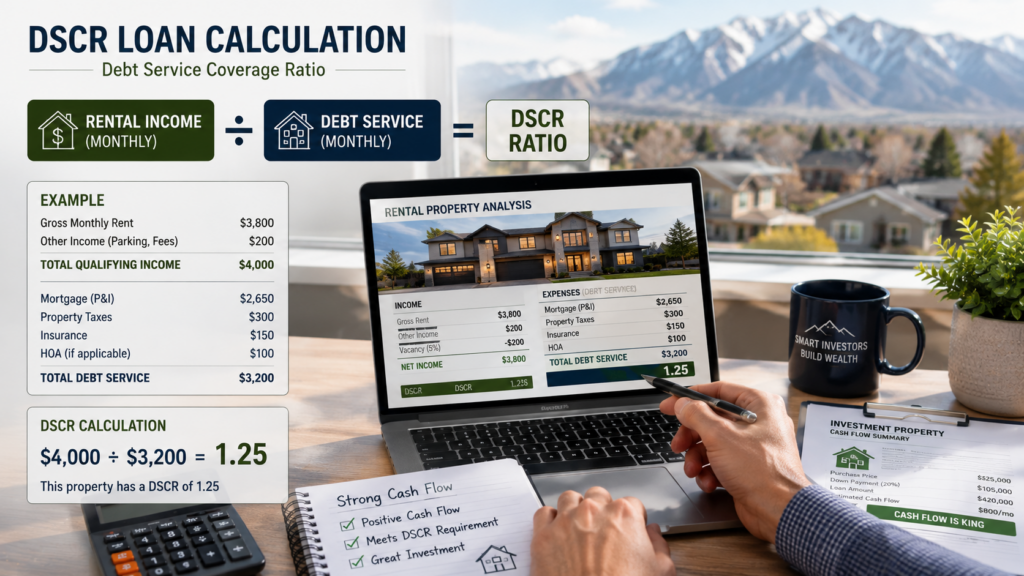
The basic calculation is:
DSCR = Qualifying Monthly Rental Income ÷ Monthly Property Debt Obligation
For example:
Qualifying rent: $6,000 per month
Applicable monthly property payment: $5,000
$6,000 ÷ $5,000 = 1.20 DSCR
A 1.20 ratio means the qualifying rent is 120% of the monthly debt obligation used in the calculation.
The important word is qualifying.
An Airbnb property might generate $100,000 in gross annual bookings, but that does not automatically mean a DSCR lender will use $8,333 per month for mortgage qualification.
Each investor determines which rental-income sources and calculations it will accept.
Start with the statewide DSCR Loans Utah guide for a broader explanation of DSCR investment-property financing.
How Are Airbnb and VRBO Properties Different?

Short-term rentals can produce income very differently from traditional rental properties.
A long-term rental may have a 12-month lease at $3,500 per month.
A short-term rental may instead generate:
- $250 per night during one season
- $500 per night during another
- Very high occupancy during holidays
- Lower occupancy during off-season months
- Cleaning fees
- Management expenses
- Platform fees
- Variable monthly revenue
That makes income analysis more complicated.
A lender needs a reasonable method for estimating sustainable rental income rather than simply using the property's best month or advertised nightly rate.
This is especially important in Utah vacation markets such as Park City, Deer Valley, Jordanelle, Heber City, Midway, St. George and other tourism-oriented communities.
How Is Rental Income Calculated for a Utah Short-Term Rental DSCR Loan?
There is no single rental-income calculation used by every DSCR lender.
Depending on the investor, property and transaction, the analysis may consider one or more of the following:
Long-Term Market Rent
Some programs base qualification primarily on the property's estimated long-term monthly market rent.
An appraiser may develop a market-rent opinion using comparable traditional rental properties.
This can be important when the lender does not permit projected Airbnb or VRBO revenue to determine DSCR.
Short-Term Rental Comparable Data
Certain lenders may consider short-term-rental market data when their guidelines permit it.
The analysis may consider comparable properties with similar:
- Location
- Property type
- Bedroom count
- Amenities
- Rental characteristics
- Seasonality
- Occupancy
- Average daily rates
The lender determines what data source and methodology are acceptable.
Actual Short-Term Rental History
For an established rental, some programs may consider documented operating history.
Potential documentation could include:
- Airbnb statements
- VRBO statements
- Property-management statements
- Rental ledgers
- Bank records
- Tax documents
- Occupancy reports
- Historical booking information
The exact requirements vary by investor.
Appraisal-Supported Rental Income
The appraisal may also include rental information or a separate rent schedule when required by the program.
Do not assume that an online Airbnb revenue estimate will automatically satisfy underwriting.
Short-Term Rental Income and Appraisal Evidence
Short-term-rental income needs to be supportable.
A strong property file may contain evidence showing both the property's physical value and its reasonable rental potential.
The appraiser or underwriting process may examine:
- Comparable property rents
- Property location
- Bedroom and bathroom count
- Square footage
- Property condition
- Furnishings when relevant to the rental operation
- Amenities
- Market demand
- Rental seasonality
- Comparable short-term rental activity
- Long-term market rent
- Historical rental performance when permitted
A property's ability to generate exceptional Airbnb revenue does not necessarily increase its real-estate appraised value by the same amount.
That distinction matters.
The mortgage is secured by real property. Furniture, platform reputation, management contracts and the business value of an established vacation-rental operation may not receive the same treatment as the underlying real estate.
A Major 2026 Development in Short-Term Rental Income Documentation
Short-term-rental underwriting is becoming more structured.
Fannie Mae's September 2026 Selling Guide now provides specific criteria for rental income from eligible one-unit subject properties operated as short-term rentals.
For qualifying purchases, its guidance allows either a traditional Form 1007 based on standard long-term rentals or qualifying validated short-term-rental market data. When the latter method is used, the data must include three comparable short-term rentals and information about rental rates and days rented.
That is Fannie Mae conventional guidance, not a universal DSCR rule.
However, it illustrates an important underwriting principle for Utah investors:
Short-term-rental income should be supported by credible market evidence rather than an unsupported projected Airbnb number.
Your DSCR lender may use a completely different methodology.
DSCR Example for a Utah Airbnb Property
Assume an investor wants to purchase a property near a Utah vacation market.
The approved rental-income analysis determines:
Qualifying monthly rent: $7,500
Assume the applicable monthly property obligation is:
$6,000
The calculation is:
$7,500 ÷ $6,000 = 1.25 DSCR
The property produces a 1.25 ratio under that calculation.
Now assume the lender recognizes only $5,700 of qualifying monthly rent.
$5,700 ÷ $6,000 = 0.95 DSCR
The same property now has a DSCR below 1.00.
That is why determining the lender's acceptable rental-income methodology before ordering the appraisal or selecting a program can be important.
Use the DSCR Loan Calculator Utah resource to model your own property.
What Does a 1.00 DSCR Mean?
A 1.00 DSCR generally means the qualifying rental income equals the applicable monthly property obligation.
For example:
$5,000 rent ÷ $5,000 payment = 1.00 DSCR
Above 1.00 means the qualifying rent exceeds the debt obligation.
Below 1.00 means it does not fully cover it under the lender's calculation.
A higher ratio can sometimes improve eligibility or pricing, but lenders establish their own DSCR tiers.
Review DSCR Loan Requirements Utah for a broader qualification discussion.
Can You Get a DSCR Loan Below 1.00?

Potentially.
Certain investors offer programs for properties with a DSCR below 1.00. These are sometimes described as no-ratio or low-DSCR programs.
They may require compensating factors such as:
- More equity
- Lower LTV
- Stronger credit
- Greater reserves
- Different pricing
- Eligible property types
- Specific loan amounts
- Strong mortgage history
Availability can change.
See No-Ratio DSCR Loans Utah for a detailed explanation.
DSCR Loans for Short-Term Rentals Utah: LTV and Down Payment
There is no universal maximum LTV for every short-term-rental DSCR program.
LTV may depend on:
- Credit score
- DSCR
- Property type
- Loan amount
- Purchase versus refinance
- Cash-out versus rate-and-term refinance
- Rental-income documentation
- Investor
- Short-term-rental eligibility
- Reserves
For illustration:
| LTV | Investor Equity |
|---|---|
| 80% | 20% |
| 75% | 25% |
| 70% | 30% |
| 65% | 35% |
These percentages illustrate the mathematical relationship between LTV and equity. They are not guaranteed loan-program limits.
For more information, review DSCR Loan Down Payment Utah and DSCR Loan LTV Utah.
Credit Score and Utah Short-Term Rental DSCR Loans
Credit can affect more than approval.
It may influence:
- Maximum LTV
- Interest rate
- Points
- Loan amount
- Reserve requirements
- Cash-out availability
- DSCR requirements
- Prepayment structure
- Available investor programs
An investor with stronger credit may qualify for a different combination of leverage and pricing than an investor purchasing the same property with lower credit.
See DSCR Loan Credit Score Utah for a deeper explanation.
Can You Cash Out Refinance an Airbnb or VRBO?
Potentially.
Qualified investors may be able to refinance an existing Utah short-term rental and access equity through a DSCR cash-out refinance.
The lender may review:
- Current value
- Existing mortgage
- Requested loan amount
- LTV
- Credit
- Rental income
- DSCR
- Property ownership history
- Title
- Seasoning
- Reserves
- Property eligibility
Cash-out guidelines can be more restrictive than purchase guidelines.
Read DSCR Cash-Out Refinance Utah before assuming the same LTV available for a purchase will apply to a cash-out transaction.
Utah Zoning Is Critical for Airbnb and VRBO Properties
A mortgage approval does not create permission to operate a short-term rental.
Utah cities and counties may regulate short-term rentals through zoning, licensing and permit requirements.
Before buying a property based on projected Airbnb or VRBO revenue, verify whether the intended rental use is legal.
Questions to ask include:
- Is short-term rental use permitted at this address?
- What zoning applies?
- Is a business license required?
- Is a separate short-term-rental permit required?
- Are there occupancy limits?
- Are there parking requirements?
- Does the property have an existing transferable permit?
- Does the municipality limit new permits?
- Are there additional fire or safety requirements?
- Does the HOA impose separate restrictions?
Do this research before closing, not after.
Utah HOA Restrictions Can Affect a Short-Term Rental
Municipal approval is not the only issue.
A property may be located in an area where short-term rentals are legally permitted while the HOA, condominium declaration or other private restrictions prohibit or limit them.
Investors should review applicable:
- CC&Rs
- HOA bylaws
- Rental restrictions
- Minimum lease periods
- Condo declarations
- Rules and regulations
- Rental caps
- Registration requirements
Do not rely solely on the seller's statement that "Airbnb is allowed."
Obtain and review the governing documents applicable to the property.
Why Legal Short-Term Rental Status Matters to a DSCR Lender
Suppose a borrower expects:
Projected Airbnb income: $8,000 per month
but local zoning does not permit short-term rentals.
The lender may not be able to rely on the investor's proposed Airbnb strategy.
That could force the transaction to be evaluated using another acceptable rental method, if the program allows it.
This could materially change DSCR.
For example:
Projected STR income: $8,000
Long-term market rent: $4,800
Applicable property obligation: $5,500
Projected STR approach:
$8,000 ÷ $5,500 = 1.45
Long-term rent approach:
$4,800 ÷ $5,500 = 0.87
That difference could completely change the available financing.
Park City and Deer Valley Short-Term Rental DSCR Loans
Park City and Deer Valley are among Utah's most visible vacation-rental markets.
However, investors should not assume that every Park City address has the same short-term-rental rules.
Properties can differ based on:
- Location
- Zoning
- Development
- HOA
- Condo project
- Rental restrictions
- Property type
- Management requirements
Luxury properties can also produce larger loan balances that require specialized DSCR or jumbo investment-property programs.
Review the DSCR Loans Park City Utah guide for local financing considerations.
Heber City, Midway and Jordanelle
The Wasatch Back includes additional markets where investors may consider vacation-rental properties.
These include:
- Heber City
- Midway
- Jordanelle
- Hideout
- Kamas
- Surrounding Wasatch and Summit County communities
Rental demand, zoning and HOA requirements can vary significantly from one development to another.
Never assume that a nearby property operating on Airbnb proves the subject property can legally operate the same way.
St. George and Southern Utah Short-Term Rentals
St. George and Southern Utah attract visitors for recreation, events, national parks, golf and seasonal travel.
That can create demand for vacation rentals.
Investors should still evaluate:
- Property-specific zoning
- HOA rules
- Rental permits
- Market rent
- Seasonal occupancy
- Property management
- Insurance
- Expected expenses
- Financing structure
For local investment-property financing information, review DSCR Loans St. George Utah.
Salt Lake City DSCR Loans for Rental Properties
Salt Lake City and surrounding Salt Lake County markets may present a different investment strategy than resort-oriented Park City or Southern Utah.
An investor might compare:
- Long-term rental
- Mid-term rental
- Furnished corporate rental
- Short-term rental
The highest projected gross income is not necessarily the best financing strategy.
A property with predictable long-term rent may sometimes produce stronger lender-supported DSCR than a short-term-rental projection that cannot be fully documented.
See DSCR Loans Salt Lake City Utah for the local guide.
What Documents May Be Needed?
Documentation varies by lender, but a Utah short-term-rental DSCR file may include:
- Mortgage application
- Government identification
- Credit authorization
- Purchase agreement
- Asset statements
- Down-payment documentation
- Reserve documentation
- Current mortgage statement for refinances
- Property insurance
- Appraisal
- Rent schedule
- Short-term-rental history when applicable
- Property-management statements when applicable
- Airbnb or VRBO records when permitted
- HOA documents
- Lease information when applicable
- Entity documents for LLC vesting
- Title documentation
- Other investor-required documentation
A DSCR mortgage is not necessarily a no-documentation loan.
The difference is that personal employment income often is not the primary qualification method.
DSCR Loans vs. Conventional Financing for Short-Term Rentals
| Feature | DSCR Loan | Conventional Investment Loan |
|---|---|---|
| Main qualification focus | Property cash flow | Borrower + property |
| Employment income | Often not primary method | Commonly evaluated |
| Personal DTI | Often not primary method | Generally important |
| Tax returns for personal income | Often not primary method | May be required |
| Rental-income methodology | Investor-specific | Agency guidelines |
| STR treatment | Investor-specific | Agency-specific |
| LLC vesting | Often available | More limited |
| Investment property | Yes | Yes |
| Primary residence | Generally no | Yes under qualifying programs |
Neither loan type is automatically better.
The appropriate financing depends on the investor, property, documentation, intended use and available terms.
Common Short-Term Rental DSCR Mistakes
Assuming Airbnb's Estimate Equals Qualifying Rent
A platform estimate is not automatically lender-approved qualifying income.
Ignoring Zoning Until After Closing
A property may produce attractive projected revenue but be legally unable to operate as intended.
Ignoring the HOA
Local zoning approval does not override private HOA restrictions.
Using Peak-Season Revenue as Monthly Income
Park City ski-season revenue or Southern Utah peak-season revenue may not represent sustainable annual monthly income.
Choosing the Lender After Ordering the Appraisal
Rental-income methodologies vary. Determine how the selected program evaluates the property before assuming an appraisal will support the needed DSCR.
Focusing Only on the Interest Rate
Investors should compare:
- Rate
- Points
- LTV
- DSCR requirements
- Prepayment provisions
- Interest-only options
- Closing costs
- Cash required
- Rental-income methodology
Review DSCR Loan Rates Utah for a more complete pricing discussion.
A Better Way to Evaluate a Utah Airbnb DSCR Scenario
Before choosing a loan, gather:
Property
- Purchase price or estimated value
- Property address
- Property type
- Number of units
Financing
- Requested loan amount
- Down payment
- Current mortgage if refinancing
- Estimated credit score
Rental Information
- Long-term market rent
- Short-term rental projection
- Existing Airbnb/VRBO history
- Property-management history
- Current lease, if applicable
Property Expenses
- Taxes
- Insurance
- HOA dues
- Applicable assessments
Legal Use
- Zoning
- STR permit
- Business license
- HOA approval
With that information, the property can be screened against multiple DSCR programs rather than forcing the scenario into one lender's guidelines.
Frequently Asked Questions About DSCR Loans for Short-Term Rentals Utah
Can I use a DSCR loan for an Airbnb in Utah?
Potentially. Certain DSCR lenders finance eligible Utah properties operated as short-term rentals. Property eligibility, legal STR use, rental-income documentation, DSCR, credit, LTV and other requirements depend on the lender.
Can I use projected Airbnb income to qualify?
Sometimes, but not automatically. The lender determines whether short-term-rental income is acceptable and what evidence is required. Some programs may rely on appraisal-supported market rent instead.
Does VRBO income count for a DSCR loan?
It may under qualifying programs when the lender accepts the documentation and rental-income methodology. Historical platform revenue alone does not guarantee that all gross revenue will be used.
What DSCR do I need for an Airbnb property?
There is no universal minimum across all DSCR programs. Some programs favor ratios at or above 1.00, while select programs may permit lower ratios or no-ratio qualification with additional restrictions.
Can I get a DSCR loan if the ratio is below 1.00?
Potentially. Select low-DSCR or no-ratio programs may be available depending on credit, LTV, property type, reserves, loan amount and current investor guidelines.
Can I cash out refinance my Utah Airbnb?
Potentially. DSCR cash-out refinance programs may be available for qualifying short-term-rental investment properties. LTV, credit, seasoning, reserves and property requirements vary.
Do I need tax returns for a DSCR loan?
Personal tax-return income is often not the primary qualification method for a DSCR loan. Documentation requirements still vary by lender and transaction.
Does Airbnb income prove that a property is legally approved for short-term rentals?
No. Rental history or an active online listing does not by itself establish zoning, licensing or HOA compliance. Investors should independently verify the property's legal short-term-rental status.
Can an HOA prohibit short-term rentals?
HOA or condominium restrictions may limit or prohibit short-term rental activity even when local governmental rules otherwise permit it. Review the property's actual governing documents before purchasing.
Are DSCR loans available in Park City and St. George?
Potentially. DSCR programs may be available for qualifying investment properties throughout Utah, including Park City, Deer Valley, Heber City, St. George, Salt Lake City and other Utah communities.
Explore the Utah DSCR Loan Resource Center
Short-term rentals are only one part of DSCR financing. Use the UtahLowRate.com DSCR resource cluster to research the part of your transaction that matters most.
Core DSCR Guides
- DSCR Loans Utah — statewide DSCR mortgage overview
- DSCR Loan Requirements Utah — qualification, documentation and underwriting
- DSCR Loan Rates Utah — pricing, points, credit, LTV and prepayment structures
- DSCR Loan Calculator Utah — calculate property DSCR
- DSCR Loan FAQ Utah — answers to common investor questions
Qualification and Structure
- DSCR Cash-Out Refinance Utah — equity access, seasoning and cash-out underwriting
- No-Ratio DSCR Loans Utah — financing concepts for DSCR below 1.00
- DSCR Loans for Short-Term Rentals Utah — Airbnb, VRBO and vacation-rental financing
- DSCR Loan Credit Score Utah — how credit can affect qualification and pricing
- DSCR Loan Down Payment Utah — equity and down-payment considerations
- DSCR Loan LTV Utah — purchase, refinance and cash-out leverage
Utah Local DSCR Guides
- DSCR Loans Salt Lake City Utah
- DSCR Loans Park City Utah
- DSCR Loans St. George Utah
As the Utah DSCR resource center expands, county and city guides should link back to the statewide DSCR hub and to the appropriate requirements, rates, calculator and FAQ resources.
Talk With a Utah DSCR Mortgage Broker About Your Short-Term Rental
Short-term-rental DSCR loans can be more complicated than financing a standard long-term rental because two lenders may treat the same Airbnb or VRBO income differently.
A useful preliminary review should compare:
- Property address
- Legal STR use
- Purchase price or property value
- Requested loan amount
- LTV
- Credit
- Long-term market rent
- Short-term rental income
- Existing rental history
- Taxes
- Insurance
- HOA dues
- Proposed DSCR
- Reserves
- Purchase, refinance or cash-out structure
Daniel Paris
Utah Mortgage Broker
NMLS #243976
UtahLowRate.com
801-604-4949
CTA: Check My Short-Term Rental DSCR Scenario
Mortgage programs, rates, pricing, LTV limits, credit requirements, DSCR calculations, reserve requirements, short-term-rental income methods and property guidelines vary by lender and investor and are subject to change. All loans are subject to borrower qualification, property eligibility, appraisal, title review, applicable law and complete underwriting.
Related guides: Utah DSCR loan guide · DSCR loan requirements · DSCR calculation guide · DSCR loan rates · DSCR questions and answers ·

