
Content updated: September 29, 2026
Quick Answer: What Is a DSCR Cash-Out Refinance in Utah?
A DSCR cash-out refinance in Utah may allow a real estate investor to refinance a rental property, pay off the existing mortgage and access a portion of the property's available equity.
Check My DSCR Scenario or call 801-604-4949.
Unlike a traditional mortgage that may rely heavily on personal income and debt-to-income ratios, a DSCR loan generally focuses on the rental property's qualifying income compared with its applicable monthly housing obligation.
Maximum LTV, credit score, DSCR, seasoning, reserves and cash-out limits vary by lender and loan program.
If you are new to this type of financing, start with our DSCR mortgage loans in Utah guide for an overview of how DSCR financing works.
Daniel Paris | UtahLowRate.com
Utah Mortgage Broker
NMLS #243976
801-604-4949
DSCR Cash-Out Refinance Utah: Key Facts
Loan percentages, credit examples and payment calculations are illustrations unless linked to an identified current program. They do not establish available terms or approval.
| Feature | General Guideline |
|---|---|
| Loan purpose | Access equity from an investment property |
| Occupancy | Non-owner-occupied investment property |
| Primary qualification | Rental-property cash flow plus lender underwriting |
| Traditional DTI | Often not the primary qualification method |
| Personal tax returns | Often not used to calculate qualifying income |
| Maximum LTV | Varies by lender and scenario |
| Minimum DSCR | Varies by lender and program |
| Credit score | Program specific |
| Property value | Usually established through an acceptable appraisal or valuation |
| Rental income | Lease, appraisal rent schedule or other permitted methodology |
| Seasoning | May apply to ownership, title, value and existing financing |
| Reserves | Frequently required |
| LLC ownership | Available through certain programs |
| Interest-only | Available through select DSCR programs |
| Prepayment provision | May apply |
| Final approval | Subject to complete underwriting |
For a broader discussion of qualification standards, see DSCR Mortgage Loans in Utah.
What Is a DSCR Cash-Out Refinance?

A DSCR cash-out refinance replaces existing financing on a Utah investment property with a new, larger mortgage.
The existing mortgage and other eligible liens are paid at closing. After closing costs and required charges are deducted, the investor may receive the remaining permitted proceeds.
For example, suppose you own a Utah rental property worth approximately $800,000 and currently owe $350,000.
If underwriting permits a new mortgage of $560,000, the difference between the new mortgage and existing payoff creates potential cash-out proceeds.
That does not mean every $800,000 property automatically qualifies for a $560,000 loan.
A DSCR lender may still review:
- Property value
- Maximum permitted LTV
- Rental income
- DSCR
- Credit history
- Mortgage history
- Cash reserves
- Ownership history
- Title
- Property type
- Loan amount
- Appraisal
- Cash-out seasoning
- Borrower documentation
- LLC or entity documentation
Investors comparing DSCR financing with other alternative-documentation programs can also review our Utah mortgage loan options.
How Much Can You Cash Out With a DSCR Loan in Utah?
The amount available through a DSCR cash-out refinance in Utah depends on the property's eligible value, existing liens and the maximum LTV allowed by the applicable loan program.
A simplified calculation is:
Maximum New Loan = Eligible Property Value × Maximum LTV
Then:
Potential Gross Cash-Out = Maximum New Loan − Existing Mortgage and Eligible Lien Payoffs
Example
Assume:
- Property value: $1,000,000
- Example maximum LTV: 70%
- Example maximum new loan: $700,000
- Existing mortgage payoff: $425,000
The difference is:
$700,000 − $425,000 = $275,000
The $275,000 is not necessarily the investor's final cash proceeds.
Closing costs, prepaid expenses, liens, lender charges and other required amounts can reduce the actual amount received at closing.
If you want to compare this strategy with a conventional cash-out transaction, visit our cash-out refinance guide.
DSCR Cash-Out Refinance LTV in Utah
Loan-to-value, or LTV, is one of the most important factors in a DSCR cash-out transaction.
The formula is:
LTV = New Loan Amount ÷ Eligible Property Value
For example:
$600,000 ÷ $800,000 = 75% LTV
Cash-out DSCR loans may have lower maximum LTVs than purchase or rate-and-term transactions.
The actual maximum can depend on:
- Credit score
- DSCR
- Loan amount
- Property type
- Number of units
- Investor experience
- Rural property characteristics
- Short-term rental use
- Recent acquisition
- Appraisal
- Requested cash-out
- Reserves
- Lender guidelines
A published maximum LTV should never be interpreted as a guarantee that the same leverage is available for every Utah rental property.
How Does Cash-Out Affect DSCR?
This is one of the most important parts of a DSCR cash-out refinance in Utah.
Taking additional equity out usually means obtaining a larger mortgage.
A larger mortgage can increase the property's monthly debt obligation. If qualifying rental income stays the same, the property's DSCR may decrease.
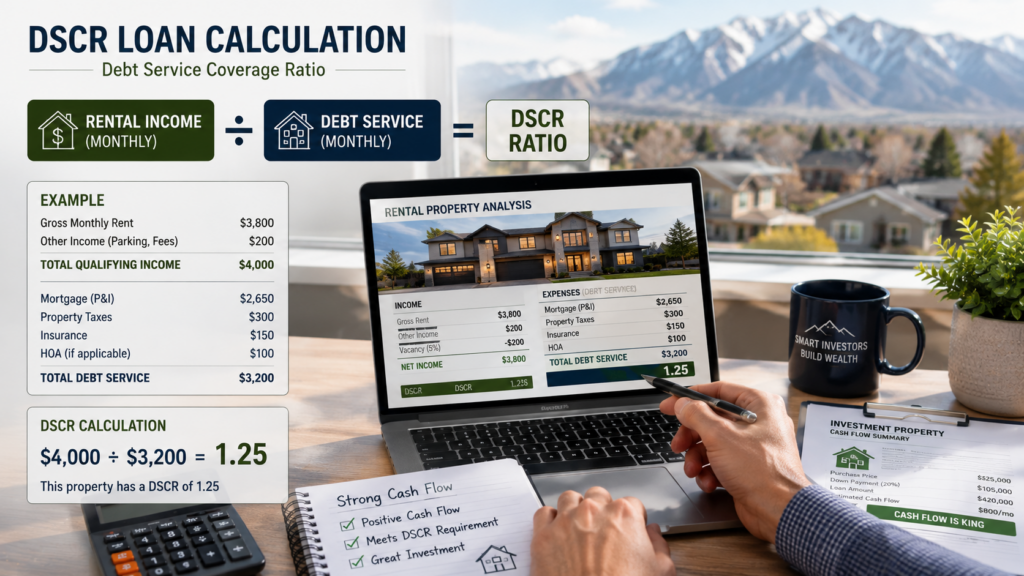
A simplified DSCR formula is:
DSCR = Qualifying Monthly Rental Income ÷ Applicable Monthly Property Debt Obligation
Depending on the lender and program, the applicable property obligation may include principal, interest, property taxes, insurance, association expenses and other required components.
DSCR Example
Assume qualifying monthly rent is:
$4,000
And the applicable monthly property obligation is:
$3,200
The DSCR would be:
$4,000 ÷ $3,200 = 1.25
Now assume additional cash-out increases the applicable monthly obligation to:
$3,500
The new calculation becomes:
$4,000 ÷ $3,500 = 1.14
The property's rental income did not change, but the additional leverage reduced its DSCR.
This is why maximum available equity and maximum practical cash-out are not always the same number.
For a complete introduction to the ratio and how lenders use it, see our Utah DSCR loan guide.
What Is Seasoning on a DSCR Cash-Out Refinance?
Seasoning generally refers to how long the borrower has owned the property, held title, maintained financing or established the property value being used for the refinance.
DSCR lenders do not all use the same seasoning rules.
An underwriter may examine:
- Original acquisition date
- Original purchase price
- Date title was transferred
- Current appraised value
- Improvements made after acquisition
- Existing mortgage history
- Whether the property was purchased with cash
- Recent financing
- Transfers into an LLC
- Appreciation since acquisition
Some programs may allow cash-out after a relatively short ownership period. Other programs may require more seasoning before the lender permits maximum cash-out or uses the full current appraised value.
There is no single seasoning period that applies to every Utah DSCR cash-out refinance.
DSCR Cash-Out Refinance After a Cash Purchase
Some Utah investors buy rental properties with cash and refinance them later.
The strategy can look like this:
- Purchase the property with cash.
- Complete repairs or improvements.
- Place the property into service.
- Establish rental income.
- Obtain longer-term investment-property financing.
- Recover part of the capital invested in the property.
The refinance is not automatically based on the new appraised value.
Depending on the program, a lender may review the original purchase price, documented improvements, acquisition date, source of funds, current appraisal and ownership seasoning.
Investors using a BRRRR strategy — Buy, Rehab, Rent, Refinance, Repeat — should review potential refinance guidelines before purchasing the property.
How Is Property Value Determined for a DSCR Cash-Out Refinance?

The lender generally needs an acceptable property valuation before determining the final LTV and cash-out amount.
An appraisal may evaluate:
- Property condition
- Comparable sales
- Location
- Marketability
- Unit count
- Improvements
- Current market conditions
- Property characteristics
- Rental information
An online estimate from a real-estate website does not establish the value that will be used for underwriting.
The applicable lender determines acceptable value under its appraisal and underwriting guidelines.
What Can DSCR Cash-Out Proceeds Be Used For?
Subject to lender guidelines, loan purpose and applicable law, a real estate investor may consider using available equity for investment or business purposes such as:
- Down payment on another rental property
- Acquisition of another investment property
- Renovations
- Property improvements
- Investment reserves
- Real-estate development expenses
- Business liquidity
- Portfolio restructuring
- Future investment opportunities
For investors trying to acquire another property rather than refinance an existing one, our DSCR mortgage loans in Utah page explains purchase financing as well.
Cash-out should still be evaluated as a financing decision. Accessing equity creates additional debt, and the cost of that debt should be compared with the intended use of the proceeds.
How Is Rental Income Verified for a DSCR Cash-Out Loan?
A DSCR loan is not a no-documentation loan.
The lender still needs an acceptable way to establish qualifying rental income.
Depending on the program and property, documentation may include:
- Current lease
- Appraisal rent schedule
- Market-rent analysis
- Permitted short-term-rental documentation
- Other lender-approved rental evidence
A property currently collecting $5,000 per month does not necessarily mean the lender will automatically use $5,000 as qualifying rental income.
The applicable underwriting guidelines determine which rental figure may be used.
Can I Cash Out a Utah Short-Term Rental?
Potentially.
Utah has significant vacation and short-term-rental markets in areas such as Park City, Deer Valley, Heber City and St. George.
Short-term rental underwriting may involve additional considerations, including:
- Appraisal market rent
- Rental history
- Permitted short-term-rental documentation
- Property location
- HOA restrictions
- Local zoning
- Rental licensing
- Property type
- Seasonality
- Investor-specific STR guidelines
Mortgage qualification does not override local zoning, licensing or HOA restrictions.
What Credit Score Is Needed for a DSCR Cash-Out Refinance in Utah?
There is no universal minimum credit score across all DSCR programs.
Credit can affect both qualification and pricing.
A stronger credit profile may provide access to:
- Higher potential LTV
- Better pricing
- More lender choices
- More flexible structures
A lower credit score can result in:
- Reduced maximum LTV
- Higher interest rates
- Additional points
- Larger reserve requirements
- Fewer eligible programs
- Additional underwriting restrictions
This interaction between credit, DSCR and LTV is one reason an investor should compare the complete loan structure rather than focusing on one qualification number.
DSCR Cash-Out Refinance Rates in Utah
Rates for DSCR cash-out loans can differ from purchase and rate-and-term refinance pricing.
Pricing may be affected by:
- Credit score
- LTV
- DSCR
- Loan amount
- Property type
- Cash-out amount
- Fixed versus adjustable rate
- Interest-only option
- Prepayment structure
- Number of units
- Short-term-rental characteristics
- Investor experience
- Market conditions
When comparing DSCR offers, look beyond the note rate.
Compare:
Interest Rate + Points + Lender Fees + Prepayment Terms + Loan Structure + Cash Proceeds + Total Financing Cost
For broader mortgage pricing information, visit UtahLowRate.com.
Reserves and Liquidity Requirements
DSCR lenders may require an investor to maintain eligible post-closing reserves.
Reserve requirements can depend on:
- Loan amount
- LTV
- Credit score
- DSCR
- Property type
- Number of financed properties
- Investor experience
- Loan program
Acceptable reserve assets are also program specific.
Do not assume that the cash-out proceeds from the new mortgage can automatically satisfy the lender's post-closing reserve requirement.
What Properties May Qualify?
DSCR cash-out programs are generally intended for non-owner-occupied investment properties.
Depending on the lender, potentially eligible properties can include:
- Single-family rental homes
- Condominiums
- Townhomes
- 2–4 unit residential investment properties
- Certain short-term rentals
- Other eligible residential investment properties
Additional restrictions can apply to:
- Rural properties
- Condotels
- Non-warrantable condominiums
- Unique properties
- High-value properties
- Properties with significant acreage
- Short-term rentals
A DSCR mortgage is generally not intended to finance the borrower's primary residence.
Can an LLC Get a DSCR Cash-Out Refinance in Utah?
Certain DSCR lenders permit eligible investment properties to be financed in an LLC or other approved entity.
The lender may still require:
- Personal guaranty
- Borrower credit review
- Articles of organization
- Operating agreement
- EIN documentation
- Certificate of good standing
- Ownership information
- Asset documentation
- Title review
Entity requirements vary substantially among DSCR programs.
Investors who are self-employed but need financing for a primary or second home rather than an investment property may want to compare bank statement loans instead.
What Does a DSCR Lender Underwrite on a Cash-Out Refinance?
DSCR does not mean "no underwriting."
A lender can still evaluate the borrower, property and transaction in detail.
Borrower Review
The lender may review:
- Credit history
- Mortgage history
- Real-estate experience
- Liquidity
- Reserves
- Assets
- Ownership
Property Review
Underwriting may include:
- Appraisal
- Rental income
- Property type
- Condition
- Marketability
- Insurance
- Property taxes
- HOA
- Title
Loan Review
The lender may evaluate:
- LTV
- DSCR
- Loan amount
- Interest rate
- Loan term
- Cash-out amount
- Interest-only structure
- Prepayment provision
Refinance History
Underwriters may also examine:
- Purchase date
- Purchase price
- Existing mortgage
- Ownership seasoning
- Title seasoning
- Previous cash-out
- Recent transfers
A DSCR loan is better described as alternative investment-property underwriting than a no-documentation mortgage.
DSCR Cash-Out vs. Rate-and-Term Refinance
The two refinance strategies serve different purposes.
| Feature | DSCR Rate-and-Term Refinance | DSCR Cash-Out Refinance |
|---|---|---|
| Replace existing mortgage | Yes | Yes |
| Receive substantial equity proceeds | Generally no | Potentially |
| LTV restrictions | Program specific | Often more restrictive |
| Seasoning | May apply | Especially important |
| Rental cash flow reviewed | Yes | Yes |
| Credit reviewed | Yes | Yes |
| Appraisal/valuation | Typically | Typically |
| Primary objective | Restructure financing | Access equity |
If you do not need additional capital, compare the economics of a rate-and-term transaction before automatically choosing cash-out.
Utah DSCR Cash-Out Refinance Example
Consider an investor with a rental property in Salt Lake County.
Estimated property value: $750,000
Current mortgage balance: $325,000
Example proposed loan: $525,000
The proposed LTV is:
$525,000 ÷ $750,000 = 70% LTV
Before closing costs and other deductions, the difference between the new mortgage and current balance is:
$525,000 − $325,000 = $200,000
The lender still needs to determine whether:
- $750,000 is an acceptable value
- 70% cash-out LTV is permitted
- Rental income supports the required DSCR
- Credit meets program guidelines
- Ownership and title seasoning are acceptable
- Reserves are sufficient
- The property is eligible
- The borrower satisfies underwriting
Equity alone does not determine DSCR cash-out eligibility.
DSCR Cash-Out Refinance in Salt Lake City
Investors in Salt Lake City, Holladay, Millcreek, Murray, Cottonwood Heights, Sandy, Draper, South Jordan, West Jordan, Riverton, Herriman, Midvale and surrounding Salt Lake County communities may consider DSCR cash-out financing for eligible rental properties.
A useful scenario review includes:
- Estimated property value
- Current mortgage payoff
- Monthly rent
- Proposed loan amount
- Estimated new payment
- DSCR
- LTV
- Credit score
- Desired cash proceeds
UtahLowRate.com can use those numbers to compare potential wholesale DSCR structures.
DSCR Cash-Out Refinance in Park City
Investment properties in Park City, Deer Valley, Canyons Village, Old Town, Empire Pass, Prospector, Kimball Junction and surrounding Summit County communities may involve larger loan balances and substantial equity.
Park City DSCR underwriting can require additional attention to:
- High loan amounts
- Short-term-rental income
- Condo eligibility
- HOA requirements
- Seasonal rental patterns
- Appraised value
- Investor liquidity
- Jumbo DSCR options
- Prepayment provisions
High property equity alone does not eliminate DSCR, LTV or underwriting requirements.
DSCR Cash-Out Refinance in St. George
Investors in St. George, Washington, Ivins, Santa Clara, Hurricane and surrounding Washington County communities may use DSCR financing for long-term rentals, vacation rentals and other eligible investment properties.
A Southern Utah transaction may involve:
- Single-family rental properties
- Townhomes
- Condominiums
- Vacation rentals
- Portfolio investors
- Properties originally purchased with cash
- Equity being accessed for another investment
Investors using a property as a short-term rental should independently confirm applicable zoning, licensing and HOA rules.
How to Apply for a DSCR Cash-Out Refinance in Utah
Step 1: Estimate the Property Value
Start with a reasonable estimate of the rental property's current market value.
Step 2: Determine Your Current Payoff
Identify the approximate mortgage balance and any other liens that must be paid.
Step 3: Choose Your Desired Cash-Out Amount
Determine how much capital you actually need rather than assuming you should borrow the maximum available amount.
Step 4: Review Rental Income
Gather the current lease, rent information and relevant property details.
Step 5: Estimate the DSCR
Compare qualifying rental income with the proposed property's applicable monthly debt obligation.
Step 6: Review Credit, LTV and Reserves
These factors can affect both program eligibility and loan pricing.
Step 7: Compare DSCR Loan Structures
Compare:
- Interest rate
- Points
- Lender fees
- Maximum LTV
- Required DSCR
- Cash proceeds
- Reserves
- Interest-only options
- Prepayment provisions
- Seasoning requirements
- Closing costs
Step 8: Complete Appraisal and Underwriting
Final loan terms and eligibility depend on complete lender underwriting.
Apply for a DSCR Cash-Out Refinance
Explore the Utah DSCR Loan Cluster
A cash-out refinance is only one part of DSCR financing. Use the following UtahLowRate.com resources to research the part of your transaction that matters most.
Start with the DSCR Mortgage Loans in Utah hub if you want a complete introduction to rental-property qualification.
Use the DSCR Loan Requirements Utah guide for credit, property, reserves, rental-income documentation and underwriting requirements.
Review DSCR Loan Rates Utah to understand how DSCR, credit score, LTV, loan amount, points, interest-only terms and prepayment structures can affect pricing.
Use the DSCR Loan Calculator Utah page to estimate your rental property's debt-service coverage ratio.
Visit DSCR Loan FAQ Utah for direct answers to common Utah investor questions.
This DSCR Cash-Out Refinance Utah guide covers accessing existing rental-property equity, seasoning, proceeds, valuation and cash-out underwriting.
Review No-Ratio DSCR Loans Utah if the property's rental income does not support a traditional 1.00 or higher DSCR and you want to understand whether alternative programs may exist.
Use DSCR Loans for Short-Term Rentals Utah when evaluating Airbnb, VRBO or other vacation-rental properties.
Review DSCR Loan Credit Score Utah to understand how borrower credit may interact with pricing and maximum leverage.
Use DSCR Loan Down Payment Utah when planning the purchase of another investment property.
Review DSCR Loan LTV Utah for a detailed explanation of purchase, refinance and cash-out loan-to-value limits.
For geographic searches, connect the cluster with DSCR Loans Salt Lake City Utah, DSCR Loans Park City Utah and DSCR Loans St. George Utah, along with future county pages for Salt Lake County, Utah County, Davis County, Weber County, Summit County, Wasatch County and Washington County.
Publishing instruction: Replace the bold page names above with their live URLs as each page is published. Do not point users or crawlers to guessed or nonexistent URLs.
Frequently Asked Questions About DSCR Cash-Out Refinance Utah
Can I cash out equity from a Utah rental property with a DSCR loan?
Yes, potentially. A DSCR cash-out refinance in Utah may allow a qualified investor to refinance an investment property and access available equity. LTV, DSCR, credit, seasoning, reserves, property eligibility and underwriting requirements apply.
Do I need tax returns for a DSCR cash-out refinance?
Many DSCR programs do not use personal tax returns to calculate qualifying income. Instead, qualification generally focuses more heavily on rental-property cash flow. Other borrower, property, asset and transaction documentation is still required.
Self-employed borrowers seeking financing for a primary residence can compare bank statement mortgage loans in Utah because that program solves a different income-documentation problem.
What is the maximum LTV for a Utah DSCR cash-out refinance?
There is no universal maximum. Cash-out LTV varies by lender and may depend on credit score, DSCR, loan amount, property type, seasoning and other risk factors.
How long do I have to own a property before doing a DSCR cash-out refinance?
Seasoning requirements vary by program. Recently acquired properties may be subject to ownership, title, valuation or cash-out seasoning requirements.
Can I refinance a Utah rental property that I bought with cash?
Potentially. Certain DSCR programs permit refinancing after a cash purchase, but seasoning, valuation, acquisition-cost and source-of-funds requirements may apply.
Does taking more cash out reduce my DSCR?
It can. Additional cash-out usually increases the new mortgage balance. If that produces a larger applicable monthly property obligation while qualifying rent stays unchanged, the DSCR decreases.
Can I cash out a short-term rental in Utah?
Potentially. Short-term-rental eligibility varies by lender. Rental history, appraisal rent, property type, location, zoning and HOA restrictions can all matter.
Can an LLC obtain a DSCR cash-out refinance?
Certain programs permit eligible LLC or entity borrowers. Personal guarantees, borrower credit review and entity documentation may still be required.
Can I use DSCR cash-out proceeds to purchase another rental property?
Depending on the lender, loan purpose and applicable requirements, proceeds may potentially provide capital for additional real-estate investment. Permitted use of proceeds should be confirmed for the specific program.
Is a DSCR cash-out refinance a no-income or no-documentation loan?
No. A DSCR mortgage is better described as an alternative investment-property qualification method. Lenders still verify the property, rental income, credit, assets, title and other required information.
Access Equity From Your Utah Rental Property
A DSCR cash-out refinance in Utah may provide a way for a qualified real estate investor to access rental-property equity without making traditional personal income the central qualification method.
The important question is not simply:
"How much equity do I have?"
A better question is:
"How much equity can I access while keeping the new loan within acceptable DSCR, LTV, credit, seasoning and underwriting guidelines?"
UtahLowRate.com can compare available wholesale DSCR programs based on your property value, rental income, current mortgage, desired cash-out amount, credit profile and investment strategy.
Check Your DSCR Cash-Out Options
Have these numbers available:
- Estimated property value
- Current mortgage balance
- Monthly rental income
- Property type
- Approximate credit score
- Desired cash-out amount
- Property city
- Original purchase date
Daniel Paris
Utah Mortgage Broker
UtahLowRate.com
NMLS #243976
801-604-4949
Start Your DSCR Loan Application
Loan programs, rates, LTV limits, DSCR calculations, credit requirements, seasoning, cash-out limits, reserves, property eligibility and underwriting guidelines vary by lender and are subject to change. Examples are educational and do not represent a commitment to lend or guarantee of qualification.
Related guides: Utah DSCR loan guide · DSCR loan requirements · DSCR calculation guide · DSCR loan rates · DSCR questions and answers ·

