
Content updated: September 29, 2026
Quick Answer: Can You Get a DSCR Loan in Utah With a Ratio Below 1.00?
Check My DSCR Scenario or call 801-604-4949.
Potentially. Some No-Ratio DSCR Loans in Utah may allow qualified real estate investors to finance a rental property when its calculated DSCR is below 1.00—or, under select programs, when no minimum DSCR is required.
These programs are not available from every lender. Lower DSCR may also require stronger compensating factors, such as a larger down payment, lower LTV, stronger credit, additional reserves or a more conservative loan structure.
If your rental property produces enough income to meet standard DSCR requirements, start with our DSCR Mortgage Loans in Utah guide.
Daniel Paris | UtahLowRate.com
Utah Mortgage Broker
NMLS #243976
801-604-4949
No-Ratio DSCR Loans Utah: Key Facts
Loan percentages, credit examples and payment calculations are illustrations unless linked to an identified current program. They do not establish available terms or approval.
| Feature | General Concept |
|---|---|
| Property type | Investment property |
| Owner occupancy | Generally not permitted |
| DSCR below 1.00 | May be available through select programs |
| 0.00/no-ratio programs | May be available from select lenders |
| Personal DTI | Often not the primary qualification method |
| Personal tax returns | Often not used to calculate qualifying income |
| LTV | Often more conservative as risk increases |
| Credit | Can significantly affect eligibility and pricing |
| Reserves | May be higher for weaker DSCR scenarios |
| Purchase | Potentially available |
| Rate-and-term refinance | Program specific |
| Cash-out refinance | More restrictive and lender specific |
| LLC/entity vesting | Available through some programs |
| Interest-only | Available through select programs |
| Prepayment provision | May apply |
| Availability | Lender and investor specific |
Important: "No-ratio DSCR" does not mean no underwriting, no credit review, no appraisal or guaranteed approval.
What Is a No-Ratio DSCR Loan?

A No-Ratio DSCR Loan is an investment-property mortgage where a lender may permit a property that does not meet the minimum DSCR required by more traditional DSCR programs.
The terminology varies among lenders.
You may encounter terms such as:
- No-ratio DSCR
- 0.00 DSCR
- DSCR below 1.00
- Low-DSCR loan
- No minimum DSCR
- Investor cash-flow loan
- Non-QM investment-property loan
These terms should not automatically be treated as identical.
One lender might permit a DSCR of 0.75, for example, while another program may have a different minimum. A separate program may allow a no-ratio or 0.00 DSCR scenario under specific conditions.
Program availability and definitions vary by lender.
What Does a DSCR Below 1.00 Mean?
DSCR stands for Debt Service Coverage Ratio.
A simplified calculation is:
DSCR = Qualifying Monthly Rental Income ÷ Applicable Monthly Property Debt Obligation
Suppose a rental property has:
Qualifying monthly rent: $2,900
Applicable monthly property obligation: $3,223.75
The calculation is:
$2,900 ÷ $3,223.75 = approximately 0.90 DSCR
A 0.90 DSCR means the qualifying rent equals approximately 90% of the applicable monthly obligation used in that calculation.
The property does not reach a 1.00 DSCR.
That does not necessarily mean the investor cannot obtain financing. It means the property may not satisfy a lender or program requiring a DSCR of at least 1.00.
A different Non-QM or low/no-ratio DSCR program may need to be considered.
For standard DSCR financing, visit DSCR Mortgage Loans in Utah.
What Does a 1.00 DSCR Mean?
If qualifying rent and the applicable monthly property obligation are equal, the DSCR is 1.00.
For example:
Qualifying rent: $2,900
Applicable monthly obligation: $2,900
Calculation:
$2,900 ÷ $2,900 = 1.00 DSCR
At 1.00, qualifying rent equals the applicable property obligation used in the calculation.
However, a 1.00 DSCR does not automatically mean the property qualifies.
The lender still evaluates credit, LTV, property type, reserves, appraisal, loan amount and other underwriting factors.
What Does a DSCR Above 1.00 Mean?
Assume:
Qualifying rent: $4,000
Applicable property obligation: $3,200
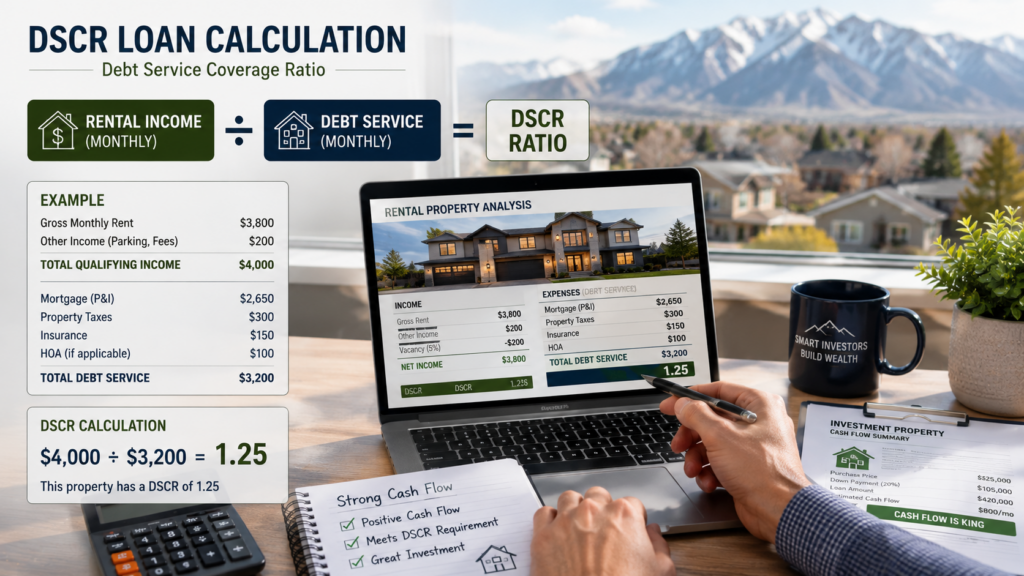
The calculation is:
$4,000 ÷ $3,200 = 1.25 DSCR
In this example, qualifying rent is 125% of the applicable monthly obligation.
Generally, a stronger DSCR gives the lender more property-level cash-flow coverage.
But DSCR is only one part of the underwriting decision.
Can You Get a DSCR Loan Below 1.00 in Utah?
Potentially.
Some lenders offer investment-property programs for ratios below 1.00. Availability can depend heavily on the overall risk profile.
For example, a lender may consider:
- DSCR
- Credit score
- LTV
- Down payment
- Property type
- Loan amount
- Reserves
- Investor experience
- Rental history
- Appraised value
- Purchase versus refinance
- Cash-out amount
- Short-term-rental status
- Prepayment structure
- Overall borrower profile
The weaker the property's cash-flow coverage, the more important other strengths of the transaction may become.
That is the concept behind compensating factors.
What Are Compensating Factors for a Low-DSCR Loan?
A compensating factor is a strength that may help offset another area of risk.
It does not erase the low DSCR, and it does not guarantee approval.
Depending on the lender, potentially helpful compensating factors can include:
Lower LTV
More borrower equity can reduce lender exposure.
A borrower requesting 60% LTV presents a different risk profile from an otherwise similar borrower requesting maximum leverage.
Stronger Credit
Higher credit scores and a strong mortgage-payment history may improve the overall borrower profile.
Larger Cash Reserves
Additional liquidity may demonstrate that the investor has resources available if the property experiences vacancies, repairs or unexpected expenses.
Experienced Investor
Some lenders consider prior investment-property or landlord experience.
Strong Property
A marketable property in a stable rental market may present a different risk profile than a highly specialized property.
Lower Loan Amount Relative to Value
More equity can sometimes help offset weak property cash flow.
Conservative Loan Structure
The selected term, amortization, interest-only feature and other structural elements can affect the overall transaction.
Compensating factors are lender specific. One lender's acceptable scenario may not meet another lender's guidelines.
No-Ratio DSCR vs. Standard DSCR Loans

The distinction is important.
| Feature | Standard DSCR Loan | Low/No-Ratio DSCR Loan |
|---|---|---|
| Investment property | Yes | Yes |
| Property cash flow reviewed | Yes | Yes/program dependent |
| DSCR at or above lender minimum | Usually | Not necessarily |
| Below 1.00 possible | Program dependent | Potentially |
| No minimum DSCR | Generally no | Select programs |
| LTV | Potentially higher | May be more conservative |
| Credit sensitivity | Yes | Often significant |
| Reserve requirements | Apply | May be greater |
| Pricing | Risk based | May be higher |
| Lender availability | Broadly available | More specialized |
Investors who satisfy normal cash-flow requirements should generally compare standard DSCR options before assuming a no-ratio program is the better choice.
Is a No-Ratio DSCR Loan the Same as a No-Income Loan?
No.
A No-Ratio DSCR Loan in Utah should not automatically be described as a no-income, no-documentation or no-underwriting loan.
Even when a lender does not impose a traditional minimum property DSCR, underwriting can still evaluate:
- Credit
- Assets
- Reserves
- Property value
- Property condition
- Title
- Insurance
- Loan-to-value
- Mortgage history
- Entity documents
- Investment-property eligibility
- Loan purpose
- Other lender requirements
The lender may also still obtain or review rental information even when a particular program does not require the property to meet a specified minimum DSCR.
How Does LTV Affect a No-Ratio DSCR Loan?
Loan-to-value can become especially important when property cash flow is weak.
The basic formula is:
LTV = Loan Amount ÷ Property Value
For example:
$600,000 loan ÷ $1,000,000 property value = 60% LTV
A lower LTV means the borrower has more equity in the transaction.
For a lender considering a property with weak DSCR, additional equity may be an important compensating factor.
This does not mean there is one universal LTV for No-Ratio DSCR Loans Utah.
Maximum leverage can change based on:
- DSCR
- Credit
- Property type
- Loan purpose
- Loan amount
- Investor experience
- Reserves
- Short-term-rental status
- Lender guidelines
How Does Credit Score Affect a No-Ratio DSCR Loan?
Credit can become more important when the property itself has weaker cash-flow coverage.
A stronger credit profile may improve:
- Program availability
- Maximum potential LTV
- Interest rate
- Points
- Reserve requirements
- Overall underwriting options
A lower credit score combined with a low DSCR and high LTV can make the transaction substantially more difficult.
For that reason, investors should evaluate DSCR + credit + LTV together, rather than treating them as separate qualification tests.
How Much Down Payment Is Needed?
There is no universal down-payment requirement for every no-ratio or below-1.00 DSCR loan.
The required equity can depend on:
- Credit score
- Calculated DSCR
- Property type
- Loan amount
- Purchase price
- Investor experience
- Reserves
- Program
- Current lender guidelines
As DSCR becomes weaker, some programs may require a more conservative LTV.
That means a property that does not generate enough qualifying rent to satisfy a standard DSCR requirement may require the investor to contribute more equity.
Do No-Ratio DSCR Loans Have Higher Rates?
They can.
Mortgage pricing generally reflects risk.
A transaction involving weak property cash flow may receive different pricing than an otherwise similar property with strong DSCR.
Potential pricing factors include:
- DSCR
- Credit score
- LTV
- Loan amount
- Property type
- Loan purpose
- Fixed versus adjustable rate
- Interest-only structure
- Prepayment provision
- Short-term-rental characteristics
- Market conditions
Do not compare no-ratio loans by interest rate alone.
Compare:
Rate + Points + Fees + LTV + Cash Required + Reserves + Prepayment Terms + Loan Structure
Can I Get a No-Ratio DSCR Cash-Out Refinance?
Possibly, but this can be a more restrictive scenario.
Cash-out already increases lender risk because the investor is removing equity from the property.
Combining:
Low DSCR + Cash-Out + High LTV
can create a materially different risk profile than a low-LTV purchase.
A lender may respond by reducing maximum LTV, requiring stronger credit, increasing reserve requirements or declining the transaction.
If your goal is to access existing rental-property equity, see our DSCR Cash-Out Refinance Utah guide for a detailed discussion of LTV, seasoning, valuation and cash proceeds.
Can No-Ratio DSCR Work for Short-Term Rentals?
Potentially.
This can be particularly relevant in Utah markets with vacation and short-term rentals, including:
- Park City
- Deer Valley
- Canyons Village
- Heber City
- Midway
- St. George
- Washington
- Hurricane
- Other tourism-oriented areas
However, short-term-rental underwriting varies significantly.
A lender may consider:
- Appraisal market rent
- Rental history
- Permitted STR income documentation
- Property type
- Location
- HOA restrictions
- Local zoning
- Seasonality
- Loan amount
- LTV
Mortgage eligibility does not override zoning, licensing or HOA restrictions.
Can an LLC Get a No-Ratio DSCR Loan?
Certain DSCR programs permit eligible LLCs or other approved borrowing entities.
The lender may still review the individual guarantor.
Common entity documentation can include:
- Articles of organization
- Operating agreement
- EIN
- Ownership information
- Certificate of good standing or equivalent
- Personal guaranty
- Borrower credit
- Asset documentation
Requirements vary by lender.
No-Ratio DSCR Loan Example
Consider a Utah investment property with:
Purchase price: $750,000
Qualifying monthly rent: $3,600
Applicable monthly property obligation: $4,000
The calculated DSCR is:
$3,600 ÷ $4,000 = 0.90 DSCR
A lender requiring a 1.00, 1.10, 1.20 or another minimum DSCR would not accept this ratio under that particular program.
But the investor might have:
- Strong credit
- Significant reserves
- 35% down
- Prior landlord experience
- A marketable property
A specialized below-1.00 or no-ratio DSCR program may potentially be considered.
The compensating factors do not turn the property's 0.90 DSCR into 1.00.
Instead, the lender evaluates whether the overall transaction meets the requirements of a program that permits the lower ratio.
No-Ratio DSCR Loans in Salt Lake City
Real estate investors in Salt Lake City, Holladay, Millcreek, Murray, Cottonwood Heights, Sandy, Draper, South Jordan, West Jordan, Riverton, Herriman and surrounding Salt Lake County communities may encounter properties where market rent does not support a traditional DSCR threshold at the desired loan amount.
Possible strategies can include:
- Increasing the down payment
- Reducing the loan amount
- Evaluating another eligible loan structure
- Reviewing permitted rental-income methodology
- Considering a low-DSCR program
- Comparing a specialized no-ratio program
The right approach depends on the actual property and lender guidelines.
No-Ratio DSCR Loans in Park City
Park City presents unique DSCR scenarios because property values can be high relative to long-term monthly rents.
Investors financing properties in Park City, Deer Valley, Canyons Village, Old Town, Empire Pass, Prospector and Kimball Junction may encounter a property that has significant value and equity but produces a DSCR below a conventional lender threshold.
That does not automatically make the property unfinanceable.
The scenario may need to be evaluated based on:
- LTV
- Credit
- Reserves
- Property type
- Rental methodology
- Short-term-rental eligibility
- Investor experience
- Loan size
- Available lender programs
This is one market where evaluating the entire transaction can be more useful than looking at DSCR alone.
No-Ratio DSCR Loans in St. George
Investors in St. George, Washington, Ivins, Santa Clara, Hurricane and surrounding Washington County communities may also encounter low-DSCR scenarios.
This may occur with:
- Vacation rentals
- Newly acquired properties
- Higher-priced rentals
- Properties undergoing rent stabilization
- Investment homes with substantial equity
A no-ratio or low-DSCR program may be worth evaluating when a standard DSCR loan does not fit.
How to Improve a Low DSCR Before Applying
A no-ratio loan should not automatically be the first solution.
Depending on the property, an investor may be able to improve the financing scenario.
Reduce the Loan Amount
A larger down payment or lower refinance balance may reduce the monthly mortgage obligation.
Verify Permitted Rental Income
Make sure the lender is using the appropriate rental-income documentation permitted by its guidelines.
Compare Loan Structures
Different rates or eligible structures can change the monthly debt obligation.
Improve Credit
A stronger credit profile can expand potential program choices and improve pricing.
Increase Reserves
Additional liquidity may strengthen the overall file.
Compare Multiple Wholesale Programs
DSCR guidelines can vary significantly among lenders.
A scenario that fails one lender's matrix may fit another program with a different DSCR threshold.
When Might a No-Ratio DSCR Loan Make Sense?
A specialized program may be worth considering when an investor:
- Has significant property equity
- Has strong credit but weak property DSCR
- Is buying in a high-value market
- Has substantial reserves
- Owns an investment property with temporarily weak cash flow
- Wants to avoid traditional personal-income qualification
- Has a unique rental scenario
- Owns a short-term rental
- Cannot satisfy a standard DSCR threshold
The key is determining whether the benefit justifies any additional rate, points, equity or reserve requirements.
How to Apply for a No-Ratio DSCR Loan in Utah
Step 1: Provide the Property Value or Purchase Price
Start with the property's purchase price or estimated current value.
Step 2: Provide the Expected Rental Income
Include the current lease, expected market rent or other applicable rental information.
Step 3: Estimate the Property Payment
Include the expected mortgage payment and applicable taxes, insurance and association expenses.
Step 4: Calculate the DSCR
Determine whether the property is above or below 1.00 and by how much.
Step 5: Review Credit and LTV
A low-DSCR scenario needs to be considered together with the investor's credit and requested leverage.
Step 6: Review Reserves
Determine the liquid assets available after closing.
Step 7: Compare Available Programs
UtahLowRate.com can compare wholesale options to determine whether a standard DSCR, low-DSCR or no-ratio structure may be available for the scenario.
Explore the Utah DSCR Loan Cluster
Start with DSCR Mortgage Loans in Utah for the statewide DSCR financing overview.
Use DSCR Loan Requirements Utah to understand general borrower, property, credit, reserve and documentation requirements.
Review DSCR Loan Rates Utah to understand how DSCR, credit, LTV, points, interest-only structures and prepayment provisions may affect pricing.
Use DSCR Loan Calculator Utah to calculate the ratio before deciding whether a no-ratio program is necessary.
Visit DSCR Loan FAQ Utah for direct answers to common Utah investment-property financing questions.
Review DSCR Cash-Out Refinance Utah when the goal is to access existing rental-property equity.
This No-Ratio DSCR Loans Utah page covers below-1.00 and no-minimum-DSCR concepts.
Use DSCR Loans for Short-Term Rentals Utah when financing Airbnb, VRBO and other vacation-rental properties.
Review DSCR Loan Credit Score Utah for the relationship between credit, LTV, DSCR and pricing.
Use DSCR Loan Down Payment Utah when determining how much equity may be required for a purchase.
Review DSCR Loan LTV Utah for a deeper explanation of leverage on purchase, refinance and cash-out transactions.
The cluster should also connect to DSCR Loans Salt Lake City Utah, DSCR Loans Park City Utah, DSCR Loans St. George Utah and your future Utah county DSCR pages.
Frequently Asked Questions About No-Ratio DSCR Loans Utah
Can I get a DSCR loan in Utah with a ratio below 1.00?
Potentially. Some lenders offer programs for properties with DSCR below 1.00. Availability, LTV, credit, reserves and pricing vary by program.
What is a 0.00 DSCR loan?
The term may be used by some lenders to describe an investment-property program without a traditional minimum DSCR requirement. The exact definition and underwriting requirements vary, so the term should be verified with the specific lender.
Does no-ratio mean the lender ignores rental income?
Not necessarily. A program may still review leases, market rent or other property information even if it does not require a traditional minimum DSCR.
Is a no-ratio DSCR loan a no-documentation mortgage?
No. Credit, assets, reserves, appraisal, title, insurance, property eligibility and other documentation may still be required.
Are no-ratio DSCR loan rates higher?
They can be. Pricing depends on the complete risk profile, including DSCR, credit, LTV, loan amount, property type and loan structure.
Can I get a no-ratio DSCR loan with bad credit?
Program availability generally becomes more limited as multiple risk factors are combined. Low DSCR, lower credit and high LTV together may substantially reduce available options.
Can I get a no-ratio DSCR loan for a short-term rental?
Potentially. Short-term-rental eligibility and acceptable rental-income methodology vary by lender.
Can I do a no-ratio DSCR cash-out refinance?
Potentially, but cash-out combined with low DSCR may result in more restrictive LTV, credit, reserve or other requirements.
Can an LLC qualify for a no-ratio DSCR loan?
Certain programs permit eligible LLC or entity borrowers, although personal guarantees and borrower-level underwriting may still apply.
Is a no-ratio DSCR loan available everywhere in Utah?
Availability depends on lender guidelines, property eligibility and the specific transaction. A program that works for one property or borrower should not be assumed to apply to another.
Check Your No-Ratio DSCR Loan Options
A property with a DSCR below 1.00 does not automatically mean the financing scenario is impossible.
The next question is whether the transaction has enough strength in areas such as credit, LTV, equity, reserves, property quality and investor experience to fit a lender program that permits a lower ratio.
UtahLowRate.com can compare wholesale DSCR programs for Utah investment properties and determine whether the scenario may fit a standard DSCR, low-DSCR or no-ratio structure.
Send These Numbers for a Scenario Review
- Property purchase price or estimated value
- Requested loan amount
- Monthly rent
- Estimated monthly property payment
- Approximate credit score
- Available down payment/equity
- Available reserves
- Property type
- Utah city
- Purchase, refinance or cash-out
Daniel Paris
Utah Mortgage Broker
UtahLowRate.com
NMLS #243976
801-604-4949
No-ratio, zero-ratio and below-1.00 DSCR programs are lender specific and may not be available for every borrower, property or transaction. Loan programs, rates, credit requirements, LTV limits, reserves, property eligibility and underwriting guidelines are subject to change. Examples are educational and are not a commitment to lend or guarantee of approval.
Related guides: Utah DSCR loan guide · DSCR loan requirements · DSCR calculation guide · DSCR loan rates · DSCR questions and answers ·

