
Content updated: September 29, 2026
Credit Requirements for Investors
If you are researching the DSCR loan credit score Utah lenders may require, there is an important point to understand first: there is no single minimum credit score that applies to every DSCR mortgage.
Check My DSCR Scenario or call 801-604-4949.
DSCR lenders evaluate the complete investment-property transaction. Your credit score can affect your interest rate, maximum loan-to-value ratio (LTV), required down payment, cash-out options and the number of loan programs available to you.
A lower credit score does not always mean a Utah real estate investor is automatically disqualified. In some cases, a lower LTV, stronger property cash flow, additional reserves or other compensating factors may help create a financeable scenario.
Daniel Paris at UtahLowRate.com helps Utah real estate investors compare DSCR mortgage programs for rental properties throughout the state.
Call Daniel Paris: 801-604-4949
Quick Answer: There is no universal minimum credit score for a Utah DSCR loan. Different lenders establish different credit tiers. Generally, stronger credit can provide access to better pricing, higher LTVs and more program choices. Lower-credit DSCR programs may also be available, but they can require more equity, higher rates, additional reserves or other risk adjustments.
Important: DSCR guidelines, rates, credit-score requirements, LTV limits, prepayment provisions and underwriting standards vary by lender and can change without notice.
Utah DSCR Credit Score Key Facts
Loan percentages, credit examples and payment calculations are illustrations unless linked to an identified current program. They do not establish available terms or approval.
| Factor | Why It Matters |
|---|---|
| Credit score | Can affect eligibility, pricing and maximum LTV |
| DSCR | Measures qualifying rent against the applicable property debt obligation |
| LTV | Lower LTV can reduce lender risk |
| Down payment | More equity may improve a lower-credit scenario |
| Reserves | Some programs require post-closing reserves |
| Loan purpose | Purchase, rate-and-term and cash-out guidelines can differ |
| Property type | SFR, condo, 2–4 unit and short-term rentals may be treated differently |
| Loan amount | Larger loans can have separate credit/LTV matrices |
| Mortgage history | Late housing payments can affect eligibility |
| Prepayment structure | May affect pricing and overall loan economics |
What Credit Score Do You Need for a DSCR Loan in Utah?

There is no universal DSCR loan credit score in Utah that guarantees approval.
One DSCR lender might offer a program at a particular score while another lender may require stronger credit for the same property, LTV or transaction type.
This is one reason working with a mortgage broker can be useful for DSCR financing. Rather than assuming that one lender's credit matrix represents the entire market, an investor can compare multiple available wholesale programs.
Credit requirements can depend on:
- Credit score
- Loan-to-value ratio
- DSCR
- Loan amount
- Property type
- Purchase versus refinance
- Cash-out amount
- Mortgage-payment history
- Recent significant credit events
- Reserves
- Investor experience
- Number of financed properties
- Short-term versus long-term rental use
- Interest-only features
- Prepayment structure
For a broader overview of qualification standards, see DSCR Loan Requirements Utah.
How DSCR Loan Credit Score Utah Tiers Work
DSCR lenders commonly organize their underwriting matrices into credit-score tiers.
The exact breakpoints vary by lender. However, the general relationship often works like this:
Stronger Credit Profile
A stronger qualifying credit score may provide:
- More lender choices
- Higher potential maximum LTV
- Lower required down payment
- More favorable pricing
- Better cash-out options
- Greater flexibility with other risk factors
Mid-Range Credit Profile
An investor with middle-tier credit may still have several DSCR options, but the transaction may be more sensitive to:
- LTV
- Property DSCR
- Reserves
- Loan amount
- Property type
- Mortgage history
Lower Credit Profile
Lower-credit DSCR financing may still be possible through certain programs.
However, a lender could compensate for additional credit risk by requiring:
- Lower maximum LTV
- Larger down payment
- More existing equity
- Higher interest rate
- Additional points or pricing adjustments
- Stronger reserves
- Higher DSCR
- Restrictions on cash-out
- Restrictions on certain property types
These are general concepts rather than guaranteed underwriting rules.
Do not assume that a particular credit score automatically qualifies or disqualifies you.
How Credit Score and LTV Work Together on a Utah DSCR Loan
Credit score should not be evaluated in isolation.
Loan-to-value ratio is one of the most important factors interacting with a DSCR loan credit score.
LTV is calculated as:
Loan Amount ÷ Property Value = LTV
For example, a $400,000 loan against a qualifying $500,000 property value represents an 80% LTV.
A $350,000 loan against the same $500,000 property represents a 70% LTV.
The second transaction gives the lender a larger equity cushion.
That can matter when evaluating a borrower with a lower credit score.
Learn more about this relationship on the DSCR Loan LTV Utah page.
Does a Higher Credit Score Mean a Lower DSCR Loan Rate?
It can.
Credit score is one of several risk factors lenders may use when determining DSCR mortgage pricing.
In general, stronger credit may qualify for more favorable pricing than a comparable transaction with weaker credit.
But two borrowers with the same credit score can still receive different pricing.
Why?
Because DSCR rates can also depend on:
- LTV
- DSCR
- Property type
- Loan amount
- Loan purpose
- Cash-out amount
- Prepayment provisions
- Interest-only structure
- Investor experience
- Short-term rental use
- Current capital-market conditions
For a detailed explanation, visit DSCR Loan Rates Utah.
DSCR Credit Score vs. DSCR Ratio
These are two different measurements.
Credit score evaluates aspects of the borrower's credit profile.
DSCR measures the property's qualifying rental income relative to its applicable monthly debt obligation.
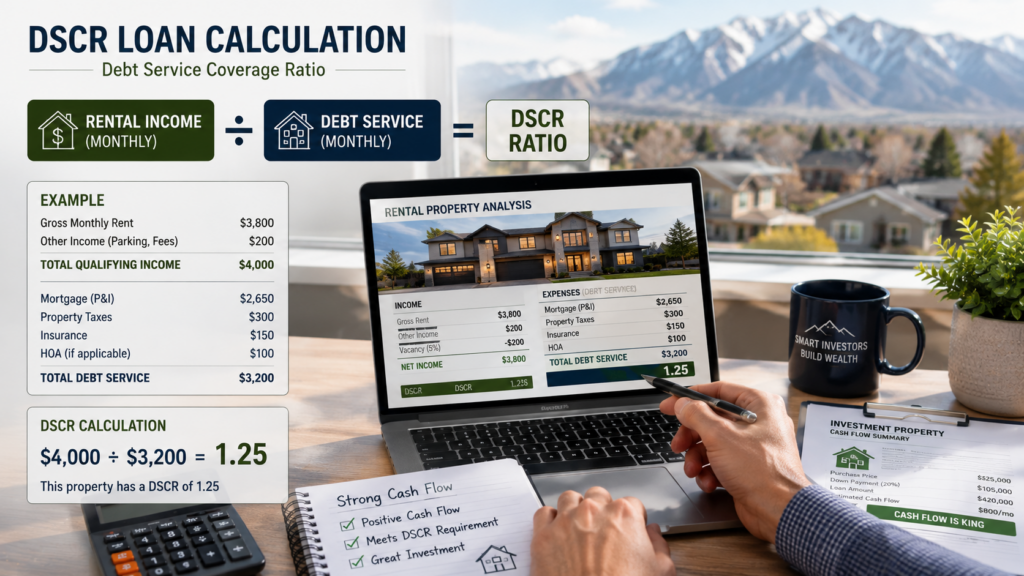
A simplified formula is:
DSCR = Qualifying Monthly Rental Income ÷ Qualifying Monthly Property Debt Obligation
Suppose qualifying monthly rent is $4,000 and the applicable qualifying property obligation is $3,200.
$4,000 ÷ $3,200 = 1.25 DSCR
That property generates qualifying rent equal to approximately 125% of the debt obligation used in this simplified calculation.
Use the DSCR Loan Calculator Utah to learn more about calculating the ratio.
Can I Get a Utah DSCR Loan With a Lower Credit Score?

Potentially.
A lower credit score does not necessarily end the discussion.
The more useful question is:
What DSCR programs are currently available for my credit score, property, LTV, rental income and transaction type?
A lower-credit investor may improve the overall risk profile by bringing more equity into the transaction.
For example, consider two otherwise similar rental-property purchases.
Scenario A
- Higher LTV
- Lower down payment
- Lower credit score
- Marginal property DSCR
This combination can create several layers of lender risk.
Scenario B
- Lower LTV
- Larger down payment
- Lower credit score
- Stronger DSCR
- Adequate reserves
The borrower still has lower credit, but the transaction contains other potentially positive factors.
That does not guarantee approval. It demonstrates why a DSCR loan should be evaluated as a complete scenario instead of using credit score alone.
DSCR Loans With Credit Scores in the 600s
Investors frequently ask whether they can obtain a DSCR mortgage with credit in the 600s.
The answer depends on the lender and the complete loan profile.
Some wholesale and Non-QM DSCR programs may accommodate credit profiles that do not fit the strongest credit tiers. Other lenders may have higher minimums or reduce maximum LTV as credit decreases.
If your credit is in this range, it is particularly important to evaluate:
- Current qualifying score
- Requested loan amount
- Property value or purchase price
- Requested LTV
- Expected qualifying rent
- Estimated PITIA or applicable debt obligation
- Property type
- Purchase or refinance
- Requested cash out
- Available reserves
Instead of asking only, “Is my score high enough?” ask Daniel Paris to compare the complete transaction against available programs.
What If My DSCR Is Strong but My Credit Score Is Lower?
A strong DSCR can be an important part of the transaction, but it does not erase the lender's credit requirements.
Suppose a property has substantial rental cash flow and produces a strong DSCR.
That can make the property's cash-flow profile attractive. The lender can still have minimum credit requirements or impose different LTV and pricing adjustments based on the borrower's credit profile.
The reverse can also occur.
Excellent borrower credit does not automatically solve a property that fails the lender's required DSCR.
The lender evaluates the combination.
What If My DSCR Is Below 1.00?
A DSCR below 1.00 generally means the qualifying rental income is less than the applicable debt obligation used in the calculation.
That does not necessarily mean every financing option disappears.
Certain programs may permit DSCR ratios below 1.00 or use no-ratio structures under qualifying circumstances.
These programs can have different:
- Credit requirements
- LTV limits
- Pricing
- Reserve requirements
- Property restrictions
- Loan-size limits
Read No-Ratio DSCR Loans Utah for a detailed explanation.
Does a Larger Down Payment Help With Lower Credit?
Potentially.
A larger down payment lowers the LTV.
Lower LTV means the lender is financing a smaller percentage of the property's value.
For example:
| Purchase Price | Loan Amount | Down Payment | LTV |
|---|---|---|---|
| $500,000 | $400,000 | $100,000 | 80% |
| $500,000 | $375,000 | $125,000 | 75% |
| $500,000 | $350,000 | $150,000 | 70% |
| $500,000 | $325,000 | $175,000 | 65% |
A lender may view a lower-LTV transaction differently from a highly leveraged transaction with the same borrower credit profile.
See DSCR Loan Down Payment Utah for more information.
How Credit Score Can Affect DSCR Cash-Out Refinancing
Credit can become particularly important when an investor wants to extract equity from a rental property.
Cash-out transactions can have different maximum LTVs and underwriting rules from purchases or rate-and-term refinances.
The lender may consider:
- Credit score
- Current property value
- Existing mortgage balance
- Requested cash out
- Ownership seasoning
- Property DSCR
- Mortgage-payment history
- Reserves
- Property type
- Loan amount
Investors considering equity access should review DSCR Cash-Out Refinance Utah.
Does Checking DSCR Loan Rates Affect My Credit?
Simply discussing a scenario or asking about general program guidelines is different from formally applying for credit.
A formal mortgage application or lender credit review may involve a credit inquiry.
Before authorizing a credit report, ask what type of inquiry will be used and at what stage it is required.
You can initially provide an estimated score along with your property information to discuss potential program categories, but final qualification may require an acceptable lender credit report and complete underwriting.
Can I Use a DSCR Loan for an Airbnb or Short-Term Rental in Utah?
Potentially.
Certain DSCR programs can finance eligible short-term rental properties. However, lender guidelines regarding rental-income documentation can differ substantially.
In addition to financing requirements, investors should independently verify:
- Local zoning
- Short-term rental licensing
- HOA restrictions
- Property-use restrictions
- Applicable municipal or county rules
A loan approval does not establish that a property may legally operate as a short-term rental.
See DSCR Loans for Short-Term Rentals Utah for more information.
Utah Markets Where DSCR Credit Requirements Matter
Utah rental-property markets can produce very different loan scenarios.
Salt Lake City and Salt Lake County
Investors may finance single-family rentals, condos and small multifamily properties throughout Salt Lake City, Murray, Sandy, Draper, South Jordan, Millcreek, Holladay and surrounding communities.
Visit DSCR Loans Salt Lake City Utah.
Park City and Summit County
Higher property values in Park City, Deer Valley, Canyons Village and surrounding Summit County communities can make loan amount, LTV, short-term rental eligibility and credit tiers especially important.
Visit DSCR Loans Park City Utah.
St. George and Washington County
St. George, Washington, Ivins, Santa Clara and Hurricane attract both long-term and short-term rental investors.
Visit DSCR Loans St. George Utah.
Utah County
Investors in Provo, Orem, Lehi, American Fork, Pleasant Grove, Saratoga Springs, Eagle Mountain, Alpine and Highland can use DSCR financing for eligible investment properties subject to program requirements.
Wasatch County
Heber City, Midway and the Jordanelle area can present investment opportunities involving long-term rentals, second-home markets and short-term rental considerations.
The property's legal use and lender eligibility should always be confirmed independently.
How to Improve a Lower-Credit DSCR Loan Scenario
If credit is preventing you from reaching the desired DSCR program, consider whether changing another part of the transaction improves available options.
1. Reduce the LTV
Increasing the down payment or leaving more equity in a refinance may open additional possibilities.
2. Improve the Property DSCR
A smaller loan amount may reduce the qualifying mortgage payment and improve the property's DSCR.
3. Increase Reserves
Some lenders may place value on stronger post-closing liquidity, subject to their guidelines.
4. Review the Credit Report
Check for inaccurate information and understand the factors affecting the qualifying score.
5. Compare Multiple DSCR Lenders
One lender's decline does not establish the guidelines of every DSCR lender.
This is one of the potential advantages of working with a wholesale mortgage broker.
DSCR Loans vs. Conventional Investment Loans With Lower Credit
A DSCR loan and conventional investment-property mortgage qualify borrowers differently.
A conventional mortgage typically evaluates personal qualifying income, liabilities and debt-to-income ratios under applicable agency guidelines.
A DSCR mortgage instead focuses heavily on the investment property's qualifying rental cash flow.
However, DSCR does not mean “no underwriting.”
DSCR lenders can still review:
- Credit
- Assets
- Reserves
- Property value
- Rental income
- Appraisal
- Title
- Mortgage history
- Entity documents
- LTV
- Loan purpose
Investors should compare both financing methods when both are available.
DSCR Loan Credit Score Utah: What to Send for a Scenario Review
You can get a much more useful DSCR evaluation by providing the complete transaction instead of only your credit score.
Send:
- Estimated credit score
- Property address
- Purchase price or estimated value
- Requested loan amount
- Current mortgage balance for refinances
- Expected monthly rent
- Current lease amount, if applicable
- Property type
- Purchase, refinance or cash-out
- Desired cash-out amount
- Estimated liquid reserves
- Short-term or long-term rental strategy
Daniel Paris can then compare the scenario against available Utah DSCR programs.
Utah DSCR Loan Credit Score FAQ
What is the minimum credit score for a DSCR loan in Utah?
There is no universal minimum credit score for every Utah DSCR lender. Minimum scores vary by lender, LTV, DSCR, property type, loan amount and transaction structure.
Can I get a DSCR loan with a 620 credit score in Utah?
Potentially, depending on currently available lender programs and the complete transaction. A lower score may result in lower maximum LTV, higher pricing or additional underwriting requirements. Availability should be verified for the actual property and borrower.
Can I get a DSCR loan with a 640 credit score?
Potentially. Some DSCR programs may accommodate this credit range, subject to the lender's current LTV, DSCR, property, reserves and other requirements.
Can I get a DSCR loan with a 660 credit score?
The selected lender must review this credit score with DSCR, LTV, reserves, loan amount, property eligibility and the full credit history. A score alone does not establish approval or pricing.
Is a 680 credit score good enough for a DSCR loan?
The selected lender must review this credit score with DSCR, LTV, reserves, loan amount, property eligibility and the full credit history. A score alone does not establish approval or pricing.
Does a 700 or higher score improve DSCR pricing?
It may. Stronger credit can provide better pricing or more program choices, but DSCR, LTV, property type, loan purpose and market conditions also influence rates.
Can a larger down payment compensate for lower credit?
Potentially. Increasing the down payment lowers LTV and reduces lender exposure. Whether that produces an acceptable loan depends on the lender's credit/LTV matrix and complete underwriting guidelines.
Does DSCR financing require personal income verification?
DSCR programs generally focus on qualifying property rental income instead of conventional personal debt-to-income qualification. However, lenders still perform underwriting and can require credit, asset, property and other documentation.
Explore the Utah DSCR Loan Resource Center
Continue researching your investment-property financing options:
- DSCR Mortgage Loans Utah — main Utah DSCR guide
- DSCR Loan Requirements Utah — underwriting and eligibility requirements
- DSCR Loan Rates Utah — factors affecting DSCR pricing
- DSCR Loan Calculator Utah — calculate rental-property DSCR
- DSCR Loan FAQ Utah — common investor questions
- DSCR Cash-Out Refinance Utah — accessing rental-property equity
- No-Ratio DSCR Loans Utah — below-1.00 and no-ratio concepts
- DSCR Loans for Short-Term Rentals Utah — Airbnb and vacation-rental financing
- DSCR Loan Down Payment Utah — equity and down-payment requirements
- DSCR Loan LTV Utah — purchase and refinance leverage
- DSCR Loans Salt Lake City Utah — Salt Lake investor financing
- DSCR Loans Park City Utah — Park City investment properties
- DSCR Loans St. George Utah — Southern Utah rental financing
Get Your Utah DSCR Scenario Reviewed
Your credit score is important, but it is only one part of a DSCR mortgage.
The best way to evaluate your options is to compare your credit score + DSCR + LTV + property + loan purpose + reserves together.
Daniel Paris
UtahLowRate.com
27+ years of mortgage experience
Call: 801-604-4949
Have a rental property in mind?
Send the property value, expected rent, loan amount and approximate credit score to compare available Utah DSCR loan options.
All loans are subject to lender underwriting, property eligibility, credit approval, appraisal and applicable program guidelines. Program availability, rates, fees, credit requirements, LTV limits and other terms are subject to change.
Related guides: Utah DSCR loan guide · DSCR loan requirements · DSCR calculation guide · DSCR loan rates · DSCR questions and answers ·

