
Content updated: September 29, 2026
Utah real estate investors often compare a DSCR vs conventional investment loan in Utah when financing a rental property. Both can finance investment real estate, but they approach qualification very differently.
A conventional investment-property mortgage generally evaluates the borrower's personal income, employment, assets, liabilities, credit and debt-to-income ratio (DTI). A DSCR loan generally places greater emphasis on the rental property's income and required housing expense, although credit, loan-to-value, reserves, property type and other underwriting requirements still matter.
Check My DSCR Scenario or call 801-604-4949.
For investors building rental portfolios, self-employed borrowers, or borrowers who have substantial tax deductions, understanding these differences can help identify which financing structure deserves consideration.
Explore Utah DSCR Loans or contact UtahLowRate.com to compare available investment-property mortgage options.
Quick Answer: A conventional investment loan normally qualifies the borrower using documented personal income and debt-to-income requirements. A DSCR loan typically focuses more heavily on whether the investment property's qualifying rental income supports its required monthly housing expense. DSCR financing may therefore be useful when personal-income documentation or DTI makes conventional financing difficult. Program guidelines, rates, LTV, credit requirements and property eligibility vary by lender.
DSCR vs Conventional Investment Loan Utah: Key Differences
The biggest difference is what drives qualification.
Loan percentages, credit examples and payment calculations are illustrations unless linked to an identified current program. They do not establish available terms or approval.
| Feature | DSCR Investment Loan | Conventional Investment Loan |
|---|---|---|
| Primary qualification focus | Property cash flow plus borrower/property risk factors | Borrower income, debts and overall underwriting |
| Personal DTI | Often not calculated in the traditional conventional manner | Generally part of qualification |
| Employment income | Often not the primary qualification method | Generally documented when used to qualify |
| Tax returns | May not be required to document personal qualifying income | May be required depending on income type |
| Rental income | Central to DSCR calculation | Can be considered under agency rental-income rules |
| LLC/entity ownership | Often available subject to lender requirements | Conventional agency financing generally follows individual borrower/title requirements |
| Investment properties | Yes | Yes |
| Primary residence | Generally no | Conventional programs can finance primary residences, but this comparison concerns investment loans |
| Credit | Important | Important |
| Reserves | Often required | May be required |
| Property value | Important | Important |
| Rate/pricing | Often higher than comparable agency financing | Agency conventional pricing may be lower for well-qualified borrowers |
| Underwriting | Lender/investor-specific non-QM guidelines | Agency and lender guidelines |
| Portfolio expansion | Can be useful when personal DTI becomes restrictive | Multiple financed-property rules can affect qualification |
Neither loan is automatically better. The right structure depends on the borrower, property, cash flow and investment strategy.
What Is a DSCR Loan?
A Debt Service Coverage Ratio mortgage is an investment-property loan that generally evaluates the property's qualifying rental income relative to the housing expense required under the lender's guidelines.
A simplified formula is:
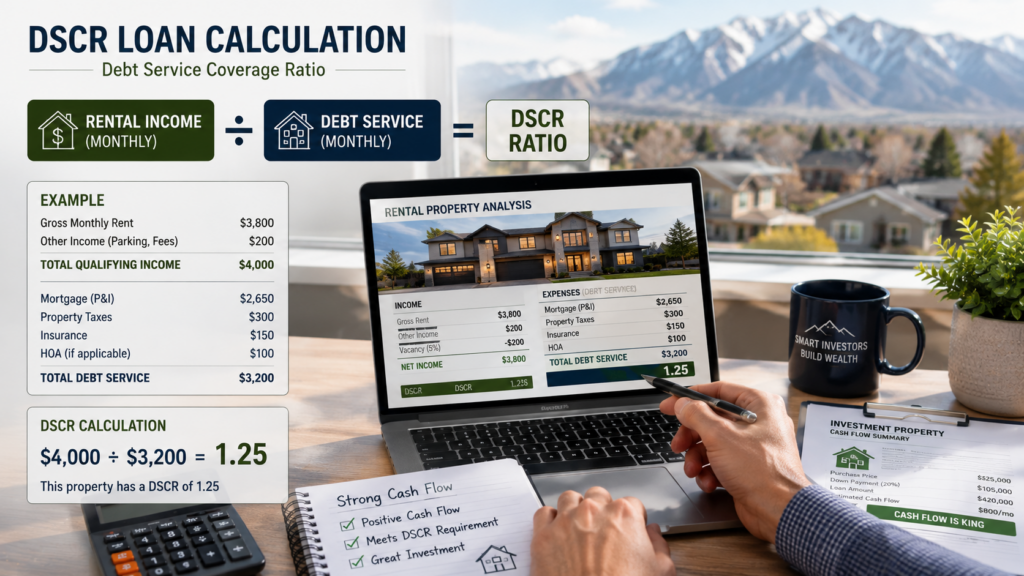
DSCR = Qualifying Monthly Rental Income ÷ Qualifying Monthly Property Expense
For example:
- Monthly qualifying rent: $4,000
- Qualifying monthly property expense: $3,200
- DSCR: 1.25
A 1.25 ratio means the property's qualifying rent is 125% of the qualifying monthly expense used in that calculation.
Different lenders can calculate income and expenses differently, so investors should not assume that a ratio calculated online will automatically be the underwriting ratio.
Use our Utah DSCR Loan Calculator to learn how the calculation works.
What Is a Conventional Investment Property Loan?

A conventional investment-property mortgage generally evaluates both the borrower and the property.
Depending on the transaction and borrower, underwriting can examine:
- Employment
- W-2 income
- Self-employed income
- Tax returns
- Assets
- Credit
- Existing mortgages
- Consumer debt
- Debt-to-income ratio
- Rental income
- Reserves
- Number of financed properties
- Property eligibility
Rental income can help a borrower qualify, but it must be calculated according to applicable program rules.
For investors with strong documented income, manageable personal debt and a straightforward property, conventional financing can be very attractive.
DSCR vs Conventional Loan: Personal Income Documentation
This is one of the most important differences.
Conventional Investment Loan
A conventional loan generally requires verification of the income being used for qualification.
Depending on the income source, documentation can include items such as:
- Paystubs
- W-2s
- Tax returns
- Employment verification
- Business returns
- K-1s
- Asset documentation
- Rental-property documentation
Self-employed investors may therefore have substantial real-world cash flow while showing less qualifying taxable income after legitimate business deductions.
DSCR Loan
A DSCR mortgage generally does not rely on the borrower's employment income as the primary qualification method.
Instead, underwriting can focus on the investment property's qualifying rental income and housing expense along with:
- Credit profile
- LTV
- Reserves
- Property type
- Appraisal
- Rental documentation
- Mortgage history
- Loan amount
- Transaction type
That distinction can make DSCR financing particularly useful for some self-employed borrowers and real estate investors.
DSCR vs Conventional Investment Loan Utah: DTI
Conventional financing generally incorporates the borrower's debts and qualifying income into a debt-to-income ratio.
That can include obligations such as mortgages, revolving accounts, installment debts and other recurring liabilities.
DSCR underwriting is different.
Many DSCR programs do not calculate the borrower's traditional personal DTI for qualification. Instead, they analyze the subject property's rental-income coverage.
This can become increasingly important as an investor acquires more properties.
An investor could have substantial assets and a profitable rental portfolio but encounter conventional qualification constraints because of personal DTI, documentation rules or the treatment of other financed properties.
A DSCR mortgage may provide another way to evaluate that investment.
How Rental Income Is Treated
Both programs can consider rental income, but they do not necessarily use it the same way.
Conventional Rental Income
Conventional underwriting follows agency requirements governing how qualifying rental income is documented and calculated.
Documentation can depend on whether the property is:
- Being purchased
- Already owned
- Currently leased
- Newly converted to rental use
- A one-unit property
- A multi-unit property
Appraisal rent schedules, leases and tax-return information may be relevant depending on the scenario.
DSCR Rental Income
DSCR lenders generally determine a qualifying rental amount according to their own program guidelines.
Possible evidence can include:
- Existing lease
- Market-rent analysis
- Appraisal rent schedule
- Short-term rental history when permitted
- Other lender-approved rental documentation
The method varies by lender and property type.
Investors considering Airbnb or VRBO-type properties should review our DSCR Loans for Short-Term Rentals Utah page because short-term rental income treatment can differ substantially between programs.
Can an LLC Get a DSCR Loan?
Potentially, and this is another major distinction.
Many DSCR programs permit qualifying investment properties to be vested in an LLC or other eligible borrowing entity, subject to the lender's rules and required guarantees.
That can be useful for investors who structure rental-property ownership through business entities.
Conventional agency mortgage structures have different borrower and vesting requirements and should not be assumed to provide the same entity-borrowing flexibility.
Learn more about DSCR Loans for LLCs in Utah.
Important: Choosing an LLC or other entity can have legal, tax, liability, insurance and estate-planning consequences. Mortgage information is not legal or tax advice. Consult qualified legal and tax professionals about ownership structure.
DSCR vs Conventional Loan Documentation

One reason investors investigate DSCR financing is the potential for a different documentation process.
Typical Conventional Documentation
Depending on the borrower:
- Loan application
- Income documentation
- Employment documentation
- Tax returns when required
- Asset statements
- Credit report
- Rental documentation
- Appraisal
- Insurance
- Title documentation
- Reserve documentation
Typical DSCR Documentation
Depending on the lender:
- Loan application
- Identification
- Credit report
- Asset/reserve documentation
- Purchase contract when applicable
- Existing lease when applicable
- Appraisal
- Market-rent documentation
- Insurance
- Title documentation
- Entity documents when applicable
DSCR does not mean “no documentation.” It means the loan uses a different qualification framework.
Which Loan Usually Has the Better Interest Rate?
Conventional financing often provides better pricing for borrowers who meet agency underwriting requirements.
DSCR loans are non-QM/business-purpose investment financing and may carry higher interest rates, points, prepayment provisions or other pricing adjustments depending on the program.
But rate alone does not determine the best investment loan.
Investors should compare:
- Interest rate
- APR when applicable
- Points
- Lender fees
- Prepayment provisions
- Amortization
- Interest-only options
- Cash-flow impact
- Required down payment
- Reserve requirements
- Qualification method
- Long-term investment strategy
Visit DSCR Loan Rates Utah for a deeper explanation of DSCR pricing.
Down Payment and LTV
Both conventional and DSCR investment loans use loan-to-value as a significant risk factor.
With DSCR financing, maximum LTV can depend on factors such as:
- Credit score
- DSCR
- Property type
- Loan amount
- Purchase versus refinance
- Cash-out versus rate-and-term
- Investor guidelines
Higher leverage can also affect pricing.
See:
How Does Credit Score Affect the Comparison?
Credit matters for both loan types.
A stronger credit profile can potentially improve eligibility, pricing or leverage, while a weaker profile can result in:
- Higher pricing
- Lower maximum LTV
- Larger down-payment requirements
- Additional reserves
- Fewer available programs
DSCR should therefore not be confused with a “no-credit” mortgage.
See DSCR Loan Credit Score Utah for a detailed explanation.
What If the Property Has a DSCR Below 1.00?
A ratio below 1.00 generally indicates that the qualifying rent is less than the qualifying housing expense used in the DSCR calculation.
That does not necessarily mean financing is impossible.
Some wholesale investors may periodically offer lower-DSCR or no-ratio programs for qualified scenarios. Availability, leverage, pricing, credit and reserve requirements can be substantially different.
Learn about No-Ratio DSCR Loans Utah.
Program availability should always be confirmed when you apply.
Purchase: DSCR or Conventional?
For a purchase, conventional financing can make sense when the borrower has:
- Strong qualifying income
- Acceptable DTI
- Strong credit
- Adequate reserves
- A conventional-eligible property
- Straightforward income documentation
DSCR may deserve consideration when the investor wants qualification to focus more heavily on the property's rental economics.
Read DSCR Purchase Loans Utah for the purchase-specific process.
Refinancing a Utah Rental Property
The same comparison applies when refinancing.
An investor may want to:
- Lower or restructure a payment
- Change loan terms
- Move from one financing structure to another
- Access a different amortization structure
- Reposition a rental portfolio
Learn more at DSCR Refinance Loans Utah.
Investors specifically seeking equity should review DSCR Cash-Out Refinance Utah.
Interest-Only DSCR vs Conventional Financing
Some DSCR programs offer interest-only payment structures.
During the interest-only period, scheduled principal is generally not included in the monthly payment. This can reduce the scheduled payment during that period, but it also means the principal balance is not being reduced through regular principal payments during the IO period.
That can affect cash flow and, depending on lender methodology, DSCR qualification.
Learn more about Interest-Only DSCR Loans Utah.
Which Loan Is Better for Building a Rental Portfolio?
There is no universal winner.
Conventional may be preferable when:
You qualify easily under agency guidelines, have strong documented income and DTI, want agency financing, and the property fits conventional requirements.
DSCR may be preferable when:
You want property-cash-flow-oriented underwriting, traditional DTI creates qualification challenges, personal income documentation is complicated, or an eligible entity structure is important.
Some investors use both strategies.
Conventional financing can be useful where the borrower and transaction fit agency underwriting well, while DSCR financing can provide an alternative for properties or portfolio situations where conventional qualification becomes restrictive.
Utah Investment Property Markets
DSCR and conventional investment-property financing can be considered throughout Utah, subject to program and property eligibility.
Investors commonly evaluate rentals in markets including:
- Salt Lake City
- Sandy
- Draper
- South Jordan
- Herriman
- Lehi
- American Fork
- Provo
- Orem
- Park City
- Heber City
- Midway
- Ogden
- Layton
- Bountiful
- St. George
- Washington
- Hurricane
- Ivins
Local rent, property taxes, homeowners insurance, HOA expenses, property type and market value can all affect the economics of a rental-property transaction.
DSCR vs Conventional: Example
Consider a Utah investor purchasing a rental property with:
Market rent: $3,500 per month
Qualifying property expense: $3,000 per month
The simplified DSCR would be:
$3,500 ÷ $3,000 = 1.17 DSCR
A DSCR lender may evaluate that ratio together with credit, LTV, reserves, property type and other guidelines.
With conventional financing, the underwriting analysis can instead incorporate qualifying rental income into the borrower's broader personal-income and liability analysis.
The same rental property can therefore produce a different underwriting outcome depending on the financing method.
DSCR Loan Requirements in Utah
DSCR requirements vary among wholesale lenders and programs.
Common underwriting factors can include:
- DSCR
- Credit score
- LTV
- Loan amount
- Property type
- Reserves
- Mortgage history
- Rental documentation
- Appraisal
- Transaction type
- Entity structure
- Prepayment terms
See the complete DSCR Loan Requirements Utah guide before comparing programs.
Frequently Asked Questions
Is a DSCR loan easier to qualify for than a conventional investment loan?
Not necessarily easier—just different. Conventional loans generally rely more heavily on documented borrower income and DTI. DSCR loans typically emphasize property rental cash flow along with credit, LTV, reserves and property eligibility.
Does a DSCR loan use my personal debt-to-income ratio?
Many DSCR programs do not qualify borrowers using the traditional personal DTI calculation used for conventional mortgages. Individual lender requirements vary.
Do I need tax returns for a DSCR loan?
Personal tax returns are often not required to document qualifying personal income for a DSCR loan because qualification is generally based primarily on the property's rental economics. Other documentation is still required.
Can I close a Utah DSCR loan in an LLC?
Many DSCR programs permit eligible entity vesting, including certain LLC structures, subject to lender requirements and guarantees. Conventional agency financing follows different borrower and title rules.
Are DSCR rates higher than conventional investment-property rates?
They often can be because DSCR loans are generally non-QM investment-property financing rather than agency conventional mortgages. Actual pricing depends on credit, LTV, DSCR, loan size, property type and market conditions.
Can I use a DSCR loan for an Airbnb in Utah?
Potentially. Short-term rental eligibility and income calculation vary by lender. Local zoning, licensing, HOA restrictions and short-term-rental regulations also need to be considered.
Can I refinance a conventional rental-property mortgage into a DSCR loan?
Potentially. Eligible investors may refinance existing investment-property debt into DSCR financing subject to property, borrower and lender requirements.
Can I take cash out with a DSCR loan?
Potentially. DSCR cash-out programs are available through some lenders, with maximum leverage, seasoning and documentation requirements varying by program.
Explore the Utah DSCR Loan Resource Center
Continue researching your financing options:
- DSCR Loans Utah
- DSCR Loan Requirements Utah
- DSCR Loan Rates Utah
- DSCR Loan Calculator Utah
- DSCR Loan FAQ Utah
- DSCR Cash-Out Refinance Utah
- No-Ratio DSCR Loans Utah
- DSCR Loans for Short-Term Rentals Utah
- DSCR Loan Credit Score Utah
- DSCR Loan Down Payment Utah
- DSCR Loan LTV Utah
- DSCR Loans for LLCs Utah
- Interest-Only DSCR Loans Utah
- DSCR Purchase Loans Utah
- DSCR Refinance Loans Utah
Compare DSCR and Conventional Investment Loan Options
The best financing structure depends on the complete transaction—not simply the advertised rate.
UtahLowRate.com can compare conventional investment-property financing with available wholesale DSCR programs based on your property's rental income, loan amount, LTV, credit profile and investment strategy.
Daniel Paris
Mortgage Broker | UtahLowRate.com
Serving Utah real estate investors statewide
Ready to compare the numbers?
Loan programs, underwriting guidelines, rates, terms, LTV limits and eligibility are subject to change. This information is educational and does not constitute a commitment to lend, legal advice or tax advice.
Related guides: Utah DSCR loan guide · DSCR loan requirements · DSCR calculation guide · DSCR loan rates · DSCR questions and answers ·

