
Content updated: September 29, 2026
Utah real estate investors who already own rental property may be able to restructure existing financing with DSCR refinance loans Utah. Instead of relying primarily on W-2 wages, tax returns or a traditional personal debt-to-income calculation, a DSCR refinance generally evaluates the rental property's qualifying income relative to its required housing debt.
A DSCR rate-and-term refinance can potentially replace an existing mortgage, change the interest rate or loan term, refinance short-term financing, move from an adjustable structure to a fixed structure, or otherwise restructure qualifying investment-property debt.
Check My DSCR Scenario or call 801-604-4949.
Daniel Paris at UtahLowRate.com helps real estate investors compare DSCR refinance programs for eligible rental properties throughout Utah.
Call Daniel Paris: 801-604-4949
Quick Answer: A DSCR refinance loan in Utah allows a qualified real estate investor to refinance an existing rental-property mortgage using the property's qualifying rental income as a central part of underwriting. Rate-and-term refinancing may be used to replace existing financing or restructure the loan without taking substantial equity out of the property. Guidelines for DSCR, LTV, credit, reserves, seasoning, property type and loan terms vary by lender.
Loan programs, rates, pricing, DSCR calculations, LTV limits and underwriting requirements can change. All loans are subject to lender approval.
DSCR Refinance Loans Utah: Quick Facts
Loan percentages, credit examples and payment calculations are illustrations unless linked to an identified current program. They do not establish available terms or approval.
| Feature | Typical DSCR Refinance Structure |
|---|---|
| Property use | Investment property |
| Primary qualification | Rental-property cash flow |
| Transaction | Rate-and-term refinance |
| Personal tax returns | Often not used for income qualification |
| Traditional personal DTI | Generally not the primary qualifying method |
| Existing rental properties | May qualify |
| LLC/entity vesting | May be permitted |
| Fixed-rate financing | May be available |
| Adjustable-rate financing | Program dependent |
| Interest-only options | May be available |
| Credit requirements | Vary by lender |
| Maximum LTV | Varies by program and risk profile |
| Minimum DSCR | Varies by lender/program |
| Reserves | May be required |
| Appraisal | Generally required |
| Prepayment provisions | May apply where permitted |
This table describes common DSCR concepts rather than guaranteed loan terms.
What Is a DSCR Refinance Loan?
A DSCR refinance replaces financing on an existing investment property with a new investment-property mortgage.
DSCR stands for Debt Service Coverage Ratio.
The lender generally evaluates the property's qualifying rental income compared with the qualifying housing or debt obligation calculated under that lender's guidelines.
The basic concept is:
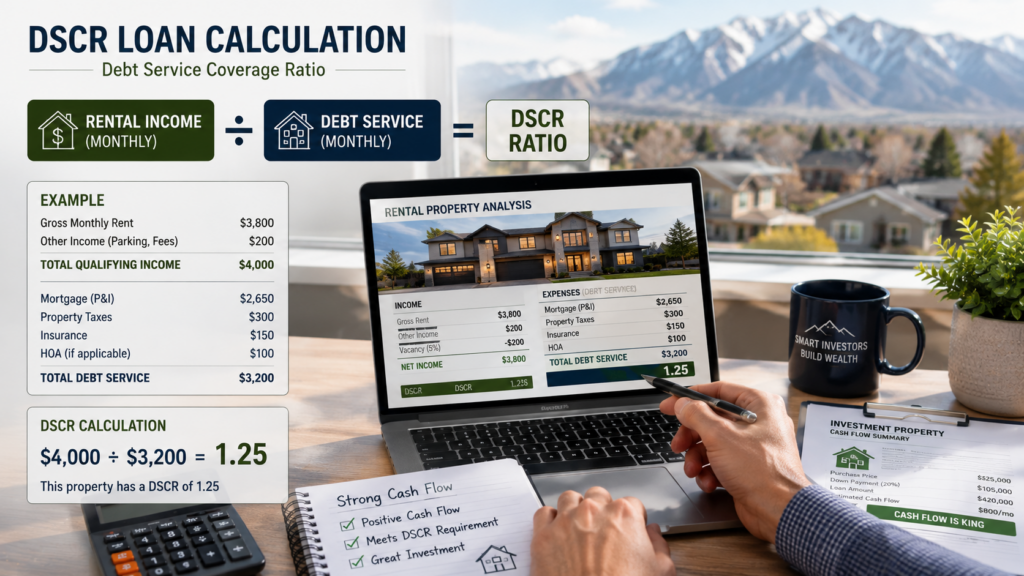
DSCR = Qualifying Monthly Rental Income ÷ Qualifying Monthly Property Debt Obligation
For example, if qualifying rent is $4,000 per month and the qualifying monthly obligation is $3,200:
$4,000 ÷ $3,200 = 1.25 DSCR
That means qualifying rental income equals approximately 125% of the debt obligation used in this simplified calculation.
Learn more about the formula and run sample numbers on our DSCR Loan Calculator Utah page.
How Do DSCR Refinance Loans Utah Work?

A DSCR refinance loan in Utah begins with the existing rental property rather than a new property acquisition.
The investor provides information about the property, current mortgage, estimated value, rental income and requested new financing.
The lender then evaluates factors such as:
- Current property value
- Existing mortgage balance
- Qualifying rental income
- Proposed new mortgage payment
- Property taxes
- Property insurance
- HOA dues when applicable
- DSCR
- Loan-to-value ratio
- Credit profile
- Mortgage payment history
- Assets and reserves
- Property type
- Title and entity structure
- Appraisal
- Existing liens
- Transaction seasoning
- Requested loan terms
Unlike many conventional mortgages, qualifying may not depend primarily on reconstructing the investor's personal taxable income.
That can be valuable for investors who own multiple properties or whose tax returns contain depreciation and other legitimate business deductions.
For a broader overview, visit DSCR Mortgage Loans in Utah.
Rate-and-Term DSCR Refinance Loans Utah
A rate-and-term DSCR refinance is designed primarily to replace existing property debt rather than extract substantial equity.
An investor might consider rate-and-term refinancing to:
- Replace an existing mortgage
- Change the interest rate
- Change the amortization period
- Replace an adjustable-rate loan
- Replace short-term financing
- Refinance qualifying bridge financing
- Move into a longer-term rental-property loan
- Change from amortizing to an available interest-only structure
- Change from interest-only to amortizing financing
- Restructure existing investment-property debt
Whether a transaction qualifies as rate-and-term depends on the lender's guidelines, including rules governing existing liens, closing costs, proceeds and permitted incidental cash back.
If your primary objective is extracting equity rather than restructuring existing debt, see DSCR Cash-Out Refinance Utah.
Rate-and-Term DSCR Refinance vs. Cash-Out DSCR Refinance
These are different transactions.
| Feature | Rate-and-Term Refinance | Cash-Out Refinance |
|---|---|---|
| Replaces existing mortgage | Yes | Yes |
| Main purpose | Restructure financing | Access property equity |
| Significant cash proceeds | Generally no | Yes |
| LTV rules | Program specific | Often more restrictive |
| Seasoning rules | Program specific | May be more restrictive |
| Pricing | Risk dependent | May differ from rate/term |
| DSCR analysis | Required by program | Required by program |
| Appraisal | Generally required | Generally required |
Investors primarily seeking equity should review our DSCR Cash-Out Refinance Utah guide before deciding which transaction structure fits their objective.
Why Refinance a Utah Rental Property With a DSCR Loan?
The reason to refinance should be based on the economics of the property and the investor's strategy—not simply because refinancing is available.
Replace Short-Term Financing
An investor may have originally purchased a property with bridge, private or other short-duration financing.
After the property is stabilized and producing qualifying rental income, a DSCR refinance may provide a path to longer-term financing, subject to lender requirements.
Restructure an Adjustable-Rate Loan
An investor with an adjustable-rate mortgage may want to compare available fixed-rate or alternative structures.
Change the Loan Term
The investor may want a different amortization schedule or loan duration.
Improve Property Cash Flow
If a new loan reduces the qualifying monthly property obligation, it may improve monthly cash flow.
However, lower payments do not automatically mean the refinance is economically beneficial. Closing costs, points, prepayment charges and the new loan's total cost should also be evaluated.
Move to Interest-Only Financing
Some DSCR programs offer interest-only periods.
An interest-only structure can reduce the scheduled payment during the IO period, but principal is not reduced through those scheduled interest-only payments.
See Interest-Only DSCR Loans Utah for a detailed comparison.
How DSCR Changes When You Refinance
One of the most important concepts in DSCR refinance loans Utah is that the proposed mortgage payment can affect the property's DSCR.
Suppose qualifying rent is:
$3,500 per month
If the qualifying monthly debt obligation under the proposed refinance is:
$3,500
Then:
$3,500 ÷ $3,500 = 1.00 DSCR
If refinancing changes the qualifying obligation to $3,000:
$3,500 ÷ $3,000 = approximately 1.17 DSCR
This illustrates why the proposed interest rate, loan amount, amortization and qualifying payment can matter.
Actual lender DSCR calculations can differ. Investors should use the lender's required rental-income and debt-obligation methodology rather than relying solely on a simple online calculation.
What DSCR Is Required for a Utah Refinance?
There is no universal minimum DSCR that applies to every lender.
Programs may establish different requirements based on:
- DSCR
- Credit score
- LTV
- Property type
- Loan amount
- Investor experience
- Reserves
- Transaction type
- Rental documentation
- Other risk characteristics
A DSCR of 1.00 generally means qualifying rental income equals the qualifying debt obligation used in the calculation.
A ratio above 1.00 generally indicates rent exceeds that obligation.
Some programs may consider DSCR below 1.00 or other no-ratio structures for qualified transactions.
Investors exploring those situations should review No-Ratio DSCR Loans Utah.
DSCR Refinance Loan LTV in Utah
Loan-to-value is another major underwriting factor.
The calculation is generally:
LTV = New Loan Amount ÷ Appraised Property Value
For example:
Property value: $600,000
Proposed refinance: $420,000
$420,000 ÷ $600,000 = 70% LTV
Maximum permitted LTV depends on the specific program.
Higher leverage can affect:
- Eligibility
- Interest rate
- Points
- Reserve requirements
- Required DSCR
- Credit requirements
- Available loan structures
Review DSCR Loan LTV Utah for a more detailed discussion of leverage and underwriting.
Credit Scores and DSCR Refinance Loans Utah
Credit remains important even though DSCR lending generally focuses heavily on rental-property cash flow.
A lender may evaluate:
- Representative credit score
- Mortgage payment history
- Housing history
- Bankruptcy or foreclosure history
- Delinquencies
- Credit utilization
- Overall credit profile
Better credit may provide access to stronger pricing or higher leverage, while lower-credit scenarios may require additional equity or other compensating factors.
See DSCR Loan Credit Score Utah for more information.
What Documents Are Needed for a DSCR Refinance?

Documentation varies, but investors should be prepared to provide items such as:
- Mortgage statement
- Property address
- Current lease when applicable
- Insurance information
- HOA information when applicable
- Asset statements
- Entity documents when applicable
- Identification
- Title information
- Existing lien information
- Property-management information when relevant
- Appraisal and rent documentation obtained through the loan process
Additional documentation can be required depending on the borrower, lender, property and transaction.
How Is Rental Income Verified?
Rental-income methodology is critical because it directly affects DSCR.
Depending on the lender and transaction, qualifying rent may be supported by an existing lease, appraisal rent schedule, market-rent analysis or other documentation acceptable to the lender.
The amount collected by the property owner is not automatically the amount a lender will use for qualification.
This distinction can become particularly important with:
- Recently increased rents
- Vacant properties
- Month-to-month tenants
- Below-market leases
- Short-term rentals
- Newly renovated properties
- Properties undergoing stabilization
Always establish the lender's qualifying rent before relying on a projected DSCR.
Refinancing a Short-Term Rental With a DSCR Loan
Qualified short-term rental properties may be eligible under certain DSCR programs.
Utah markets where investors may encounter short-term rental properties include areas around Park City, Deer Valley, Heber City, Midway, St. George and other tourism-oriented communities.
Short-term rental underwriting can be different from traditional long-term leases.
Investors should independently verify local zoning, licensing, HOA restrictions and other rules governing rental use. Mortgage approval does not establish that short-term rental activity is legally permitted.
Read DSCR Loans for Short-Term Rentals Utah for the detailed financing discussion.
DSCR Refinance Loans for LLC-Owned Utah Properties
Investment properties may sometimes be financed or vested in an eligible LLC or other approved business entity.
Lenders can require documentation such as:
- Articles of organization
- Operating agreement
- EIN information
- Good-standing documentation
- Ownership information
- Authorized signer information
- Personal guaranty when required
Entity requirements vary considerably.
Visit DSCR Loans for LLCs Utah for more information.
Can You Refinance Hard Money Into a DSCR Loan?
Potentially.
An investor may use temporary financing to acquire or renovate a property and later evaluate DSCR financing after the rental property is stabilized.
The lender may examine:
- Acquisition date
- Original purchase price
- Current appraised value
- Existing liens
- Payment history
- Property improvements
- Current rental income
- Seasoning
- Source of funds
- Requested refinance structure
The fact that a property now appraises for more than its original purchase price does not automatically mean the full new value can immediately be used for every refinance program.
Seasoning and value rules can apply.
DSCR Refinance Rates in Utah
There is no single DSCR refinance rate for every Utah rental property.
Pricing can depend on:
- Credit score
- DSCR
- LTV
- Loan amount
- Property type
- Rate-and-term versus cash-out
- Fixed versus adjustable structure
- Interest-only option
- Prepayment structure
- Investor experience
- Loan purpose
- Current capital-market conditions
That is why investors should compare the complete transaction rather than an advertised interest rate alone.
Visit DSCR Loan Rates Utah for a detailed explanation of DSCR mortgage pricing.
Points, Fees and Refinance Break-Even
A lower rate does not necessarily make a refinance worthwhile.
Suppose refinancing saves an investor $250 per month, but total refinance costs are $7,500.
A simple break-even estimate is:
$7,500 ÷ $250 = 30 months
The investor would need approximately 30 months of those monthly savings to recover the upfront costs, ignoring other financial effects.
The analysis should also consider:
- Discount points
- Lender fees
- Third-party closing costs
- Prepayment penalties on the existing loan
- New prepayment provisions
- Loan-term reset
- Principal reduction
- Expected property holding period
- Expected sale date
- Future refinance plans
Comparing APR, payment and total borrowing cost can provide a more complete picture than rate alone.
Prepayment Penalties and DSCR Refinancing
Prepayment provisions are particularly important for real estate investors.
Depending on applicable law and the loan program, a DSCR loan may include a prepayment provision.
Before refinancing, determine whether your existing mortgage has a prepayment charge.
Then review whether the new mortgage has one.
This is especially important if you expect to:
- Sell the property
- Refinance again
- Complete a 1031 exchange
- Pay down the loan
- Change investment strategies
A seemingly attractive rate may be less attractive when the complete prepayment structure is considered.
DSCR Refinance Loans Throughout Utah
UtahLowRate.com works with qualified rental-property investors throughout Utah.
Salt Lake County
DSCR refinance scenarios may involve rental properties in Salt Lake City, Murray, Holladay, Millcreek, Cottonwood Heights, Sandy, Draper, South Jordan, West Jordan, Riverton, Herriman, Midvale and surrounding communities.
Explore DSCR Loans Salt Lake City Utah for localized information.
Summit County and Park City
Park City, Deer Valley and surrounding Summit County communities include long-term rentals, vacation properties and short-term rental scenarios that may require specialized underwriting.
Visit DSCR Loans Park City Utah.
Washington County and St. George
Investors refinancing properties in St. George, Washington, Ivins, Santa Clara and Hurricane may also evaluate DSCR programs.
Visit DSCR Loans St. George Utah.
DSCR financing may also be available for qualified investment properties throughout Utah County, Davis County, Weber County, Wasatch County, Cache County and other eligible Utah markets.
DSCR Refinance vs. Conventional Investment-Property Refinance
The best program depends on the investor.
A conventional investment-property refinance may rely more heavily on the borrower's personal income, debt-to-income ratio and agency underwriting requirements.
A DSCR refinance generally places greater emphasis on the property's qualifying rental cash flow.
DSCR financing can therefore be useful for investors who:
- Own multiple rentals
- Have complex tax returns
- Are self-employed
- Have substantial business deductions
- Want property-focused qualification
- Hold investment properties in LLCs
- Need a Non-QM investment-property solution
However, DSCR financing is not automatically better or less expensive than conventional financing.
Compare both when both are available.
How to Apply for a DSCR Refinance Loan in Utah
Step 1: Provide the Property Information
Start with the property address, estimated value, property type and occupancy.
Step 2: Review the Existing Mortgage
Provide the approximate payoff, current rate, payment and loan structure.
Step 3: Establish Qualifying Rent
Determine what rental documentation the lender can use.
Step 4: Calculate the Proposed DSCR
Compare qualifying rent with the debt obligation under the proposed new mortgage.
Step 5: Review Credit and LTV
Credit and property equity can affect both eligibility and pricing.
Step 6: Compare Programs
Compare rate, APR, points, fees, payment, prepayment provisions, reserves and loan terms.
Step 7: Complete Appraisal and Underwriting
The lender reviews the property, borrower, title, assets, appraisal, rental income and other required documentation.
Ready to proceed? Use the UtahLowRate.com mortgage application or call Daniel Paris at 801-604-4949.
DSCR Refinance Loans Utah: Questions to Ask Before Refinancing
Before replacing an existing rental-property mortgage, ask:
- What is my current interest rate and remaining term?
- What will my new payment be?
- What DSCR does the proposed loan produce?
- What is my new LTV?
- How many discount points am I paying?
- What are the total closing costs?
- Does my existing loan have a prepayment penalty?
- Does the proposed DSCR loan have a prepayment provision?
- How long will it take to recover my refinance costs?
- How long do I expect to keep the property?
- Is rate-and-term or cash-out refinancing more appropriate?
- Would an interest-only structure improve cash flow enough to justify its tradeoffs?
Those questions turn a rate quote into an investment decision.
Frequently Asked Questions About DSCR Refinance Loans Utah
Can I refinance a rental property with a DSCR loan in Utah?
Potentially. Qualified investors may use DSCR financing to refinance eligible Utah rental properties. Approval depends on the property, rental income, DSCR, credit, LTV, appraisal, assets and lender guidelines.
Do I need tax returns for a DSCR refinance?
Many DSCR programs do not use personal tax returns as the primary method of establishing qualifying income. Documentation and underwriting requirements vary by lender.
Can I refinance an investment property owned by an LLC?
Potentially. Some DSCR lenders permit eligible business entities such as LLCs, subject to entity-documentation and guaranty requirements.
Can I refinance a short-term rental?
Some programs permit qualified short-term rental properties. Rental-income methodology, property eligibility and documentation vary substantially by lender.
Can I refinance a hard money loan into a DSCR loan?
Potentially. Investors sometimes evaluate DSCR financing after acquiring or stabilizing a rental property with short-term financing. Seasoning, appraisal, value, lien and refinance requirements apply.
Does refinancing affect my DSCR?
Yes. Because the proposed mortgage payment is part of the property's debt obligation under the applicable lender methodology, changing the loan amount, rate or payment can change the DSCR.
Can I get an interest-only DSCR refinance?
Interest-only structures may be available through certain DSCR programs. Qualification, pricing and maximum LTV vary.
What is the difference between DSCR rate-and-term and cash-out refinancing?
Rate-and-term refinancing primarily restructures existing qualifying debt. Cash-out refinancing is designed to provide equity proceeds to the investor. Cash-out transactions can have different LTV, seasoning, pricing and underwriting requirements.
Explore the Utah DSCR Loan Cluster
Continue researching your financing options:
DSCR Mortgage Loans in Utah — Complete statewide DSCR guide
DSCR Loan Requirements Utah — Qualification and underwriting requirements
DSCR Loan Rates Utah — Pricing, points and rate factors
DSCR Loan Calculator Utah — Calculate rental-property DSCR
DSCR Loan FAQ Utah — Frequently asked investor questions
DSCR Cash-Out Refinance Utah — Access investment-property equity
No-Ratio DSCR Loans Utah — Below-1.00 and alternative DSCR structures
DSCR Loans for Short-Term Rentals Utah — Airbnb/VRBO-type financing considerations
DSCR Loan Credit Score Utah — Credit tiers and financing interaction
DSCR Loan Down Payment Utah — Equity and purchase requirements
DSCR Loan LTV Utah — Loan-to-value guidelines and risk factors
DSCR Loans for LLCs Utah — Entity vesting and documentation
Interest-Only DSCR Loans Utah — Interest-only payment structures
DSCR Purchase Loans Utah — Rental-property acquisition financing
DSCR Refinance Loans Utah — Existing rental-property refinancing
DSCR Loans Salt Lake City Utah — Salt Lake-area investors
DSCR Loans Park City Utah — Park City and Summit County investors
DSCR Loans St. George Utah — Southern Utah rental properties
Get a DSCR Refinance Quote in Utah
If you already own a Utah rental property, the first step is not simply asking, “What is today's DSCR rate?”
The better question is:
What refinance structure produces the best combination of payment, DSCR, LTV, costs and flexibility for this property?
Daniel Paris at UtahLowRate.com can help qualified Utah real estate investors compare available wholesale DSCR refinance programs.
Daniel Paris
Utah Mortgage Broker | UtahLowRate.com
Call: 801-604-4949
Have the property address, estimated value, current mortgage balance, approximate rent and credit profile available for a more useful preliminary review.
Check My DSCR Refinance Options
Loan programs, interest rates, lender guidelines, DSCR requirements, LTV limits, credit requirements, prepayment provisions and property eligibility are subject to change. This material is educational and is not a commitment to lend or a guarantee of approval. Equal Housing Opportunity.
Related guides: Utah DSCR loan guide · DSCR loan requirements · DSCR calculation guide · DSCR loan rates · DSCR questions and answers ·

