
Content updated: September 29, 2026
Buy Utah Rental Property Based Primarily on Property Cash Flow
DSCR purchase loans Utah real estate investors use can provide an alternative to traditional investment-property financing. Instead of qualifying primarily from personal W-2 income or tax-return income, a DSCR loan focuses heavily on the rental property's qualifying income compared with its required housing payment.
Check My DSCR Scenario or call 801-604-4949.
That can make DSCR financing useful for investors purchasing single-family rentals, condos, townhomes, 2–4 unit properties and certain eligible short-term rentals throughout Utah.
Daniel Paris with UtahLowRate.com helps real estate investors compare DSCR purchase programs, rental-income calculations, credit requirements, down-payment options, reserves, interest-only structures and other investment-property financing.
Quick Answer: A DSCR purchase loan can allow a qualified Utah investor to buy an investment property based primarily on the property's qualifying rental income rather than traditional personal-income qualification. The lender still reviews credit, assets, down payment, reserves, property eligibility, appraisal, title and other underwriting requirements.
Loan guidelines, rates, DSCR calculations, credit requirements, LTV limits, reserves, property eligibility and program availability vary by lender and can change.
DSCR Purchase Loans Utah: Key Facts
Loan percentages, credit examples and payment calculations are illustrations unless linked to an identified current program. They do not establish available terms or approval.
| Feature | Typical DSCR Purchase Structure |
|---|---|
| Loan purpose | Purchase investment property |
| Occupancy | Non-owner-occupied |
| Main qualification method | Property rental cash flow |
| Personal tax returns | Often not required to establish qualifying income |
| Traditional personal DTI | Generally not the primary qualification method |
| Property types | Program dependent |
| Long-term rentals | Commonly eligible |
| Short-term rentals | May qualify under eligible programs |
| LLC/entity vesting | May be permitted |
| Down payment | Depends on LTV and program |
| Credit score | Lender/program dependent |
| DSCR requirement | Lender/program dependent |
| Reserves | May be required |
| Interest-only | Available through certain programs |
| Prepayment provisions | May apply where legally permitted |
| Appraisal | Generally required |
A DSCR loan is still an underwritten mortgage. "No tax returns" or "no personal DTI" should never be interpreted as "no underwriting."
What Is a DSCR Purchase Loan?
A DSCR purchase loan is generally a business-purpose mortgage used to acquire a non-owner-occupied rental property.
DSCR stands for Debt Service Coverage Ratio.
Rather than beginning with:
"How much personal income does the investor report?"
DSCR underwriting places greater emphasis on:
"How much qualifying rent does this property produce relative to its qualifying housing obligation?"
That distinction is especially important for real estate investors who have multiple rental properties, substantial tax deductions, depreciation, business ownership or complicated personal tax returns.
If you are researching DSCR financing generally before choosing a transaction type, start with the DSCR Mortgage Loans Utah guide.
How Does a DSCR Purchase Loan Work in Utah?

A DSCR purchase loan in Utah starts with the property you want to acquire.
The lender typically evaluates the proposed transaction using factors such as:
- Purchase price.
- Appraised value.
- Qualifying monthly rental income.
- Proposed principal and interest payment.
- Property taxes.
- Homeowners insurance.
- HOA dues when applicable.
- Loan amount.
- Loan-to-value ratio.
- Borrower credit.
- Required reserves.
- Property type.
- Investor experience when required.
- Entity structure.
- Prepayment terms.
- Interest-only or amortizing payment structure.
The lender then determines whether the property, borrower and proposed financing satisfy its DSCR purchase guidelines.
This makes it useful to evaluate financing before submitting an offer rather than waiting until the property is under contract.
DSCR Purchase Loans Utah: How the Ratio Is Calculated
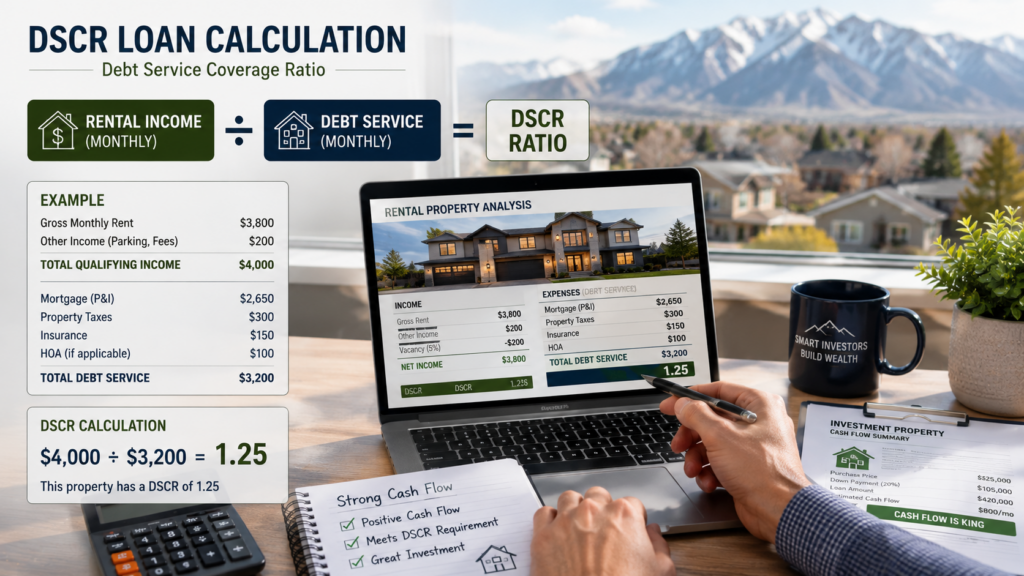
The simplified calculation is:
DSCR = Qualifying Monthly Rental Income ÷ Qualifying Monthly Property Debt Obligation
Suppose a Utah rental property has:
Qualifying rent: $4,000 per month
Qualifying housing obligation: $3,200 per month
The estimated DSCR is:
$4,000 ÷ $3,200 = 1.25 DSCR
In this simplified example, qualifying rental income equals 125% of the qualifying monthly obligation.
A ratio of 1.00 generally indicates that qualifying rent equals the obligation used in the lender's calculation.
A ratio above 1.00 indicates that rent exceeds that obligation.
A ratio below 1.00 indicates that rent is below it.
The exact numerator and denominator are lender-specific. Investors should therefore avoid assuming that a calculation from an online spreadsheet will exactly match an underwriter's result.
Use the DSCR Loan Calculator Utah page to examine the calculation in greater detail.
What Payment Does a Lender Use for a DSCR Purchase?
Many DSCR lenders compare qualifying rent with a housing obligation that can include some combination of:
- Principal
- Interest
- Property taxes
- Homeowners insurance
- HOA dues
- Other applicable housing expenses
The methodology varies.
That matters when comparing properties.
A condominium with substantial HOA dues, for example, may produce the same gross rent as a similar single-family rental but generate a lower DSCR because the qualifying monthly obligation is higher.
Taxes and insurance can have the same effect.
For this reason, investors should evaluate the complete proposed housing expense, not just principal and interest.
How Is Rental Income Determined on a Purchase?
This is one of the most important questions in DSCR purchase underwriting.
Depending on the lender and property, qualifying rent may be supported through documents such as:
- An appraisal rent schedule.
- Market-rent analysis.
- An existing lease when acceptable.
- Current rental documentation.
- Other lender-approved evidence.
The underwriter determines which rent figure is permitted under the applicable program.
Do not assume the rent advertised by a seller, real estate agent, property manager, Airbnb listing or investment-property calculator will automatically become qualifying DSCR income.
Why This Matters Before Making an Offer
Suppose an investor expects $4,500 in monthly rent but acceptable underwriting documentation supports only $4,000.
That difference could change:
- DSCR.
- Maximum LTV.
- Required down payment.
- Pricing.
- Loan eligibility.
- Reserve requirements.
- Available loan structure.
A preliminary DSCR analysis can help identify this risk before the investor gets too far into the transaction.
How Much Down Payment Is Required for a DSCR Purchase Loan?
There is no universal down-payment requirement for every DSCR purchase loan in Utah.
The required equity can depend on:
- Credit score.
- DSCR.
- Property type.
- Loan amount.
- Investor experience.
- Long-term versus short-term rental.
- Condominium characteristics.
- Property location.
- Interest-only versus amortizing structure.
- Current lender guidelines.
Maximum financing and required equity depend on the selected lender, credit, loan amount, property, documentation and transaction. Request a current program review before relying on an LTV percentage.
Availability is lender and scenario specific.
For a detailed explanation of the relationship between equity, DSCR and credit, see DSCR Loan Down Payment Utah and DSCR Loan LTV Utah.
Purchase Price vs. Appraised Value
For purchase transactions, maximum loan-to-value is generally determined using the applicable value established under lender guidelines, often involving the lower of the purchase price or appraised value.
This can create a problem when an appraisal comes in below the contract price.
For example, an investor might agree to pay $600,000 for a property but receive an appraisal supporting $575,000.
If financing is calculated from the lower eligible value, the investor may need additional cash or a revised transaction structure.
This is why both property value and property cash flow matter in DSCR purchase underwriting.
What Credit Score Is Needed for a Utah DSCR Purchase Loan?

There is no single minimum credit score across the entire DSCR market.
Credit can influence:
- Maximum LTV.
- Down payment.
- Interest rate.
- Points.
- Reserve requirements.
- Loan amount.
- DSCR flexibility.
- Property eligibility.
- Available lender choices.
A stronger credit profile may allow an investor to qualify for a more favorable combination of leverage and pricing.
Lower-credit scenarios may still have options, but they can involve lower LTVs, higher pricing or other compensating factors.
See DSCR Loan Credit Score Utah for a deeper discussion of how credit interacts with DSCR and LTV.
Does a DSCR Purchase Loan Require Personal Tax Returns?
Many DSCR programs do not require personal tax returns to establish the income used to qualify for the investment-property loan.
That is one of the major distinctions between DSCR and conventional income underwriting.
However, this does not eliminate documentation.
A lender can still require documentation relating to:
- Identity.
- Credit.
- Assets.
- Down payment.
- Closing costs.
- Reserves.
- Entity ownership.
- Property.
- Appraisal.
- Rental income.
- Insurance.
- Title.
- Housing history.
- Other underwriting conditions.
The transaction remains subject to complete lender underwriting.
DSCR Purchase Loans for LLCs
Many real estate investors prefer to acquire rental properties through an LLC or another eligible business entity.
Certain DSCR lenders permit eligible entity vesting.
Depending on the program, underwriting may request:
- Articles of organization.
- Operating agreement.
- EIN.
- Ownership information.
- Authorized signer information.
- Certificate or evidence of good standing.
- Personal guaranty from qualifying owners.
Entity requirements vary substantially.
Read DSCR Loans for LLCs Utah before deciding how the transaction will be titled.
Borrowers should consult qualified legal and tax professionals regarding liability protection, entity selection, tax consequences and ownership structure. Mortgage professionals do not provide legal or tax advice.
Can I Purchase a Short-Term Rental With a DSCR Loan?
Potentially.
Certain programs allow qualifying short-term or vacation rentals, but the underwriting of rental income can differ from a standard long-term lease.
This can be especially relevant in Utah recreation and tourism markets such as Park City, Deer Valley, the Wasatch Back and parts of Southern Utah.
Mortgage eligibility does not establish that a property may legally operate as a short-term rental.
Before relying on short-term rental revenue, independently investigate:
- Municipal zoning.
- County rules.
- Licensing.
- HOA restrictions.
- Deed restrictions.
- Rental caps.
- Nightly-rental restrictions.
- Property-specific requirements.
See DSCR Loans for Short-Term Rentals Utah for the specialized financing issues associated with Airbnb- and VRBO-type properties.
Interest-Only DSCR Purchase Loans Utah
Certain DSCR lenders offer interest-only structures.
During the interest-only period, the scheduled principal-and-interest payment can be lower than the payment on a fully amortizing loan.
That can potentially affect the DSCR calculation when the lender permits the applicable interest-only payment methodology.
But a lower initial payment does not automatically make an interest-only loan the better financial choice.
Investors should compare:
- Interest rate.
- Initial payment.
- Interest-only period.
- DSCR.
- Points.
- Remaining amortization period.
- Payment after the IO period.
- Total interest cost.
- Prepayment provisions.
- Expected property holding period.
See Interest-Only DSCR Loans Utah for a side-by-side explanation.
Can You Purchase With a DSCR Below 1.00?
Some lenders may offer programs for qualifying transactions with DSCR below 1.00 or other reduced/no-ratio structures.
Availability varies substantially.
A lender considering a weaker property cash-flow ratio may look more closely at compensating factors such as:
- Higher credit.
- Lower LTV.
- Larger down payment.
- Strong reserves.
- Property quality.
- Investor experience.
- Loan amount.
- Overall transaction strength.
Investors should not assume that a property failing a 1.00 DSCR automatically qualifies for a "no-ratio" program.
See No-Ratio DSCR Loans Utah for a more detailed discussion.
What Properties Can Be Purchased With DSCR Financing?
Depending on the lender, qualifying DSCR purchase financing may be available for:
Single-Family Rentals
Detached single-family rental homes are among the most common DSCR properties.
Townhomes
Eligible non-owner-occupied townhomes may qualify.
Condominiums
Investment condos may qualify, although project characteristics can create additional underwriting requirements.
Duplexes
A qualifying duplex can provide two potential rental-income streams within one property.
Triplexes
Three-unit investment properties may be eligible under certain programs.
Fourplexes
Eligible four-unit properties may also qualify under residential DSCR programs.
Short-Term Rentals
Certain programs consider eligible vacation and short-term rentals subject to lender requirements and local rental restrictions.
Property eligibility varies. Confirm the specific property before assuming a program is available.
Utah DSCR Purchase Loan Workflow
A strong acquisition process begins before the purchase contract.
Step 1: Establish Your Investment Strategy
Identify whether you are buying a:
- Long-term rental.
- Short-term rental.
- Single-family property.
- Condo or townhome.
- 2–4 unit property.
- Higher-balance investment property.
The intended property type can influence lender selection.
Step 2: Review Credit and Available Cash
Determine the approximate credit profile and available funds for:
- Down payment.
- Closing costs.
- Required reserves.
- Potential appraisal shortfall.
This establishes a realistic purchase range.
Step 3: Estimate the Property's Qualifying Rent
Do not rely exclusively on the listing agent's projected rent.
Evaluate likely market rent and determine what documentation the prospective DSCR lender may accept.
Step 4: Estimate PITIA and DSCR
Calculate the proposed payment using realistic:
- Interest rate.
- Taxes.
- Insurance.
- HOA dues.
- Loan amount.
Then compare qualifying rent with the applicable payment.
Step 5: Compare Lender Programs
Compare more than the rate.
Review:
- DSCR requirement.
- Maximum LTV.
- Credit tier.
- Interest rate.
- Points.
- Lender fees.
- Reserves.
- Prepayment provisions.
- Interest-only availability.
- Property restrictions.
- Entity requirements.
Step 6: Submit the Purchase Contract
Once under contract, provide the executed agreement and requested property information promptly.
Step 7: Complete the Appraisal and Rent Analysis
The appraisal can establish both property value and, when applicable, acceptable market-rent information.
Step 8: Complete Underwriting
The lender reviews the borrower, assets, credit, property, appraisal, rent, title, insurance, entity documents and other required conditions.
Step 9: Review Final Loan Terms
Before closing, compare the approved loan with your investment assumptions.
Pay particular attention to:
- Rate.
- Payment.
- Cash to close.
- Points.
- Prepayment terms.
- Interest-only provisions.
- Final DSCR.
Step 10: Close the Rental Property Purchase
After final approval and satisfaction of all conditions, the acquisition can proceed to closing.
Documents to Prepare for a DSCR Purchase
The exact list varies, but investors may need documents such as:
- Purchase agreement.
- Identification.
- Asset statements.
- Earnest-money documentation.
- Insurance information.
- Entity documents when applicable.
- Existing lease when relevant.
- Property information.
- HOA information when applicable.
- Explanation or documentation of significant asset transactions when required.
- Other lender-requested underwriting documents.
Preparing the file early can reduce avoidable delays after the property is under contract.
DSCR Purchase Loans vs. Conventional Investment Loans
| Feature | DSCR Purchase Loan | Conventional Investment Loan |
|---|---|---|
| Primary income focus | Property rental cash flow | Borrower income and DTI |
| Tax returns for income qualification | Often not required | Commonly required depending on income type |
| Personal DTI | Generally not primary method | Important |
| Investment property | Yes | Yes |
| LLC closing | May be available | More limited |
| Multiple financed properties | Program dependent | Agency rules apply |
| Short-term rentals | Specialized programs available | More restrictive income treatment may apply |
| Pricing | Non-QM/investor specific | Agency/market based |
| Prepayment provision | May apply | Typically different structure |
Neither option is automatically better.
The appropriate financing depends on the investor, property, documentation, cash flow and long-term strategy.
DSCR Purchase Loans in Salt Lake City and Salt Lake County
Investors may use qualifying DSCR purchase financing for eligible properties throughout Salt Lake County, including:
Salt Lake City, Murray, Holladay, Millcreek, Cottonwood Heights, Sandy, Draper, South Jordan, West Jordan, Riverton, Herriman, Bluffdale, Midvale, Taylorsville and surrounding communities.
Two properties with the same purchase price can produce very different DSCR results because rent, property taxes, insurance and HOA expenses differ.
DSCR Purchase Loans in Utah County
DSCR financing may be available for eligible investment-property purchases in:
Provo, Orem, Lehi, American Fork, Alpine, Highland, Pleasant Grove, Saratoga Springs, Eagle Mountain, Spanish Fork and surrounding Utah County communities.
Investors should evaluate current market rent rather than assuming future appreciation will compensate for weak cash flow.
DSCR Purchase Loans in Park City and the Wasatch Back
Park City and the Wasatch Back can require a more specialized DSCR analysis because of:
- Higher property values.
- Condominiums.
- Resort properties.
- HOA expenses.
- Seasonal rent.
- Short-term rental activity.
- Property-specific rental restrictions.
Potential markets include Park City, Deer Valley, Canyons Village, Old Town, Kimball Junction, Promontory, Heber City, Midway, Jordanelle, Hideout and Kamas.
Confirm short-term rental legality independently before basing an acquisition on projected nightly-rental income.
DSCR Purchase Loans in St. George and Southern Utah
Eligible DSCR purchases may also be considered in St. George, Washington, Ivins, Santa Clara, Hurricane and other Southern Utah communities.
Investors considering vacation-rental properties should separately confirm zoning, HOA rules, licensing and other local requirements.
Loan approval does not establish legal short-term rental eligibility.
Common DSCR Purchase Mistakes
Assuming Seller-Proposed Rent Will Qualify
Underwriting may use different acceptable rental evidence.
Looking Only at the Interest Rate
Points, lender fees, prepayment provisions and loan structure can materially affect the economics.
Ignoring HOA Dues
HOA expenses can reduce DSCR.
Underestimating Property Taxes or Insurance
Both can change the qualifying payment and cash flow.
Using Maximum Leverage Without Testing Cash Flow
A larger down payment can reduce the loan amount and payment and potentially improve DSCR.
Waiting Until After the Contract to Review DSCR
Analyzing financing before making an offer can reveal problems earlier.
Assuming Every Lender Uses the Same Guidelines
DSCR is a broad category of Non-QM/business-purpose lending. Guidelines vary significantly between investors.
How to Improve a DSCR Purchase Scenario
If the initial transaction does not work, possible alternatives can include:
- Increasing the down payment.
- Reducing the loan amount.
- Selecting a different eligible loan structure.
- Evaluating interest-only financing when appropriate.
- Comparing lenders with different DSCR requirements.
- Documenting eligible market rent correctly.
- Evaluating a different property.
- Improving credit before closing when practical.
- Considering an eligible reduced-DSCR/no-ratio program.
The appropriate solution depends on why the original transaction failed.
Frequently Asked Questions About DSCR Purchase Loans Utah
Can I use a DSCR loan to buy a rental property in Utah?
Potentially. DSCR purchase loans are designed for qualifying non-owner-occupied investment properties and generally focus primarily on the property's qualifying rental cash flow.
Do I need a job to qualify for a DSCR purchase loan?
Traditional employment income is generally not the primary qualifying method for a DSCR mortgage. The lender still evaluates credit, assets, property, reserves and other program requirements.
Do DSCR purchase loans require tax returns?
Many programs do not require personal tax returns to establish qualifying income. Exact documentation requirements vary by lender.
How much do I need down on a DSCR purchase?
Maximum financing and required equity depend on the selected lender, credit, loan amount, property, documentation and transaction. Request a current program review before relying on an LTV percentage.
Can I buy a property in an LLC?
Many DSCR programs permit eligible LLC or entity vesting, subject to lender documentation and guarantor requirements.
Can I purchase an Airbnb property with a DSCR loan?
Certain programs finance eligible short-term rentals. Mortgage eligibility is separate from local zoning, HOA, licensing and rental rules.
Does a 1.00 DSCR guarantee approval?
No. DSCR is only one underwriting factor. Credit, LTV, assets, reserves, property eligibility and other requirements still apply.
Can a property qualify with DSCR below 1.00?
Potentially. Some lenders offer reduced-DSCR or no-ratio options for qualifying transactions, but availability, pricing and LTV can differ.
Does a bigger down payment improve DSCR?
It often can. A larger down payment reduces the loan amount and can reduce the required mortgage payment, which may improve the property's calculated DSCR.
Should I get a DSCR analysis before making an offer?
It can be useful. Reviewing estimated rent, payment, DSCR, LTV and available programs before entering a purchase contract can identify financing problems earlier.
Explore the Utah DSCR Loan Resource Center
Use these guides to research the specific part of your transaction:
DSCR Mortgage Loans Utah — statewide DSCR financing overview.
DSCR Loan Requirements Utah — borrower, property, credit, asset and underwriting requirements.
DSCR Loan Rates Utah — understand how DSCR, credit, LTV, points and loan structure can affect pricing.
DSCR Loan Calculator Utah — calculate estimated property DSCR.
DSCR Loan FAQ Utah — answers to common investor questions.
DSCR Cash-Out Refinance Utah — accessing equity from an existing Utah investment property.
No-Ratio DSCR Loans Utah — reduced-DSCR and no-ratio program concepts.
DSCR Loans for Short-Term Rentals Utah — financing considerations for qualifying Airbnb- and VRBO-type properties.
DSCR Loan Credit Score Utah — credit tiers and their relationship to pricing and leverage.
DSCR Loan Down Payment Utah — understand required purchase equity.
DSCR Loan LTV Utah — purchase, refinance and cash-out loan-to-value considerations.
DSCR Loans for LLCs Utah — entity vesting, guaranties and common LLC documentation.
Interest-Only DSCR Loans Utah — compare interest-only and amortizing payment structures.
DSCR Purchase Loans Utah — acquisition financing and purchase underwriting.
Local guides should also connect investors with dedicated DSCR Loans Salt Lake City Utah, DSCR Loans Park City Utah, DSCR Loans St. George Utah and other Utah county/city resources as the statewide cluster expands.
Get a DSCR Purchase Loan Quote in Utah
A rental property can look attractive on paper and still produce a very different result once qualifying rent, taxes, insurance, HOA dues, loan amount, rate and lender DSCR rules are applied.
That is why the best time to evaluate financing is often before making the offer.
Daniel Paris with UtahLowRate.com can compare available wholesale DSCR programs for qualified Utah real estate investors and evaluate the property's estimated:
- DSCR.
- Down payment.
- LTV.
- Credit tier.
- Loan structure.
- Interest-only options.
- Reserves.
- Estimated cash to close.
Daniel Paris
UtahLowRate.com
Utah Mortgage Broker
Call: 801-604-4949
Next step: Get a DSCR purchase scenario before you submit your offer.
Loan programs, rates, guidelines, DSCR calculations, loan-to-value limits, credit requirements, reserve requirements, property eligibility and program availability are subject to change and lender underwriting. Information is educational and is not a commitment to lend. Short-term rental legality should be independently verified with applicable municipalities, counties, HOAs and qualified professionals. Consult legal and tax professionals regarding entity ownership and tax matters.
Related guides: Utah DSCR loan guide · DSCR loan requirements · DSCR calculation guide · DSCR loan rates · DSCR questions and answers ·

