
Content updated: September 29, 2026
Lower Initial Payments and the Effect on DSCR Qualification
Interest-only DSCR loans in Utah may allow qualified real estate investors to make scheduled interest payments without scheduled principal reduction during an initial interest-only period. Because the required mortgage payment can be lower during that period, an interest-only structure may also affect the property's Debt Service Coverage Ratio calculation, depending on the lender's underwriting method.
Check My DSCR Scenario or call 801-604-4949.
That does not automatically make an interest-only DSCR loan the better choice.
Utah investors should compare the initial payment, qualifying DSCR, interest-only period, future amortizing payment, interest rate, points, prepayment provisions, equity requirements and total financing strategy.
Daniel Paris with UtahLowRate.com helps real estate investors compare DSCR financing for eligible investment properties throughout Utah.
Call Daniel Paris: 801-604-4949
Loan programs, interest-only features, DSCR calculations, rates, loan-to-value limits, credit requirements, prepayment provisions and property eligibility vary by lender and are subject to change.
Quick Answer: How Do Interest-Only DSCR Loans Work in Utah?
An interest-only DSCR loan in Utah may allow a qualified investor to pay only the scheduled interest due on the mortgage during a defined IO period. Principal is generally not reduced through the required monthly payment during that period.
The lower scheduled payment can improve monthly property cash flow and, when the lender permits the interest-only payment to be used for qualification, may improve the property's calculated DSCR.
However, the loan eventually reaches the end of its interest-only period. The borrower must then follow the loan's applicable repayment structure, which may result in a higher required monthly payment.
The exact qualifying payment and DSCR methodology are lender specific.
Interest-Only DSCR Loans Utah: Key Facts
Loan percentages, credit examples and payment calculations are illustrations unless linked to an identified current program. They do not establish available terms or approval.
| Feature | Typical Consideration |
|---|---|
| Property occupancy | Investment property |
| Primary qualification | Property rental cash flow and lender requirements |
| Interest-only period | Program specific |
| Scheduled principal during IO period | Generally none |
| Initial required payment | May be lower than comparable amortizing payment |
| Effect on DSCR | May improve calculated ratio when lender qualifies using IO payment |
| Tax returns for income qualification | Often not required |
| Traditional personal DTI | Generally not the primary qualifying method |
| Purchase | May be available |
| Rate-and-term refinance | May be available |
| Cash-out refinance | May be available |
| LLC/entity vesting | May be permitted |
| Prepayment provision | May apply where permitted |
| Reserves | Program dependent |
| Credit requirements | Lender/program specific |
| LTV | Depends on credit, DSCR, property and transaction |
| Payment after IO period | Can increase materially |
These are general concepts rather than universal lending guidelines. Review the actual loan documents and lender requirements before selecting an interest-only structure.
What Is an Interest-Only DSCR Loan?

An interest-only DSCR mortgage combines two separate concepts.
The first is DSCR underwriting.
DSCR stands for Debt Service Coverage Ratio. Rather than qualifying primarily from the investor's personal employment income, a DSCR lender generally evaluates the rental property's qualifying income relative to the property's applicable monthly debt obligation.
Learn more in the Utah DSCR Mortgage Loan Guide.
The second concept is interest-only repayment.
During the interest-only period, the scheduled mortgage payment generally covers interest but does not include scheduled principal reduction.
This can produce a lower required initial payment than a comparable loan requiring principal and interest from the beginning.
But principal does not disappear. The investor still owes the applicable outstanding loan balance.
How Does an Interest-Only DSCR Payment Work?
Consider a simplified example.
Assume an investor has a:
- $500,000 loan balance
- 7.50% interest rate
- Interest-only payment structure
The simplified monthly interest calculation is:
$500,000 × 7.50% ÷ 12 = $3,125
The scheduled monthly interest payment would therefore be approximately $3,125, before property taxes, insurance, HOA dues or other applicable housing expenses.
With a fully amortizing loan, the required principal-and-interest payment would generally be higher because each scheduled payment also includes principal repayment.
This difference is central to understanding Interest-Only DSCR Loans Utah.
How Interest-Only Payments Can Affect DSCR
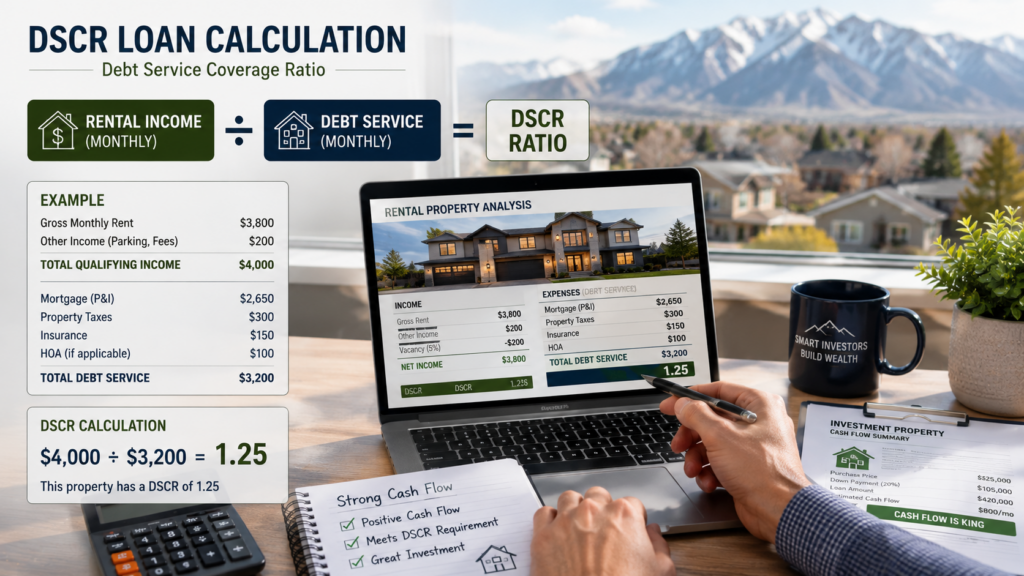
The basic DSCR concept can be expressed as:
DSCR = Qualifying Monthly Rental Income ÷ Qualifying Monthly Property Obligation
The lender determines what qualifies as rental income and what expenses are included in the denominator.
Depending on the program, the qualifying property obligation may include applicable amounts for:
- Principal and interest, or interest-only payment
- Property taxes
- Homeowners insurance
- Flood insurance when required
- HOA dues
- Other required property expenses
This is why two loans on the same Utah rental property can potentially produce different DSCR results.
For a deeper explanation of the formula, see the DSCR Loan Calculator Utah guide.
Interest-Only DSCR Example
Suppose an eligible Utah rental property has:
Qualifying monthly rent: $4,500
Assume the lender calculates the applicable housing obligation under an interest-only structure at:
$3,600 per month
The simplified DSCR would be:
$4,500 ÷ $3,600 = 1.25 DSCR
Now suppose the comparable fully amortizing structure creates an applicable qualifying obligation of:
$4,000 per month
The calculation becomes:
$4,500 ÷ $4,000 = 1.125 DSCR
The property's rent did not change.
The payment structure changed.
That difference illustrates why an interest-only option can potentially affect DSCR qualification when the lender permits qualification using the interest-only payment.
Actual calculations must follow the specific lender's guidelines.
Interest-Only vs. Amortizing DSCR Loans
An interest-only loan should not be judged solely by its lower initial payment.
Investors should compare the complete financing structure.
| Factor | Interest-Only DSCR | Fully Amortizing DSCR |
|---|---|---|
| Initial scheduled payment | Typically lower, all else equal | Typically higher |
| Scheduled principal reduction during initial period | No | Yes |
| Initial property cash flow | May be higher | May be lower |
| Potential qualifying DSCR | May be higher if IO payment is permitted for qualification | Based on applicable amortizing payment |
| Loan balance reduction from scheduled payments | Generally none during IO period | Yes |
| Payment-change risk | Higher when IO period ends | Generally more predictable with fixed-rate amortization |
| Equity growth from amortization | None from scheduled IO payments | Principal reduction contributes to equity |
| Investor flexibility | Can preserve monthly cash flow | Builds principal reduction into payment |
| Best choice | Strategy dependent | Strategy dependent |
Neither structure is automatically superior.
The appropriate choice depends on the investor's property, cash-flow objectives, expected holding period, leverage, reserves and exit strategy.
Why Would a Utah Investor Choose an Interest-Only DSCR Loan?
There are several possible reasons.
Improve Initial Property Cash Flow
A lower required mortgage payment may leave more rental income available after debt service.
That may be attractive to investors focused on near-term cash flow.
Potentially Improve the DSCR Calculation
If the lender uses the interest-only payment when calculating the property's qualifying obligation, the lower payment may result in a higher DSCR.
Investors near a lender's minimum ratio may therefore want to compare IO and amortizing structures.
Preserve Liquidity
Some investors prefer to retain capital rather than accelerate principal repayment.
The retained cash could potentially be held in reserves, used for property improvements or deployed elsewhere in an investment portfolio.
That is an investment decision, however, rather than a guaranteed financial advantage.
Portfolio Strategy
An investor acquiring several properties may value near-term cash-flow flexibility differently from an investor buying one long-term rental with a goal of rapidly reducing debt.
The mortgage should fit the investment strategy.
The Important Tradeoff: You Are Not Paying Down Principal
The lower payment has a cost.
During the interest-only period, required payments generally do not reduce principal.
If an investor borrows $750,000 and makes only the scheduled interest payments throughout the IO period, the investor could still owe approximately the original principal balance at the end of that period, absent additional principal payments or other balance adjustments.
With an amortizing mortgage, part of each scheduled payment normally reduces principal.
That distinction becomes especially important when evaluating long-term wealth, refinancing risk and exit strategy.
What Happens When the Interest-Only Period Ends?

This is one of the most important questions to ask before closing.
The mortgage does not become free after the interest-only period.
The loan transitions according to its contractual terms.
Depending on the specific structure, the remaining balance may then need to amortize over the remaining term.
That can cause a meaningful payment increase.
For example, a loan structured with an initial interest-only period followed by amortization has fewer remaining years over which to repay principal than a mortgage that began amortizing immediately.
Investors should evaluate both:
Payment today
and
Potential payment after the IO period
before choosing the loan.
Interest-Only DSCR Loans Utah and Cash Flow
Interest-only financing can make the initial cash-flow numbers look stronger.
But investors should evaluate more than the first month's payment.
A useful property analysis may include:
- Gross scheduled rent
- Vacancy assumptions
- Property taxes
- Insurance
- HOA dues
- Property management
- Repairs
- Maintenance
- Capital expenditures
- Utilities paid by the owner
- Interest-only mortgage payment
- Future amortizing payment
- Reserves
A lender's DSCR calculation is an underwriting formula.
It is not necessarily the same as the investor's actual economic cash flow.
That distinction matters.
A property can satisfy a lender's DSCR requirement while still having expenses that the lender's qualifying formula does not fully capture.
Can an Interest-Only Loan Help a Property Qualify for DSCR?
Potentially.
If a property's DSCR is weak because the proposed mortgage payment is high relative to qualifying rent, reducing the applicable payment through an interest-only structure may improve the ratio.
But the lender must permit that payment structure and qualification method.
Other factors still matter, including:
- Credit score
- LTV
- Loan amount
- Property type
- Rental income
- Reserves
- Transaction type
- Investor experience when required
- Prepayment structure
- Appraisal
- Market rent
- Entity structure
Investors with marginal property cash flow should also review No-Ratio DSCR Loans Utah, because some programs may consider ratios below 1.00 or use different minimum requirements.
Does Interest-Only Mean No-Ratio DSCR?
No.
These are different concepts.
Interest-only describes how scheduled mortgage payments are structured during a specified period.
No-ratio or low-DSCR financing describes an underwriting approach that may permit a property with a DSCR below the minimum required by other programs.
A loan could potentially be:
- Interest-only with a strong DSCR
- Interest-only with a low DSCR
- Fully amortizing with a strong DSCR
- Fully amortizing with a lower DSCR
Program availability and guidelines determine which combinations are permitted.
Interest-Only DSCR Loan Rates in Utah
Interest-only DSCR pricing should be compared using the entire loan structure rather than the note rate alone.
Pricing can be influenced by:
- Credit score
- DSCR
- LTV
- Loan amount
- Property type
- Purchase versus refinance
- Cash-out versus rate-and-term refinance
- Interest-only feature
- Fixed or adjustable structure
- Prepayment provision
- Investor experience
- Short-term rental characteristics
- Current capital-market conditions
Review DSCR Loan Rates Utah for a more detailed explanation of DSCR pricing.
A lower initial payment does not necessarily mean the loan has the lowest total financing cost.
Credit Score and Interest-Only DSCR Financing
Credit remains important even when personal income is not the primary qualifying factor.
A stronger credit profile may provide access to different combinations of:
- Pricing
- LTV
- DSCR requirements
- Loan amounts
- Interest-only structures
Lower-credit borrowers may face tighter leverage or different pricing.
See DSCR Loan Credit Score Utah for a detailed explanation of how credit can interact with DSCR financing.
LTV Matters With Interest-Only DSCR Loans
Loan-to-value represents the mortgage amount relative to the property's applicable value.
Higher leverage generally increases lender risk.
That means an investor seeking an interest-only DSCR structure should evaluate the interaction among:
LTV + credit + DSCR + property type + loan purpose
rather than considering any one variable by itself.
Review the DSCR Loan LTV Utah guide for purchase, refinance and cash-out considerations.
Investors planning a purchase should also compare the equity requirements discussed in DSCR Loan Down Payment Utah.
Interest-Only DSCR Cash-Out Refinance
Interest-only financing may also be available with certain DSCR refinance programs.
A qualified investor may want to access equity while keeping the initial required payment lower than a comparable amortizing structure.
However, cash-out transactions can have different:
- Maximum LTV limits
- Pricing
- Seasoning requirements
- Reserve requirements
- Credit requirements
- DSCR requirements
- Documentation rules
See DSCR Cash-Out Refinance Utah before structuring an equity-access transaction.
Interest-Only DSCR Loans for Short-Term Rentals
An interest-only structure may also be considered for an eligible short-term rental when the lender permits both the property type and the applicable rental-income methodology.
Utah investors should be especially careful with short-term rentals.
Financing approval does not establish that a property can legally operate as a nightly or short-term rental.
Investors should independently verify applicable:
- City rules
- County requirements
- Zoning
- HOA restrictions
- Licensing requirements
- Rental restrictions
See DSCR Loans for Short-Term Rentals Utah for more information.
Can an LLC Get an Interest-Only DSCR Loan in Utah?
Potentially.
Certain DSCR programs may permit eligible LLC or entity vesting.
The lender may require documents such as applicable formation documents, operating agreements, evidence of ownership and personal guarantees.
Entity requirements vary substantially.
See DSCR Loans for LLCs Utah for a dedicated explanation of entity vesting and documentation.
Investors should consult their attorney or tax professional regarding legal, liability and tax consequences of holding real estate in an entity.
Interest-Only DSCR Loans in Utah Investment Markets
Interest-only DSCR financing may be relevant across Utah because investor strategies differ significantly by market.
Salt Lake City and Salt Lake County
Investors may finance eligible single-family rentals, condominiums and other qualifying investment properties throughout Salt Lake City, Murray, Holladay, Millcreek, Sandy, Draper, South Jordan, West Jordan, Riverton, Herriman and surrounding communities.
Park City and Summit County
Higher property values can make payment structure particularly important for Park City, Deer Valley, Canyons Village, Old Town, Prospector, Kimball Junction and other Summit County investment properties.
Short-term rental rules and HOA restrictions should be independently verified when applicable.
Heber City and Wasatch County
Heber City, Midway, Jordanelle and surrounding Wasatch County markets may attract investors seeking long-term rentals, vacation-market properties and other investment opportunities.
Utah County
DSCR financing may be considered for eligible rental properties in Provo, Orem, Lehi, American Fork, Pleasant Grove, Alpine, Highland, Saratoga Springs, Eagle Mountain and other Utah County communities.
St. George and Washington County
St. George, Washington, Ivins, Santa Clara, Hurricane and surrounding Southern Utah communities can present different long-term and short-term rental strategies.
The appropriate financing structure depends on the property and the investor's objectives—not simply the city.
Interest-Only DSCR Loan Requirements in Utah
Requirements vary by lender, but an underwriter may evaluate:
- Property value
- Qualifying rental income
- Calculated DSCR
- Credit profile
- Loan-to-value ratio
- Requested loan amount
- Property type
- Purchase or refinance purpose
- Reserves
- Appraisal
- Lease or market-rent documentation
- Entity documents when applicable
- Investor experience when required
- Prepayment provisions
- Interest-only structure
For the broader qualification checklist, visit DSCR Loan Requirements Utah.
Questions to Ask Before Choosing an Interest-Only DSCR Loan
Do not compare interest-only loans using payment alone.
Ask:
How long is the interest-only period?
What payment is used to qualify the DSCR?
What will my payment potentially become after the IO period?
Does the interest rate change?
What are the points and lender fees?
Is there a prepayment penalty or prepayment provision?
Can I make additional principal payments?
What LTV is available?
What reserves are required?
How does the IO option compare with a fully amortizing loan?
These questions provide a much better basis for comparison than simply asking which loan has the lowest initial monthly payment.
When an Amortizing DSCR Loan May Be Better
Interest-only financing is not appropriate for every investor.
A fully amortizing loan may deserve consideration when the investor prioritizes:
- Consistent scheduled principal reduction
- Long-term debt reduction
- Building equity through amortization
- Avoiding a scheduled payment increase associated with the end of an IO period
- A simpler long-term repayment strategy
The right structure depends on the investor's goals.
When an Interest-Only DSCR Loan May Be Worth Comparing
An interest-only structure may deserve consideration when an investor prioritizes:
- Lower initial required payments
- Near-term rental cash flow
- Potential improvement to DSCR qualification
- Liquidity
- Portfolio expansion
- A defined property holding strategy
- A planned refinance or sale
Those potential advantages should always be compared against the lack of scheduled principal reduction and the future payment structure.
Interest-Only DSCR Loan Example: Look Beyond the First Payment
Consider two hypothetical loans on the same rental property.
Option A: Interest-Only DSCR
The initial required mortgage payment is lower.
That may improve initial cash flow and potentially the qualifying DSCR.
But the investor is not reducing principal through the required IO payments.
Option B: Fully Amortizing DSCR
The required payment is higher.
That may reduce initial monthly cash flow.
However, part of each scheduled payment reduces principal.
The correct comparison therefore is not:
“Which payment is lower?”
It is:
“Which financing structure better matches my investment plan, expected holding period, cash flow, reserves and exit strategy?”
Interest-Only DSCR Loans Utah FAQ
Can I get an interest-only DSCR loan in Utah?
Potentially. Interest-only options may be available through qualifying DSCR programs for eligible Utah investment properties. Availability, pricing and underwriting requirements vary by lender.
Does interest-only improve DSCR?
It can when the lender permits qualification using the lower interest-only payment. A lower applicable property obligation can mathematically produce a higher DSCR when qualifying rent remains unchanged.
Do I pay principal on an interest-only DSCR loan?
Generally, scheduled payments during the interest-only period do not include scheduled principal reduction. Review the actual note and loan documents for the specific repayment requirements.
What happens when the interest-only period ends?
The loan follows its contractual repayment structure. The required payment may increase when principal amortization begins.
Is an interest-only DSCR loan better than a 30-year amortizing loan?
Not automatically. Interest-only financing may provide lower initial payments, while amortizing financing provides scheduled principal reduction. The better structure depends on the investor's objectives and complete loan terms.
Can I use an interest-only DSCR loan for a Utah rental property held in an LLC?
Potentially. Some programs permit eligible entity vesting, subject to lender requirements and applicable guarantees and documentation.
Are interest-only DSCR loans available for short-term rentals?
Potentially, depending on the lender, property, location and rental-income methodology. Investors must separately confirm local zoning, licensing, HOA and short-term-rental restrictions.
Does an interest-only DSCR loan require tax returns?
Personal tax returns are often not used to establish qualifying employment income for a DSCR mortgage. However, lenders may require other borrower, asset, property and entity documentation.
Explore the Utah DSCR Loan Resource Center
Use these guides to compare the major parts of a Utah DSCR transaction:
DSCR Mortgage Loans Utah — complete statewide DSCR financing guide.
DSCR Loan Requirements Utah — credit, property, rental income, reserves and underwriting.
DSCR Loan Rates Utah — rate, points, credit, DSCR, LTV and pricing considerations.
DSCR Loan Calculator Utah — DSCR formula, PITIA methodology and worked examples.
DSCR Loan FAQ Utah — common Utah investor questions.
DSCR Cash-Out Refinance Utah — accessing equity from qualifying rental properties.
No-Ratio DSCR Loans Utah — lower-DSCR and below-1.00 program concepts.
DSCR Loans for Short-Term Rentals Utah — short-term rental financing considerations.
DSCR Loan Credit Score Utah — credit tiers and their relationship with pricing and leverage.
DSCR Loan Down Payment Utah — equity requirements for investment-property purchases.
DSCR Loan LTV Utah — purchase, refinance and cash-out loan-to-value considerations.
DSCR Loans for LLCs Utah — entity vesting, guarantees and common entity documents.
Interest-Only DSCR Loans Utah — IO payments, DSCR interaction and amortizing comparisons.
Compare Interest-Only DSCR Loan Options in Utah
An interest-only DSCR loan can change both the initial mortgage payment and potentially the property's qualifying DSCR.
But the lowest initial payment is not necessarily the best financing structure.
Before choosing an IO option, compare:
Interest-only payment • amortizing payment • DSCR • rate • points • LTV • credit requirements • reserves • prepayment terms • IO period • future payment • exit strategy
Daniel Paris with UtahLowRate.com can help qualified Utah real estate investors compare available DSCR mortgage structures across multiple wholesale lending programs.
Daniel Paris
Utah Mortgage Broker
UtahLowRate.com
Call: 801-604-4949
Serving qualified real estate investors throughout Salt Lake County, Utah County, Davis County, Weber County, Summit County, Wasatch County, Washington County and communities throughout Utah.
Check My Interest-Only DSCR Scenario
Have the following information ready:
- Property address
- Purchase price or estimated value
- Requested loan amount
- Monthly rent
- Estimated credit score
- Purchase, refinance or cash-out
- Property type
- Current mortgage balance, if applicable
That information makes it easier to compare an interest-only structure with a fully amortizing DSCR loan.
Important: Loan programs, rates, interest-only options, DSCR calculations, LTV limits, credit requirements, prepayment provisions, property eligibility and underwriting guidelines can change without notice. This information is educational and is not tax, legal or investment advice, a commitment to lend, or a guarantee of qualification. Investors should consult qualified legal and tax professionals regarding their individual circumstances. Equal Housing Opportunity.
Related guides: Utah DSCR loan guide · DSCR loan requirements · DSCR calculation guide · DSCR loan rates · DSCR questions and answers ·

