
Content updated: September 29, 2026
Super Jumbo Construction-to-Permanent Loans Utah can provide qualified borrowers with financing to build high-value custom homes when the required loan amount exceeds the range of conventional construction financing.
For borrowers building multimillion-dollar homes in Park City, Deer Valley, Salt Lake City, Holladay, Draper, Alpine, Highland, Heber City, Midway, St. George and other Utah luxury markets, specialized construction financing may offer loan structures designed for larger projects, complex assets and high-net-worth financial profiles.
Check My Jumbo Options or call 801-604-4949.
Daniel Paris with UtahLowRate.com helps qualified borrowers compare construction, jumbo and Super Jumbo mortgage programs for custom residential projects throughout Utah.
Daniel Paris | Utah Mortgage Broker
UtahLowRate.com
Call: 801-604-4949
More than 27 years of mortgage lending experience
Loan amounts, LTVs, rates, construction periods, builder requirements, reserves, documentation and permanent financing options vary by lender and are subject to underwriting and program availability.
Quick Answer: What Is a Super Jumbo Construction-to-Permanent Loan?
A Super Jumbo Construction-to-Permanent Loan in Utah is financing designed for qualified borrowers building expensive custom homes that require unusually large mortgage amounts. The financing provides funds during construction through scheduled draws and can transition into longer-term mortgage financing after the home is completed, depending on the selected loan structure.
Super Jumbo Construction-to-Permanent Loans Utah: Key Facts
Loan percentages, credit examples and payment calculations are illustrations unless linked to an identified current program. They do not establish available terms or approval.
| Feature | Potential Option |
|---|---|
| Purpose | Construction of high-value custom residences |
| Loan category | Jumbo / Super Jumbo |
| Construction financing | Available through qualifying programs |
| Permanent mortgage | May be incorporated or arranged after construction |
| Primary residence | Common eligible occupancy |
| Second home | Select programs |
| Luxury custom homes | Yes |
| Construction draws | Typically required |
| Builder approval | Generally required |
| Plans and specifications | Generally required |
| Construction budget | Required |
| Appraisal | Subject-to-completion appraisal typically required |
| Land equity | May potentially contribute toward required equity |
| Fixed or ARM permanent financing | Program dependent |
| Interest-only construction payments | Common structure; program dependent |
| Utah availability | Subject to lender and borrower eligibility |
The exact structure depends on the lender, project, property, borrower profile and permanent financing program.
What Is Construction-to-Permanent Financing?

Construction-to-permanent financing combines two important phases of building a home:
- financing the construction of the property; and
- establishing long-term mortgage financing after construction is completed.
During construction, loan proceeds are generally not released to the builder all at once.
Instead, funds are advanced through a draw schedule as specific stages of construction are completed.
Those stages may include:
- land or site preparation;
- foundation;
- framing;
- roofing;
- mechanical systems;
- electrical and plumbing;
- drywall and interior construction;
- cabinetry and finishes;
- landscaping; and
- final completion.
Inspections or other verification may be required before subsequent draws are released.
UtahLowRate.com also offers information about broader Utah construction loans and one-time-close construction loans.
How Do Super Jumbo Construction-to-Permanent Loans Work?
A large custom-home construction transaction typically begins with an analysis of the complete project rather than just the finished home's purchase price.
The lender may evaluate:
Land value + construction costs + soft costs + eligible reserves/contingencies = total project cost.
The borrower generally submits architectural plans, construction specifications, a detailed budget and builder information.
An appraiser may then estimate the property's expected value subject to completion.
The lender evaluates both the project and the borrower before determining the maximum loan amount and required equity.
Once approved and closed, construction funds are released according to the lender's draw procedures.
After the home is finished and applicable completion requirements are satisfied, the financing moves into its permanent phase or is refinanced into permanent financing, depending on how the transaction was originally structured.
One-Time Close vs Two-Time Close Super Jumbo Construction Loans
There are two broad ways a construction loan may be structured.
One-Time Close
A one-time-close construction-to-permanent mortgage generally establishes both the construction and permanent financing as part of one transaction.
Potential advantages can include:
- one initial closing;
- reduced exposure to a second loan approval;
- a permanent financing structure established earlier; and
- potentially fewer duplicated closing procedures.
However, extremely large Super Jumbo transactions may not always qualify for a one-time-close structure.
Two-Time Close
A two-time-close transaction uses separate construction and permanent loans.
The borrower initially obtains construction financing. When construction is complete, a second mortgage replaces the construction loan.
This approach can provide additional flexibility when the permanent loan involves specialized Super Jumbo underwriting.
The better structure depends on the project's size, expected completion date, borrower profile, interest-rate strategy and available lending programs.
Super Jumbo Construction Loans for Multimillion-Dollar Homes
Large luxury construction projects require different underwriting than typical residential construction loans.
A $5 million, $10 million or $20 million custom residence may involve substantial costs for:
- premium building materials;
- architectural and engineering services;
- extensive excavation;
- mountain-site construction;
- pools and spas;
- home automation;
- theaters;
- wine rooms;
- elevators;
- guest houses;
- large garages;
- specialty kitchens;
- landscaping; and
- other luxury improvements.
The lender must determine which costs contribute to the financeable project and appraised value.
Borrowers requiring substantial permanent financing should also review Super Jumbo mortgage loans in Utah.
Super Jumbo Construction-to-Permanent Loan Requirements
There is no universal set of requirements for every Super Jumbo construction loan.
Underwriting may evaluate:
Credit Profile
Credit history remains important even when a borrower has substantial income or net worth.
Large loan amounts can result in higher credit expectations, although requirements vary significantly among lenders.
Liquidity
A lender may want to see substantial liquid assets beyond the money needed to complete the transaction.
Reserves
Super Jumbo financing can require significant post-closing reserves.
Required reserves depend on factors such as:
- loan amount;
- occupancy;
- leverage;
- financial profile;
- number of financed properties; and
- lender guidelines.
Income and Cash Flow
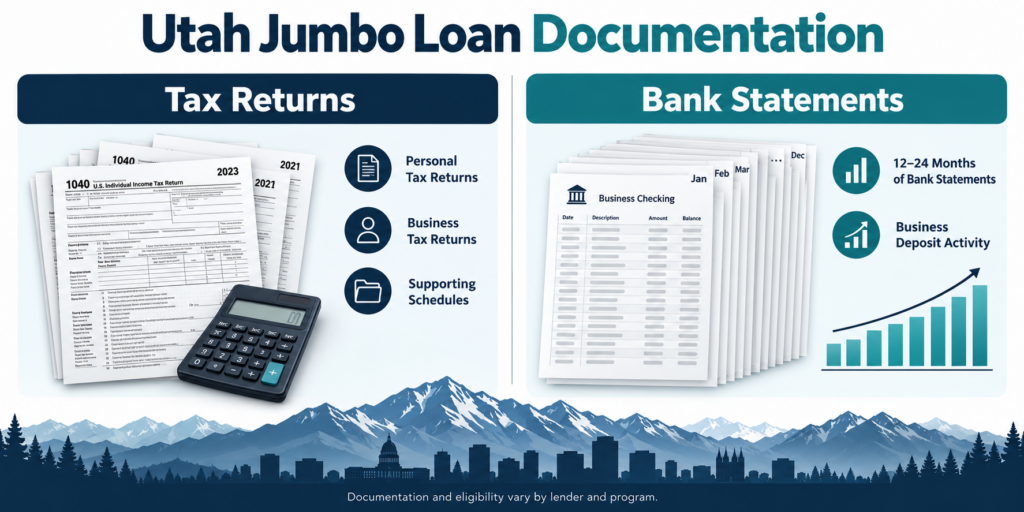
Traditional income documentation may include W-2s, tax returns, business income and investment income.
High-net-worth and self-employed borrowers may also have access to alternative documentation or asset-based programs through certain lending sources.
Assets
Underwriting may consider:
- checking and savings;
- brokerage accounts;
- retirement accounts;
- stocks and bonds;
- business assets when eligible;
- trusts;
- vested compensation;
- other qualifying liquid assets; and
- potentially pledged assets under specialized programs.
Builder Qualifications
The builder may also need to satisfy the construction lender's approval requirements.
Can Land Equity Be Used for a Super Jumbo Construction Loan?

Potentially.
If you already own the building lot, the lender may be able to recognize eligible land equity when calculating the project's financing structure.
For example, assume a borrower owns a valuable homesite in Park City and wants to build a custom residence.
The lender may analyze:
- current land value;
- existing liens;
- construction budget;
- completed property value;
- requested loan amount; and
- required borrower equity.
The treatment of land equity varies by lender.
How Are Construction Draws Handled?
Construction lenders generally release funds incrementally rather than providing the entire loan balance at closing.
The lender establishes a draw schedule based on the construction budget.
When a construction phase is completed, the builder submits a draw request.
Depending on the program, the process may involve:
- draw request;
- inspection;
- verification of completed work;
- title or lien review;
- lender approval; and
- release of funds.
This process protects both the lender and borrower by helping ensure that funds correspond with construction progress.
Interest Payments During Construction
Many construction loans charge interest only on the amount of money that has actually been advanced.
For example, a borrower with a $6 million construction commitment generally would not necessarily pay interest on the full $6 million on day one if only a smaller amount has been disbursed.
As additional draws are released, the outstanding construction balance increases.
The exact payment calculation depends on the loan agreement.
Building a Super Jumbo Home in Park City or Deer Valley
Park City and Deer Valley are among Utah's most important luxury construction markets.
Projects can include:
- ski-in/ski-out residences;
- mountain estates;
- resort-area second homes;
- contemporary custom homes;
- Promontory-area residences;
- gated-community properties; and
- multimillion-dollar custom construction.
Mountain construction can introduce additional considerations such as steep lots, excavation, retaining structures, snow conditions, access and longer construction schedules.
A lender experienced with high-value construction can be especially important when financing these properties.
Salt Lake City and Wasatch Front Luxury Construction
Super Jumbo construction financing may also be appropriate for high-value custom homes throughout the Salt Lake Valley and Wasatch Front.
Potential markets include:
Salt Lake City, Holladay, Millcreek, Cottonwood Heights, Sandy, Draper, Alpine, Highland and surrounding luxury communities.
Projects can range from contemporary estates to large custom residences on substantial homesites.
Borrowers who are purchasing an already completed high-value residence instead of constructing one can review Jumbo mortgage loans in Utah.
Heber City, Midway and Wasatch Back Construction
The Wasatch Back has become another important market for custom residential construction.
Heber City, Midway and surrounding communities offer luxury properties ranging from mountain estates to second homes and recreational residences.
Super Jumbo construction financing may provide an option when conventional construction loan limits do not accommodate the size of the project.
Super Jumbo Construction Loans in St. George
Southern Utah also includes substantial luxury-home construction.
Custom residences in St. George, Ivins, Santa Clara, Washington and surrounding communities can include premium desert architecture, large lots, pools, outdoor living areas and high-end finishes.
A specialized construction lender may be needed when the project's cost or permanent mortgage exceeds conventional or traditional jumbo limits.
Construction Financing for Self-Employed Borrowers
Many people building multimillion-dollar homes are entrepreneurs, business owners or self-employed professionals.
Traditional underwriting can become complicated when taxable income does not reflect actual cash flow or financial strength.
Depending on the available program, possible financing strategies may involve:
- traditional tax-return qualification;
- bank statement income;
- asset depletion;
- asset-based qualification;
- pledged assets; or
- other specialized private-bank or Non-QM structures.
Borrowers with complex income can also review Jumbo Bank Statement Loans Utah.
Super Jumbo Construction vs Traditional Construction Financing
| Feature | Traditional Construction | Super Jumbo Construction |
|---|---|---|
| Typical project | Standard custom home | High-value luxury residence |
| Loan amount | Lower | Potentially multimillion-dollar |
| Underwriting | Standard | More individualized |
| Liquidity requirements | Program dependent | Often more significant |
| Reserve requirements | Program dependent | Can be substantial |
| Asset review | Standard | Often detailed |
| Builder review | Required | Typically extensive |
| Property complexity | Standard | May accommodate complex luxury projects |
| Permanent financing | Conventional/Jumbo | Jumbo/Super Jumbo |
The larger the transaction becomes, the more important the borrower's complete financial profile may be.
Documents You May Need
Prepare documentation early when planning a large custom-home project.
Potential documents include:
- architectural plans;
- construction specifications;
- builder contract;
- detailed construction budget;
- construction timeline;
- builder information;
- land purchase documentation;
- title information;
- recent asset statements;
- brokerage statements;
- retirement statements;
- income documentation;
- tax returns when required;
- business financial statements when applicable;
- entity or trust documentation when applicable; and
- documentation for other real estate owned.
Exact documentation requirements vary considerably by lender.
Super Jumbo Construction Loan Process
Step 1: Review the Project
Determine the land value, estimated construction cost, expected finished value and required loan amount.
Step 2: Review the Borrower's Financial Profile
Evaluate credit, income, liquidity, reserves, assets and existing obligations.
Step 3: Select the Financing Structure
Compare one-time-close, two-time-close and other available construction strategies.
Step 4: Builder and Project Review
Submit the builder, plans, specifications, contract and budget.
Step 5: Appraisal
An appraisal is generally completed using the proposed plans and specifications to estimate the value of the finished residence.
Step 6: Underwriting
The lender evaluates both the borrower and construction project.
Step 7: Close the Construction Loan
After final approval and satisfaction of closing conditions, construction financing can close.
Step 8: Construction Draws
Funds are advanced as construction progresses.
Step 9: Complete the Residence
Final inspections and completion documentation are obtained.
Step 10: Permanent Financing
The loan transitions to or is replaced by the planned permanent Super Jumbo mortgage, depending on the original structure.
Why Work With a Mortgage Broker for a Super Jumbo Construction Loan?
Super Jumbo construction programs can differ significantly between lending sources.
One lender may be strong for a $3 million project while another may be better suited to a substantially larger transaction.
A mortgage broker can evaluate the transaction across multiple potential lending sources rather than attempting to force every project into one institution's guidelines.
Daniel Paris has more than 27 years of mortgage lending experience and works with wholesale and specialty lending sources to help qualified borrowers evaluate large residential financing transactions.
Learn more about Daniel Paris and UtahLowRate.com.
Related Super Jumbo Mortgage Options
Depending on your financial profile and project, another Super Jumbo strategy may also be appropriate.
Related financing can include:
- Super Jumbo purchase mortgages;
- Super Jumbo refinancing;
- Super Jumbo cash-out financing;
- asset depletion mortgages;
- pledged-asset mortgages;
- bridge financing;
- bank statement jumbo mortgages;
- second-home financing; and
- investment-property financing.
Start with the Super Jumbo Mortgage Loans Utah & California hub to compare broader luxury mortgage options.
Investment Property Construction and DSCR Financing
A traditional Super Jumbo construction-to-permanent loan is different from a DSCR mortgage.
DSCR financing is generally designed for qualifying investment properties and focuses heavily on the property's qualifying rental income relative to its housing obligation.
If the finished property will be held as a rental investment, review the complete UtahLowRate.com DSCR loan cluster:
- DSCR Mortgage Loans Utah
- DSCR Loan Requirements Utah
- DSCR Loan Rates Utah
- DSCR Loan Calculator Utah
- DSCR Loan FAQ Utah
- DSCR Loans Salt Lake City Utah
- DSCR Loans Park City Utah
- DSCR Loans St. George Utah
Construction financing and permanent DSCR financing are separate issues. Eligibility for one does not guarantee eligibility for the other.
Frequently Asked Questions
What is a Super Jumbo Construction-to-Permanent Loan?
It is financing designed for qualified borrowers building high-value custom residences requiring loan amounts above typical construction mortgage ranges. The financing funds construction and provides or leads into longer-term permanent mortgage financing.
Can I finance a multimillion-dollar custom home in Utah?
Potentially. Specialized Super Jumbo construction programs may finance multimillion-dollar residential projects for qualified borrowers. Maximum loan amounts depend on the project, completed value, borrower equity, liquidity, credit and lender guidelines.
Can my land count toward my down payment?
Potentially. Eligible equity in land already owned may be considered when determining the borrower's equity contribution. The lender will determine the acceptable value and treatment of the land.
Do I pay interest on the entire construction loan immediately?
Many construction loans charge interest based primarily on funds actually advanced during construction rather than the full commitment from the first day. The exact calculation depends on the lender and loan agreement.
Can I lock my permanent mortgage rate before construction starts?
Certain construction-to-permanent programs may provide rate-lock options, while others establish permanent financing later. Lock periods, fees and requirements vary substantially for large construction transactions.
Can self-employed borrowers qualify?
Yes, qualified self-employed borrowers may potentially obtain Super Jumbo construction financing. Depending on the program, underwriting may use traditional income documentation, business financials, bank statements, assets or another approved qualification method.
Are Super Jumbo construction loans available for second homes?
Select programs may permit second-home construction. Occupancy requirements vary by lender, loan size, leverage and property type.
Are Super Jumbo construction loans available in Park City?
Potentially. Qualified borrowers may have access to specialized construction financing for high-value homes in Park City, Deer Valley and other Summit County luxury markets, subject to lender and property requirements.
Get a Super Jumbo Construction Loan Review
Building a multimillion-dollar custom residence requires more than simply finding a lender with a high maximum loan amount.
The construction budget, builder, appraisal, land equity, liquidity, reserves, income, assets and permanent mortgage strategy all need to work together.
Daniel Paris at UtahLowRate.com can help qualified borrowers compare Super Jumbo Construction-to-Permanent Loans in Utah and determine which available structure may fit the project.
Daniel Paris
Utah Mortgage Broker
UtahLowRate.com
Call: 801-604-4949
Start Your Super Jumbo Construction Loan Review
Programs, rates, terms, maximum loan amounts, construction periods, LTV limits, builder requirements, appraisal requirements, reserves, documentation and permanent financing options are subject to lender guidelines, underwriting and change without notice. This information is educational and is not a commitment to lend. Equal Housing Opportunity.
Related guides: Utah jumbo mortgage guide · Jumbo loan requirements · Jumbo mortgage rates · Jumbo payment calculation guide · Jumbo mortgage questions and answers ·

