
Content updated: September 29, 2026
Jumbo vs Conventional Mortgage Utah: Which Loan Is Better?
If you are comparing Jumbo vs Conventional Mortgage Utah financing, the biggest difference is usually the loan amount and the underwriting rules that apply. A conforming conventional mortgage must stay within applicable conforming loan limits and meet agency requirements. A jumbo mortgage generally finances amounts above those limits and may use different rules for credit, reserves, down payment, income and property eligibility.
Check My Jumbo Options or call 801-604-4949.
For Utah buyers, that distinction matters most in higher-priced markets such as Park City, Deer Valley, Salt Lake City, Holladay, Draper, Alpine, Highland, Heber City, Midway and St. George.
Quick Answer: A conventional conforming loan may be the better fit when your mortgage amount falls within the applicable county loan limit and you qualify under conventional guidelines. A jumbo mortgage may be needed when the required loan amount exceeds the applicable conforming limit. Jumbo financing can also provide options for borrowers, properties or financial profiles that do not fit standard agency guidelines.
Daniel Paris of UtahLowRate.com helps qualified Utah borrowers compare conventional, jumbo and super-jumbo mortgage options based on the actual property, loan amount, down payment, credit profile, income and assets.
Daniel Paris | Utah Mortgage Broker
UtahLowRate.com | 801-604-4949
Serving qualified borrowers throughout Utah
Mortgage guidelines, rates, loan limits, LTVs and program availability are subject to change and underwriting approval.
Jumbo vs Conventional Mortgage Utah: Quick Comparison
Loan percentages, credit examples and payment calculations are illustrations unless linked to an identified current program. They do not establish available terms or approval.
| Feature | Conventional Conforming Mortgage | Jumbo Mortgage |
|---|---|---|
| Loan size | Within applicable conforming limit | Generally above applicable conforming limit |
| Government insured? | No | No |
| Fannie Mae/Freddie Mac conforming | Usually, when conforming | No |
| Primary residence | Yes | Yes, subject to program |
| Second home | Available | Available under qualifying programs |
| Investment property | Available | Available under qualifying programs |
| Credit requirements | Program dependent | Often lender/program specific |
| Down payment | Multiple options | Often larger, but varies |
| Cash reserves | Depends on scenario | Can be more substantial |
| Income documentation | Standard agency documentation | Standard or alternative documentation may be available |
| Automated underwriting | Common | May use different underwriting methods |
| Large loan amounts | Limited by conforming limits | Designed for larger mortgages |
| Self-employed options | Available | Traditional and alternative-documentation options may be available |
| Luxury properties | Possible | Common |
| Rates | Market and borrower dependent | Market, loan size and borrower dependent |
The better mortgage cannot be determined from the loan label alone. Rate, APR, points, fees, mortgage insurance, reserves, down payment and long-term cost should all be considered.
What Is a Conventional Mortgage in Utah?

A conventional mortgage is a home loan that is not insured or guaranteed by a government agency such as FHA, VA or USDA.
Many conventional mortgages are conforming loans, meaning they satisfy applicable Fannie Mae or Freddie Mac requirements, including the applicable conforming loan limit.
However, the words “conventional” and “conforming” do not mean exactly the same thing.
A simple way to remember the difference is:
A conforming loan is conventional, but not every conventional mortgage is necessarily conforming.
Utah borrowers can learn more in the Conventional Mortgage Loans Utah guide.
What Is a Jumbo Mortgage in Utah?
A jumbo mortgage is generally a mortgage with a loan amount above the conforming loan limit applicable to the property's county and number of units.
Jumbo mortgages are considered non-conforming because they are outside standard agency-conforming loan-size parameters.
That does not mean jumbo mortgages are unusual or inherently difficult to obtain.
They are commonly used to finance higher-value properties in Utah communities such as:
- Park City
- Deer Valley
- Empire Pass
- Salt Lake City
- Holladay
- Cottonwood Heights
- Draper
- Alpine
- Highland
- Heber City
- Midway
- St. George
Qualified borrowers can explore current program options through the Jumbo Mortgage Utah guide.
What Are the 2026 Conventional Loan Limits in Utah?
The 2026 baseline conforming loan limit for a one-unit property in most Utah counties is $832,750.
Utah also has counties with higher one-unit limits, including:
| Utah County | 2026 One-Unit Conforming Limit |
|---|---|
| Most Utah counties | $832,750 |
| Grand County | $839,500 |
| Wayne County | $997,050 |
| Summit County | $1,150,000 |
| Wasatch County | $1,150,000 |
Loan limits are based on the mortgage amount, not simply the purchase price.
That distinction is critical when comparing Jumbo vs Conventional Mortgage Utah financing.
See the complete county-by-county guide at 2026 Conventional Loan Limits Utah.
Does a $1 Million Utah Home Require a Jumbo Loan?
Not necessarily.
Consider a $1,000,000 home in Salt Lake County.
If a buyer puts down enough money to keep the mortgage at or below the applicable conforming limit, the transaction may still qualify for conforming conventional financing, subject to all other requirements.
For example:
Purchase price: $1,000,000
Mortgage: $800,000
Property: One-unit home in Salt Lake County
The home costs $1 million, but the mortgage itself is below the standard 2026 one-unit conforming limit of $832,750.
The loan amount, rather than the property's sales price alone, helps determine whether jumbo financing is required.
Jumbo vs Conventional Mortgage Utah Down Payment
There is no universal down-payment percentage that applies to every conventional or jumbo mortgage.
Certain conventional programs can provide relatively low-down-payment options to eligible borrowers purchasing qualifying primary residences.
Jumbo requirements are different.
Because the lender is financing a larger amount outside standard agency-conforming parameters, down-payment and maximum LTV requirements can depend heavily on:
- Loan amount
- Credit score
- Property type
- Occupancy
- Purchase versus refinance
- Property value
- Liquidity
- Reserves
- Documentation method
- Individual jumbo investor guidelines
A borrower should therefore compare the actual maximum LTV available for the proposed loan rather than assuming every jumbo lender requires the same down payment.
Jumbo vs Conventional Mortgage Credit Score Requirements

Credit requirements also differ.
Conventional mortgage qualification may be determined through Fannie Mae or Freddie Mac guidelines, automated underwriting findings and lender overlays.
Jumbo lenders establish their own credit standards.
As a result, there is no single credit score that applies to every Utah jumbo mortgage.
A stronger credit profile can potentially improve:
- Available LTV
- Interest rate
- Pricing
- Loan amount
- Reserve requirements
- Program selection
However, a borrower should not assume that failing one jumbo lender's credit requirement means jumbo financing is unavailable elsewhere.
Different wholesale lenders and investors can have materially different guidelines.
Which Loan Has the Better Mortgage Rate?
Neither conventional nor jumbo mortgages always have the lower interest rate.
Jumbo pricing does not automatically mean a dramatically higher rate.
Actual mortgage pricing can depend on factors including:
- Credit score
- Loan amount
- LTV
- Occupancy
- Property type
- Loan purpose
- Fixed versus adjustable rate
- Loan term
- Points
- Cash reserves
- Market conditions
- Investor pricing
The appropriate comparison should include rate, APR, points, lender fees and total financing cost.
A slightly lower advertised rate may not be the least expensive option when points and fees are considered.
Jumbo vs Conventional Mortgage Reserve Requirements
Reserve requirements can become especially important with jumbo financing.
A lender may require borrowers to demonstrate that they will retain a certain amount of liquid or eligible assets after closing.
Reserve requirements can depend on:
- Loan amount
- Number of financed properties
- Occupancy
- LTV
- Credit profile
- Property type
- Overall borrower strength
Some high-net-worth borrowers may have substantial assets but income that does not fit neatly into traditional mortgage underwriting.
That is one reason working with multiple jumbo lending sources can be useful.
Jumbo Mortgages for Self-Employed Utah Borrowers
Self-employed borrowers frequently have strong cash flow and assets while reporting taxable income that does not fully reflect their financial capacity.
Traditional conventional financing may still work.
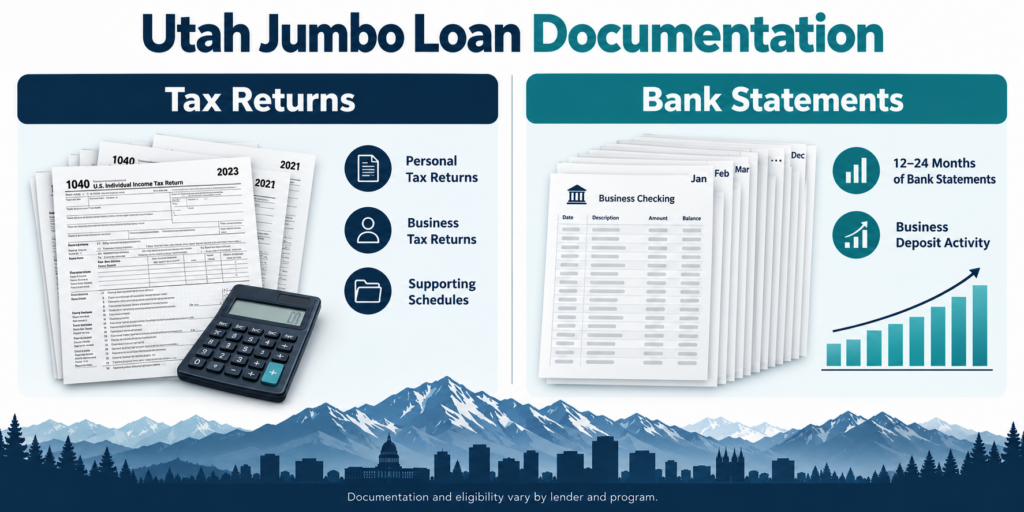
When it does not, alternative-documentation jumbo programs may provide another path.
Potential options can include:
- Jumbo bank statement mortgages
- Personal bank statement loans
- Business bank statement loans
- Asset-depletion programs
- Profit-and-loss programs
- Other Non-QM jumbo financing
Read more about Jumbo Bank Statement Loans Utah.
Jumbo vs Conventional Mortgage for Park City and Deer Valley
The jumbo-versus-conventional decision becomes particularly important in Park City and Deer Valley.
Properties in this market can involve substantial purchase prices, and Park City extends into both Summit and Wasatch counties.
Both Summit County and Wasatch County have higher 2026 conforming limits than most Utah counties.
That means a borrower should identify the property's actual county before deciding that a mortgage must be jumbo.
Jumbo financing can nevertheless become important for luxury properties in communities and resort areas such as Deer Valley, Empire Pass, Old Town, Canyons Village, Promontory and surrounding Park City neighborhoods.
Jumbo vs Conventional Mortgage in Salt Lake County
Salt Lake County has a 2026 one-unit conforming limit of $832,750.
This can make the conventional-versus-jumbo calculation particularly important for higher-value properties in:
- Salt Lake City
- Holladay
- Millcreek
- Cottonwood Heights
- Murray
- Sandy
- Draper
- South Jordan
- Herriman
A buyer purchasing above the conforming threshold may still be able to use conventional financing if the down payment reduces the required mortgage to an eligible conforming amount.
Otherwise, jumbo financing can be considered.
Jumbo vs Conventional Mortgage for Second Homes
Both conventional and jumbo financing may be available for qualifying second homes.
This is relevant in Utah markets such as:
- Park City
- Deer Valley
- Midway
- Heber City
- St. George
- Southern Utah recreation communities
Second-home underwriting has specific occupancy and property-use requirements.
A property that is actually being acquired primarily as a rental investment should not be represented as a second home simply to obtain different financing terms.
Jumbo vs Conventional Mortgage for Utah Investment Properties
Real estate investors may have even more choices.
Depending on the transaction, an investor might compare:
- Conventional investment-property financing
- Jumbo investment-property financing
- DSCR financing
- Bank statement financing
- Other Non-QM investment-property programs
A conventional investment loan may work well when the borrower can document qualifying personal income under standard guidelines.
A jumbo investment-property mortgage may be useful when the required mortgage exceeds conforming limits.
A DSCR loan takes a different approach. Rather than primarily qualifying the borrower through personal W-2 or tax-return income, a DSCR program generally focuses heavily on whether the property's qualifying rental income supports its applicable debt obligation.
Explore the Utah DSCR Mortgage Loans hub if the property will be held for investment.
Conventional vs Jumbo vs DSCR Loans
| Feature | Conventional | Jumbo | DSCR |
|---|---|---|---|
| Primary residence | Yes | Yes | Generally no |
| Second home | Possible | Possible | Generally no |
| Investment property | Yes | Program dependent | Yes |
| Personal income qualification | Generally yes | Usually, unless alternative program | Generally not the primary qualification method |
| Property rental income important | Can be | Can be | Central to qualification |
| Conforming loan limits | Yes when conforming | Exceeds/outside conforming parameters | Non-conforming |
| LLC/entity vesting | Limited/program dependent | Program dependent | Common under qualifying programs |
| Best suited for | Traditional qualification | Larger mortgages | Rental-property investors |
When Might a Conventional Mortgage Be Better?
A conventional mortgage may deserve priority when:
- The mortgage fits within the applicable conforming limit.
- You qualify under agency guidelines.
- You have stable documentable income.
- Conventional pricing is favorable.
- You do not need alternative income documentation.
- You are purchasing an eligible primary residence, second home or investment property.
There is little reason to make a mortgage more complicated than necessary.
If conventional financing accomplishes the objective at competitive terms, it may be the logical choice.
When Might a Jumbo Mortgage Be Better?
A jumbo mortgage may make more sense when:
- The required loan exceeds the applicable conforming limit.
- You are purchasing a high-value Utah property.
- You want to make a smaller down payment rather than reducing the loan to the conforming threshold.
- You need a larger cash-out refinance.
- You have substantial assets.
- You require a specialized jumbo program.
- Your financial profile fits a particular jumbo investor better than agency underwriting.
The best structure depends on the entire transaction.
Should I Put More Money Down to Get a Conventional Loan?
Sometimes—but not automatically.
Imagine that your required mortgage is slightly above the applicable conforming limit.
You might have two choices:
Option A: Increase your down payment enough to obtain a conforming mortgage.
Option B: Keep more money invested or liquid and use a jumbo mortgage.
The correct answer depends on more than the mortgage rate.
Consider:
- Additional cash required
- Conventional versus jumbo rate
- APR
- Points
- Closing costs
- Liquidity after closing
- Required reserves
- Opportunity cost of the additional down payment
- Investment objectives
- Monthly payment
- Long-term plans for the property
This is one of the most useful comparisons to make before purchasing a higher-value Utah home.
How to Compare Jumbo and Conventional Mortgages
Step 1: Determine the Property County
Conforming limits vary by location.
Step 2: Determine the Required Mortgage Amount
Do not compare the purchase price with the conforming limit. Compare the loan amount.
Step 3: Review Your Down Payment
Determine whether increasing or decreasing the down payment changes the available financing options.
Step 4: Review Credit, Income and Assets
These factors can materially affect both jumbo and conventional qualification.
Step 5: Compare Real Loan Scenarios
Compare:
- Rate
- APR
- Points
- Fees
- Monthly payment
- Cash required
- Reserves
- Fixed versus ARM
- Prepayment provisions, when applicable
Step 6: Choose the Structure That Fits Your Goals
The mortgage with the lowest advertised interest rate is not automatically the best financial structure.
Jumbo vs Conventional Mortgage Utah FAQ
What is the main difference between a jumbo and conventional mortgage in Utah?
A conforming conventional mortgage stays within applicable conforming loan limits and follows agency requirements. A jumbo mortgage generally exceeds the applicable conforming loan limit and follows lender or investor-specific jumbo underwriting guidelines.
What is the conventional loan limit in Utah for 2026?
The baseline 2026 one-unit conforming loan limit is $832,750 in most Utah counties. Certain counties have higher limits, including Summit and Wasatch counties.
Is a jumbo mortgage harder to qualify for?
It can involve more stringent requirements for credit, reserves, assets or documentation, but requirements vary substantially between jumbo programs and lenders.
Are jumbo mortgage rates always higher?
No. Jumbo rates are not automatically higher than conventional rates. Pricing depends on current markets and the borrower's complete scenario.
Can I use a jumbo loan for a second home in Park City?
Qualified borrowers may have jumbo second-home financing options for eligible Park City properties, subject to occupancy, property and underwriting requirements.
Can self-employed borrowers get jumbo mortgages in Utah?
Yes. Qualified self-employed borrowers may use traditional documentation or eligible alternative-documentation programs such as jumbo bank statement mortgages.
Is DSCR better than a jumbo mortgage for an investment property?
It depends on the transaction. A traditional jumbo investment-property mortgage may use the borrower's qualifying income, while a DSCR mortgage focuses more heavily on the rental property's qualifying cash flow.
Is the jumbo threshold based on the home's price?
No. The key comparison is generally the mortgage amount versus the applicable conforming loan limit—not simply the home's purchase price.
Compare Your Utah Jumbo and Conventional Mortgage Options
Choosing between Jumbo vs Conventional Mortgage Utah financing should begin with the actual numbers.
The best structure may depend on your:
- Purchase price
- Property county
- Loan amount
- Down payment
- Credit
- Income
- Assets
- Reserves
- Occupancy
- Property type
UtahLowRate.com provides access to conventional, jumbo, super-jumbo and alternative-documentation mortgage programs so qualified borrowers can compare multiple financing structures.
Daniel Paris
Utah Mortgage Broker
UtahLowRate.com
801-604-4949
More than 27 years of mortgage lending experience
Serving qualified borrowers throughout Salt Lake City, Holladay, Draper, Sandy, South Jordan, Lehi, Provo, Alpine, Highland, Park City, Deer Valley, Heber City, Midway, St. George and communities throughout Utah.
Get a hassle-free mortgage quote and compare your conventional and jumbo options before deciding how much to put down.
Mortgage programs, rates, loan limits, LTV requirements, credit requirements, reserves and underwriting guidelines are subject to change. Not all borrowers or properties will qualify. This information is educational and is not a commitment to lend.
Related guides: Utah jumbo mortgage guide · Jumbo loan requirements · Jumbo mortgage rates · Jumbo payment calculation guide · Jumbo mortgage questions and answers ·

