
Content updated: September 29, 2026
A Jumbo Cash-Out Refinance Utah loan can help qualified homeowners convert equity in a high-value Utah property into usable funds while replacing their existing mortgage with a new jumbo loan.
Unlike a standard conforming refinance, jumbo cash-out financing is designed for larger mortgage balances and higher-value properties. Loan-to-value limits, credit requirements, reserves, documentation and maximum cash-out can vary significantly by lender and loan size.
Check My Jumbo Options or call 801-604-4949.
UtahLowRate.com works with wholesale mortgage programs for qualified borrowers throughout Utah, including Salt Lake City, Park City, Deer Valley, Holladay, Draper, Alpine, Highland, Heber City, Midway and St. George.
Quick Answer: A jumbo cash-out refinance replaces an existing mortgage with a larger jumbo mortgage and allows the homeowner to receive eligible equity as cash at closing. Qualification generally depends on property value, existing liens, requested loan amount, LTV, credit, income, assets, reserves and occupancy. Large jumbo and super-jumbo transactions may have substantially different guidelines from conforming mortgages.
Check My Jumbo Cash-Out Options
Jumbo Cash-Out Refinance Utah: Key Facts
Loan percentages, credit examples and payment calculations are illustrations unless linked to an identified current program. They do not establish available terms or approval.
| Feature | Typical Consideration |
|---|---|
| Transaction | Cash-out refinance |
| Loan category | Jumbo / Super Jumbo |
| Property | High-value residential real estate |
| Occupancy | Primary, second home or investment depending on program |
| Qualification | Credit, income/assets, LTV, reserves and property |
| Loan amounts | Program-specific; large and multi-million-dollar loans available through select programs |
| Appraisal | Generally required |
| Cash-out | Subject to equity and program limits |
| Fixed or ARM | Both may be available |
| Self-employed | Alternative-documentation programs may be available |
| Location | Utah statewide |
Guidelines vary by lender and individual transaction. A preliminary jumbo review is the best way to determine which programs fit a specific property and borrower.
What Is a Jumbo Cash-Out Refinance?
A jumbo cash-out refinance is a new mortgage that replaces an existing home loan while allowing an eligible homeowner to receive a portion of the property's available equity.
For example, assume a Utah homeowner has:
- Property value: $3,000,000
- Existing mortgage: $1,100,000
- Proposed new jumbo mortgage: $1,800,000
Before closing costs, payoff adjustments and other transaction expenses, the difference between the new mortgage and existing payoff could potentially provide substantial cash to the borrower.
That does not mean every homeowner with equity can borrow to a particular percentage of property value. Jumbo lenders establish their own limits based on loan amount, credit, occupancy, property type, liquidity and overall borrower strength.
For general information about accessing home equity, see our Utah Cash-Out Refinance guide.
How Does a Jumbo Cash-Out Refinance Work?

The basic process is straightforward.
1. Determine the Current Property Value
The property's current market value is one of the major factors determining available equity.
High-value and unique Utah properties may require more extensive appraisal review than typical homes.
2. Determine Existing Mortgage Debt
Your current first mortgage and any applicable subordinate financing must be reviewed.
3. Select the Requested Cash-Out Amount
Instead of simply borrowing the maximum amount available, determine how much equity you actually want to access.
4. Calculate the New LTV
Loan-to-value is calculated as:
New loan amount ÷ property value = LTV
A $2,000,000 mortgage against a $4,000,000 property represents a 50% LTV.
5. Underwrite the Jumbo Loan
The lender evaluates the borrower, property and transaction.
Depending on the program, underwriting may review:
- Credit history
- Income
- Employment or self-employment
- Assets
- Liquidity
- Mortgage history
- Reserves
- Property value
- Property type
- Occupancy
- Loan amount
- LTV
- Existing liens
6. Close the New Mortgage
The new jumbo mortgage pays off the existing mortgage and eligible liens. After closing costs and required payoffs, eligible remaining proceeds are distributed according to the final settlement statement.
How Much Cash Can I Take Out of a Jumbo Home in Utah?
There is no universal maximum.
The available amount is generally influenced by two limits:
Maximum permitted LTV and maximum permitted cash-out proceeds.
Some jumbo programs may permit a certain LTV but separately cap the dollar amount of cash a borrower can receive.
This distinction becomes especially important with multi-million-dollar homes.
For example, a homeowner with $4 million of equity may not necessarily be permitted to withdraw all equity available under a simple LTV calculation.
Large cash-out requests can require stronger credit, greater liquidity, lower LTVs or additional documentation.
See our Jumbo Loan Limits Utah guide for additional information about high-balance financing.
Jumbo Cash-Out Refinance LTV in Utah
LTV becomes increasingly important as the requested mortgage gets larger.
A lender may allow one maximum LTV for a lower jumbo balance and a different LTV for a $3 million, $5 million or larger mortgage.
Factors affecting the maximum LTV can include:
- Loan amount
- Credit score
- Primary residence versus second home
- Property type
- Cash-out amount
- Reserves
- Liquidity
- Documentation type
- Recent credit history
Do not assume that an 80% LTV available on one jumbo program applies to every jumbo cash-out transaction.
For a deeper explanation, visit Jumbo Loan Down Payment Utah.
Credit Score Requirements for a Jumbo Cash-Out Refinance
Jumbo mortgage credit requirements are not standardized across every lender.
Generally, stronger credit can improve the number of available programs and may improve the combination of LTV, loan amount and pricing available to a borrower.
Underwriters may evaluate more than the numerical credit score.
They can also consider:
- Mortgage payment history
- Revolving debt utilization
- Recent late payments
- Bankruptcy or foreclosure history
- Number of financed properties
- Overall debt profile
- Depth of credit history
Some specialized programs may accommodate borrowers outside traditional jumbo credit parameters, but lower scores can mean reduced leverage or additional requirements.
Read Jumbo Loan Credit Score Utah for more information.
Jumbo Cash-Out Refinance Reserve Requirements
Cash reserves are particularly important in jumbo underwriting.
A lender may require borrowers to demonstrate that sufficient liquid or eligible assets remain after closing.
Required reserves can depend on:
- Mortgage payment
- Loan amount
- Number of financed properties
- Occupancy
- Credit
- LTV
- Documentation
- Overall borrower profile
Large jumbo and super-jumbo loans can require significant post-closing liquidity.
Eligible assets may differ by lender, so retirement accounts, brokerage assets, business funds and other asset categories should be reviewed before assuming they qualify.
What Can Jumbo Cash-Out Proceeds Be Used For?

Subject to lender and program restrictions, homeowners may consider accessing equity for purposes such as:
- Home improvements
- Major renovations
- Debt consolidation
- Investment capital
- Business purposes
- Real estate acquisitions
- Liquidity planning
- Education expenses
- Large purchases
- Financial restructuring
Cash-out refinancing increases mortgage debt and places the property behind the new obligation. Borrowers should compare the financing cost with alternatives before deciding how much equity to access.
Jumbo Cash-Out Refinance vs. HELOC
Homeowners with significant equity may compare a jumbo cash-out refinance with a home equity line of credit.
| Jumbo Cash-Out Refinance | HELOC |
|---|---|
| Replaces existing first mortgage | Usually leaves first mortgage intact |
| One new mortgage | Adds subordinate financing |
| May offer fixed or adjustable structures | Commonly variable-rate |
| Potentially large loan amount | Credit line limits vary |
| One combined mortgage payment | Separate first and second lien payments |
| Changes rate on entire first mortgage balance | Existing first-mortgage rate remains unchanged |
A HELOC may be attractive when the existing first mortgage has favorable terms that a homeowner does not want to replace.
A jumbo cash-out refinance may be more appropriate when restructuring the entire mortgage makes financial sense.
Compare the interest rate, APR, closing costs, total interest expense, monthly payment and expected holding period—not simply the amount of cash received.
Jumbo Cash-Out Refinance vs. Rate-and-Term Refinance
These transactions solve different problems.
A rate-and-term jumbo refinance primarily restructures existing mortgage debt without taking substantial equity out of the property.
A jumbo cash-out refinance intentionally increases the new mortgage beyond qualifying existing obligations so that the borrower can access equity.
If accessing equity is not the primary objective, see our Jumbo Refinance Loans Utah guide.
Super Jumbo Cash-Out Refinance Utah
Some Utah properties require financing well beyond ordinary jumbo ranges.
UtahLowRate.com works with select wholesale channels offering super jumbo mortgage options, including programs that may accommodate qualified multi-million-dollar transactions.
Depending on the program and borrower profile, financing options can include:
- Large first mortgages
- Fixed-rate mortgages
- Adjustable-rate mortgages
- Interest-only structures
- Asset-based qualification
- Pledged-asset strategies
- Alternative documentation
- Bridge financing
- Cross-collateralized financing
Select programs may reach approximately $30 million, although maximum loan amounts, cash-out limits and LTV decline or change according to the specific transaction.
A published maximum loan size does not mean every borrower or property qualifies for that amount.
Explore Super Jumbo Loans Utah for large-balance financing options.
Jumbo Cash-Out Refinance for Self-Employed Utah Homeowners
A self-employed homeowner may have substantial property equity and assets but show taxable income that does not fit conventional jumbo underwriting.
Alternative-documentation jumbo programs may provide another path.
Depending on eligibility, qualification may use:
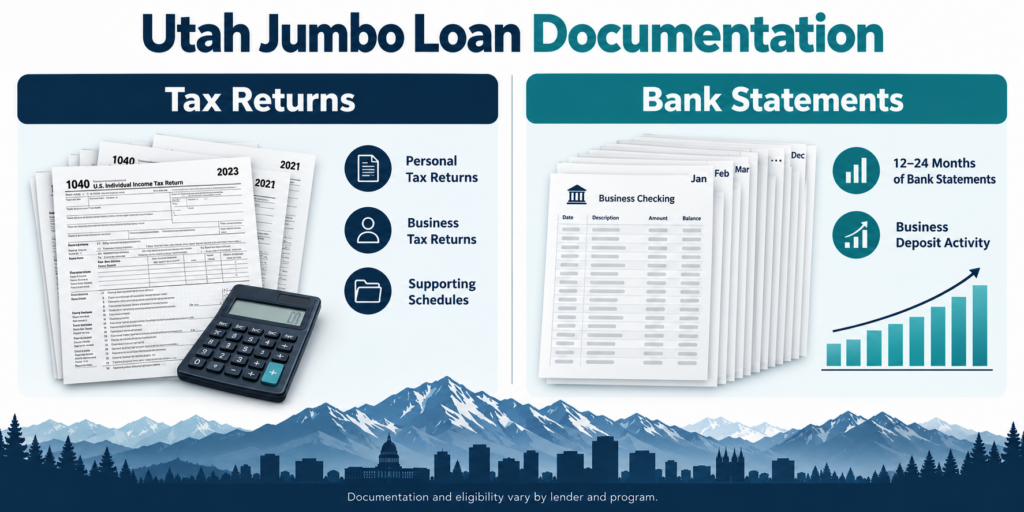
- Personal bank statements
- Business bank statements
- 12-month bank statements
- 24-month bank statements
- 1099 income
- Profit-and-loss documentation
- Asset depletion
- Other eligible non-QM documentation
For self-employed borrowers, visit our Bank Statement Loans Utah guide.
A bank statement cash-out transaction can have different LTV, seasoning, reserve and credit requirements from a full-documentation jumbo loan.
Jumbo Cash-Out Refinance for Utah Investment Properties
Investors should compare traditional jumbo investment-property financing with specialized investor programs.
If the property is an income-producing rental, a DSCR loan may provide another approach because qualification can focus more heavily on property cash flow instead of the borrower's traditional employment income.
Start with our DSCR Mortgage Loans Utah hub.
Explore the Utah DSCR Loan Cluster
- DSCR Loan Requirements Utah
- DSCR Loan Rates Utah
- DSCR Loan Calculator Utah
- DSCR Loan FAQ Utah
- DSCR Purchase Loans Utah
- DSCR Refinance Loans Utah
- Interest-Only DSCR Loans Utah
- DSCR vs. Conventional Investment Loan Utah
- DSCR Loans Salt Lake City
- DSCR Loans Park City
- DSCR Loans St. George
The best structure depends on whether the property is owner-occupied or an investment, the property's cash flow, available documentation and the borrower's objectives.
Jumbo Cash-Out Refinance in Park City and Deer Valley
Park City and Deer Valley are natural markets for jumbo and super-jumbo financing because of their concentration of high-value homes, resort residences, second homes and luxury properties.
A cash-out transaction on a Park City property can require careful evaluation of:
- Property type
- Condo or project eligibility
- Primary versus second-home occupancy
- Appraised value
- Loan amount
- Liquidity
- Cash-out limits
- Reserve requirements
Properties in areas such as Old Town, Empire Pass, Canyons Village, Promontory and surrounding Summit County communities can have characteristics that require specialized jumbo underwriting.
Jumbo Cash-Out Refinance in Salt Lake City
High-value properties throughout the Salt Lake Valley can also benefit from jumbo financing.
Relevant markets include:
- Salt Lake City
- Holladay
- Cottonwood Heights
- Millcreek
- Murray
- Sandy
- Draper
- South Jordan
Custom homes and luxury properties can produce loan amounts that exceed standard conforming financing, particularly when the homeowner wants to access substantial equity.
Jumbo Cash-Out Refinance in Alpine and Highland
Alpine, Highland, Lehi and other northern Utah County communities contain many large custom homes and high-value properties.
Homeowners with substantial equity may use a jumbo refinance to restructure an existing mortgage or access capital.
Large properties, acreage, accessory structures and unique custom-home characteristics can require additional appraisal review.
Jumbo Cash-Out Refinance in St. George
Southern Utah has a growing luxury-home market in St. George, Washington, Ivins and Santa Clara.
A high-value primary residence or qualifying second home may be eligible for jumbo cash-out financing depending on the homeowner's equity, requested loan amount and overall financial profile.
Documents Commonly Needed for a Jumbo Cash-Out Refinance
Documentation varies by program, but borrowers should be prepared to provide information covering:
Income
W-2s, tax returns, pay statements or alternative income documentation depending on the program.
Assets
Bank, brokerage, retirement and other qualifying asset statements.
Current Mortgage
Recent mortgage statements and information about subordinate liens.
Property
Homeowners insurance, property details and appraisal documentation.
Identity and Credit
Identification and authorization for applicable credit and underwriting reviews.
Self-employed and high-net-worth borrowers may require additional documentation depending on the selected program.
How to Prepare for a Jumbo Cash-Out Refinance
Before applying, gather four important numbers:
1. Estimated property value
2. Current mortgage payoff
3. Desired cash-out amount
4. Approximate credit profile
Then identify the purpose of the refinance.
That information allows a mortgage broker to compare potential jumbo programs much more efficiently.
For very large transactions, also be prepared to discuss liquidity, reserves and other assets early in the process.
Why Work With a Wholesale Mortgage Broker for a Jumbo Refinance?
Jumbo mortgage guidelines can vary substantially from one lender to another.
One lender may offer a strong program at a particular LTV while another may be better suited for:
- Larger loan amounts
- Higher cash-out requests
- Self-employed borrowers
- Second homes
- Investment properties
- Interest-only financing
- High-net-worth borrowers
- Alternative documentation
UtahLowRate.com is a Utah mortgage brokerage led by Daniel Paris, a mortgage professional with more than 27 years of industry experience.
Instead of assuming one bank's jumbo guidelines are the only option, qualified borrowers can compare wholesale mortgage programs based on the actual transaction.
Frequently Asked Questions About Jumbo Cash-Out Refinance Utah
What is a jumbo cash-out refinance in Utah?
A jumbo cash-out refinance replaces an existing mortgage with a larger mortgage exceeding applicable conforming loan limits and allows an eligible homeowner to receive a portion of available equity as cash.
How much equity do I need for a jumbo cash-out refinance?
It depends on the lender, loan amount, occupancy, property type and borrower profile. Jumbo cash-out LTV limits are not uniform across lenders.
Can I get cash out of a multi-million-dollar Utah home?
Potentially. Qualified borrowers with sufficient equity may have access to jumbo or super-jumbo cash-out programs. Maximum proceeds and LTV depend on the specific lender and transaction.
Can I do a jumbo cash-out refinance on a second home?
Some jumbo programs permit cash-out refinancing on qualifying second homes. Guidelines may be more restrictive than those for primary residences.
Can a self-employed borrower get a jumbo cash-out refinance?
Yes, potentially. Full-documentation and alternative-documentation programs may be available. Bank statement, asset-based and other non-QM options can help qualified borrowers whose tax returns do not reflect their actual cash flow.
Is a jumbo cash-out refinance better than a HELOC?
Neither is automatically better. A cash-out refinance replaces the first mortgage, while a HELOC generally leaves the existing first mortgage intact. Compare rates, payments, closing costs, loan structure and long-term interest expense.
Can I use DSCR financing for cash out?
A qualifying investment property may be eligible for a DSCR cash-out refinance. DSCR programs are designed for investment properties and typically evaluate the property's rental cash flow rather than using the same qualification method as an owner-occupied jumbo mortgage.
Do jumbo cash-out loans require an appraisal?
Generally, yes. High-value or unique properties can require additional appraisal review depending on the lender, property and loan amount.
Get a Jumbo Cash-Out Refinance Quote
Related guides: Utah jumbo mortgage guide · Jumbo loan requirements · Jumbo mortgage rates · Jumbo payment calculation guide · Jumbo mortgage questions and answers ·

